
What Is Keyword Clustering? Your 2026 SEO Guide
Keyword clustering is defined as the practice of grouping related keywords that share the same search intent to target them with a single, comprehensive page instead of scattering them across many thin pages. This technique, also called keyword grouping in content strategy circles, prevents keyword cannibalization and signals topical authority to search engines. Effective clustering allows a single page to rank for 10–30 related queries rather than competing against itself. For content marketers and SEO professionals managing large keyword lists, this is the most direct path from raw keyword research to a content structure that actually performs.
What is keyword clustering and why does it matter for SEO?
Keyword clustering is an SEO strategy where related queries with identical user search intent are grouped together and targeted on one page. The core benefit is consolidation. Instead of publishing five separate articles that each rank weakly for one query, you publish one authoritative page that ranks for all five.
The SEO impact is measurable. A well-clustered page can rank for 10–30+ queries simultaneously, compared to a thin page that struggles to hold position for even one. That multiplier effect is why clustering has become a foundational practice in modern content strategy.

Clustering also solves keyword cannibalization directly. When two pages on your site target the same intent, Google must choose which one to rank. It often picks neither, splitting authority between them. Grouping those keywords onto one page removes the ambiguity. You can read more about spotting this problem in the Ranksector guide on keyword cannibalization effects.
Beyond rankings, clustering builds topical authority. Search engines reward sites that cover a subject thoroughly and coherently. A cluster of tightly related pages, all linking back to a central pillar, signals that your site owns a topic rather than merely touching it.
How do SERP-based and semantic clustering methods differ?
Two primary methods define how SEO professionals approach keyword grouping. Each has distinct strengths, and the best workflows combine both.
SERP-based clustering
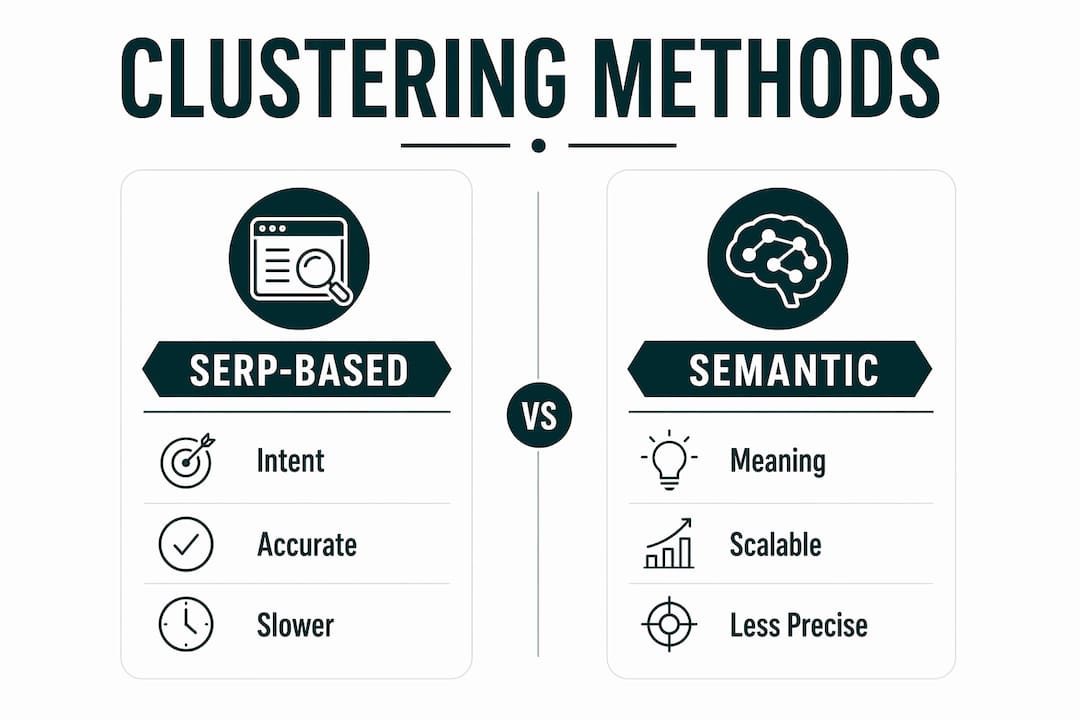
SERP-based clustering uses URL overlap analysis to determine intent alignment. The industry-standard threshold is 3 or more shared URLs in the top 10 results for two keywords. If three or more of the same pages rank for both queries, those queries belong in the same cluster. Many professional tools apply a 1–10 scale threshold to control grouping precision when processing large keyword lists.
This method is reliable because it reflects actual search engine behavior. Google’s rankings reveal what it considers relevant for a given query. SERP overlap is not a proxy for intent. It is intent, as measured by the world’s most sophisticated relevance engine.
Semantic clustering
Semantic clustering groups keywords by meaning and concept similarity using natural language processing. It does not check live SERPs. Instead, it analyzes how closely related two phrases are based on language models and topic graphs.
Semantic clustering is fast and inexpensive to run at scale. It works well as a first pass on a list of 5,000+ keywords, reducing it to manageable groups before deeper validation.
Comparing the two methods
| Method | Basis | Strength | Weakness |
|---|---|---|---|
| SERP-based | URL overlap in top 10 results | Reflects true search intent | Slow and costly at large scale |
| Semantic | Language model similarity | Fast, scales to thousands of keywords | May miss intent differences |
| Hybrid | Semantic pre-filter + SERP check | Accurate and cost-efficient | Requires two-step workflow |
The hybrid approach is the practitioner’s choice for large projects. Run semantic clustering first to reduce your raw list, then validate cluster heads with SERP overlap checks. This cuts API costs and processing time while maintaining precise cluster boundaries.
Pro Tip: When building clusters for a list larger than 500 keywords, use semantic grouping to create draft clusters, then run SERP checks only on the top keyword in each group. You get SERP-level accuracy at a fraction of the cost.
How to implement a keyword clustering strategy effectively
A repeatable clustering process follows five clear steps. Skipping any one of them produces clusters that either miss intent or collapse under SERP changes.
-
Collect your raw keyword list. Pull keywords from your existing rankings, competitor gap analysis, and search suggestion tools. Aim for breadth before you filter. The Ranksector guide on finding untapped keywords covers competitive research methods that feed this step well.
-
Label every keyword by search intent. Categorize each keyword as informational, commercial, transactional, or navigational before you cluster. Intent labeling before clustering prevents the most common clustering mistake: grouping a “what is” query with a “buy now” query on the same page. A page cannot serve both intents effectively.
-
Run your clustering method. Apply semantic clustering for speed on large lists, then validate with SERP overlap analysis. Use a threshold of 3+ shared URLs to confirm intent alignment. Adjust the threshold up for tighter clusters or down for broader groupings.
-
Map clusters to a pillar-and-spoke architecture. The pillar-and-spoke model assigns broad head keywords to a pillar page and specific sub-intents to cluster pages that link back to it. This structure improves crawlability, strengthens internal linking, and concentrates domain authority where it matters most. The Ranksector breakdown of topic clusters vs. pillar pages explains how Google rewards this architecture in 2026.
-
Validate and publish. Before writing, check that each cluster contains only keywords sharing the same intent type. A cluster mixing informational and transactional queries will produce a page that satisfies neither searcher.
Common pitfalls to avoid
- Mixing search intent types in one cluster. A page cannot rank for “how to write a meta description” and “meta description writing service” simultaneously.
- Over-clustering. Forcing every keyword into a cluster creates bloated pages that lack focus. Some keywords deserve their own page.
- Treating clustering as a one-time task. Clusters require periodic re-validation because search intent and SERP composition change over time.
Pro Tip: Schedule a cluster review every quarter. A cluster that was accurate six months ago may now contain keywords whose SERPs have diverged, creating silent cannibalization you will not notice until rankings drop.
What are the common challenges in keyword clustering?
Keyword clustering is not a set-and-forget process. Several real-world complications reduce its accuracy if left unaddressed.
SERP distortion from aggregators. When a SERP is dominated by aggregator sites like Reddit, Quora, or large directories, URL overlap analysis can produce false positives. Two keywords may share aggregator URLs without actually sharing intent. Manual review corrects these errors, especially for ambiguous or volatile SERPs. Build manual spot-checking into your workflow for any cluster that looks unexpectedly broad.
Ambiguous and shifting intent. Some keywords carry mixed intent that changes by season, news cycle, or product category. “Best CRM” may be informational in january and transactional in march when budgets reset. Clusters built on these keywords need more frequent review than stable informational queries.
Scale and cost. Running full SERP-based clustering on 10,000 keywords requires thousands of API calls. The hybrid workflow solves this by using semantic pre-filtering to reduce the list before SERP validation. Practitioners run SERP checks only on cluster heads, cutting computational load while preserving accuracy.
- Watch for clusters that grow too large after re-validation. A cluster of 40+ keywords often contains sub-intents that deserve separate pages.
- Flag any keyword whose top-ranking URLs changed significantly since the last review. That is a signal that intent has shifted.
- Treat navigational keywords separately. They almost never cluster with informational or transactional queries.
The underlying principle is that clustering reflects actual user intent, not just word similarity. Two keywords that look identical on paper may trigger completely different SERPs and require separate pages. Two keywords that look unrelated may share three top-ranking URLs and belong in the same cluster. The data decides, not intuition.
Key Takeaways
Keyword clustering is the most direct method for turning a raw keyword list into a content structure that ranks across multiple queries without self-competition.
| Point | Details |
|---|---|
| Core definition | Clustering groups keywords by shared search intent to target them on one page. |
| Primary SEO benefit | A clustered page can rank for 10–30+ related queries instead of one. |
| Best method for accuracy | SERP-based overlap analysis using a threshold of 3+ shared URLs confirms true intent alignment. |
| Recommended architecture | Map clusters to a pillar-and-spoke structure to build topical authority and improve internal linking. |
| Ongoing maintenance | Re-validate clusters quarterly because SERP composition and intent interpretation change over time. |
Why most teams cluster keywords wrong
Most SEO teams treat keyword clustering as a synonym exercise. They group “email marketing software” with “email marketing tool” and call it a cluster. That is lexical matching, not intent clustering. The distinction matters enormously in practice.
I have reviewed content strategies where teams built 200-page sites using synonym-based clusters, only to find that half their pages were competing directly with each other. The keywords looked different. The SERPs were nearly identical. Google saw two pages chasing the same intent and ranked neither consistently.
The fix is always the same: go back to the SERP. If two keywords surface the same top-ranking URLs, they belong together regardless of how different they look. If two keywords look like synonyms but surface different URLs, they need separate pages. This is not a subtle distinction. It is the entire foundation of effective clustering.
Automation helps with scale, but human judgment remains necessary at the edges. Aggregator-dominated SERPs, seasonal intent shifts, and newly emerging queries all require a human to make the final call. The best clustering workflows I have seen treat automation as the first pass and human review as the quality gate.
Clustering also does not end at publication. Search intent evolves. A cluster that was tight and accurate a year ago may now contain keywords whose SERPs have diverged. Teams that skip quarterly re-validation watch their rankings erode slowly, never connecting the decline to stale cluster boundaries. Build the review into your content calendar the same way you schedule content audits.
— Savannah
How Ranksector supports your keyword clustering workflow
Keyword clustering at scale requires consistent keyword research, intent labeling, and content production running in parallel. For small teams, that combination is where execution breaks down.
Ranksector automates the full pipeline from keyword research to published, SEO-optimized articles. The platform combines competitor-driven keyword discovery with daily content publication, so your cluster pages go live without manual effort. With over 11,000 articles already published for B2B SaaS clients, Ranksector has a proven track record of building topical authority fast. You can explore the free SEO tools to see how keyword clustering and content planning work inside the platform, or review the AI content audit to identify gaps in your existing cluster structure.
FAQ
What is keyword clustering in SEO?
Keyword clustering is the process of grouping related keywords that share the same user search intent to target them with one page. It prevents keyword cannibalization and allows a single page to rank for multiple related queries.
How many keywords should be in one cluster?
Cluster size depends on intent specificity, but most effective clusters contain 5–20 closely related keywords. Clusters exceeding 40 keywords often contain mixed sub-intents that perform better as separate pages.
What is the SERP overlap threshold for clustering?
The industry-standard threshold is 3 or more shared URLs in the top 10 results. Keywords meeting this threshold share intent and should be grouped on one page.
How often should I re-validate keyword clusters?
Clusters should be reviewed at least quarterly. Search intent and SERP composition change over time, and outdated clusters can cause cannibalization or missed ranking opportunities.
What is the difference between semantic and SERP-based clustering?
Semantic clustering groups keywords by language similarity and runs quickly at scale. SERP-based clustering uses URL overlap to confirm actual intent alignment. The hybrid approach runs semantic clustering first, then validates with SERP checks for accuracy and efficiency.
Recommended
- Keyword Position Tracking: A 2026 Guide for SEO Specialists · Ranksector Blog — Ranksector
- Keyword Opportunity Identification Guide for SEO Pros · Ranksector Blog — Ranksector
- Winning Keywords Niche Market Analysis: 2026 Guide · Ranksector Blog — Ranksector
- Why Keyword Research Drives Content Decisions in 2026 · Ranksector Blog — Ranksector