
How Search Intent Drives Content Strategy in 2026
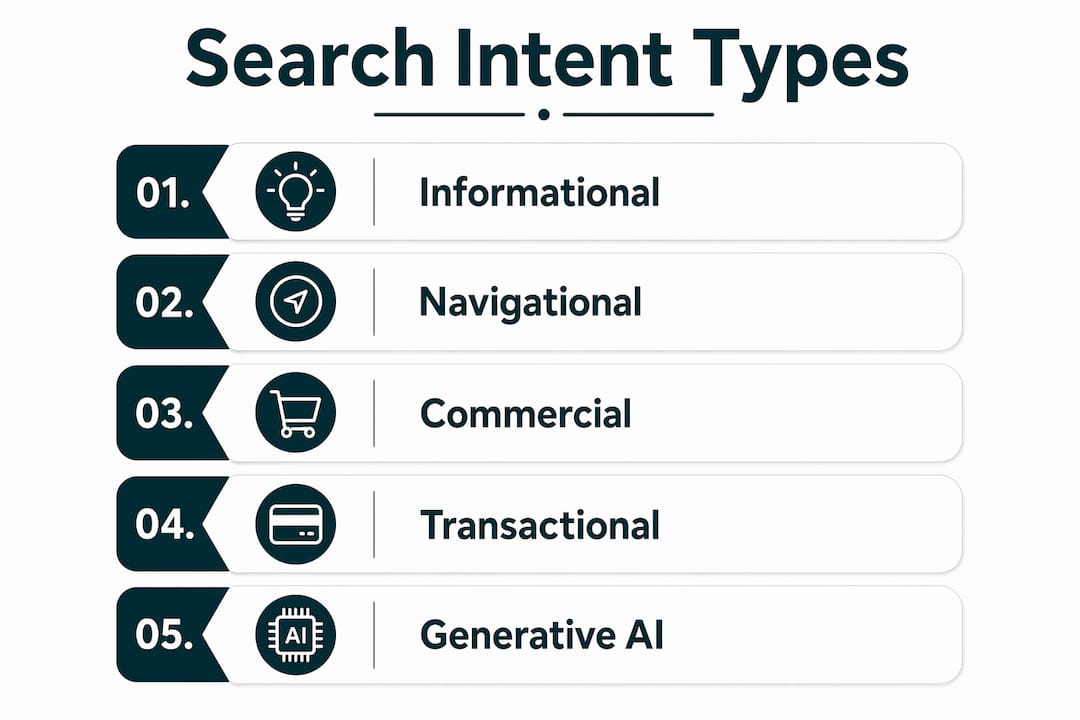
Search intent is defined as the underlying reason a user types a query into a search engine. How search intent drives content strategy is the process of matching your content type, format, and angle to that reason, so your page delivers exactly what the user expects. Teams that align their content to intent report traffic gains of 500% or more within a few months. That number is not a fluke. It reflects a fundamental shift from keyword stuffing to purpose-driven content planning. The SEO industry recognizes four primary intent categories: informational, navigational, transactional, and commercial. A fifth category, generative AI intent, has emerged in 2026 and now demands its own strategy. Understanding all five is the starting point for any content plan that actually performs.
How search intent drives content strategy: the four core intent types
Search intent shapes every content decision you make, from the format you choose to the call to action you write. Get the intent wrong and even a well-written, well-optimized page will fail to rank. Mismatching content type to keyword intent is one of the most common and costly errors in content strategy.
The four traditional intent types each call for a different content format:
- Informational intent: The user wants to learn something. A query like “how does compound interest work” signals a need for a guide, explainer, or how-to article. Featured snippets and “People also ask” boxes dominate these SERPs.
- Navigational intent: The user wants to reach a specific website or page. Content here is usually a branded landing page or homepage. Competing on navigational queries for another brand’s name is rarely worth the effort.
- Commercial intent: The user is researching before buying. Queries like “best project management tools for startups” call for comparison articles, buyer’s guides, and review-style content. These pages convert well when they answer the comparison question directly.
- Transactional intent: The user is ready to act. Queries like “buy noise-canceling headphones” demand product pages, pricing pages, or sign-up flows. Transactional intent requires product pages, not blog posts.
Each intent type also maps to a different success metric. Informational content succeeds when dwell time is high and bounce rate is low. Transactional content succeeds when it drives conversions. Tracking the wrong metric for the wrong intent type gives you misleading data.
| Intent type | Best content format | Primary success metric |
|---|---|---|
| Informational | Guide, how-to, explainer | Dwell time, return visits |
| Navigational | Branded landing page | Direct traffic, click-through rate |
| Commercial | Comparison, buyer’s guide | Time on page, lead generation |
| Transactional | Product page, pricing page | Conversion rate, revenue |
Pro Tip: Before writing any piece, type the target keyword into Google and note what type of content fills the first page. If you see product pages, write a product page. If you see listicles, write a listicle. The SERP is Google’s public declaration of what it believes the user wants.
How do you analyze search intent through SERP features?
Reading the SERP is the most reliable method for identifying what Google believes a query means. Theoretical frameworks help, but the SERP is ground truth. If 9 out of 10 top results are blog posts, the query is informational, and publishing a product page for that keyword will not rank regardless of how good the page is.
Here is a practical process for decoding intent from the SERP:
- Search the keyword in an incognito window. Remove personalization bias. Look at the first five organic results and note their content type: blog post, product page, video, tool, or landing page.
- Check SERP features. A featured snippet signals informational intent. Shopping results signal transactional intent. Local packs signal navigational or local intent. AI Overviews signal that Google is synthesizing answers, which means your content needs to be structured for extraction.
- Read the “People also ask” section. These questions reveal the subtopics users expect your content to cover. Each question is a subheading opportunity. Answering them directly inside your article improves both user satisfaction and snippet eligibility.
- Analyze the top three pages. Note their word count, heading structure, and whether they lead with a direct answer or bury it. The best-performing pages lead with a direct answer immediately after the heading, then expand with detail.
- Check the related searches at the bottom. These reveal adjacent intent signals. If related searches are mostly comparison queries, the primary intent leans commercial even if the keyword looks informational.
Aligned content improves user engagement signals including dwell time, bounce rate, and conversion rate. Those signals feed back into Google’s ranking algorithm. Intent alignment is not just a content quality issue. It is a ranking signal.
Pro Tip: Create a simple spreadsheet with columns for keyword, SERP content type, featured snippet presence, and AI Overview presence. Run your top 20 target keywords through this process before writing a single word. It takes two hours and prevents months of wasted effort.
What is generative AI intent and why does it matter in 2026?
Generative AI intent is a distinct search behavior category where users phrase queries expecting a synthesized, conversational answer rather than a list of links. As of early 2026, generative AI intent accounts for approximately 7.5% of search queries. That share is growing fast, and it changes what “optimizing for intent” means in practice.
AI Overviews in Google pull structured answers directly from web pages. If your content is not structured for extraction, it will not appear in those overviews, even if it ranks on page one. Here is what content optimized for generative AI intent looks like:
- Clear, concise headings that match the exact question a user would ask. Vague headings like “More Information” do not get cited by AI systems.
- Answer-first paragraphs that state the key point in the first sentence. Structural clarity and distinct information improve AI citation rates and content reach.
- Data-backed claims with specific numbers, named standards, or attributed sources. AI systems favor content that is verifiable.
- Short paragraphs of three to five sentences. Dense walls of text are harder for AI to parse and extract from.
- Logical content flow that moves from definition to explanation to example. AI systems reward content that mirrors how a knowledgeable person would explain a topic.
Content strategies built for enterprise AI platforms, like those described in enterprise AI content approaches, increasingly treat AI-readiness as a baseline requirement rather than an advanced tactic. For B2B SaaS content teams, this means auditing existing content for structural clarity before worrying about new keyword targets. You can also learn how AI-generated content risks affect your rankings when AI-readiness is ignored.
Practical steps to align content with search intent for better results
Intent analysis without execution is just research. These steps turn intent data into content that performs.
Step 1: Audit your existing content first. Before creating anything new, map your current pages to intent categories. Identify pages that target informational keywords but are formatted as product pages, or vice versa. Realigning these pages to the correct intent is the fastest path to traffic gains. Intent-based optimizations consistently produce significant traffic increases, and existing pages with domain authority behind them respond faster than new content.

Step 2: Filter your keyword list by intent. Keyword research treats intent as a strategic filter. Remove high-volume keywords that do not match your site’s conversion goals or content capabilities. A B2B SaaS company targeting “what is CRM software” with a product page is wasting crawl budget. That keyword needs an educational guide. Assign every keyword an intent label before assigning it to a writer.
Step 3: Match your headline and subheadings to the intent. An informational headline asks or answers a question. A transactional headline names the product and the benefit. A commercial headline frames a comparison. Mismatched headlines confuse users and reduce click-through rates from the SERP.
Step 4: Write with an answer-first structure. High-performing content leads with a direct answer and follows with expanded detail. This structure satisfies human readers who scan and AI systems that extract. Put the core answer in the first sentence after every heading. Expand with evidence, examples, and context in the following sentences.
Step 5: Create separate content assets for each intent stage. Distinct content assets for each funnel stage prevent user frustration and trust loss. A single page cannot serve a user who wants to learn and a user who wants to buy. Build an informational guide, a comparison page, and a product page as three separate assets targeting three separate keywords.
Step 6: Track intent-aligned metrics and iterate. Search intent optimization is ongoing. Monitor dwell time for informational pages, conversion rate for transactional pages, and lead volume for commercial pages. When a page underperforms on its intent-aligned metric, revisit the SERP and check whether Google’s interpretation of that query has shifted.
| Content stage | Intent type | Key metric to track |
|---|---|---|
| Awareness | Informational | Dwell time, organic impressions |
| Consideration | Commercial | Time on page, email signups |
| Decision | Transactional | Conversion rate, revenue per visit |
Pro Tip: Use the featured snippet tactics developed for AI Overviews as a template for every piece of informational content you write. If the structure works for AI extraction, it works for human readers too.
Key Takeaways
Search intent is the single most important filter in content strategy, and every content decision from format to metric should follow from it.
| Point | Details |
|---|---|
| Intent determines content format | Match your content type to what Google already rewards for that query. |
| SERP analysis beats theory | Read the top 10 results before writing to confirm the correct intent and format. |
| AI intent is now a real category | Generative AI intent accounts for 7.5% of queries and requires structured, answer-first content. |
| Audit before you create | Realigning existing content to the correct intent produces faster traffic gains than publishing new pages. |
| Track intent-aligned metrics | Use dwell time for informational content and conversion rate for transactional content to measure true fit. |
Why most content teams get intent wrong at the planning stage
Most content teams treat intent as a labeling exercise rather than a planning constraint. They assign an intent category to a keyword, then write whatever format they were already planning to write. That is not intent alignment. That is intent theater.
The real discipline is letting intent override your instincts. If you want to write a long-form guide but the SERP shows product pages, you write a product page. If your sales team wants a landing page but the SERP shows comparison articles, you build a comparison article. Intent is not a suggestion. It is the brief.
The teams I have seen produce consistent organic growth share one habit: they check the SERP before every brief, not just at the keyword research stage. Intent shifts over time. A query that returned blog posts two years ago may now return AI Overviews. Keyword research for 2026 has to account for that drift. The teams that build intent checks into their editorial calendar, not just their initial research, are the ones that hold their rankings through algorithm updates.
The other mistake I see constantly is treating the content calendar as a production schedule rather than a strategy document. Publishing volume matters, but publishing the wrong format at scale just creates more pages that will never rank. One well-aligned page outperforms ten misaligned ones every time.
— Savannah
Ranksector makes intent-driven content creation practical
Content strategists who understand search intent still face one persistent problem: producing enough correctly formatted, intent-aligned content to compete at scale.
Ranksector’s free SEO tools give content teams a direct path from intent analysis to published, optimized articles. The platform combines keyword research with intent filtering, so every article brief starts from the right format and angle. Ranksector has published over 11,000 SEO-optimized articles for B2B SaaS companies, with results that include measurable domain rating increases in weeks rather than months. For teams that need a full content audit before scaling production, Ranksector’s AI content audit identifies which existing pages are misaligned to intent and flags the highest-impact fixes first. Intent strategy works. Ranksector makes it repeatable.
FAQ
What is search intent in SEO?
Search intent is the reason behind a user’s query, whether they want to learn, navigate, compare, or buy. Matching your content type to that reason is the foundation of effective SEO.
Why does intent alignment improve rankings?
Google rewards content that satisfies the user’s actual goal. Aligned content produces stronger engagement signals like dwell time and lower bounce rate, which reinforce rankings over time.
What are the main types of search intent?
The four traditional types are informational, navigational, commercial, and transactional. In 2026, generative AI intent has emerged as a fifth category, accounting for approximately 7.5% of queries.
How do I identify the intent behind a keyword?
Search the keyword in an incognito window and analyze the top 10 results. The dominant content type, SERP features like featured snippets or shopping results, and the “People also ask” section all signal Google’s intent interpretation.
How often should I revisit intent for existing content?
Search intent optimization is ongoing. Review your top-performing pages quarterly and check whether the SERP has shifted, especially for queries where AI Overviews have appeared since your last audit.
Recommended
- Why Keyword Research Drives Content Decisions in 2026 · Ranksector Blog — Ranksector
- How Search Engines Rank Websites: 2026 Guide · Ranksector Blog — Ranksector
- How Search Trends Affect Your Keyword Strategy · Ranksector Blog — Ranksector
- Common Keyword Research Mistakes Businesses Make in 2026 · Ranksector Blog — Ranksector