
How Keyword Cannibalization Affects Rankings in 2026
Keyword cannibalization is defined as the condition where multiple pages on the same website target the same primary keyword and search intent, causing them to compete against each other in search results. This internal competition splits ranking signals, dilutes link equity, and confuses Google about which URL to surface. The result is predictable: weaker rankings across all competing pages, unstable positions, and measurable traffic loss. Understanding how keyword cannibalization affects rankings is the first step toward fixing a problem that quietly undermines even well-maintained sites. SEO professionals who ignore it often wonder why strong content fails to rank despite solid backlink profiles.
How keyword cannibalization affects rankings through authority dilution
Search engines calculate authority at the URL level, not the domain level. That distinction matters enormously when cannibalization is present. One page with 20 backlinks consistently outperforms two pages with 10 backlinks each targeting the same keyword. The math is straightforward, but the implication is significant: every time you split your content across competing URLs, you cut your ranking potential in half.

The authority split problem compounds over time. Internal links, external backlinks, and user engagement signals all get distributed across multiple pages instead of concentrating on one authoritative source. Google then faces a genuine signal conflict. It cannot confidently determine which URL best answers the query, so it rotates between them.
This rotation has a name: URL flickering. Google alternates ranking among competing URLs, which causes position volatility in Search Console data. A page ranks in position 4 one week, then drops to position 11 the next, then climbs back to position 6. That instability reduces click-through rates because users trust consistent top results. Without active consolidation, the flickering reinforces poor ranking outcomes indefinitely.
- Authority split: Backlinks and internal links divide across competing URLs instead of building one strong page.
- Signal confusion: Google receives mixed signals about which URL best matches the query intent.
- Crawl budget waste: Large sites lose crawl budget to redundant competing pages, which delays indexing of new content.
- CTR erosion: Ranking volatility from URL flickering reduces user trust and lowers click-through rates.
- Traffic fragmentation: Impressions split across multiple URLs, so no single page accumulates the engagement signals needed to rank higher.
Pro Tip: Analyze keyword rankings per URL rather than at the aggregate site level. Tracking only site-wide averages masks cannibalization effects that only become visible when you isolate individual URL performance.
Is keyword cannibalization the same as duplicate content?
These two problems share surface-level similarities but require completely different fixes. Confusing them leads to wasted effort and unresolved ranking issues.
| Factor | Duplicate content | Keyword cannibalization |
|---|---|---|
| Core problem | Identical or near-identical text across URLs | Same keyword and search intent targeted by distinct pages |
| Google’s concern | Which version to index and show | Which URL best answers the query |
| Primary fix | Canonical tags pointing to the preferred URL | Consolidation, 301 redirects, or intent differentiation |
| Content similarity | High, often copied or templated | Low to moderate, pages may cover different angles |
| User experience impact | Minimal if canonicalized correctly | Significant, creates inconsistent brand messaging |
Duplicate content is resolved with canonical tags. Cannibalization requires a deeper diagnosis because the competing pages often contain genuinely different content. The problem is not textual similarity. The problem is intent overlap. Two pages can be written completely differently and still cannibalize each other if they both target the same search query and user goal.
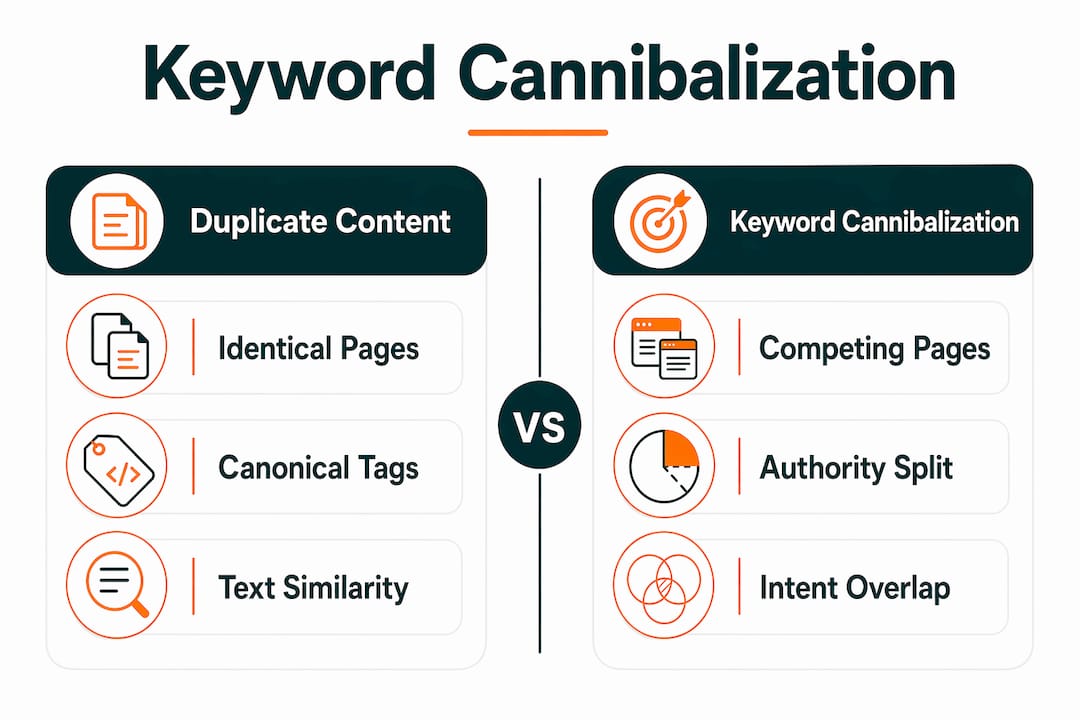
A common mistake is applying canonical tags to cannibalized pages and calling the job done. That approach fails because the non-canonical pages still exist, still attract internal links, and still dilute authority. The correct fix depends on the specific situation: merge the pages if they cover the same ground, redirect the weaker URL if one page is clearly superior, or reposition the content to serve a genuinely different intent.
Cannibalization also harms user experience by presenting inconsistent information across multiple pages. A visitor who lands on the wrong page gets a partial answer and bounces. That bounce signal feeds back into Google’s quality assessment and further weakens rankings.
How do you detect keyword cannibalization on your site?
Detection requires looking at ranking data at the URL level, not the keyword level. Most SEO professionals check which keywords a site ranks for. The more useful question is which URLs rank for each keyword, and whether more than one URL appears.
- Open Google Search Console and navigate to the Search Results report. Filter by a target keyword, then click “Pages” to see every URL ranking for that query. Two or more URLs appearing for the same query is a direct cannibalization signal.
- Look for rank position swapping over time. Rank swapping and impression splitting are the clearest behavioral signals. Export position data for a keyword over 90 days and check whether different URLs hold the top position at different times.
- Run a site search using Google. Type
site:yourdomain.com "target keyword phrase"into Google. Multiple results targeting the same phrase confirm the problem exists and shows you exactly which pages compete. - Audit internal links for anchor text patterns. If multiple pages receive internal links with the same anchor text, you are distributing authority across competing URLs. Consistent anchor text pointing to one preferred URL consolidates authority effectively.
- Map every page to a primary keyword and intent. Build a simple spreadsheet with URL, target keyword, and search intent. Any row where the same keyword or intent appears twice flags a cannibalization risk.
Pro Tip: Run this audit quarterly, not just once. New content published without a keyword map creates fresh cannibalization over time, especially on active blogs with high publication frequency.
Analyzing keyword ranking per URL rather than at the site level is the method that surfaces hidden cannibalization. Aggregate data smooths over the volatility that reveals the problem.
Effective strategies to fix and prevent keyword cannibalization
Fixing cannibalization starts with a decision: merge, redirect, or differentiate. Each approach fits a different situation, and choosing the wrong one wastes time.
- Merge and consolidate when two pages cover the same topic and intent. Combine the best content from both into one authoritative page. Then redirect the weaker URL to the consolidated page with a 301 redirect. Consolidation can drive significant traffic growth, with some sites reporting a 466% increase in clicks year over year after fixing cannibalization, and typical improvements landing between 20–50%.
- Apply a 301 redirect when one page clearly outperforms the other and the weaker page adds no unique value. The redirect passes link equity to the stronger URL and removes the competing signal.
- Differentiate by intent when both pages serve genuinely different user goals but share keyword overlap. Rewrite one page to target a distinct query variation. For example, a page targeting “content strategy” and another targeting “content strategy for SaaS” can coexist if the SaaS page goes deeper on industry-specific tactics.
- Fix internal linking to reinforce the preferred URL. Internal linking with consistent anchor text refocuses authority on the page you want to rank. Audit every internal link pointing to competing pages and update them to point to the canonical version.
- Use canonical tags selectively for cases where you must keep both URLs live but want Google to prioritize one. Canonical tags do not pass full link equity, so they are a secondary tool, not a primary fix.
- Build content hubs with clear intent mapping. Content hubs and pillar pages assign one topic per URL by design. A pillar page covers the broad topic, and cluster pages each address a specific subtopic. This structure prevents overlap before it starts.
SEO recovery after consolidation typically occurs within 2–8 weeks. That window allows Google to re-index the consolidated page and update its ranking signals. Do not expect overnight results, but do monitor Search Console weekly to confirm the preferred URL gains impressions while the redirected URL drops out.
Preventing future cannibalization requires a keyword map maintained before any new content goes live. Every article gets assigned a primary keyword and intent before writing begins. If the keyword already appears in the map, the writer either differentiates the angle or contributes to the existing page instead of creating a new one. This process, combined with search intent-driven content strategy, is the most reliable way to keep a growing content library free of overlap.
Key Takeaways
Keyword cannibalization splits authority across competing URLs, and consolidating those pages into one is the most direct path to recovering lost rankings and traffic.
| Point | Details |
|---|---|
| Authority splits at the URL level | One strong page outranks two weak ones targeting the same keyword every time. |
| URL flickering signals active cannibalization | Rank position swapping in Search Console is the clearest early warning sign. |
| Cannibalization differs from duplicate content | Canonical tags fix duplicate content but do not resolve intent-based competition between pages. |
| Detection requires per-URL analysis | Use Google Search Console’s Pages report filtered by query to expose competing URLs. |
| Consolidation drives measurable recovery | Merging competing pages typically improves traffic by 20–50%, with some sites seeing far larger gains. |
Why I think most SEO teams underestimate this problem
Keyword cannibalization rarely looks catastrophic in a dashboard. Rankings dip a few positions, traffic plateaus, and the cause is not obvious. That subtlety is exactly why teams underestimate it. They chase backlinks or rewrite meta titles while the real problem sits in their site architecture.
What I have seen consistently is that cannibalization stems from poor planning, not poor writing. Teams publish frequently without a keyword map, and over 12 to 18 months, the overlap accumulates. By the time someone notices the ranking instability, dozens of pages compete for the same queries.
The AI Overviews dimension makes this more urgent in 2026. Sites with cannibalization are less likely to be cited in AI-generated answers, which fragments content authority and reduces organic click-through rates significantly. AI systems favor clear, authoritative single sources. A site with three competing pages on the same topic gives AI no clean signal to cite.
My recommendation is to treat keyword mapping as a publishing prerequisite, not an afterthought. A content hub structure built around clear intent boundaries prevents the problem entirely. Fixing cannibalization after the fact costs far more time than preventing it upfront. The teams that get this right build authority faster, rank more consistently, and show up in AI citations at a higher rate.
— Savannah
Ranksector’s approach to content structure and SEO health
Keyword cannibalization is a structural problem, and solving it requires a structural solution. Ranksector’s AI audit tool identifies cannibalization signals across your content library, flagging competing URLs and intent overlaps before they compound into ranking losses.
For B2B SaaS teams publishing at scale, Ranksector’s agency solution combines keyword mapping, intent-driven content planning, and automated publication into one workflow. Every article gets assigned a unique keyword and intent before it goes live, which eliminates the overlap that causes cannibalization in the first place. Teams that have used Ranksector’s structured approach report faster domain authority growth and more stable ranking positions over time. If your content library has grown without a keyword map, the audit is the right place to start.
FAQ
What is keyword cannibalization in SEO?
Keyword cannibalization occurs when multiple pages on the same site target the same keyword and search intent, causing them to compete against each other in search results. This splits authority and weakens rankings for all competing pages.
How does cannibalization differ from duplicate content?
Duplicate content involves near-identical text across URLs and is typically fixed with canonical tags. Keyword cannibalization involves distinct pages competing on the same intent, which requires consolidation, redirects, or intent differentiation to resolve.
How long does it take to recover after fixing cannibalization?
SEO recovery after consolidation typically occurs within 2–8 weeks, as Google re-indexes the consolidated page and updates its ranking signals based on the new structure.
Does keyword cannibalization affect AI Overviews?
Sites with cannibalization are less likely to appear in AI-generated answer features. Fragmented content authority gives AI systems no clear single source to cite, which reduces visibility in AI Overviews and lowers organic click-through rates.
What is the fastest way to spot keyword cannibalization?
Open Google Search Console, filter the Search Results report by a target keyword, and click “Pages.” If more than one URL appears for the same query, cannibalization is present and requires immediate attention.
Recommended
- How Search Engines Rank Websites: 2026 Guide · Ranksector Blog — Ranksector
- Common Keyword Research Mistakes Businesses Make in 2026 · Ranksector Blog — Ranksector
- Why Keyword Research Drives Content Decisions in 2026 · Ranksector Blog — Ranksector
- Monitor Competitor Keyword Rankings: 2026 Guide · Ranksector Blog — Ranksector