
Find Untapped Keywords: Competitor Research Guide
Keyword gap analysis is defined as the process of identifying queries your competitors rank for that your site does not, making it the highest-yield method to find untapped keywords through competitor research. Tools like Semrush, Ahrefs, and Google Search Console turn this process from guesswork into a repeatable system. Keyword gap reports rank as top SEO strategy tools because competitor-ranked terms represent proven demand, not speculative topics. You are not betting on whether people search for something. You are targeting queries with a verified audience, then building content to claim your share.
How to find untapped keywords with competitor research
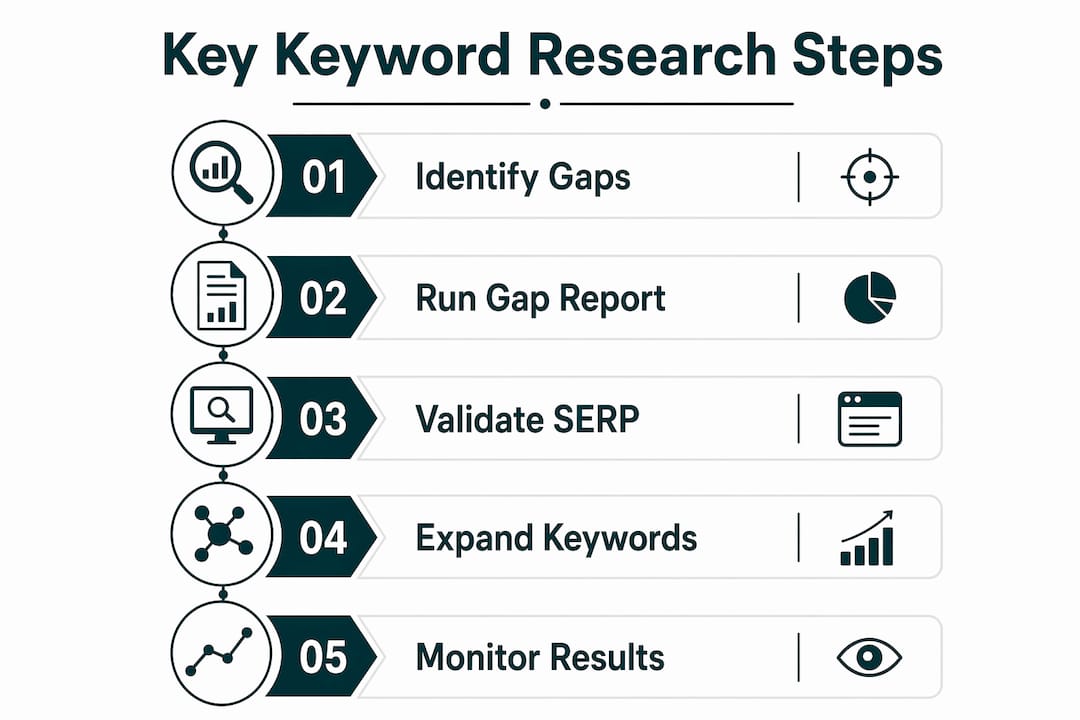
The formal industry term for this process is keyword gap analysis. It compares your site’s organic keyword profile against one or more competitors and surfaces the gaps. Competitor keywords represent proven demand because someone is already ranking for them, which means the traffic is real and the intent is confirmed.
Follow this four-step workflow to run it correctly:
- Identify your true organic competitors. These are not always your business competitors. Use Semrush’s Organic Research or Ahrefs’ Site Explorer to find which domains rank for the same keywords you do. A SaaS company selling project management software may compete organically with productivity blogs, not just rival software vendors.
- Run a keyword gap report. In Semrush, use the Keyword Gap tool. In Ahrefs, use Content Gap. Enter your domain and up to four competitor domains. The tool generates a side-by-side comparison of keyword rankings.
- Filter to “Missing” and “Weak” keywords. Filter to top 20 positions for realistic quick wins. “Missing” means competitors rank and you have zero presence. “Weak” means you rank but outside the top 20, where clicks are negligible.
- Prioritize by volume and keyword difficulty. A true keyword gap requires meaningful monthly volume and your site not ranking at all. Sort by search volume, then filter out anything with a keyword difficulty score above your domain authority threshold.
Here is a comparison of the most widely used tools for this process:
| Tool | Gap Report Feature | Filters Available | Free Tier |
|---|---|---|---|
| Semrush | Keyword Gap | Missing, Weak, Untapped | Limited (10 queries/day) |
| Ahrefs | Content Gap | Missing, Weak, Top 10 only | No (paid only) |
| Moz | True Competitor | Overlap score | Limited |
| Google Search Console | Performance Report | Position, CTR, Impressions | Yes (full access) |
Pro Tip: Run your gap report against three to five competitors simultaneously. A keyword that appears in multiple competitors’ profiles but not yours is a high-confidence gap worth prioritizing immediately.

How do you validate that a keyword is truly untapped?
Identifying a gap in a tool is only the first step. SERP analysis is the ground truth for confirming whether a keyword is genuinely untapped or simply mismatched in intent. Before you build content, you need to confirm two things: what the user actually wants, and what format Google rewards for that query.
Here is a practical validation checklist:
- Check the SERP type. Search the keyword manually. If the top results are product pages and your plan is a blog post, you have an intent mismatch. Google rewards the format that matches user intent, not the format you prefer to create.
- Identify SERP features. Note whether Google shows a Featured Snippet, People Also Ask boxes, or a video carousel. These features signal the content format most likely to capture clicks.
- Account for zero-click behavior. Zero-click searches now account for 68% of all searches. That number means ranking alone does not guarantee traffic. Target keywords where the SERP shows a snippet you can own, or where users must click through to get a complete answer.
- Confirm search volume is real. Some gaps appear because a keyword has near-zero monthly searches. Cross-reference volume in two tools before committing to content creation.
- Check the competitive content format. SERP analysis reveals competitive content formats, guiding how to align your content to win. If every top result is a long-form comparison article, a 400-word post will not compete.
Pro Tip: Paste the top three ranking URLs for your target keyword into Ahrefs’ Site Explorer and check their word count, backlink count, and publishing date. This tells you exactly what bar you need to clear to rank.
Skipping SERP validation is the most common reason keyword gap analysis fails to produce results. You can have a perfectly identified gap and still produce content that never ranks because the format or intent is wrong.
Expanding discovery with long-tail keywords and GSC data
Head terms from competitor gap reports are a starting point, not the full picture. A seed-based keyword pipeline that uses autocomplete expansion and clustering can uncover 200–500 keyword shortlists beyond saturated head terms. This approach preserves fragmented long-tail demand that most marketers miss entirely.
Here is how to build that pipeline:
- Take your gap keywords as seeds. Each validated gap keyword becomes a seed for expansion. Enter it into Google Autocomplete, Google’s “Related Searches” section, and niche forums like Reddit or industry-specific communities.
- Collect autocomplete and related search variations. Google Autocomplete surfaces what real users type. A seed like “project management software” generates long-tail variants like “project management software for remote teams under 10 people,” which carries lower competition and higher purchase intent.
- Mine Google Search Console for hidden queries. The GSC API allows querying impressions, clicks, CTR, and average position with fewer limits than the UI. Export your full query report and filter for queries with high impressions but low clicks. These are keywords where you appear in search results but fail to capture traffic, a different category of untapped opportunity.
- Cross-validate with GSC data. Two-layer validation using competitor rank plus GSC data confirms that a keyword is truly not captured by your site. A query showing 500 impressions and zero clicks in GSC is a different problem than a query where you have no presence at all.
- Cluster and score your shortlist. Group related long-tail variants under parent topics. Score each cluster by total combined search volume, average keyword difficulty, and your existing content coverage.
| Expansion Method | Best For | Key Tool |
|---|---|---|
| Google Autocomplete | Discovering natural query variants | Google Search |
| GSC Query Export | Finding high-impression, low-click gaps | Google Search Console |
| Niche Forums (Reddit) | Uncovering real user language | Reddit, Quora |
| Competitor Gap Report | Identifying proven demand gaps | Semrush, Ahrefs |
This combination of outward expansion and inward GSC mining gives you a keyword strategy that covers both competitive gaps and your own underperforming content. Most teams run only one of these. Running both gives you a significant edge.
What are the most common mistakes in keyword gap workflows?
Execution separates teams that see results from those that generate reports and do nothing with them. Keyword gap outputs should be treated as prioritized content briefs, not a raw keyword dump. Here is how to run the workflow correctly and avoid the pitfalls that waste time.
Step 1: Audit existing content before creating anything new. Check whether you already have a page that partially covers the gap keyword. Many teams create new pages for every gap they find. Avoid creating new pages for every missing keyword. Merge related gap keywords into existing pages to avoid thin content and keyword cannibalization. You can use Ranksector’s guide on spotting keyword cannibalization to identify conflicts before they hurt your rankings.
Step 2: Apply two-layer validation before writing. Confirm the gap in your keyword tool, then check GSC to verify you have zero impressions for that query. This two-step check prevents you from optimizing for queries you already reach without clicks, which is a different problem requiring a different fix.
Step 3: Separate quick wins from long-term clusters. Quick wins are gap keywords with search volume above 200, keyword difficulty below 30, and clear informational intent. Long-term clusters are higher-volume, higher-difficulty topics that require building topical authority over time. Work both tracks in parallel.
“The biggest mistake in competitor keyword research is assuming low competition means easy ranking. Low competition only matters if the intent matches your content and the volume justifies the effort.”
Common mistakes to avoid:
- Chasing gaps with no clear intent match
- Building standalone pages for every keyword instead of clustering
- Ignoring GSC data and relying solely on third-party tools
- Failing to check ranking prediction metrics before committing to content production
Pro Tip: Set a calendar reminder to re-run your keyword gap report every 90 days. Competitor content strategies shift, and new gaps open regularly. Treating this as a one-time exercise means leaving recurring opportunities on the table.
Key takeaways
Competitor keyword gap analysis is the most reliable method to find untapped keywords because it targets proven demand, not guesswork, and combining it with SERP validation and GSC data produces the highest-quality content opportunities.
| Point | Details |
|---|---|
| Start with keyword gap analysis | Use Semrush or Ahrefs to find queries competitors rank for that your site misses entirely. |
| Validate with SERP analysis | Confirm intent and content format before writing to avoid producing content that cannot rank. |
| Mine GSC for hidden gaps | High-impression, low-click queries in Google Search Console reveal a separate category of untapped opportunity. |
| Cluster before creating | Merge related gap keywords into existing pages to prevent thin content and cannibalization. |
| Rerun every 90 days | Competitor strategies shift constantly, so gap analysis must be a recurring workflow, not a one-time task. |
Competitor research is a habit, not a project
I have run keyword gap analyses for teams ranging from solo founders to 20-person content departments, and the pattern is consistent. The teams that see compounding SEO growth treat competitor research as a standing workflow item, not a quarterly project they revisit when traffic drops.
The tools are not the hard part. Semrush and Ahrefs surface the gaps in minutes. The hard part is resisting the urge to act on every gap at once. I have watched teams generate 400-keyword gap reports and then spend three months producing thin pages for each one, only to see rankings stagnate because none of the pages had enough depth or authority to compete.
What actually works is narrowing the list aggressively. Take your gap report, apply the SERP validation step, cross-check against GSC, and commit to the top 10–15 opportunities per quarter. Build those out with real depth. Then rerun the report.
The other thing most articles will not tell you: AI-based keyword suggestions only become trustworthy when grounded in real competitor organic data. AI tools can generate keyword ideas quickly, but without anchoring those ideas in what competitors actually rank for, you are guessing. The competitor data is the anchor. Everything else is expansion.
Treat your keyword gap report as a living document. Update it, act on it in focused sprints, and align it with your editorial calendar. That discipline is what separates teams with growing organic traffic from those stuck in a plateau.
— Savannah
How Ranksector automates competitor keyword discovery
Identifying keyword gaps manually across multiple competitors is time-consuming, especially for small teams publishing content daily. Ranksector combines competitor-driven keyword research with automated content creation, so you can act on gap findings without the manual overhead.
Ranksector’s platform detects competitor keyword gaps, generates long-tail keyword suggestions, and tracks content performance continuously. It has published over 11,000 SEO-optimized articles for B2B SaaS teams, with results showing measurable domain rating growth in weeks rather than months. If you want to see how the free SEO tools work before committing, you can run your first competitor gap analysis there. For agencies managing multiple client sites, the agency solution scales the same workflow across every account.
FAQ
What is keyword gap analysis?
Keyword gap analysis is the process of comparing your site’s organic keyword rankings against competitors to find queries they rank for that you do not. Tools like Semrush and Ahrefs automate this comparison and filter results by “Missing” or “Weak” status.
How do i choose which keyword gaps to target first?
Prioritize gaps with meaningful monthly search volume, a keyword difficulty score within your domain authority range, and clear informational or commercial intent confirmed by SERP analysis. Quick wins typically have volume above 200 and difficulty below 30.
Why should i use google search console for keyword research?
Google Search Console surfaces queries where your site already appears in results but fails to earn clicks, a category of untapped opportunity that third-party tools cannot detect. The GSC API enables deeper query analysis with fewer row limits than the standard UI.
How often should i run a competitor keyword gap report?
Run a full competitor gap report every 90 days. Competitor content strategies shift regularly, and new gaps open as competitors publish or remove content. Treating it as a recurring workflow rather than a one-time audit produces compounding results.
What is the difference between a missing and an untapped keyword?
A “Missing” keyword is one where competitors rank and your site has zero presence. An “Untapped” keyword, as labeled in tools like Semrush, is one where only some of your selected competitors rank for it. Both categories are worth targeting, with “Missing” keywords representing the highest-priority gaps.