
Why Keyword Research Drives Content Decisions in 2026
Keyword research is the process of identifying the exact search terms and underlying intents your audience uses, and it is the single most reliable input for every content decision you make. Without it, you are writing for yourself, not for the people searching for solutions you provide. Organic search drives over 53% of all website traffic, making the ability to align content with real demand a direct revenue lever. Why keyword research drives content decisions comes down to one principle: content built on search evidence consistently outperforms content built on assumptions.
Why keyword research drives content decisions
Keyword research is the discipline of mapping what your audience searches for, how often, and with what intent. The industry term for the broader practice is search demand analysis, and it encompasses not just keyword lists but intent classification, competitive gap analysis, and topical authority mapping. Understanding search demand and intent rather than just collecting terms is what separates teams that grow organic traffic from those that spin their wheels.
The numbers make the case plainly. 94.74% of keywords receive 10 or fewer monthly searches, which means the long tail of specific, lower-volume queries represents the vast majority of search activity. That matters because those low-volume terms often convert better than head terms, since a person searching “B2B SaaS onboarding checklist template” is far closer to a buying decision than someone searching “onboarding.”

Content decisions that ignore keyword research default to guessing. Keyword research replaces that guesswork with evidence, telling you which topics to cover, in what format, and at what depth.
What variables determine the value of a keyword for content targeting
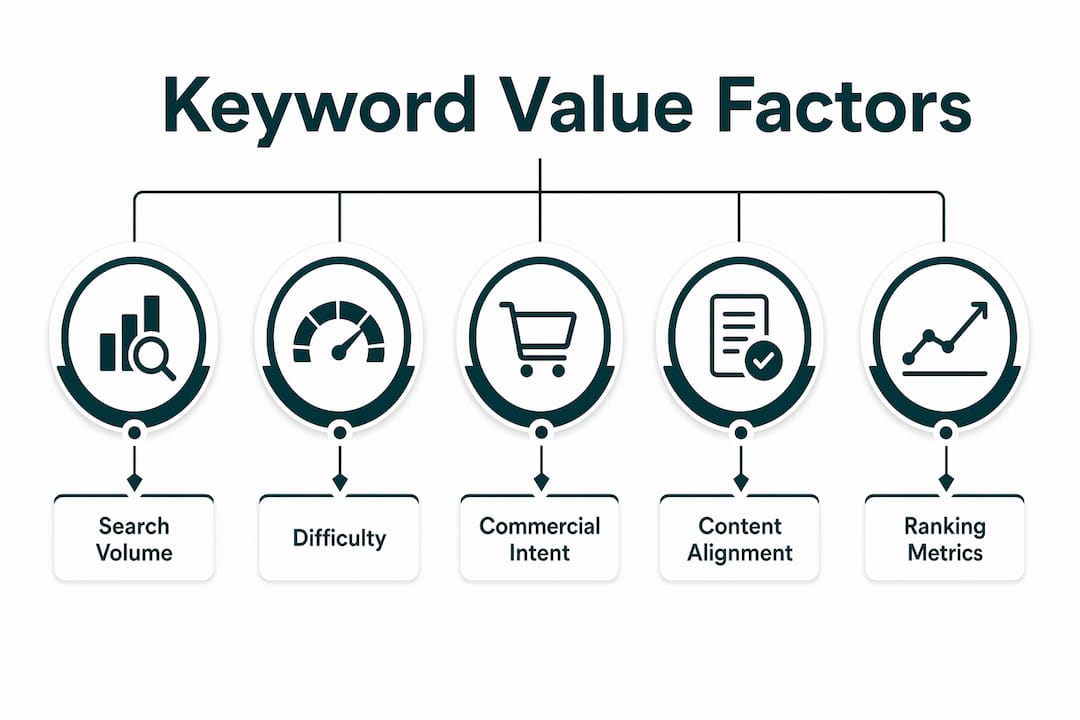
Not every keyword deserves a content investment. Four variables determine whether a keyword is worth targeting.
- Search volume tells you how many people search a term monthly. High volume sounds attractive, but targeting commercial intent keywords can outperform informational queries by 4x in conversion rates despite generating less traffic. Volume without intent context is a vanity metric.
- Keyword difficulty (KD) measures how hard it is to rank based on the authority of pages currently ranking. A domain with a DR of 30 competing for a KD 70 keyword is wasting resources. Match your domain authority to realistic KD targets.
- Search intent classifies what the searcher actually wants: informational, navigational, commercial, or transactional. A listicle will not rank for a transactional query. Matching your content format to the dominant SERP intent is non-negotiable.
- Topical authority is the degree to which your site is recognized as a credible source on a subject. Building content clusters around a core topic, rather than isolated articles, signals depth to Google and improves rankings across the entire cluster.
Pro Tip: Before targeting any keyword, check the six ranking metrics that predict article performance in 2026. Keyword difficulty alone does not tell the full story.
These four variables work together. A keyword with moderate volume, low difficulty, clear commercial intent, and alignment to a topic cluster you already own is far more valuable than a high-volume term where you have no topical foothold.
How has AI changed keyword research in 2026?
Search behavior is fragmenting. Users now split their queries across Google, ChatGPT, Perplexity, Reddit, and TikTok, which means demand signals no longer live in a single platform. Keyword research has shifted from building static lists to mapping demand and intent across multiple channels. That shift is not optional in 2026. It is the baseline.
AI Overviews in Google SERPs present a specific challenge. AI Overviews decrease CTR for organic listings below them, but they also create an opportunity: content that is cited inside an AI Overview gains visibility without a click. The implication is that completeness and structure matter more than ever. An article that directly answers a question in its first paragraph is more likely to be cited by both AI Overviews and LLMs like Claude or Perplexity.
| Search channel | Keyword signal type | Research implication |
|---|---|---|
| Google Search | Traditional volume and SERP data | Still the primary data source for volume |
| ChatGPT / Perplexity | Conversational, long-tail queries | Requires monitoring AI-generated query patterns |
| Reddit / social | Community language and pain points | Surfaces intent language not found in keyword tools |
| Google AI Overviews | Featured answer triggers | Signals which queries need direct, structured answers |
The practical response is continuous research. Teams running quarterly keyword reviews consistently outperform those treating research as a one-time setup task, because intent shifts and new queries emerge constantly. Understanding how ChatGPT and Google interpret the same query differently is now a core competency for any SEO team.
Pro Tip: Monitor AI-generated answer patterns in Perplexity monthly. The phrasing AI uses to answer questions reveals long-tail query structures that traditional keyword tools miss entirely.
How professional teams execute keyword research for content strategy
Collecting keywords is the easy part. What you do after research determines whether the investment pays off. Data cleaning, intent clustering, silo mapping, and content briefs are the mandatory steps that separate teams generating ROI from those sitting on spreadsheets.
Here is the process professional SEO teams follow:
-
Export and clean your keyword data. Remove branded terms (unless you are targeting them deliberately), keywords with zero commercial relevance, and terms where the SERP is dominated by pages you cannot realistically compete with. A raw export of 5,000 keywords often yields 300 to 500 genuinely actionable targets after cleaning.
-
Cluster by SERP intent overlap. Group keywords that return similar SERP results into the same cluster. If two keywords consistently surface the same top-ranking URLs, they share intent and should be targeted by a single piece of content. This prevents keyword cannibalization before it starts.
-
Map clusters to content silos. Organize clusters into pillar pages and supporting articles. A pillar page covers a broad topic at depth; supporting articles target specific subtopics and link back to the pillar. This architecture builds topical authority systematically. You can learn to spot keyword cannibalization in minutes if you map your silos correctly from the start.
-
Write content briefs for each cluster. A brief specifies the target keyword, secondary keywords, intended search intent, recommended format, required headers, and competitor content gaps to address. Briefs align writers with SEO goals before a word is written, not after.
-
Monitor, refresh, and iterate. Rankings shift. Intent evolves. Schedule quarterly reviews to identify declining content, new keyword opportunities, and gaps created by competitor moves.
| Approach | One-time research | Continuous research |
|---|---|---|
| Keyword freshness | Stale within 3 to 6 months | Updated quarterly |
| Intent alignment | Drifts as behavior changes | Adjusted to current SERP signals |
| Competitive response | Reactive | Proactive |
| Cannibalization risk | High without ongoing audits | Managed through regular mapping |
What are the advantages of ongoing keyword research?
The most underrated advantage of continuous keyword research is competitive intelligence. Systematic research uncovers dozens of keywords with search volume above 500 and keyword difficulty below 20 that competitors have missed entirely. Those gaps represent traffic you can capture without fighting for it.
Beyond gap analysis, ongoing research delivers four concrete benefits:
- Traffic quality over traffic volume. Targeting intent-matched keywords attracts visitors who are ready to act. A smaller audience that converts is more valuable than a large audience that bounces.
- Trend detection before saturation. New queries emerge constantly. Teams monitoring keyword data monthly spot rising trends before competitors do, giving them a first-mover ranking advantage.
- Cannibalization prevention. When multiple pages on your site compete for the same keyword, they split ranking signals and both perform worse. Regular keyword audits catch this before it compounds.
- Cluster efficiency. Long-tail keyword clusters allow a single article to rank for 15 to 30 related terms, multiplying the organic reach of each content investment without multiplying the production cost.
“Replacing guesswork with systematic keyword research can triple organic traffic within six months by targeting keyword clusters instead of individual keywords.” — Atlas Marketing, 2026
The compounding effect is real. Each well-researched article adds to your topical authority, which makes the next article easier to rank. Teams that treat keyword research as a quarterly operational function, not a project kickoff task, build this compounding advantage deliberately. AI-powered SEO platforms now automate much of the monitoring work, making continuous research feasible even for small teams.
Key takeaways
Keyword research is not a preliminary step. It is the continuous intelligence function that makes every content decision defensible and every article more likely to rank.
| Point | Details |
|---|---|
| Intent beats volume | Commercial intent keywords convert at up to 4x the rate of high-volume informational terms. |
| Continuous research wins | Teams running quarterly keyword reviews consistently outperform one-time research approaches. |
| Clusters multiply reach | A single article targeting a long-tail cluster can rank for 15 to 30 related terms. |
| AI changes the signals | Demand now fragments across Google, ChatGPT, and social, requiring multi-channel monitoring. |
| Post-research process matters | Data cleaning, clustering, and content briefs are what convert keyword lists into ROI. |
Why I think most teams are doing keyword research wrong
Most content teams treat keyword research as a project phase. They do it once before a site launch or content calendar refresh, export a spreadsheet, and move on. That approach made sense in 2018. It does not hold up in 2026.
What I have observed across content operations is that the teams generating consistent organic growth are not necessarily doing more research. They are doing it more often and acting on it faster. They treat keyword data the way a product team treats user feedback: as a continuous input, not a one-time discovery. When a new AI Overview appears for a target keyword, they update the article within weeks, not quarters.
The other mistake I see constantly is confusing keyword research with keyword collection. Pulling 10,000 terms from Ahrefs or Semrush and dropping them into a spreadsheet is not research. Research is the interpretation layer: understanding why a query exists, what the searcher actually needs, and whether your site is positioned to serve that need better than the current top results. That interpretive work is where the real advantage lives, and it cannot be automated away.
My practical advice: block two hours per quarter for a keyword review tied directly to your content calendar. Identify three to five clusters where intent has shifted or where competitors have moved. Assign those to your next content sprint. That cadence, applied consistently, compounds faster than any single content push.
— Savannah
How Ranksector automates keyword-driven content publishing
Building a keyword-driven content operation from scratch takes time most B2B SaaS teams do not have. Ranksector solves that directly. The platform combines competitor-driven keyword research with automated article creation and daily publication, so your blog stays active and SEO-aligned without manual effort from your team. Every article is built around real keyword clusters, mapped to search intent, and published with the structure needed to compete in 2026 SERPs. With over 11,000 articles already published for clients, Ranksector delivers the continuous content output that keyword strategy demands. Explore the free SEO tools to see how keyword clustering and content briefs work in practice.
FAQ
What is keyword research in content strategy?
Keyword research in content strategy is the process of identifying the search terms your audience uses and mapping them to content topics, formats, and intent. It replaces assumption-based content planning with evidence-based decisions.
Why do content decisions rely on keywords?
Content decisions rely on keywords because keywords reveal what your audience actually wants, not what you assume they want. Aligning content to real search demand is what drives organic traffic and qualified conversions.
How often should you update your keyword research?
Teams running quarterly keyword reviews consistently outperform those treating research as a one-time task. Search intent shifts, new queries emerge, and competitor moves create gaps that only regular research will catch.
Does keyword research still matter with AI search?
Keyword research matters more in the AI era, not less. AI Overviews and LLMs fragment demand across platforms, making it critical to monitor intent signals beyond traditional Google data and to structure content for AI citation.
What is keyword cannibalization and how do you prevent it?
Keyword cannibalization occurs when multiple pages on your site compete for the same search term, splitting ranking signals and weakening both pages. Preventing it requires clustering keywords by intent before writing and auditing your content map regularly.
Recommended
- 6 Metrics That Predict Article Rankings in 2026 · Ranksector Blog — Ranksector
- How to Spot Keyword Cannibalization in Five Minutes · Ranksector Blog — Ranksector
- Best AI SEO Content Tools for Solo Founders: What to Use in 2026 · Ranksector Blog — Ranksector
- Why meta descriptions matter more after AI Overviews for SaaS SEO · Ranksector Blog — Ranksector