
Winning Keywords Niche Market Analysis: 2026 Guide
Winning keywords niche market analysis is the process of identifying highly relevant, low-competition search terms that deliver measurable SEO and revenue impact within a specific niche. 94.74% of keywords receive 10 or fewer monthly searches, yet these low-volume terms consistently outperform broad keywords for niche conversions. That single fact reframes the entire discipline. Focusing on 8–12 validated niche keywords monthly can boost organic traffic by 340% over six months. The shift from chasing volume to targeting relevance is not a trend. It is the foundation of modern niche SEO, and it starts with understanding exactly what your niche is and who you are writing for.
What is winning keywords niche market analysis and why does it matter?
Niche keyword research, the recognized industry term for this process, targets search terms that are highly specific to a defined audience rather than broadly popular. The goal is not maximum reach. The goal is maximum relevance to buyers who are ready to act.
New or low-authority domains can realistically reach page one rankings within 3–6 months by focusing on niche keywords. That timeline is nearly impossible with broad, high-competition terms. Niche keyword strategies give smaller sites a genuine path to visibility without requiring massive domain authority.

Keyword analysis must prioritize revenue relevance over raw search volume. A keyword with 50 monthly searches from buyers in your exact niche is worth far more than a keyword with 50,000 searches from a general audience with no purchase intent. This is the core principle that separates effective keyword analysis from vanity metric chasing.
How to define your niche before you research keywords
Clear niche definition is the first step in any keyword research process. Without it, you generate keyword ideas that are too broad to rank for and too generic to convert. Your niche is the intersection of your product, your audience, and the specific problem you solve.
Start by building an ideal customer profile (ICP). Document the industry your buyer works in, the stage of the buying journey they are at, and the exact language they use to describe their problem. This language becomes your first set of seed keywords. For example, a B2B SaaS company selling project management software to architecture firms would not target “project management software.” They would target “project management software for architecture firms” or “AEC project tracking tools.”
- Pull existing data from Google Search Console to find which queries already bring visitors to your site.
- Review your own support tickets, sales call notes, and customer reviews for exact phrases buyers use.
- Scan niche forums, Reddit threads, and LinkedIn groups to capture audience language in the wild.
- List industry-specific jargon, certifications, and job titles that define your niche.
Pro Tip: Set up a simple spreadsheet with three columns: seed keyword, audience segment, and buyer intent stage. Filling this in before you open any keyword tool saves hours of irrelevant research later.
Google Search Console is particularly valuable here because it shows real queries from real visitors. These are terms you already have some relevance for, making them strong candidates for content expansion.
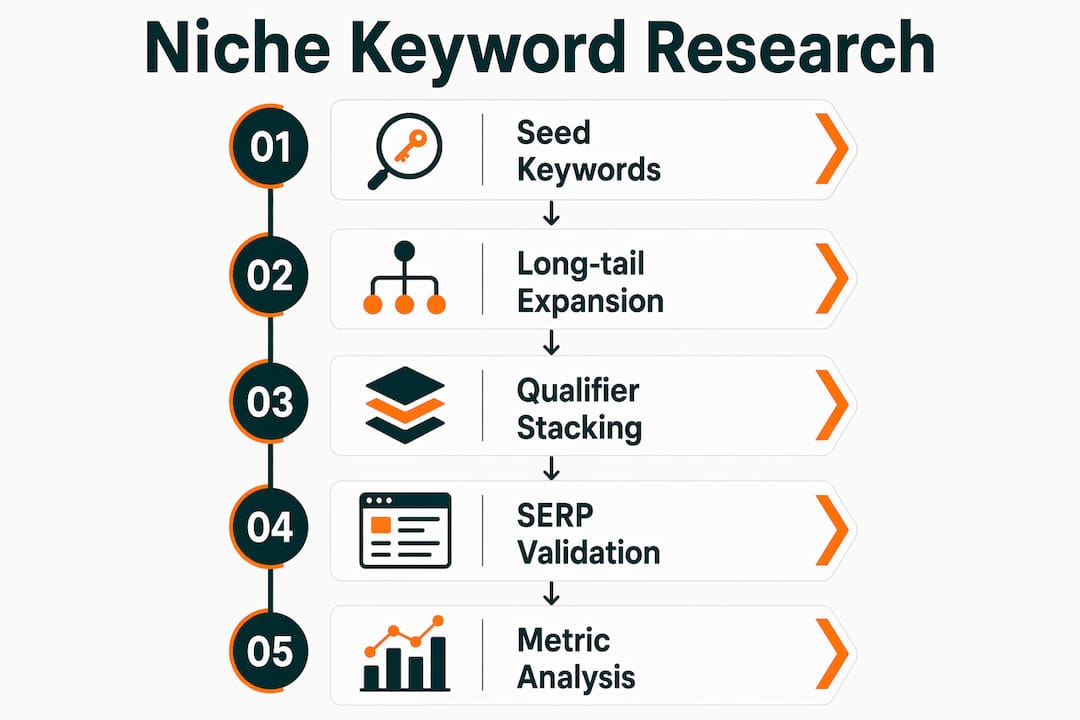
How to generate, expand, and validate your niche keyword list
Building a strong keyword list follows a clear sequence. You start with seed keywords, expand them into long-tail variations, and then validate each candidate before committing to content creation.
Step 1: Expand seed keywords into long-tail variations
Take each seed keyword and generate 20–30 long-tail variations using autocomplete suggestions, People Also Ask (PAA) mining, and competitor keyword gap analysis. Autocomplete from Google Search reveals what real users type. PAA boxes surface the exact questions your audience asks. Competitor gap analysis shows which terms your competitors rank for that you do not.
Step 2: Apply qualifier stacking
Qualifier stacking refines broad seed keywords into focused, rankable niche terms by adding industry, intent, and stage qualifiers. A broad seed like “email marketing” becomes “email marketing automation for SaaS startups” or “email marketing best practices for B2B onboarding.” One broad seed can produce 30–50 rankable terms through this method alone.
Step 3: Validate with manual SERP inspection
Manual SERP inspection is the most reliable method to uncover true keyword opportunities. Search your candidate keyword and examine what currently ranks. If the top results are forum threads, thin blog posts, or outdated content from low-authority sites, the keyword is genuinely winnable regardless of what a tool’s difficulty score says.
Step 4: Check key metrics
| Metric | What to check | Why it matters |
|---|---|---|
| Search volume | Reported monthly searches | Baseline demand signal, not the full picture |
| Keyword difficulty | Tool-assigned score (0–100) | Indicates competition level for ranking |
| SERP quality | Authority of ranking pages | Real competition is often lower than scores suggest |
| Revenue relevance | Buyer intent signals in the query | Determines conversion potential |
| CPC (cost per click) | Paid search bid price | High CPC signals commercial intent |
Keyword tools under-report niche search volume significantly. A keyword showing 10 reported monthly searches often has 50–100 real searches. Never dismiss a keyword purely because its reported volume looks small.
Pro Tip: Search your candidate keyword in an incognito browser window. Count how many of the top 10 results come from sites with clear topical authority versus generic or thin content. That ratio tells you more than any difficulty score.
You can also learn about high-intent commercial keywords to sharpen your evaluation of which terms signal genuine buyer readiness.
How to build content clusters around your niche keywords
Content clusters are groups of related pages built around a central topic, with one pillar page targeting the primary keyword and multiple supporting pages targeting related terms. Pages ranking for one keyword typically also rank for 1,000+ related terms through comprehensive topical content clusters. That multiplier effect is why clusters outperform isolated pages every time.
The cluster approach works because Google rewards topical authority. A site that covers one topic deeply signals expertise. A site that covers many topics shallowly signals nothing.
Assign one primary keyword per URL
Targeting a focused set of keywords and assigning one primary keyword per URL prevents cannibalization. Cannibalization happens when two pages on your site compete for the same term, splitting ranking signals and weakening both. Assign your primary keyword to one URL, then cluster secondary keywords and variations around it on the same page.
Map keywords to funnel stages
Match each cluster page to a specific buyer intent stage. Awareness-stage content targets informational queries like “what is X” or “how does X work.” Consideration-stage content targets comparison queries. Decision-stage content targets transactional queries with high commercial intent. This mapping ensures your content covers the full buyer journey within your niche.
- Pillar page: Targets the broadest primary keyword in the cluster.
- Supporting pages: Each targets one specific long-tail variation or subtopic.
- Internal links: Connect supporting pages back to the pillar page to pass authority.
- Funnel alignment: Label each page by intent stage so content gaps are visible at a glance.
Sites with clear keyword clusters rank 53% faster for new terms within established topic areas. That speed advantage compounds over time. Each new supporting page strengthens the pillar, and the pillar lifts every supporting page. Understanding why ranking on page one matters makes the case for investing in this structure from day one.
What are the most common pitfalls in niche keyword research?
Niche keyword research fails in predictable ways. Knowing the failure modes in advance saves months of wasted content production.
Chasing vanity metrics. High search volume feels like proof of demand, but volume without intent is worthless. A keyword with 10,000 monthly searches from users who never buy costs you content budget with no return. Evaluating keywords for intent and lead potential is the discipline that separates profitable SEO from traffic theater.
Ignoring cannibalization. Publishing multiple pages targeting the same keyword without a clear mapping system creates internal competition. Your own pages fight each other for rankings, and neither wins. A simple keyword-to-URL map, maintained in a spreadsheet, prevents this entirely.
Dismissing low-volume terms too quickly. A keyword showing 10 monthly searches in a tool may have 50–100 real searches. Niche buyers are a small population by definition. Low reported volume in a niche is normal, not a disqualifier.
“Keyword research is not a one-time event. Markets shift, competitors publish new content, and search behavior evolves. Treating your keyword list as a living document, reviewed and updated monthly, is what separates sites that sustain rankings from sites that plateau.”
- Review your keyword list every 30 days against actual ranking and traffic data.
- Drop terms that show no ranking movement after 90 days of targeted content.
- Add new terms as your topical authority grows and new subtopics become viable.
- Watch for emerging queries in your niche using Google Trends and Search Console’s new queries report.
Pro Tip: Create a “parking lot” tab in your keyword spreadsheet for terms you are not ready to target yet. When your domain authority grows or a new product launches, those parked terms become your next content sprint.
Why low-volume keywords deserve more credit than they get
The conventional wisdom in SEO has long been to target keywords with the highest possible search volume. I spent years watching that approach produce traffic spikes with no revenue attached. The real wins came from the opposite direction.
A client in the industrial equipment space once dismissed a keyword showing 30 monthly searches. I pushed to create one focused page targeting that term. Within four months, that page generated three qualified leads worth more than the entire previous quarter’s broad-traffic content combined. The math is simple: 30 searches from buyers beats 30,000 searches from browsers.
Topical clusters, not isolated keywords, enable long-lasting SEO success in competitive niches. I have seen this play out repeatedly. The sites that build deep coverage around a narrow topic outrank sites with ten times the domain authority on broad terms. Google recognizes expertise, and expertise shows up as coverage depth, not keyword density.
Manual SERP review is the step most marketers skip because it feels slow. It is not slow. It is the fastest way to find a keyword worth targeting. When you search a term and see Reddit threads and five-year-old blog posts ranking in the top five, you have found a gap. No tool will tell you that as clearly as your own eyes will.
My honest advice: pick 8–12 niche keywords per month, build one piece of content per keyword, and review performance at 90 days. That cadence, applied consistently, compounds into real authority. Chasing volume with thin content does not.
— Savannah
How Ranksector fits into your niche keyword workflow
Identifying winning keywords is only half the work. Publishing consistent, well-structured content around those keywords is where most small teams fall behind.
Ranksector automates the creation and publication of SEO-optimized articles for B2B SaaS companies, combining keyword research with a backlink exchange system that builds domain authority without manual effort. The platform has published over 11,000 articles and delivers daily content tailored to your niche audience. For teams that have done the keyword analysis but lack the bandwidth to execute at scale, Ranksector fills that gap directly. Explore Ranksector’s free SEO tools to see how keyword research and content publishing work together in one place, or review the agency-level solutions for full-scale niche content programs.
FAQ
What is niche keyword research?
Niche keyword research is the process of identifying low-competition, high-relevance search terms within a specific market segment. These terms typically have low reported search volume but deliver strong conversion rates because they match precise buyer intent.
How many niche keywords should I target per month?
Focusing on 8–12 validated niche keywords monthly produces the most consistent results. That focused approach can drive a 340% increase in organic traffic over six months, compared to spreading effort across dozens of loosely researched terms.
Why do keyword tools show inaccurate search volumes for niche terms?
Keyword tools under-report niche search volume because their data models are calibrated for high-volume terms. A keyword showing 10 monthly searches in a tool often has 50–100 real searches. Manual SERP inspection and Google Search Console data provide a more accurate picture.
What is keyword cannibalization and how do I avoid it?
Keyword cannibalization happens when two pages on the same site compete for the same primary keyword, splitting ranking signals between them. Assigning one primary keyword per URL and maintaining a keyword-to-URL map prevents this problem entirely.
How long does it take to rank for niche keywords?
New or low-authority domains can realistically reach page one rankings within 3–6 months by targeting focused niche keywords. Sites with established content clusters rank 53% faster for new terms within their topic area.
Key takeaways
Winning keywords niche market analysis requires prioritizing revenue relevance over search volume, building content clusters for topical authority, and validating every keyword through manual SERP inspection before publishing.
| Point | Details |
|---|---|
| Low volume beats high volume | Keywords with 10 reported searches often have 50–100 real searches and higher buyer intent. |
| Qualifier stacking expands your list | Adding industry, intent, and stage qualifiers turns one seed keyword into 30–50 rankable niche terms. |
| One primary keyword per URL | Assigning keywords to specific URLs prevents cannibalization and strengthens your cluster structure. |
| Clusters rank faster | Sites with clear keyword clusters rank 53% faster for new terms within established topic areas. |
| Manual SERP review is non-negotiable | Tool difficulty scores miss real opportunities that only a direct search result review reveals. |
Recommended
- Rank for Competitor Traffic Keywords: 2026 SaaS Guide · Ranksector Blog — Ranksector
- Find Untapped Keywords: Competitor Research Guide · Ranksector Blog — Ranksector
- Common Keyword Research Mistakes Businesses Make in 2026 · Ranksector Blog — Ranksector
- Why Keyword Research Drives Content Decisions in 2026 · Ranksector Blog — Ranksector