
Keyword Position Tracking: A 2026 Guide for SEO Specialists
Keyword position tracking is defined as the systematic, ongoing monitoring of where your website ranks in search engine results for specific target keywords. Also called SEO rank tracking, this practice goes far beyond a one-time rank check. Tracking over 30, 60, or 90 days drives the kind of trend analysis that a single snapshot simply cannot provide. You can identify which pages are gaining ground, which are slipping, and where your SEO efforts are actually paying off. For digital marketers and SEO specialists, this continuous visibility into ranking performance is the foundation of every data-driven decision.
What is keyword position tracking and how does it work?
Keyword position tracking is the process of recording your site’s organic search position for a defined set of keywords at regular intervals, then analyzing changes over time. A one-time rank check tells you where you stand today. Systematic tracking tells you whether you are moving up, holding steady, or losing ground, and at what rate.
The primary data source for your own site’s performance is Google Search Console, which provides up to 16 months of historical keyword data. You can pull average position, impressions, and clicks broken down by query and by page. That combination of metrics makes it the most authoritative free tool for understanding your own ranking history.

Third-party keyword ranking tools extend what Google Search Console offers. They add competitor tracking, location-specific rankings, device-level breakdowns, and coverage across multiple search engines. Rank tracking now spans multiple search engines, devices, locations, and emerging channels like YouTube and app stores, giving you a full picture of SEO performance beyond Google’s web results.
The core metrics you will encounter include:
- Actual rank: The specific position your page holds for a given query on a given day.
- Average position: The mean rank across all queries in a selected period, weighted by impressions.
- Weighted average position: A calculation that accounts for search volume, giving higher-traffic keywords more influence on the overall score.
- Impressions and CTR: How often your page appears and how often users click, which together reveal whether your ranking is translating into traffic.
- AI visibility score: A newer metric that measures how often your content appears in AI-generated answers from tools like ChatGPT, Perplexity, and Google AI Overviews.
Pro Tip: Filter your Google Search Console data by page and query simultaneously. This combination isolates exactly which pages drive rankings for which terms, cutting through the noise of aggregate averages.
Why use keyword tracking for your SEO strategy?
Position tracking turns raw ranking data into measurable business outcomes. Without it, you are running SEO campaigns blind, unable to confirm whether your content updates, link building, or technical fixes are producing results.
The clearest benefit is campaign measurement. When you publish a new article or refresh existing content, tracking shows you whether rankings move within the expected window, typically 30 to 90 days. If they do not, you have an early signal to investigate before traffic loss compounds.
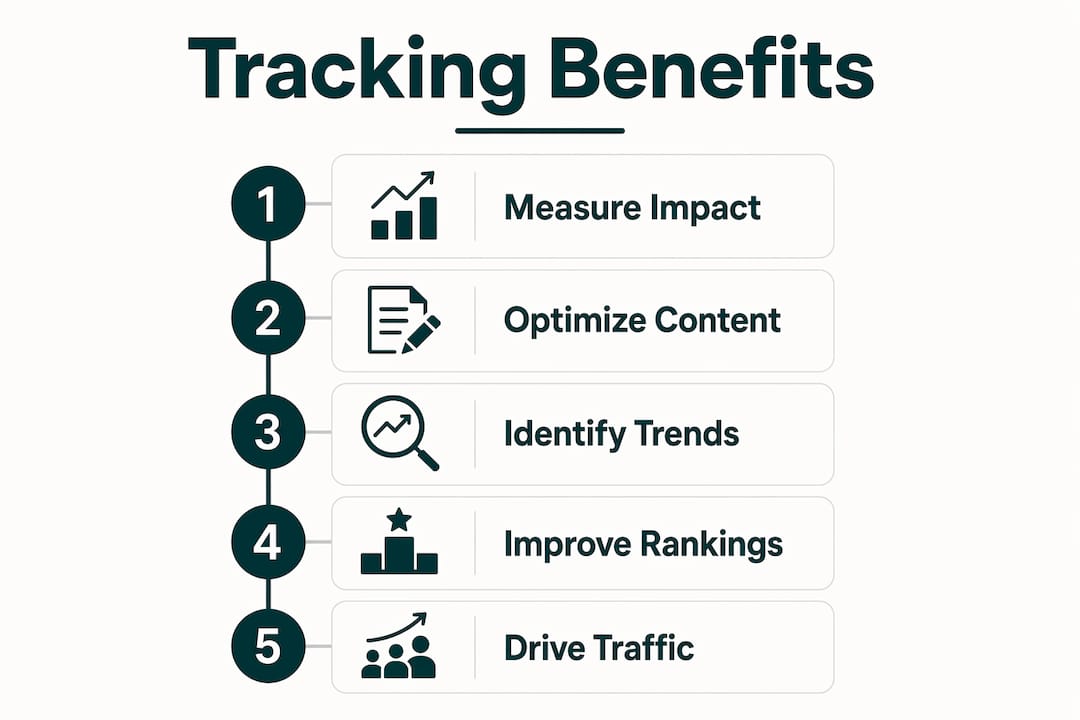
Tracking also surfaces content optimization opportunities. Pages sitting in positions 5 through 15 are within striking distance of the top three results, where click-through rates drop sharply as you move down the page. Identifying these pages and prioritizing them for improvement delivers a higher return than trying to move a page from position 40 to position 20.
The benefits of position tracking extend to competitive intelligence through a metric called Share of Voice (SOV). SOV adjusts rankings by search volume and click potential, giving you a more reliable indicator of competitive momentum than raw position alone. A site ranking number one for a low-volume keyword and number five for a high-volume keyword may have a lower SOV than a competitor, even if its average position looks better on paper.
Key business benefits of consistent rank monitoring include:
- Early anomaly detection: Catch ranking drops before they translate into significant traffic loss.
- Resource prioritization: Direct content and link-building efforts toward keywords with the highest growth potential.
- ROI measurement: Correlate ranking improvements with organic traffic and conversion data to quantify SEO value.
- Competitive benchmarking: Understand your Share of Voice relative to competitors across your core keyword set.
Best practices for implementing rank monitoring effectively
The most common mistake in keyword position tracking is tracking too many keywords. Experienced SEOs focus on keywords ranking between positions 5 and 15 for the highest growth potential. Tracking 2,000 keywords when only 50 are actionable creates noise that buries the signals you actually need.
A practical implementation follows this sequence:
- Audit your current keyword portfolio. Pull your top queries from Google Search Console and identify which ones rank in the 5–15 range. These are your priority targets.
- Set a tracking cadence. Weekly tracking suits most sites. Daily tracking makes sense for high-competition keywords or during active campaigns.
- Segment by page and query. Group keywords by the pages they map to. This makes it easier to spot when a single page is cannibalizing rankings across multiple terms.
- Add competitor tracking. Use a third-party tool to monitor how your top competitors rank for the same keyword set. This adds context to your own movements.
- Layer in AI visibility monitoring. A comprehensive 2026 SEO visibility strategy must include both traditional rank tracking and AI visibility metrics. If your content is not appearing in AI-generated answers, you are missing a growing share of search visibility.
- Filter out low-value keywords. Filtering out low-traffic, low-value keywords reduces noise and makes your dashboard genuinely actionable.
Pro Tip: Combine Google Search Console’s free historical data with a specialized third-party tool. Use Search Console for your own site’s trends and the third-party tool for competitor and AI visibility analysis. Neither alone gives you the full picture.
How to interpret and act on position tracking data
Raw ranking data only becomes useful when you know what to look for. The first distinction to make is between stable growth and volatility. A keyword that moves from position 12 to position 9 over six weeks shows stable, positive momentum. A keyword that bounces between positions 8 and 22 week over week signals a ranking instability problem, often caused by content quality issues or competing pages on your own site.
The table below maps common tracking signals to the actions they require:
| Tracking signal | What it means | Recommended action |
|---|---|---|
| Consistent downward trend over 60 days | Content is losing relevance or authority | Refresh content, audit backlinks |
| High impressions, low CTR | Page ranks but title or meta description underperforms | Rewrite title tag and meta description |
| Ranking volatility week over week | Google is unsure which page to rank | Check for keyword cannibalization |
| Sudden ranking drop after site change | Technical issue or content change caused demotion | Audit the change and revert if needed |
| Stable rank but declining traffic | SERP features or AI Overviews absorbing clicks | Optimize for featured snippets and AI visibility |
Correlating ranking data with traffic and conversions adds the business layer. A keyword moving from position 6 to position 3 should produce a measurable traffic increase. If it does not, the SERP for that query has likely changed, with featured snippets, People Also Ask boxes, or AI Overviews absorbing clicks before users reach organic results.
Average position can mask high volatility caused by ranking fluctuations. This is why query-level and page-level filters are not optional. They are the only way to isolate whether a problem is site-wide, page-specific, or query-specific. Checking your Google Search Console setup is a good starting point for configuring these filters correctly.
AI visibility tracking adds a new dimension to interpretation. If your content appears in Google AI Overviews for a query but your organic click-through rate drops, the AI answer is satisfying user intent before the user reaches your page. That is not a ranking failure. It is a content format opportunity: structure your content to be cited within AI answers, not just ranked below them.
Key Takeaways
Keyword position tracking is the foundation of measurable SEO. Without it, you cannot confirm that your work is producing results, catch problems early, or allocate resources to the keywords that matter most.
| Point | Details |
|---|---|
| Track trends, not snapshots | Monitor rankings over 30, 60, or 90 days to identify real trends rather than daily noise. |
| Focus on positions 5–15 | Keywords in this range offer the highest growth potential and deserve priority attention. |
| Use SOV over raw rank | Share of Voice accounts for search volume and CTR, giving a more accurate competitive picture. |
| Combine data sources | Use Google Search Console for historical site data and a third-party tool for competitor and AI visibility. |
| Add AI visibility metrics | A 2026 SEO strategy must track presence in AI-generated answers alongside traditional SERP positions. |
The metric that misleads more SEOs than any other
Average position is the number most SEO dashboards show by default. It is also the number most likely to give you a false sense of security.
I have seen sites where average position improved by two points over a quarter while organic traffic fell. The reason was simple: the keywords pulling the average up were low-volume, low-competition terms that no one was searching for. The high-value keywords were quietly slipping. Average position hid the problem entirely.
The fix is not to stop using average position. It is to stop treating it as your primary signal. The metrics that actually tell you something are downward trending keywords, pages with high impressions and low CTR, and query-level volatility. These are the triggers that demand action. Average position is context, not a conclusion.
The shift toward AI visibility tracking is real, and I think most SEO teams are underestimating how fast it is changing what “ranking” means. A page can hold position four in traditional results and still lose significant visibility if an AI Overview answers the query above it. Tracking both dimensions is not optional anymore. It is the baseline for understanding where your content actually stands in 2026.
The SEOs who will outperform in the next two years are the ones who treat their tracking setup as a decision-making system, not a reporting tool. That means fewer keywords tracked with more depth, cleaner segmentation, and a genuine integration of AI visibility data alongside traditional rank metrics.
— Savannah
Ranksector’s tools for tracking and growing your search visibility
Keyword position tracking is only as useful as the content strategy behind it. Knowing which keywords to target and how to create content that ranks for them is where most teams hit a wall.
Ranksector combines AI-powered content creation with built-in SEO research to help B2B SaaS teams publish consistently without a large content team. The platform’s free SEO tools include keyword tracking utilities that help you identify ranking opportunities and monitor performance without manual effort. For teams that need deeper analysis, Ranksector’s AI audit tool maps your content gaps against competitor rankings and surfaces the keywords most likely to move the needle. Over 11,000 articles published and counting, Ranksector delivers the content volume that position tracking data demands.
FAQ
What is keyword position tracking in SEO?
Keyword position tracking is the systematic monitoring of where a website ranks in search engine results for specific keywords over time. It enables SEO specialists to identify trends, validate optimizations, and detect ranking drops before they affect traffic.
How do I track keyword position for free?
Google Search Console provides up to 16 months of free historical keyword data, including average position, impressions, and clicks by query and page. It is the most authoritative free starting point for tracking your own site’s rankings.
What is the best keyword tracking software?
The best approach combines Google Search Console for your own site’s historical data with a third-party keyword ranking tool for competitor tracking, location-specific rankings, and AI visibility monitoring. No single tool covers all dimensions equally well.
Why is average position a misleading metric?
Average position can mask volatility because it aggregates rankings across all queries, including low-volume terms that skew the number upward. Filtering by specific queries and pages reveals the actual performance of your most important keywords.
What is Share of Voice in keyword tracking?
Share of Voice adjusts keyword rankings by search volume and click potential, giving a more accurate measure of competitive visibility than raw position. It accounts for both where you rank and how much traffic that position realistically delivers.
Recommended
- Monitor Competitor Keyword Rankings: 2026 Guide · Ranksector Blog — Ranksector
- Rank for Competitor Traffic Keywords: 2026 SaaS Guide · Ranksector Blog — Ranksector
- How Search Engines Rank Websites: 2026 Guide · Ranksector Blog — Ranksector
- Why Keyword Research Drives Content Decisions in 2026 · Ranksector Blog — Ranksector