
Keyword Opportunity Identification Guide for SEO Pros
Keyword opportunity identification is the process of systematically uncovering and prioritizing search terms that can drive targeted traffic and conversions for your site. Most SEO professionals treat it as a volume exercise. That is the wrong frame. 94.74% of keywords receive 10 or fewer monthly searches, which means chasing raw volume leaves the vast majority of the search landscape unexplored. The real discipline, what this guide calls keyword opportunity identification, is better known in the industry as keyword gap analysis combined with intent-driven prioritization. Mastering it separates content marketers who rank from those who publish and wait.
What does a keyword opportunity identification guide actually cover?
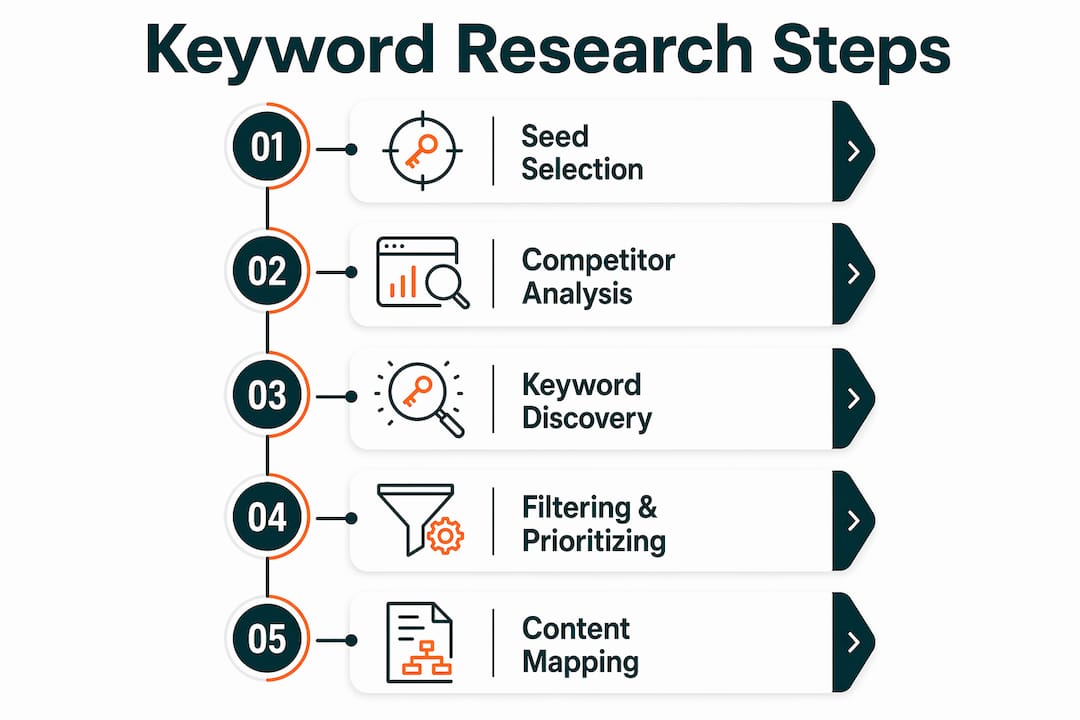
A keyword opportunity identification guide covers the full workflow: from selecting seed keywords and pulling competitor data, through scoring candidates on difficulty and intent, to mapping winners to specific pages. Each step builds on the last. Skip the intent analysis step, and you will rank for terms that never convert. Skip the competitor gap step, and you will miss the easiest wins available to your domain right now.
The process relies on three core data inputs: search volume, keyword difficulty, and search intent. Search volume tells you how many people search a term monthly. Keyword difficulty estimates how hard it is to rank on page one. Search intent tells you what the searcher actually wants, whether that is information, a product, a comparison, or a specific page. All three inputs must align before a keyword qualifies as a real opportunity.

Search intent is the most critical dimension in this process. A keyword with 5,000 monthly searches and commercial intent is worth far more than one with 50,000 searches and purely informational intent, if your goal is conversions. Treat intent as a filter, not an afterthought.
What prerequisites and tools do you need for effective keyword research?
Before you pull a single keyword report, you need two things: a clear picture of your domain’s authority and a defined set of seed keywords tied to your business goals. Domain authority, measured by metrics like Domain Rating (DR) or Domain Authority (DA), sets your difficulty ceiling. A site with a DR of 25 cannot realistically target keywords where every ranking page has a DR above 70.
Seed keywords are the starting point for every expansion. They are the 5–15 core terms that describe your product, service, or content category. From seeds, you branch into long-tail variations, question-based queries, and competitor-specific terms. Without strong seeds, your keyword pool will drift off-topic and waste analysis time.
The tools you use determine the quality of your data. Most keyword research platforms offer four core feature categories:
| Feature category | What it delivers |
|---|---|
| Keyword discovery | Generates related terms, questions, and variations from seed inputs |
| Intent classification | Labels keywords as informational, navigational, commercial, or transactional |
| Volume estimates | Provides monthly search volume data by country or region |
| SERP analysis | Shows which pages currently rank and their authority metrics |
Entry-level tools cover keyword discovery and volume estimates. Enterprise platforms add intent classification, SERP analysis, and competitor gap exports. Choose based on your domain’s current authority and the depth of competitor data you need.
How do you discover and collect candidate keywords?
The discovery phase generates a wide pool of candidates before any filtering happens. Start with your seed keywords and expand in three directions: long-tail variations, question-based queries, and competitor gap data.
Long-tail keywords carry lower search volume but attract users with clearer intent and higher conversion rates. A term like “B2B SaaS onboarding checklist template” will convert better than “onboarding” even though the volume difference is dramatic. Specificity is the point.
Question-based queries surface naturally in tools that pull “People Also Ask” data and forum discussions. These map directly to informational intent and work well for top-of-funnel content. They also tend to have lower keyword difficulty because fewer sites target them with dedicated pages.
Competitor gap research is where the fastest wins live. Content gap and competitor gap tools reveal missing topics and intents you have not covered. The technique is straightforward: export a competitor’s ranking keywords, then filter for terms where your site does not appear in the top 100.
Here is the step-by-step discovery process:
- Enter your 5–15 seed keywords into your keyword research tool.
- Export all related keyword suggestions, including questions and long-tail variants.
- Pull competitor keyword exports for your top 3–5 organic competitors.
- Filter competitor exports to show only keywords where your domain does not rank.
- Set a minimum volume floor (typically 50–100 monthly searches) to remove noise.
- Set a keyword difficulty ceiling calibrated to your domain authority.
- Merge all filtered lists into one master candidate pool.
Pro Tip: When mining competitor exports, focus on rows 80–300 in the keyword list rather than the top 10. The top rows are their strongest pages. Rows 80–300 often contain terms where competitors rank with weak pages like outdated glossaries or tag archives. A well-structured long-form guide can outrank those pages quickly.
You can go deeper on this approach with Ranksector’s guide on finding keyword gaps your competitors missed, which walks through the full SaaS-specific workflow.
What criteria and frameworks should you use to prioritize keyword opportunities?
Raw candidate lists are useless without a scoring system. Effective keyword prioritization balances business value, traffic potential, ranking feasibility, and strategic fit. Weighting these dimensions turns a list of 500 candidates into a ranked action plan.
The five dimensions to score are:
- Search volume: Higher volume means more potential traffic, but never the only factor.
- Keyword difficulty: Must be calibrated against your domain authority to assess realistic ranking chances.
- Search intent alignment: Does the keyword match the content type and conversion goal of your page?
- Business value: Will ranking for this term attract buyers, not just readers?
- Strategic fit: Does this keyword support a content cluster or fill a gap in your existing coverage?
Here is a simple scoring framework you can apply immediately:
| Dimension | Weight | Score range | Notes |
|---|---|---|---|
| Search volume | 20% | 1–5 | Higher volume scores higher |
| Keyword difficulty | 25% | 1–5 | Lower difficulty scores higher |
| Intent alignment | 30% | 1–5 | Exact match to page goal scores highest |
| Business value | 15% | 1–5 | Transactional or commercial intent scores higher |
| Strategic fit | 10% | 1–5 | Fills a content gap or supports a cluster |
Multiply each score by its weight and sum the results. Keywords scoring above 3.5 out of 5 are your primary targets. Keywords scoring 2.5–3.5 are secondary targets for future quarters.
Keyword difficulty must be matched to domain authority to avoid chasing unreachable terms. A DR 30 site targeting a keyword where all ranking pages have DR 70+ will not rank regardless of content quality. Calibrate your difficulty ceiling honestly.
Pro Tip: Apply the one primary keyword per page principle strictly. Targeting two or more primary keywords on a single page creates keyword cannibalization, where your pages compete against each other in search results. Assign one primary keyword per page, then support it with a cluster of related secondary terms.
How do you map chosen keywords to content and build your SEO strategy?
Keyword mapping is the process of assigning each prioritized keyword to a specific page on your site. Every page gets one primary keyword and a cluster of supporting terms. Pages that do not yet exist get flagged for creation. Pages that exist but target the wrong keyword get flagged for optimization.
The content format must match the search intent of the mapped keyword. Mismatching content formats to search intent is the leading cause of ranking failure despite good technical SEO. A keyword with informational intent needs a guide or article. A keyword with transactional intent needs a product or landing page. A keyword with commercial intent needs a comparison or review format.
Weak page types to avoid when mapping:
- Tag pages and category archives with thin content
- Outdated glossary entries that have not been updated in two or more years
- Blog posts that target a keyword in the title but never address the full search intent in the body
- Landing pages optimized for a transactional keyword but written in a purely informational style
After mapping and publishing, the work shifts to tracking. Ongoing keyword position tracking allows you to adapt to SERP changes and maintain long-term performance. Set a monthly review cadence. Check which mapped keywords moved up, stalled, or dropped. Re-optimize pages that stalled by improving content depth, updating examples, or adding supporting internal links.
The monitoring loop is not optional. Regular audits improve optimization by keeping your content aligned with shifting search trends and algorithm updates. Treat your keyword map as a living document, not a one-time deliverable.
Key Takeaways
Effective keyword opportunity identification requires combining competitor gap analysis, intent-driven scoring, and strict one-keyword-per-page mapping to consistently find and rank for high-value search terms.
| Point | Details |
|---|---|
| Intent beats volume | Score keywords on intent alignment first; volume alone misleads prioritization decisions. |
| Calibrate difficulty to your domain | Never target keywords where all ranking pages far exceed your domain authority. |
| Mine competitor rows 80–300 | Weak competitor pages in this range are the fastest source of winnable opportunities. |
| Map one primary keyword per page | Avoid cannibalization by assigning one primary keyword per page with supporting clusters. |
| Track and re-optimize monthly | Keyword maps require regular audits to stay aligned with SERP changes and search trends. |
What I’ve learned about keyword research that most guides skip
Search intent has always mattered, but in 2026 it is the deciding factor. Keyword research now includes prompt research to account for AI-driven search behaviors, which means the queries people type into AI tools differ from what they type into traditional search engines. If you are not thinking about how your content answers both, you are leaving visibility on the table.
The single most underused technique I have seen is competitor gap mining in the 80–300 row range. Most SEO professionals look at a competitor’s top 20 ranking keywords and feel defeated. The real opportunity sits further down the list, where competitors rank with pages they built years ago and never updated. A fresh, well-structured guide targeting those same keywords will outrank a stale glossary page within months.
The mistake I see most often is chasing high-volume keywords because they look impressive in a report. A keyword with 40,000 monthly searches and weak intent alignment will drive traffic that bounces. A keyword with 800 monthly searches and strong transactional intent will drive revenue. Build your keyword strategy around what you want visitors to do, not just how many you want to attract. That shift in thinking is what separates a keyword list from an actual keyword analysis for SEO that produces results.
— Savannah
How Ranksector supports your keyword opportunity workflow
Finding keyword opportunities is one challenge. Turning them into published, optimized content consistently is another. Ranksector’s free SEO tools help content marketers and SEO professionals move from keyword discovery to published content without the manual bottleneck that kills most content programs.
Ranksector combines competitor-driven keyword research with AI-powered content creation and a backlink exchange system. The platform has published over 11,000 SEO-optimized articles for B2B SaaS teams, with daily publication cadences that keep domain authority growing without requiring a full content team. For agencies managing multiple clients, Ranksector’s agency solution scales the entire keyword-to-content workflow across accounts. If you are building a keyword strategy and need the content to follow through, Ranksector closes that gap.
FAQ
What is keyword opportunity identification?
Keyword opportunity identification is the process of finding and prioritizing search terms where your site can realistically rank and drive targeted traffic. It combines search volume, keyword difficulty, and intent analysis to surface the best candidates.
How do I identify keyword gaps in my SEO strategy?
Export your competitors’ ranking keywords and filter for terms where your domain does not appear in the top 100. Focus on rows 80–300 in competitor exports, where weak pages create the most winnable opportunities.
What is the best practice for keyword difficulty analysis?
Match keyword difficulty to your domain authority before targeting any term. A site with low domain authority should target keywords where competing pages have similar or lower authority scores.
Why do long-tail keywords matter for SEO?
Long-tail keywords carry lower search volume but attract users with clearer intent and higher conversion rates. They are easier to rank for and deliver more qualified traffic than broad, high-volume terms.
How often should I audit my keyword map?
Review your keyword map monthly. Regular position tracking lets you catch ranking drops early and re-optimize pages before they fall off page one entirely.
Recommended
- Keyword Position Tracking: A 2026 Guide for SEO Specialists · Ranksector Blog — Ranksector
- Types of High-Intent Commercial Keywords: SEO Guide · Ranksector Blog — Ranksector
- Find Untapped Keywords: Competitor Research Guide · Ranksector Blog — Ranksector
- Competitive SERP Analysis Best Practices for SEO Teams · Ranksector Blog — Ranksector