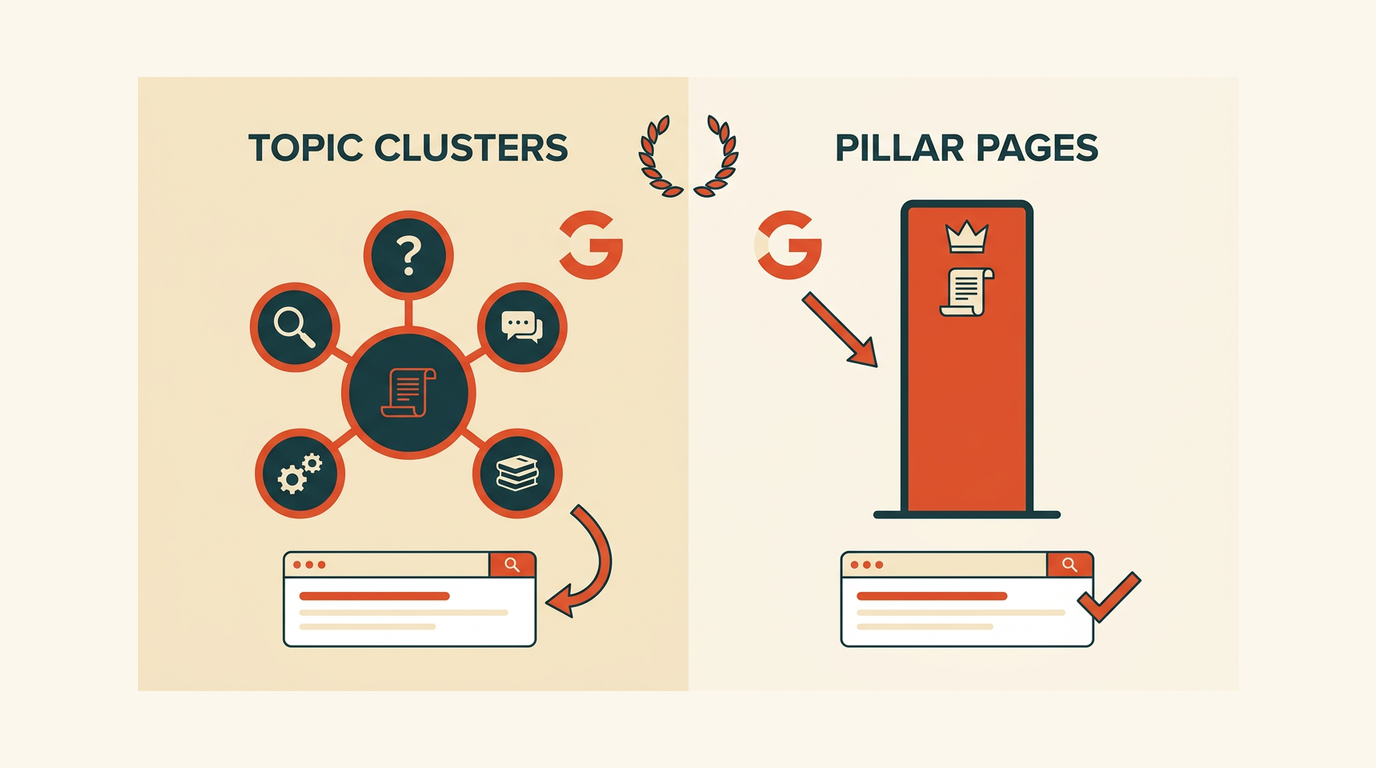
Topic Clusters vs Pillar Pages: What Google Still Rewards in 2026
You mapped out a content strategy three months ago. Built a pillar page on your core topic, published 6 supporting articles, linked them together. Then you waited. Rankings barely moved. Now you're wondering whether the whole topic cluster model is legacy advice dressed up in new language.
That doubt is reasonable. The topic clusters vs pillar pages debate has been running for years, and most guides either oversimplify it or ignore the real question: which structure does Google actually reward in 2026, and when does each one apply?
The honest answer is that Google rewards neither structure on its own. It rewards organized, useful topical coverage. The architecture is the vehicle. Intent and coherence are the fuel.
What Google still rewards: the short answer
You can stop looking for a single winning format. Google's guidance on helpful content is explicit: the goal is content that serves people first, not content engineered around structural templates.
That means a pillar page with no real supporting articles is just a long page. A cluster with no coherent hub is just a pile of posts. What Google rewards is the combination: a clear subject, organized coverage, and internal links that actually help a reader navigate.
Why SaaS teams feel the pressure here
SaaS content teams are running on limited budgets. Publishing 15 articles per cluster is not realistic when you have 2 writers and a product to ship. The good news is that smaller, denser clusters with strong cross-linking often outperform large, loosely connected hubs. Depth beats volume.
The real unit of success
A useful heuristic I've seen hold up: if a new page inside your cluster ranks within 60 days while a similar standalone page takes 4 to 6 months, the cluster structure is working. That speed difference is topical lift in action. It's measurable and it's the right thing to watch.
Google rewards usefulness plus coherence, not content buckets. Structure only matters when it serves intent.
Pillar page vs topic cluster: the difference that actually matters
These two terms get used interchangeably. They shouldn't be. They describe different things at different levels of the same architecture.
A pillar page is a broad hub. It covers a topic end-to-end at a high level, typically 2,000 to 4,000 words, and it links out to deeper supporting pages. Think of it as the floor plan. A topic cluster is the collection of supporting pages that answer sub-questions, comparisons, and narrower intent. Those pages link back to the pillar. That bidirectional linking is what signals topical depth to Google's crawlers.
Where the internal link does the real work
The internal link between a pillar and its cluster pages is not decorative. Google's spam policies explicitly devalue manipulative linking patterns. That means your links need to be genuinely navigable, not just placed for SEO. A link that helps a reader go deeper earns its place. A link that exists only to pass authority is noise.
| Feature | Pillar page | Topic cluster page |
|---|---|---|
| Scope | Broad, high-level overview | Narrow, specific sub-topic |
| Typical length | 2,000 to 4,000 words | 800 to 1,800 words |
| Target keyword type | Head term, high volume | Long-tail, high intent |
| Internal link direction | Links out to cluster pages | Links back to pillar |
| Primary job | Establish topical authority | Capture specific intent |
| Best for | Durable, broad subjects | Comparisons, how-tos, objections |
Why this model still holds up in Google's current guidance
Some SEO advice ages out in 18 months. The cluster-pillar model has not, because it was never purely a technical trick. It maps to how people actually research a topic: start broad, go narrow, come back to compare.
Search Engine Land's cluster guide frames it well: the strategy works because it aligns content organization with the way search systems evaluate authority. If your site covers a subject from 8 to 12 distinct angles, each one useful on its own, Google has more signal that you know what you're talking about.
The AI-era adjustment
AI Overviews and generative answers pull from pages that are clearly organized and easy to parse. A pillar page with clean headers, specific answers, and links to deeper pages is exactly what those systems scan. Thin pages with vague headings get skipped. Structure is still signal. 🎯
What the helpful content guidance actually says
The phrase 'people-first content' gets repeated without anyone unpacking what it means operationally. In the context of clusters, it means this: each page in your cluster should answer a real question someone actually asks, not a keyword variant you invented to pad the cluster. Current 2026 cluster strategy builds around question taxonomies and search intent, not just keyword lists. That shift is important.
The algorithm changed. The content architecture lesson did not. Useful internal linking beats decorative internal linking every time.
Where guides oversimplify this strategy
Pick up any SEO guide from the last 3 years and you'll find the same recommendation: build a pillar page, surround it with 10 to 15 cluster articles, link everything together. Done. That advice is not wrong. It's just incomplete.
The problem is that it treats pillar pages as the default answer for every topic. They're not. Some topics are too narrow to justify a 3,000-word hub. Some buyer journeys are too short. Some SaaS products serve a niche where 4 tightly focused cluster pages outperform a bloated pillar that tries to cover everything.
When a pillar page actually hurts you
If your pillar page targets a broad head term with a search volume of 8,000 per month but your product only solves one specific version of that problem, you're attracting the wrong audience at scale. A tight cluster of 4 to 6 pages around the exact conversion intent will serve you better. More traffic is not always better traffic. Brafton's cluster strategy breakdown makes this point, though it buries it under agency-generic framing.
The gap competitors miss
Guides describe the structure. Almost none give you a clear decision framework for choosing between a pillar-led architecture and a compact cluster. That gap is where teams waste the most time, building the wrong format for the wrong topic and wondering why rankings stall after 90 days.
How to choose the right structure for a SaaS topic
Three filters cut through the noise: search intent, business value, and content budget. Run every topic through all three before you decide on a format.
- Search intent tells you whether the topic attracts researchers, buyers, or both. A topic that pulls researchers needs a pillar. A topic that pulls buyers can often be handled by 3 to 5 cluster pages alone.
- Business value tells you whether ranking for this topic moves a metric you care about. If the head term is high-volume but low-conversion, a full pillar build may not be worth the 6 to 8 weeks of production time.
- Content budget tells you what's realistic. Smaller, denser clusters with stronger cross-linking are a practical alternative for teams that can't publish 12 articles per quarter.
When to build a pillar
Use a pillar page when the topic is broad, durable, and relevant to multiple buyer stages. 'CRM software for SaaS' is a pillar topic. It covers enough ground to support 8 to 12 supporting pages and it attracts traffic at every funnel stage. InMotion's guide on pillar pages that rank gives a solid walkthrough of the production process, even if it skips the decision step.
When a compact cluster is enough
Use a cluster without a heavyweight pillar when the topic is narrow and high-intent. 'How to migrate from HubSpot to [your product]' does not need a 3,000-word hub. It needs 4 focused pages: a comparison, a migration guide, a pricing breakdown, and a case study. That's a cluster. No pillar required.
Start with intent, not with page templates. If the topic can support multiple intents, it can usually support a cluster.
Manual workflow: build the cluster by hand
Before you write a single word, audit what you already have. This step alone saves weeks of wasted production.
Step 1: audit first
Search Engine Land recommends starting with existing pages that already rank, earn links, or sit close to page one. Pull your Google Search Console data. Look for pages ranking in positions 8 to 20 with at least 50 impressions per month. Those are your near-miss pages. They're either pillar candidates or cluster gaps you haven't filled yet.
Step 2: map subtopics from real sources
Don't invent subtopics from a keyword tool alone. Pull from 4 sources: search queries in GSC, sales call objections, support ticket themes, and competitor content gaps. A subtopic that appears in all 4 sources is a high-priority cluster page. One that appears in only 1 is optional. This filter alone cuts your content backlog by roughly 30 to 40 percent in my experience.
- Sales objections surface comparison and pricing pages that cluster pages handle better than a pillar.
- Support questions surface troubleshooting and how-to pages that capture long-tail intent with almost no competition.
- Competitor gaps surface topics your rivals rank for but haven't covered deeply, which is where you can take positions fast.
- GSC queries surface near-miss keywords that already have some traction, making them lower-risk to prioritize.
Step 3: write, link, and connect
Write the pillar first if you're building one. Publish it. Then publish supporting pages one at a time, linking each back to the pillar immediately on publication. Don't batch-publish 8 pages at once and add links later. The link should be live from day one. Pepperland Marketing's cluster guide covers the linking mechanics in useful detail.
Automated workflow: how Ranksector scales the same process
The manual workflow works. It also takes time that SaaS teams don't have. Ranksector automates the planning layer without replacing the editorial judgment that makes clusters actually useful.
From keyword list to cluster map in minutes
Instead of manually grouping 200 keywords by intent, Ranksector's cluster scanner groups them by topical proximity and surfaces gaps in your existing coverage. You see which sub-topics you've covered, which ones you've missed, and which ones your competitors rank for but you don't. That audit step that used to take 3 to 4 hours takes closer to 20 minutes.
Prioritization without guesswork
Ranksector ranks cluster opportunities by a combination of search volume, competition level, and your existing topical footprint. A topic where you already have 2 related pages ranks higher in priority than a cold topic with no supporting context. That's not a magic algorithm. It's the same logic you'd apply manually, just applied consistently across every keyword in your list.
- Ranksector flags near-miss pages (positions 8 to 20) automatically so you don't have to dig through GSC exports manually.
- It groups keywords into clusters of 5 to 12 pages, which aligns with the 8 to 15 page range current guides recommend.
- It surfaces internal linking opportunities between published pages, so you can close link gaps without a full site audit.
- It tracks whether new cluster pages are ranking faster than standalone pages, giving you the topical lift KPI without building a custom dashboard.
What automation doesn't replace
Ranksector handles the operational layer. It doesn't decide whether a topic fits your product positioning, whether a comparison page will cannibalize a conversion page, or whether your brand voice is right for a given angle. Those calls still belong to you. The trade-off is clear: faster decisions on structure, same editorial responsibility for quality.
Manual clustering works once. Automation makes it repeatable. The goal is not more content. It is faster decisions.
What to measure after publishing
Teams track rankings and traffic. Both are useful. Neither tells you whether your cluster architecture is working as a system.
The metrics that actually show cluster health
- New cluster pages ranking within 60 days signals topical lift. Standalone pages on similar topics taking 4 to 6 months is the baseline to compare against.
- Pillar page impressions for the head term growing over 90 days means Google is treating it as an authority page, not just another result.
- Internal link click-through rate in GSC shows whether your cluster navigation is actually useful to readers, not just to crawlers.
- Conversion-assisted traffic from cluster pages tells you whether the cluster is pulling buyers, not just researchers. If traffic rises but conversions stay flat, the cluster is attracting the wrong intent.
- Indexation rate for new cluster pages within 14 days tells you whether your site's crawl health is strong enough to support the cluster strategy. Topical authority guides often skip this step, but it matters.
A note on vanity metrics
Page views per cluster page is a vanity metric in this context. A cluster page with 80 monthly visits that converts at 4 percent is more valuable than a cluster page with 800 monthly visits that converts at 0.2 percent. Measure intent alignment, not just volume. That shift in measurement changes which pages you prioritize next.
Frequently asked questions
Does Google still reward pillar pages in 2026?
Yes, but not because of the format. Google rewards pages that cover a subject thoroughly and link to useful related content. A pillar page earns its rankings by being genuinely comprehensive and by anchoring a cluster of supporting pages. A long page with no supporting cluster is just a long page. The structure matters only when the content behind it is useful.
Do topic clusters replace keyword research?
No. Keyword research is how you find the subtopics that belong in your cluster. Clusters are the organizational structure; keyword research is the input. In my experience, the teams that skip keyword research and build clusters from intuition end up with 6 to 8 pages covering the same intent from slightly different angles, which creates cannibalization, not authority.
Can AI-generated content fit into a cluster strategy?
Google's helpful content guidance applies the same quality standards regardless of how content is produced. AI content can fit into a cluster if it is reviewed for accuracy, structured around real search intent, and genuinely useful to the reader. AI content that is unreviewed, generic, or optimized only for keyword density will drag down the cluster's authority, not build it. The production method is not the variable. Quality is.
How many pages does a topic cluster need?
A useful heuristic is 5 to 12 supporting pages per pillar, based on current practice in 2026 SEO guides. But the number is less important than the intent coverage. A cluster of 5 pages that each answer a distinct question is stronger than a cluster of 12 pages where 4 of them target near-identical intent. Count distinct intents served, not pages published.
What is topical authority and how does it relate to clusters?
Topical authority is Google's assessment of how well your site covers a subject. Topic clusters are the mechanism for building it. Each cluster page adds a signal that your site goes deep on a topic, not just wide. Topical authority is not a direct ranking factor you can measure in a dashboard. It's an emergent property of publishing useful, organized, well-linked content over time. Clusters are the fastest reliable path to it.
Ranksector
Try Ranksector to map your next cluster in under 20 minutes. Start by dropping your seed keyword into the cluster scanner, see which subtopics you're missing, and prioritize the pages most likely to rank fast. Build the structure once, then let Ranksector keep it updated as your content grows.