
Types of SEO Quick Wins for Faster Rankings in 2026
SEO quick wins are targeted, low-effort actions that produce measurable ranking and traffic gains within days or weeks, not months. The industry term for these is “tactical SEO improvements,” and they work by fixing existing gaps rather than building from scratch. The three highest-impact categories are content optimization, technical fixes, and internal linking. Each one addresses a specific bottleneck that holds your site back from ranking where it should. This article covers the most effective types of SEO quick wins so you can act on them this week.
1. Types of SEO quick wins: optimizing near-miss content
Near-miss keywords are your fastest path to page one. Pages ranking in positions 11–20 already have Google’s attention. They just need a push. Rewrite the title tag to match the exact search query more closely. Tighten the meta description to increase click-through rate. Add two or three internal links from stronger pages pointing to the target URL.
The logic is simple. Google already considers these pages relevant. You are not convincing the algorithm from scratch. You are nudging a page that is already in the conversation.

Pro Tip: Open Google Search Console, filter by position 11–20, and sort by impressions. The pages with high impressions but low clicks are your best candidates for title and meta description rewrites.
2. Refreshing declining pages
A page that ranked well six months ago and now sits lower is not a lost cause. Updating old content with new statistics, recent examples, and corrected links signals freshness to Google without requiring a full rewrite. This approach preserves the existing ranking signals while adding new value.
Check the page’s original publish date and the date of any statistics you cited. Replace outdated figures with current ones. Add a section covering anything that changed in your industry since the original post went live. A content freshness update often takes under two hours and can recover lost positions within weeks.
3. Fixing keyword cannibalization
Keyword cannibalization happens when two or more pages on your site compete for the same search query. Google splits its ranking signals between them instead of concentrating authority on one strong page. The fix is consolidation. Merge the weaker page into the stronger one using a 301 redirect, or rewrite each page to target a distinct, non-overlapping keyword.
A single authoritative page on a topic outperforms two thin ones every time. This is one of the most underused easy SEO improvements available to sites with more than 50 pages of content.
4. Adding FAQ blocks to money pages
FAQ sections on commercial pages improve snippet capture and address buyer objections at the same time. Write each question the way a real customer would type it into Google. Answer it in two to three sentences. Keep the language plain and direct.
FAQ blocks also support AI-friendly content structure, which matters more in 2026 as AI-powered search answers pull from clearly formatted responses. Structuring content for easy AI quoting boosts visibility in AI-generated search results even when your page ranks outside the top three.
5. Fixing broken links and redirect chains
Broken links and long redirect chains waste crawl budget and frustrate visitors. A 404 error on an internal link tells Google that your site is not well-maintained. A redirect chain with three or more hops slows page load and dilutes link equity. Both are fixable in an afternoon with a free crawl tool like Screaming Frog.
Fix internal 404s by updating the link to the correct destination. Collapse redirect chains to a single direct redirect. These are instant SEO optimization fixes that improve both crawl efficiency and user experience.
6. Compressing images for Core Web Vitals
Compressing images to under 100 KB is one of the fastest ways to improve Core Web Vitals scores, particularly Largest Contentful Paint. Google uses Core Web Vitals as a ranking signal. A slow-loading hero image can drag down an otherwise well-optimized page.
Use tools like Squoosh or TinyPNG to compress images before uploading. Convert JPEGs and PNGs to WebP format where browser support allows. The practical guide to Core Web Vitals from Ranksector covers exactly which image settings move the needle fastest.
| Issue | Quick fix | Expected impact |
|---|---|---|
| Images over 500 KB | Compress to under 100 KB using Squoosh | Faster LCP, better Core Web Vitals score |
| PNG format for photos | Convert to WebP | Smaller file size, same visual quality |
| Missing width/height attributes | Add explicit dimensions in HTML | Reduces Cumulative Layout Shift |
| Unoptimized hero image | Lazy-load below-fold images only | Faster initial page render |
Pro Tip: Run your site through Google PageSpeed Insights before and after image compression. Screenshot both scores. The before-and-after comparison is useful for reporting to clients or stakeholders.
7. Adding descriptive alt text to images
Descriptive alt text helps Google understand what an image shows, which contributes to image search traffic and overall page relevance. Write alt text that describes the image content and includes a relevant keyword where it fits naturally. Avoid stuffing multiple keywords into a single alt attribute.
A product photo with alt text “blue running shoe with foam sole” performs better in image search than one labeled “img_4521.jpg.” This is a simple SEO fix that most small business sites overlook entirely.
8. Fixing duplicate titles and meta descriptions
Duplicate title tags and meta descriptions dilute ranking signals by confusing Google about which page to rank for a given query. Use canonical tags to tell Google which version of a page is the primary one. Rewrite duplicate titles so each page targets a unique keyword angle.
Meta descriptions matter more in an AI-driven search environment because they influence whether a user clicks your result over an AI-generated summary. A unique, benefit-focused meta description on every page is a non-negotiable quick win.
9. Internal linking from high-authority pages
Internal links from your strongest pages to your priority commercial pages pass authority and help Google understand your site’s content hierarchy. Use anchor text that matches the target page’s primary keyword. Keep the link contextual, meaning it should appear within a relevant sentence, not in a sidebar or footer.
The mechanics of internal linking are straightforward, but the placement decisions require judgment. Prioritize pages that generate leads or sales. A blog post with strong backlinks pointing to your pricing page is worth more than ten random cross-links between low-traffic articles.
10. Adding schema markup for rich results
Schema markup tells Google exactly what type of content a page contains. FAQ schema, product schema, and review schema all increase the chance of rich results appearing in search. Rich results take up more visual space in the SERP, which increases click-through rate even without a ranking change.
Adding FAQ schema to a page that already has an FAQ block takes under 30 minutes. Use Google’s Rich Results Test to verify the markup before publishing. This is one of the quickest structural SEO improvements available without touching your site’s core code.
11. Pruning thin and outdated pages
Thin pages with fewer than 300 words and no meaningful traffic drag down your site’s overall quality signals. Google evaluates site quality at a domain level, not just page by page. Consolidate thin pages into stronger ones, or add enough depth to justify their existence.
Search intent alignment is the deciding factor. If a thin page targets a query that your audience actually searches, expand it. If it targets a query with no real demand, redirect it and move on. Pruning is a quick SEO strategy that pays off over one to three months.
12. Optimizing content for AI search visibility
AI-generated search answers favor content that is clearly structured, directly answers a question, and uses plain language. Write your key points as standalone paragraphs that make sense without surrounding context. Lead every section with a direct claim. Avoid burying the answer in a long preamble.
This approach benefits both traditional SEO and AI-powered search results. A page that answers a question in the first sentence is more likely to be quoted by AI tools and more likely to earn a featured snippet from Google.
Key takeaways
The highest-ROI SEO quick wins focus on existing content and technical gaps rather than creating new pages from scratch.
| Point | Details |
|---|---|
| Near-miss keywords first | Target pages in positions 11–20 for title and meta rewrites to move to page one fast. |
| Technical fixes unblock signals | Fix broken links, compress images, and remove duplicate tags before optimizing content. |
| Internal links move authority | Add contextual links from strong pages to commercial pages using keyword-relevant anchor text. |
| Freshness beats full rewrites | Update statistics and examples on declining pages to recover rankings without starting over. |
| Schema markup earns rich results | Adding FAQ or product schema increases SERP visibility without requiring a ranking improvement. |
Why I always start with technical fixes, not content
Most marketers want to jump straight to content because it feels productive. Writing a new blog post or refreshing a headline is visible work. Fixing a redirect chain is not. But technical issues are the reason content fixes fail to stick.
I have seen sites where a team spent weeks rewriting landing pages, only to watch rankings stay flat because crawl errors were blocking Google from indexing the updated versions. The 80/20 rule applies here: focus quick wins on pages that directly drive revenue, and fix technical blockers first so your content work actually registers.
Google Search Console is the only tool you need to prioritize. Sort by impressions, not just clicks. High-impression, low-CTR pages tell you where the opportunity is. High-impression pages with crawl errors tell you where the technical debt is costing you real traffic. Work through that list in order of revenue impact, not alphabetical order or publish date.
The mistake I see most often is chasing every possible fix instead of finishing the high-ROI ones. Pick five actions from this list. Complete them fully. Measure the result in Search Console after 30 days. Then pick five more.
— Savannah
How Ranksector helps you act on quick wins faster
Identifying quick wins is one thing. Executing them consistently across a growing site is another problem entirely.
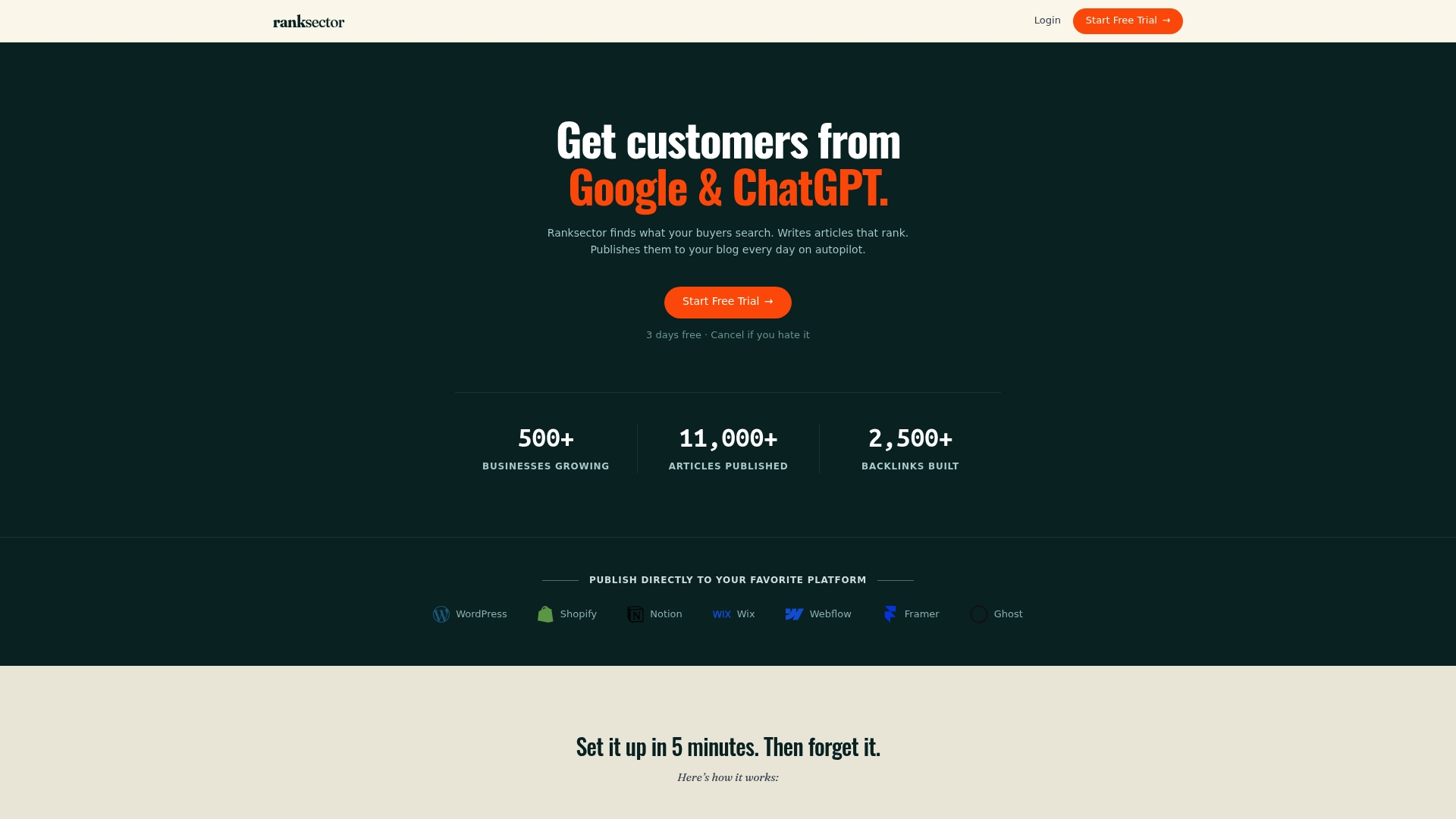
Ranksector’s free SEO tools help digital marketers and small business owners find and fix content gaps without spending hours in spreadsheets. The platform publishes SEO-optimized articles daily, built around keyword research and competitor analysis, so your site stays fresh and relevant without manual effort. With over 11,000 articles already published for B2B SaaS clients, Ranksector delivers the content volume that sustains ranking gains over time. If you need a full audit to identify your highest-impact opportunities, the AI-driven audit tool maps your site’s quick win priorities in minutes.
FAQ
What are SEO quick wins?
SEO quick wins are targeted, low-effort actions that improve search rankings and traffic within days or weeks. They focus on fixing existing gaps rather than building new content from scratch.
Which type of SEO quick win has the highest ROI?
Optimizing pages ranked in positions 11–20 by improving title tags and internal links delivers the highest quick-win ROI. These pages already have Google’s attention and need only a small push to reach page one.
How do I find quick win opportunities on my site?
Open Google Search Console and filter by pages with high impressions but low click-through rates. Those pages are your best candidates for title rewrites, meta description updates, and internal link additions.
Does fixing technical SEO really improve rankings fast?
Fixing broken links, compressing images, and removing duplicate title tags can produce ranking improvements within weeks. Technical fixes unblock the signals that content optimization depends on.
How does content freshness affect SEO rankings?
Updating old posts with new statistics and examples signals freshness to Google and can recover lost positions without a full rewrite. Content freshness updates are often faster and more effective than publishing new pages.