
Why Ranking on Page One Matters in 2026
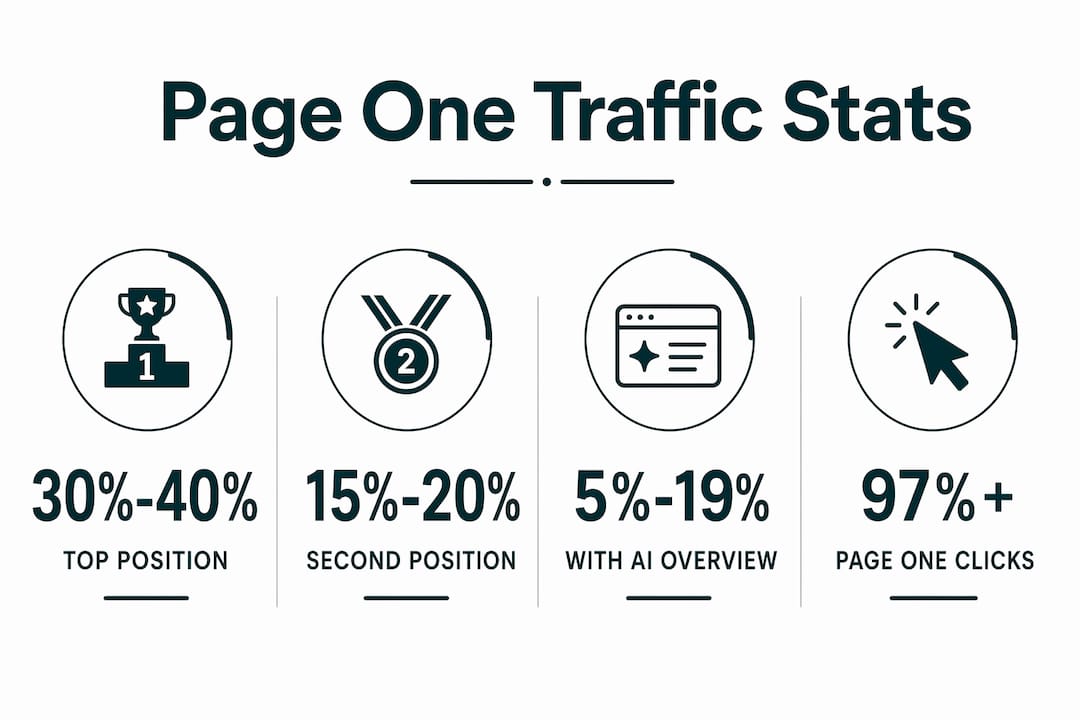
Page one ranking is defined as your website appearing within the top 10 organic search results on Google, where nearly all organic clicks occur. Desktop searches see 96.98% of clicks stay on page one. Mobile searches push that figure to 97.56%. That leaves less than 3% of clicks for every other page combined. For businesses and marketers, understanding why ranking on page one matters is not a theoretical exercise. It is the single most important factor determining whether your content gets found or ignored. Search engines like Google, Bing, and AI-powered tools like Perplexity all reward page one presence with compounding visibility that paid ads simply cannot replicate long term.
How much traffic does page one really capture?
The traffic gap between page one and page two is not a gradual slope. It is a cliff. Position 1 captures 29%–39.8% of all clicks for a given query, while position 2 receives roughly 40%–66% fewer clicks than position 1. That drop continues sharply through positions 3 to 10, and then falls to near zero beyond page one.
The table below shows how click-through rates (CTR) shift across positions on a standard search results page versus one with an AI Overview present.

| Position | CTR Without AI Overview | CTR With AI Overview |
|---|---|---|
| 1 | 30%–40% | 5%–19% |
| 2 | 15%–20% | 3%–8% |
| 3 | 10%–14% | 2%–5% |
| 4–5 | 5%–9% | 1%–3% |
| 6–10 | 1%–4% | Under 1% |
The presence of AI Overviews compresses CTR across the board. AI Overviews appear on 31% of all search pages, and they reduce organic clicks by 30%–60% for standard results. That is a significant shift in how traffic is distributed, and it makes the importance of first page ranking even more pronounced for the pages that remain visible.
Desktop and mobile users behave differently, too. Mobile users scroll less and click faster, which concentrates even more clicks on positions 1 and 2. The benefits of page one visibility are not evenly distributed across all ten spots. Positions 1 through 3 capture the overwhelming majority of the available traffic.
Pro Tip: Track SERP features for your target keywords using tools like Google Search Console or Semrush. If AI Overviews are appearing on your key queries, recalibrate your CTR expectations and focus on being cited as a source within those overviews.
Why do users trust page one results more?
The psychological case for first page SEO is as strong as the statistical one. Users apply what researchers call “primacy bias,” the tendency to trust and act on the first options they encounter. In a search context, this means position 1 is not just seen first. It is perceived as the most credible answer.
This connects directly to the “halo effect.” Top-ranked brands earn trust advantages that paid ads struggle to replicate. When a user sees your site at the top of organic results, they associate that position with authority, quality, and relevance. That perception carries into the click, the visit, and ultimately the conversion decision.
Here is why ranking high drives stronger marketing ROI beyond raw traffic:
- Credibility transfer: Users assume Google has vetted the top results, so your brand inherits that credibility.
- Lower bounce rates: Visitors who click organic results with high intent tend to engage more deeply with the content.
- Higher conversion rates: Trust built before the click translates into more form fills, purchases, and sign-ups.
- Reduced ad dependency: Organic trust cannot be bought, which makes it a durable competitive asset.
- Brand recall: Users who see your brand at position 1 repeatedly begin to associate it with category leadership.
The effects of page one rankings extend well beyond the click itself. A business that ranks consistently at the top of its category builds brand equity with every search impression, even when users do not click through.
Pro Tip: Reinforce the trust signals users expect from a page one brand. Add author bios, customer reviews, and trust badges to landing pages so the credibility implied by your ranking is confirmed the moment users arrive.
How have AI overviews changed the page one equation?
AI Overviews have restructured the top of the search results page in a way that no update since Google’s Panda has. AI Overviews now appear on 31% of searches, and when they do, the CTR for position 1 drops from roughly 40% to as low as 5%–19%. That is not a minor adjustment. It changes how you measure success on page one entirely.
The table below compares CTR benchmarks on clean SERPs versus those with AI Overviews active.
| SERP Type | Position 1 CTR | Position 2 CTR | Position 3 CTR |
|---|---|---|---|
| Standard SERP | 30%–40% | 15%–20% | 10%–14% |
| SERP with AI Overview | 5%–19% | 3%–8% | 2%–5% |
The counterintuitive finding is that pages cited inside AI Overviews gain a 35% higher CTR than standard organic results on the same page. Being cited as a source in an AI-generated answer is now a distinct traffic channel, separate from your organic ranking position.
Integrating traditional rankings with AI citation optimization is now the recommended approach for 2026. Treating them as a unified strategy rather than competing priorities is what separates forward-thinking SEO teams from those still operating on 2022 playbooks.
Here are the tactical adjustments businesses should prioritize in 2026:
- Audit your top pages for AI Overview presence. Use Google Search Console to identify which queries now trigger AI Overviews and how your CTR has shifted.
- Structure content for citation. Use clear definitions, numbered lists, and direct answers in the first 30% of your articles. AI systems pull from structured, authoritative content.
- Build topical authority. Publish clusters of related content so Google and AI systems recognize your site as a reliable source on a given topic.
- Optimize meta descriptions aggressively. With AI Overviews compressing organic CTR, your meta description’s role in driving clicks has grown significantly.
- Monitor citation sources. Track which domains are being cited in AI Overviews for your target queries and analyze what makes their content citation-worthy.
Understanding what AI search engines look for when selecting citations gives you a concrete framework for optimizing content to appear in both traditional results and AI-generated answers.
How can businesses use page one rankings for competitive advantage?
The advantages of top search results compound over time in ways that paid search cannot. Page one ranking builds domain authority and lowers customer acquisition costs as organic traffic grows without proportional increases in spend. Paid ads stop delivering the moment your budget runs out. Organic rankings keep working.
The highest-ROI tactic most teams overlook is targeting “striking distance” keywords. Pages ranked 11–20 are one meaningful content update away from page one. Moving a page from position 15 to position 8 can multiply its traffic several times over, and it requires far less effort than building a new page from scratch to rank for an unrelated keyword.
CTR itself is a ranking signal. Google’s NavBoost system uses a 13-month rolling window of CTR data to adjust rankings. A page that earns higher-than-average clicks for its position gets a ranking boost. A page that underperforms gets pushed down. This creates a feedback loop where compelling titles and descriptions directly influence your rank, not just your traffic.
Best practices for page one SEO success in 2026:
- Write titles that match search intent precisely. Vague titles lose clicks to competitors with more specific ones.
- Use numbers and current years in titles. “2026 Benchmarks” outperforms “Complete Guide” in CTR for most informational queries.
- Update existing content regularly. Fresh content signals relevance to Google and improves the chances of AI citation.
- Improve page speed and Core Web Vitals. Google uses user experience signals as ranking factors, and slow pages lose rankings over time.
- Build internal links between related articles. Strong internal linking distributes authority across your site and helps Google understand your topical depth.
Reviewing the six metrics that predict article rankings in 2026 gives you a data-backed framework for prioritizing which pages to update first. For small teams, that kind of prioritization is the difference between scattered effort and measurable results.
For businesses using a small business SEO content checklist, the fundamentals remain consistent: publish regularly, target the right keywords, and build authority through quality content and backlinks.
Key takeaways
Page one ranking captures over 97% of organic clicks, making first-page SEO the highest-leverage investment a business can make in digital visibility.
| Point | Details |
|---|---|
| Page one dominates clicks | Over 97% of organic clicks stay on page one, leaving almost nothing for page two and beyond. |
| Position 1 earns outsized trust | The halo effect gives top-ranked brands credibility that converts at higher rates than paid ads. |
| AI Overviews reshape CTR | Standard CTR benchmarks no longer apply when AI Overviews appear; cited pages gain a 35% CTR boost. |
| Striking distance keywords win fast | Pages ranked 11–20 offer the highest ROI for traffic growth with targeted content updates. |
| CTR feeds rankings | Google’s NavBoost system rewards pages with above-average CTR with ranking boosts over a 13-month window. |
Page one is still the foundation, even when the rules change
I have watched businesses chase every new SERP feature as if it were a replacement for solid organic rankings. Featured snippets, knowledge panels, AI Overviews. Each one gets treated like the new thing that makes traditional SEO obsolete. It never does.
What I have found consistently is that the businesses performing best in 2026 are the ones that treated page one ranking as a foundation, not a destination. They built topical authority through consistent publishing, kept their technical SEO clean, and then layered AI citation optimization on top. They did not abandon the fundamentals when AI Overviews arrived. They extended them.
The compounding nature of organic rankings is genuinely underappreciated. A page that ranks at position 2 for a competitive keyword earns trust signals, backlinks, and brand impressions every single day. Those signals make the next piece of content easier to rank. Paid search does not work that way. The moment you stop paying, the visibility stops.
My honest caution for any marketer reading this: do not let the complexity of AI Overviews distract you from the basics. If your pages are not on page one yet, that is the problem to solve first. Once you are there, then optimize for AI citation. Trying to skip the first step is like trying to win a relay race by starting at the second baton exchange.
— Savannah
Get to page one faster with Ranksector
Reaching page one requires consistent, high-quality content published at a pace most small teams cannot sustain manually. Ranksector automates that process for B2B SaaS companies and growing businesses, publishing daily SEO-optimized articles built around competitor keyword research and a backlink exchange system that grows domain authority without manual effort.
With over 11,000 articles already published and proven results in raising domain ratings, Ranksector gives your team the content output of a full SEO agency without the overhead. If you want to see where your site stands right now, start with Ranksector’s AI SEO audit to identify the gaps between your current rankings and page one. You can also explore the free SEO tools to start optimizing immediately.
FAQ
What percentage of clicks go to page one results?
Approximately 97% of all organic clicks occur within the top 10 search results. Less than 3% of users ever click beyond page one.
How much more traffic does position 1 get than position 2?
Position 1 earns 29%–39.8% of clicks, while position 2 receives roughly 40%–66% fewer clicks. The gap between the top two positions is larger than most marketers expect.
Do AI overviews hurt page one rankings?
AI Overviews reduce CTR for standard organic results by 30%–60%, but pages cited inside AI Overviews gain a 35% higher CTR than typical organic results. The goal is to rank on page one and be cited in the AI Overview.
What are striking distance keywords?
Striking distance keywords are pages currently ranked in positions 11–20. Improving these pages with targeted updates is the highest-ROI tactic for moving content onto page one quickly.
Does CTR affect google rankings?
Yes. Google’s NavBoost system uses a 13-month rolling window of CTR data as a ranking signal. Pages that earn above-average clicks for their position receive ranking boosts over time.