
How Search Engines Rank Websites: 2026 Guide
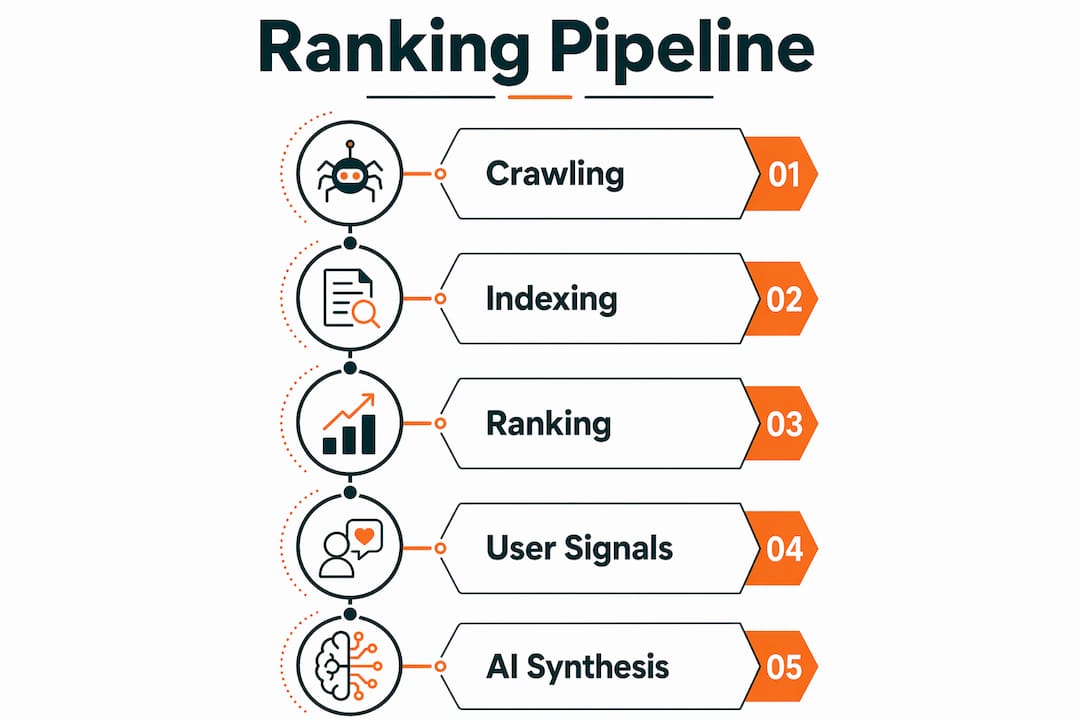
Search engines rank websites by running every page through a layered algorithmic system that evaluates hundreds of signals, from content relevance and backlink authority to real-time user behavior. Understanding this process is the single most valuable thing a website owner or digital marketer can do to grow organic traffic. The ranking process moves through four core stages: crawling, indexing, ranking, and an AI synthesis layer that now determines which sources get cited in generated answers. Each stage filters your site further. Miss one, and the others do not matter.
How search engines rank websites: crawling, indexing, and ranking explained
The ranking pipeline starts long before a user types a query. Search engines send automated bots, called crawlers or spiders, to discover pages by following links across the web. Those bots read your HTML, JavaScript, and metadata, then pass the data back to the search engine’s servers.
Indexing comes next. The search engine analyzes the crawled content, filters out duplicate or low-value pages, and stores the rest in a massive database. A page that never gets indexed never ranks. This is why crawl configuration matters from day one.
Ranking is where the real competition begins. When a user submits a query, the search engine pulls candidate pages from its index and scores them using a layered stack of systems including RankBrain, BERT, and MUM. Each model processes a different dimension: RankBrain interprets query intent, BERT reads sentence context, and MUM handles complex, multi-step questions. The result is a scored list ordered by predicted relevance and quality.
The fourth stage is newer and increasingly important. AI synthesis layers, like those powering Google’s AI Overviews, select specific sources to cite in generated answers. Structured formatting and answer-first writing directly increase your chances of appearing in those citations.
- Crawling: Bots follow links to discover pages. Blocked or orphaned pages get skipped entirely.
- Indexing: Content is analyzed, filtered, and stored. Thin or duplicate pages are excluded.
- Ranking: Hundreds of signals score each page against the query using AI models like RankBrain and BERT.
- AI synthesis: A citation layer selects well-structured sources for AI-generated answer snippets.
Pro Tip: Check Google Search Console’s Coverage report monthly. Pages stuck in “Discovered, not indexed” status are losing ranking potential every day they sit there.
Which factors most influence website ranking in 2026?
Content quality is the dominant ranking signal right now. Google’s Helpful Content system rewards original, user-focused content and penalizes thin or derivative pages that lack genuine insight. A page that summarizes what five other pages already say will not outrank them.

The E-E-A-T framework, which stands for Experience, Expertise, Authoritativeness, and Trustworthiness, has become a hard filter. After the may 2026 core updates, sites without clear authorship and credible sourcing saw significant visibility losses. Adding a named author with verifiable credentials, linking to authoritative sources, and maintaining a consistent publishing record all strengthen your E-E-A-T signals. You can go deeper on this with Ranksector’s guide to Google E-E-A-T.
Technical health is the foundation everything else sits on. The key factors are:
- Mobile experience: Google indexes the mobile version of your site first. A broken mobile layout directly hurts rankings.
- Page speed and Core Web Vitals: Slow load times increase bounce rates and send negative engagement signals.
- Structured formatting: Clear headings, short paragraphs, and answer-first writing improve both human readability and AI extraction.
- Backlink quality: One link from a trusted, relevant domain outweighs dozens of low-authority links.
User interaction signals complete the picture. Pogo-sticking and dwell time feed directly into ranking models as real-time feedback. If users click your result and immediately return to the search page, rankings drop within hours, not weeks.
Pro Tip: Fix your worst-performing pages before creating new ones. Auditing existing content for intent alignment consistently delivers faster traffic gains than publishing fresh articles.
How does topical authority and site architecture affect rankings?
Topical authority is the concept that a site ranking well for a subject must cover that subject comprehensively, not just target individual keywords. Hub-and-spoke content models correlate strongly with improved rankings because they signal depth to the algorithm. A pillar page covers a broad topic, while cluster pages address every related subtopic and question. Internal links connect them, passing authority and guiding crawlers through the full content set.
Site architecture determines how efficiently that authority flows. Pages more than three clicks from the homepage risk lower indexation rates and weaker rankings. The deeper a page sits, the less crawl budget it receives and the less link equity reaches it. Keeping your most important pages shallow and well-linked is not optional. It is a structural requirement.
The table below contrasts two common architecture approaches and their ranking implications.
| Architecture type | Crawlability | Authority flow | Ranking potential |
|---|---|---|---|
| Flat structure (1–2 clicks deep) | High | Strong across all pages | High for all key pages |
| Deep structure (4+ clicks deep) | Low for deeper pages | Diluted at lower levels | Weak for buried content |
| Hub-and-spoke with internal links | High | Concentrated on pillar pages | Strong for pillar and cluster pages |
| Siloed with no cross-links | Moderate | Trapped within silos | Inconsistent across site |
Technical misconfigurations are the silent killers of site architecture. Improper robots.txt settings or canonical tag errors can block crawlers from your best pages or split link equity across duplicate URLs for months before you notice the ranking drop. Audit these elements on a quarterly schedule at minimum.
Common pitfalls to avoid:
- Orphaned pages with no internal links pointing to them
- Canonical tags pointing to the wrong URL
- Robots.txt accidentally blocking CSS or JavaScript files
- Pagination errors creating duplicate content at scale
How can website owners optimize content and technical SEO for better rankings?
Answer-first writing is the most direct way to improve both traditional rankings and AI citation rates. Structured formatting and clear headings increase the likelihood that AI synthesis layers extract and cite your content. Lead every page with the direct answer to the query it targets, then expand with evidence and context.
Follow these steps to build a repeatable optimization process:
- Audit existing content first. Map every page to a specific search intent. Pages targeting the same keyword compete against each other, a problem called keyword cannibalization. Merge or redirect weaker pages into stronger ones.
- Fix technical errors before adding content. Run a crawl audit to catch broken links, slow pages, missing meta descriptions, and mobile rendering issues. Common SEO mistakes like these suppress rankings regardless of content quality.
- Improve internal linking. Every new page should receive at least two internal links from relevant existing pages. Use descriptive anchor text that reflects the target page’s topic. Ranksector’s guide to internal linking covers when automation helps and when it creates problems.
- Strengthen authorship signals. Add author bios with credentials, link to the author’s professional profiles, and cite credible external sources within the content. These actions directly support E-E-A-T.
- Monitor Core Web Vitals. Use Google Search Console’s Core Web Vitals report to identify pages with poor Largest Contentful Paint or Cumulative Layout Shift scores. Fix the worst offenders first.
Pro Tip: Mobile responsiveness is not just about screen size. Test your pages on actual mobile devices, not just browser emulators. Tap targets, font sizes, and form inputs often fail in real-world conditions that emulators miss.
What emerging trends in search engine ranking algorithms should marketers watch?
The biggest shift in website ranking algorithms is the move from a single scoring model to a layered stack trained on continuous user interaction data. Ranking shifts now happen within hours based on fresh engagement metrics, not just after formal algorithm updates. This means your rankings are never static. A page that performs well today can drop tomorrow if users start bouncing from it.
AI synthesis layers are redefining what it means to rank. Appearing in position one is valuable. Being cited as a source in an AI-generated answer is increasingly where high-intent traffic goes. The selection criteria for AI citations favor structured, authoritative, and clearly formatted content.
Key trends shaping rankings in 2026 and beyond:
- Topical authority over keyword targeting: Sites that cover a subject comprehensively outperform sites that optimize isolated pages for individual keywords.
- Real-time engagement feedback: User satisfaction signals update rankings dynamically, making content quality a continuous requirement, not a one-time effort.
- AI citation optimization: Answer-first headings, short direct paragraphs, and credible sourcing increase citation probability in AI-generated results.
- Content originality standards: Generic or derivative content faces growing penalties. First-hand experience and original research carry more weight with each update.
- Technical precision: As competition increases, technical errors that were once minor issues now create meaningful ranking gaps between similar sites.
Key Takeaways
Search engines rank websites through a four-stage process combining crawling, indexing, algorithmic ranking, and AI synthesis, where content quality, E-E-A-T, site architecture, and real-time user signals all determine final position.
| Point | Details |
|---|---|
| Four-stage ranking pipeline | Crawling, indexing, ranking, and AI synthesis each filter your site before a result appears. |
| E-E-A-T is a hard filter | Sites without clear authorship and credible sourcing lost visibility after the may 2026 core updates. |
| Site architecture matters | Pages more than three clicks deep face lower indexation rates and weaker authority flow. |
| Audit before you publish | Fixing existing content for intent alignment delivers faster ranking gains than adding new pages. |
| Real-time signals move rankings | Pogo-sticking and dwell time cause ranking shifts within hours, not weeks. |
The part most marketers skip entirely
Most of the website owners I talk to focus almost entirely on content production. They publish more articles, target more keywords, and build more links. The ranking results stay flat. The reason is almost always the same: they are competing at the ranking stage while losing at the retrieval stage.
Crawlers cannot rank what they cannot find. A misconfigured robots.txt or a site architecture that buries key pages five clicks deep will silently suppress rankings for months. I have seen sites with genuinely excellent content sitting at position 15 simply because their internal linking structure was broken. Fixing the architecture moved them to page one faster than any content update would have.
The second thing most marketers underestimate is topical authority. Writing one strong article on a subject is not enough. The algorithm looks at your entire site to judge whether you are a credible source on a topic. A site with 30 tightly linked articles on B2B SaaS pricing will outrank a site with one excellent article on the same subject, even if that single article is technically better written.
My honest advice: spend one month auditing what you already have before writing anything new. Map your content to intent, fix your architecture, and close the technical gaps. The rankings will follow.
— Savannah
Ranksector’s tools for ranking faster without the manual work
Building topical authority, fixing technical SEO, and publishing consistently are the three pillars of ranking growth. The problem is that most small teams do not have the bandwidth to do all three at once.
Ranksector automates the content side of that equation. The platform publishes daily SEO-optimized articles tailored to your audience, runs AI-powered content audits to align your pages with E-E-A-T and ranking signals, and builds domain authority through a backlink exchange system. With over 11,000 articles already published, Ranksector is built for B2B SaaS teams that need consistent output without a full content team. Start with the free SEO tools to audit your current rankings and identify your biggest gaps.
FAQ
How do search engines decide which websites rank first?
Search engines score pages using hundreds of signals including content relevance, E-E-A-T, backlink authority, and user engagement. The highest-scoring page for a given query appears first.
What is the most important factor in website ranking?
Content quality and E-E-A-T are the dominant factors following the 2026 core updates. Original, user-focused content with clear authorship consistently outranks thin or derivative pages.
How does site architecture affect search engine rankings?
Pages more than three clicks from the homepage receive less crawl budget and weaker link equity, which directly reduces their ranking potential. A flat, well-linked structure keeps authority flowing to all key pages.
What is topical authority and why does it matter for rankings?
Topical authority means covering a subject comprehensively across multiple interlinked pages. Sites with deep topic coverage outrank sites that target isolated keywords, because the algorithm treats comprehensive coverage as a credibility signal.
How quickly do ranking changes take effect?
User engagement signals like pogo-sticking and dwell time can trigger ranking shifts within hours. Technical fixes and content updates typically take days to weeks to reflect in rankings, depending on crawl frequency.