
What Is the SEO Competitive Landscape in 2026?
The SEO competitive landscape is the multi-layered arena where websites and brands compete for organic search rankings and AI-generated answer citations to capture traffic and user attention. The global SEO market sits at approximately $108 billion in 2026, growing 17% year over year. That growth reflects a fundamental shift: winning search visibility now means competing on two fronts simultaneously. The first is traditional organic rankings. The second is generative engine optimization (GEO), where platforms like ChatGPT, Gemini, and Claude pull trusted sources into their answers. Digital marketers and business owners who understand both fronts hold a real advantage over those still focused on blue links alone.
What does the SEO competitive landscape include in 2026?
The SEO competitive landscape covers every channel where a brand can appear in front of a user who is actively searching. That used to mean Google’s ten blue links. Now it includes AI-powered answer surfaces that summarize information before a user ever clicks a result.
Google processes over 8.5 billion searches daily and holds roughly 90% of global search market share. A growing share of those searches now return zero-click answers, where the user gets what they need without visiting any website. That shift makes AI citation authority just as important as a page-one ranking.
The modern SEO competitive environment has three distinct layers:
- Traditional organic SEO. This covers ranking in Google’s standard results through technical health, backlinks, and content relevance. The #1 organic result captures 27.6% of all clicks, while the #2 position earns only 15.8%. The drop-off after position one is steep and unforgiving.
- Answer Engine Optimization (AEO). This focuses on structuring content so search engines pull it into featured snippets, knowledge panels, and voice answers. Schema markup, FAQ formatting, and concise definitions all contribute here.
- Generative Engine Optimization (GEO). This is the newest layer. 43% of marketers were actively implementing GEO in 2026, up from near zero a year earlier. GEO means building the kind of entity authority and citation credibility that causes AI platforms to reference your content in their answers.
These three layers overlap but reward different signals. Traditional SEO rewards technical structure and backlinks. AEO rewards clear, structured answers. GEO rewards trusted citations, original expertise, and brand mentions across multiple platforms.
Pro Tip: Check whether your brand appears in ChatGPT or Perplexity answers for your core topics. If it does not, your GEO strategy needs attention before your traditional SEO rankings become less relevant.
How do you identify your true SEO competitors?
Your SEO competitors are not the same as your business competitors. A direct business rival sells the same product to the same customer. An SEO competitor is any website that ranks for the keywords your audience searches, regardless of what that site sells.
A SaaS company selling project management software might find that a productivity blog, a consulting firm, and a university research page all outrank it for its most valuable queries. None of those are business rivals. All of them are SEO competitors. True SEO competitors are identified through SERP overlap across target keywords, not by industry category.
The most reliable method for identifying SEO competitors is keyword-driven SERP analysis:
- List your 20 to 30 most important target keywords. These are the queries your audience uses when they are closest to taking action.
- Search each keyword and record every domain that appears on page one. Do this across multiple keyword clusters, not just your top terms.
- Identify which domains appear repeatedly. A site that shows up on page one for 15 of your 20 keywords is a core SEO competitor, even if you have never thought of it as a rival.
- Expand your competitive set using four segments. Experts advise including direct, indirect, emerging entrant, and substitute competitors to capture the full picture. Substitutes are especially easy to miss. They solve the same user problem in a different way.
- Track SERP overlap over time. A domain that suddenly appears across multiple keywords may signal a new entrant investing heavily in content.
Many SEO teams fall into what analysts call “SEO myopia.” They monitor only their direct business rivals and miss the indirect and substitute competitors that are quietly capturing their audience’s attention. A broader competitive set gives you a more accurate map of where your traffic is actually going.
Pro Tip: Use competitor research methods to build a living list of SEO competitors. Update it every quarter, because the competitive set shifts as new content enters the market.
What analytical methods decode competitor SEO strategies?
Identifying your competitors is step one. Understanding what they are doing to rank is where the real intelligence lives. Four analytical methods give you the clearest picture.

Keyword gap analysis
Keyword gap analysis compares the keywords your competitors rank for against the keywords you rank for. The gap is your opportunity. If three competitors consistently rank for a cluster of queries you have not addressed, that cluster represents both a traffic loss and a content priority. The goal is not to copy competitor content. The goal is to identify the topics your audience is searching for that you have not yet covered with depth and authority.
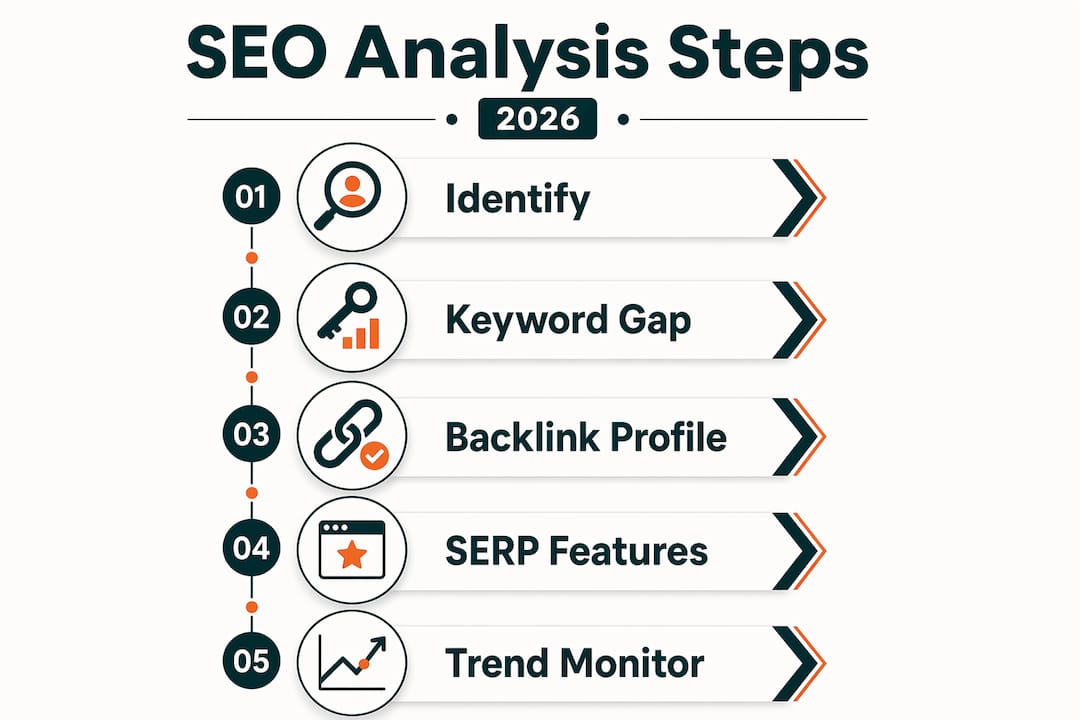
Backlink and citation profiling
Backlinks still carry weight in traditional SEO. Citation signals and brand mentions across multiple platforms now function as authority signals that influence AI answer inclusion. Analyzing a competitor’s backlink profile reveals which publications, directories, and communities trust them enough to reference them. Those same sources are your outreach targets. For GEO, look at which authoritative sites quote or cite your competitors in editorial content. That is the citation-building model you need to replicate.
SERP feature analysis
SERP features include featured snippets, tables, FAQ boxes, image packs, and video embeds. Each feature type signals what Google believes users want for that query. If a competitor owns the featured snippet for a high-value keyword, examine the format they used. Snippets typically come from concise, direct answers placed near the top of a page. Tables appear when the query has a comparative or list-based intent. Matching the right format to the right query is a faster path to a SERP feature than simply publishing more content.
Ranking trend monitoring
| Analysis method | What it reveals | Time horizon |
|---|---|---|
| Keyword gap analysis | Missing topics and content opportunities | Snapshot, updated monthly |
| Backlink profiling | Link-building and citation prospects | Snapshot, updated quarterly |
| SERP feature tracking | Format and structure signals for top results | Ongoing |
| Ranking trend monitoring | Strategic investment vs. content decay | 3–6 months |
Tracking ranking changes over 3–6 months distinguishes strategic competitor moves from temporary fluctuations. A competitor that climbs steadily across dozens of keywords over several months is actively investing in content or links. A competitor that spikes and then drops is likely riding a temporary signal. Reacting to every SERP movement wastes resources. Reacting to sustained trends is where the competitive advantage is built.
- Monitor competitor keyword rankings on a monthly cadence, not daily.
- Flag any competitor that gains 20 or more new ranking keywords in a single month.
- Investigate ranking drops in your own site before attributing them to competitor gains.
How do you apply competitive insights to improve your visibility?
Understanding the SEO competitive environment only creates value when you act on it. The most effective application combines content quality, entity authority, and AI citation readiness into a single workflow.
Building entity authority requires original expert judgment, detailed factual content, and credible citations rather than keyword repetition. Search engines and AI platforms both favor sources that demonstrate genuine expertise. That means publishing content that takes a clear position, cites primary sources, and provides information a user cannot find summarized elsewhere.
Practical steps to apply competitive intelligence:
- Fill the keyword gaps your analysis identified. Prioritize gaps where multiple competitors rank but none of them have strong content. Those are the easiest wins.
- Match content format to SERP intent. If the top results for a query are all listicles, a long-form essay will not outrank them. Format is a ranking signal.
- Add structured data markup. Schema for FAQs, how-to content, and articles increases eligibility for SERP features and AI answer inclusion.
- Build citations, not just backlinks. Getting mentioned by name in authoritative editorial content signals trust to AI platforms. Reach out to industry publications, contribute expert quotes, and participate in research roundups.
- Track AI answer visibility alongside Google rankings. Competitive intelligence must now monitor both ranked search results and AI answer visibility to capture the full picture. A brand that ranks #3 on Google but appears in ChatGPT answers for its core topics may be capturing more qualified attention than the #1 organic result.
For ecommerce sites, technical SEO decisions like controlling which pages get indexed directly affect how efficiently your competitive authority concentrates on the pages that matter most.
Pro Tip: Assign one team member to review AI answer surfaces for your top 10 keywords every month. Document which competitors appear in those answers and what content they used to earn the citation.
A hybrid SEO approach that targets both traditional rankings and AI citation authority is the standard for competitive teams in 2026. Focusing on only one surface leaves traffic on the table.
Key Takeaways
The SEO competitive landscape in 2026 requires competing on both traditional organic rankings and AI-generated answer citations, using entity authority, keyword gap analysis, and structured content to win visibility across all search surfaces.
| Point | Details |
|---|---|
| Two-front competition | Win both Google rankings and AI answer citations to capture the full range of search visibility. |
| SEO competitors differ from business rivals | Identify competitors by SERP overlap across target keywords, not by industry category alone. |
| Four competitor segments | Analyze direct, indirect, emerging entrant, and substitute competitors for a complete competitive map. |
| Trend monitoring over snapshots | Track ranking changes over 3–6 months to separate strategic moves from temporary fluctuations. |
| Entity authority drives AI citations | Publish original expert content with credible citations to appear in AI-generated answers. |
The shift I think most marketers are still missing
The SEO teams I respect most in 2026 are the ones who stopped treating AI answer surfaces as a future problem. They started treating them as a current competitive front, right now, alongside their Google rankings.
The uncomfortable truth is that most competitive analysis workflows were built for a world where Google’s ten blue links were the only game in town. Those workflows are not wrong. They are just incomplete. A brand can rank #1 on Google for its most important keyword and still lose the user to a competitor that appears in the ChatGPT answer for the same query. That is a real traffic loss that most ranking reports will never show you.
The other pattern I see consistently is what I call static competitive snapshots. A team runs a competitor analysis in january, builds a content calendar from it, and then does not revisit the competitive set until the following year. The SEO environment does not hold still for twelve months. New entrants appear. Existing competitors pivot their content strategy. AI platforms update which sources they favor. Dynamic, ongoing monitoring is not a nice-to-have. It is the baseline for staying competitive.
My honest recommendation: build a competitive SERP analysis practice that runs continuously, not periodically. Pair it with monthly checks on AI answer visibility. The brands that do both will compound their advantage over the ones still running quarterly snapshots.
— Savannah
How Ranksector maps your competitive SEO position
Staying ahead of a competitive SEO environment requires more than a one-time audit. It requires continuous content production, keyword gap tracking, and citation-building at a pace most small teams cannot maintain manually.
Ranksector automates the full cycle. Its AI audit tool analyzes your site’s competitive positioning, identifies keyword gaps, and flags AI citation readiness in a single pass. The platform then publishes daily SEO-optimized articles built around those gaps, so your content calendar stays active without consuming your team’s time. With over 11,000 articles already published for B2B SaaS clients, Ranksector delivers the consistent output that competitive SEO demands. Explore the free SEO tools to see where your competitive gaps are right now.
FAQ
What is the SEO competitive landscape?
The SEO competitive landscape is the full set of websites and entities competing for visibility in organic search results and AI-generated answers for a shared set of keywords and topics. It includes direct business rivals, indirect competitors, and substitute content sources.
How do I find my real SEO competitors?
Search your 20 to 30 most important target keywords and record every domain that appears on page one. Domains that appear repeatedly across multiple keyword clusters are your core SEO competitors, regardless of whether they sell what you sell.
What is generative engine optimization (GEO)?
GEO is the practice of building content and citation authority so that AI platforms like ChatGPT, Gemini, and Claude reference your brand in their generated answers. It focuses on entity authority, credible citations, and original expert content rather than traditional keyword targeting.
How often should I run a competitive SEO analysis?
Run a full competitive analysis quarterly and monitor ranking trends monthly. Tracking competitor movements over 3–6 months separates genuine strategic shifts from temporary SERP fluctuations.
Why do AI citations matter for SEO competition?
AI platforms now answer queries directly, often without sending users to a website. Brands that appear in those answers capture user attention before any organic click happens. Monitoring AI answer visibility alongside Google rankings gives a complete picture of where your competitive position actually stands.
Recommended
- How Competitor SEO Research Works: 2026 Guide · Ranksector Blog — Ranksector
- Competitive SERP Analysis Best Practices for SEO Teams · Ranksector Blog — Ranksector
- How Search Engines Rank Websites: 2026 Guide · Ranksector Blog — Ranksector
- Monitor Competitor Keyword Rankings: 2026 Guide · Ranksector Blog — Ranksector