
Why Niche Sites Rank Faster: The Mechanics Explained
Niche sites rank faster because they align precisely with search intent, target lower-competition keywords, and concentrate topical signals in a tight content cluster. The result is a site that search engines can map, trust, and reward more quickly than a broad-topic domain spreading its authority thin. Five mechanisms drive this speed advantage:
- Intent alignment: Every page answers a specific query, lifting CTR and dwell time from day one.
- Lower keyword difficulty: Long-tail, niche-specific queries face weaker SERP defenders, so new pages break into top positions faster.
- Topical authority: Dense content clusters and deliberate internal linking build subject-matter trust faster than scattered posts.
- Content velocity: Frequent, focused publishing increases crawl rate, accelerating indexation of new pages.
- Niche backlinks: Links from specialist publications and communities carry stronger contextual relevance than generic links at the same volume.
Together, these factors create a compounding loop: faster indexing leads to earlier ranking signals, which attract niche links, which reinforce topical authority, which speeds up the next round of rankings.
Key Takeaways
Niche sites rank faster because they concentrate topical signals, target low-competition queries, and earn contextually relevant links, producing measurable ranking movement within weeks rather than months.
| Point | Details |
|---|---|
| Target long-tail first | Start with keyword difficulty under 20 to reach page one within 6–12 weeks. |
| Build pillar + cluster | One pillar page plus 6–12 cluster posts with consistent internal linking accelerates topical authority. |
| Earn niche-specific links | One contextual link from a specialist newsletter outperforms generic directory links at higher volume. |
| Fix technical basics early | Submitting your sitemap, passing Core Web Vitals, and adding schema speeds indexation from day one. |
| Ranksector automates execution | Ranksector’s daily publishing, internal linking suggestions, and backlink exchange replicate these tactics at scale. |
Table of Contents
- Why niche sites rank faster: the core mechanics
- How to replicate the niche speed advantage
- What “faster” actually means: realistic timelines
- Mistakes that kill the niche speed advantage
- Evidence from practice: what targeted publishing actually produces
- How domain authority and age affect your ranking speed
- How to use niche communities and platforms for faster ranking
- How semantic SEO and structured data speed up niche rankings
- Speed vs. sustainability: a perspective on building niche sites
- Ranksector cuts the time between strategy and published content
- Sources
Why niche sites rank faster: the core mechanics
The speed advantage is not accidental. Each mechanism below has a measurable cause and effect chain you can influence directly.
Intent match and the long-tail advantage
Long-tail queries make up the vast majority of search volume, and they convert at a higher rate than head terms because the searcher’s need is specific. When your page answers exactly what the query asks, Google’s engagement signals (CTR, dwell time, low bounce rate) confirm the match and push the page up. According to Shopify’s niche SEO guide, targeting long-tail, low-competition keywords and building topical depth produces higher-intent traffic and is more efficient for smaller budgets. A broad site covering “marketing” competes with thousands of pages; a niche site covering “email marketing for Shopify stores” competes with dozens.
Topical authority through content clusters
Search engines build a mental map of what a domain covers. A focused content cluster, where a pillar page links to six to twelve supporting posts on related subtopics, signals concentrated expertise. Site Academy’s analysis confirms that topical focus and intent alignment let smaller sites beat larger brands on relevant queries because Google rewards the site most likely to satisfy the user’s intent, not the site with the biggest domain.
Dense internal linking within the cluster passes PageRank efficiently and shortens the path from any entry page to the pillar, reinforcing the topical signal on every crawl.
Lower competition and weaker SERP defenders
Niche queries typically have a Keyword Difficulty score well below competitive head terms. The sites currently ranking for them are often thin resource pages, outdated forum threads, or general-purpose sites that touched the topic once. A purpose-built niche page with proper on-page structure, schema, and internal links can displace these defenders within weeks rather than months.
Content velocity and crawl frequency
Google crawls active sites more often. Publishing two to four focused posts per week signals an active, authoritative source. Each new page also creates fresh internal linking opportunities, reinforcing the cluster map on every crawl cycle. Ranktracker’s micro-niche analysis shows that early wins from targeted clusters improve crawl frequency, backlinks, and SERP share inside the niche, creating a compounding effect over time.
Niche backlinks and contextual relevance
A single link from a specialist newsletter, a niche podcast show notes page, or a community roundup carries more contextual weight than ten generic directory links. Ranking Labs’ niche intelligence research notes that every niche has a distinct ranking fingerprint, and calibrating content signals to that profile raises winnability in ways generic advice misses. Niche-specific backlinks are part of that fingerprint.
User engagement as a ranking accelerator
When content precisely matches intent, users stay longer and click through to related pages. That behavior tells Google the page is satisfying. Matching keyword intent to content structure is one of the fastest levers for improving these signals on an existing site.
| Factor | Mechanism | Measurable signal |
|---|---|---|
| Intent alignment | Page answers the exact query | Higher CTR, lower bounce rate |
| Topical authority | Cluster + internal links build subject trust | Crawl frequency, ranking breadth |
| Low keyword difficulty | Weak SERP defenders, faster displacement | Position movement within 4–8 weeks |
| Niche backlinks | Contextual relevance amplifies link value | Domain Rating growth, referring domains |
How to replicate the niche speed advantage
This checklist is ordered by impact. Work through it sequentially for the fastest results.
Step 1: Select a niche with measurable criteria
Before writing a single word, confirm three things: the niche has a cluster of at least 20–30 related long-tail queries with clear informational or commercial intent, the top-ranking pages are thin or outdated, and there is at least one specialist publication or community where you can earn links. Tools like Ahrefs, Semrush, or Google Search Console’s query data can surface these gaps. A keyword gap workflow speeds this step considerably.
Step 2: Build your keyword cluster
Use these long-tail templates to expand a seed keyword into a cluster:
- Problem-based: “How to fix [specific problem] in [niche context]”
- Comparison: “[Tool A] vs [Tool B] for [specific use case]”
- How-to: “How to [task] without [common obstacle]”
- Best-for: “Best [product/method] for [narrow audience segment]”
Map each keyword to a single page. Group related queries under one URL to avoid cannibalization.
Step 3: Produce pillar + cluster content
Write one pillar page (1,500–2,500 words) that covers the niche topic broadly, then publish six to twelve cluster posts (800–1,200 words each) targeting specific subtopics. Each cluster post links back to the pillar and to at least two sibling cluster posts. This internal linking map accelerates topical authority because every crawl reinforces the subject-matter signal. Long-tail cluster strategies consistently outperform scattered publishing for small sites.
Pro Tip: Write the pillar page last. After publishing four or five cluster posts, you will know exactly which subtopics generate the most engagement, and that data shapes a stronger pillar.
Step 4: Handle technical SEO basics first
Before publishing, confirm: XML sitemap submitted to Google Search Console, Core Web Vitals passing (LCP under 2.5 seconds), mobile-responsive layout, and schema markup on key pages. These are not optional extras; they determine how quickly Google indexes new pages. A technical SEO checklist covers each step for non-technical owners.
Step 5: Execute niche outreach
Three outreach angles that work for niche sites:
- Newsletter sponsorship or mention: Email the editor of a niche newsletter with a specific data point from your content that fits their audience. Keep the pitch to three sentences.
- Podcast guest pitch: Offer to cover one specific, practical topic relevant to the show’s niche. Podcast show notes links are contextually strong.
- Community contribution: Answer questions in niche forums or Slack groups, then reference your content when it directly answers the question. Never drop a link without adding value first.
Step 6: Track the right KPIs
- Rank position movement for each cluster keyword (check weekly for the first 90 days)
- Impressions growth in Google Search Console (a leading indicator before clicks arrive)
- Referring domain count from niche-relevant sites
- Average position for the pillar page (should improve as cluster posts gain traction)
- Search visibility share within the niche
What “faster” actually means: realistic timelines
“Faster” is relative. Here is what you can realistically expect at different effort levels.
Fast win (6–12 weeks): Targeting long-tail queries with keyword difficulty under 20, a simple technical setup, and two to three posts per week. A documented case reached 32,000 impressions in 28 days at an average position of 7.3 by focusing exclusively on long-tail problem-based keywords with clean technical fundamentals. This is achievable but requires tight niche focus and consistent publishing.
Realistic build (3–6 months): A full pillar-plus-cluster structure with active outreach produces stable first-page rankings across the cluster. Domain Rating starts climbing as niche backlinks accumulate.
Durable authority (6–18 months): The niche becomes defensible. Competitors would need to replicate your entire cluster to displace you, and your crawl frequency advantage makes it hard for them to catch up.
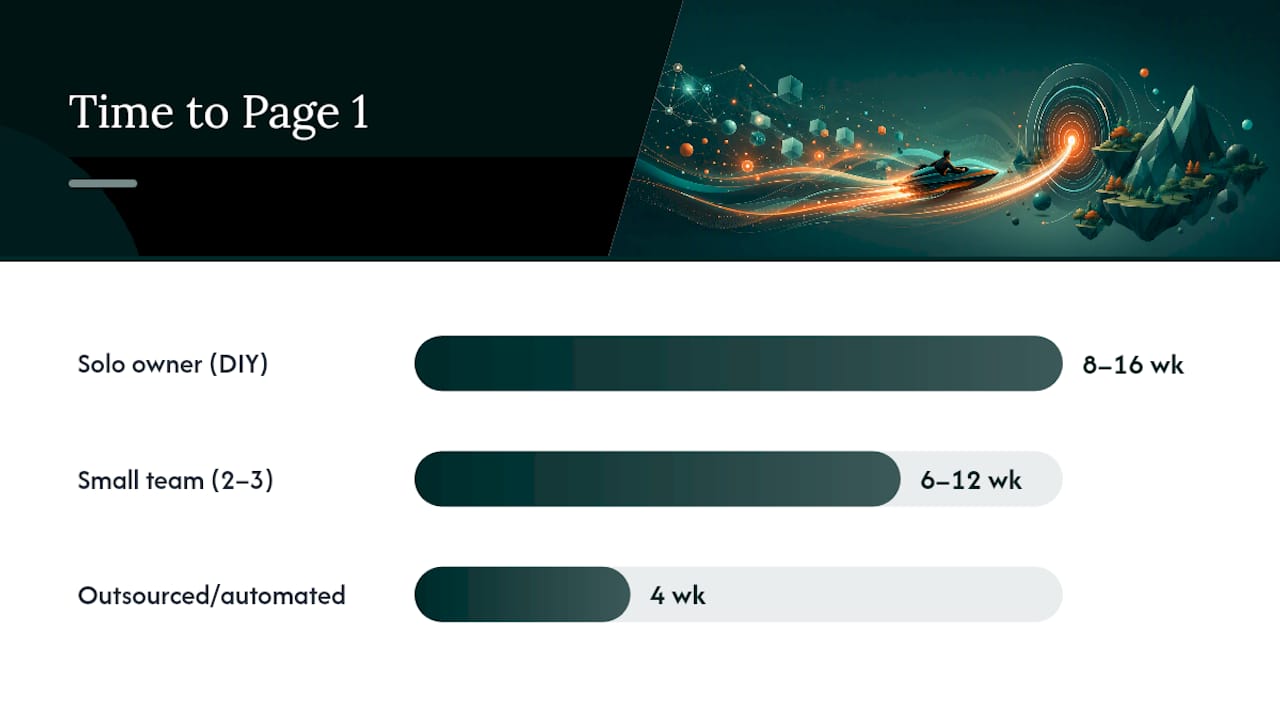
| Scenario | Weekly output | Backlinks/month | Expected timeline to page 1 |
|---|---|---|---|
| Solo owner, DIY | 2 posts | 1–3 niche links | 8–16 weeks for long-tail |
| Small team (2–3 people) | 4–5 posts | 4–8 niche links | 6–12 weeks for long-tail |
| Outsourced/automated | 5–7 posts | 5 niche links | 4 weeks for long-tail |
Quick technical wins, such as fixing page speed and adding schema, can accelerate indexation regardless of team size. Page speed improvements alone can shorten the gap between publishing and indexation by days.
Mistakes that kill the niche speed advantage
Most niche sites stall not because the strategy is wrong, but because of a handful of avoidable errors.
- Chasing head terms too early. Targeting “email marketing” before you have topical authority wastes crawl budget and produces no early wins. Fix: stay in the long-tail until you hold first-page positions for at least ten cluster keywords, then expand.
- Thin or duplicate content. Publishing 300-word posts that restate the query without answering it triggers Panda-era quality signals. Fix: every post must answer the query completely, with a specific example or data point the competitor pages lack.
- Broken internal linking. Cluster posts that do not link back to the pillar or to sibling posts waste the topical signal. Fix: build a simple linking map before you publish and check it on every new post.
- Buying low-quality links. Generic link packages from link farms dilute the niche relevance signal. Fix: one contextual link from a niche newsletter is worth more than fifty directory links.
- Ignoring search intent. Publishing informational content for a query with commercial intent (or vice versa) produces high bounce rates that suppress rankings. Fix: check the SERP format before writing. If the top results are product pages, your post should be a comparison or review, not a how-to guide.
A page with good CTR but high bounce rate signals a content-intent mismatch. Both are fixable before they become ranking liabilities.
Evidence from practice: what targeted publishing actually produces
The mechanics above are not theoretical. A documented niche site case, focused on long-tail problem-based keywords with a clean technical setup, reached 32,000 impressions and an average position of 7.3 within 28 days. The site used no paid links and no complex technical infrastructure. The result came from intent alignment, consistent publishing, and a simple internal linking structure.
Why does this happen mechanically? Frequent, focused publishing increases crawl frequency. Each new cluster post adds internal links that reinforce the pillar’s topical signal. As the cluster grows, Google’s understanding of the domain’s subject-matter depth improves, which raises the probability that any new page in the cluster gets indexed and ranked quickly.
Implementation checklist to reproduce this:
| Step | Action | Target metric |
|---|---|---|
| Publishing cadence | 2–4 posts/week, all within the niche | 8–12 posts live within 30 days |
| Internal linking | Every post links to pillar + 2 sibling posts | Zero orphan pages |
| Link targets | 1–2 niche-relevant placements per month | 5+ contextual referring domains by month 3 |
Neil Patel’s niche SEO guide reinforces this: quality, targeted content combined with niche backlinks makes the strategy practical even for small teams without large budgets.
How domain authority and age affect your ranking speed
Domain authority and age matter, but not in the way most people assume. A brand-new domain in a niche with weak SERP defenders can reach page one for long-tail queries within weeks. The constraint is not age itself; it is the absence of trust signals that age typically accumulates.
What age actually provides is crawl history, a backlink profile, and indexed content. You can partially replicate these signals faster on a niche site by publishing consistently, earning contextual links early, and keeping technical fundamentals clean. A two-year-old domain with 50 scattered posts and no niche focus will often lose to a six-month-old domain with a tight cluster and five relevant backlinks.
The practical implication: if you are starting fresh, prioritize earning your first three to five niche-relevant backlinks within the first 60 days. That early link signal, combined with a published cluster, tells Google the domain is a real, active source in the niche. SEO quick wins like title tag optimization and schema additions can also accelerate early trust signals on a new domain.
How to use niche communities and platforms for faster ranking
Niche communities are both a link source and a content intelligence tool. Reddit threads, Slack groups, Discord servers, niche newsletters, and specialist podcasts tell you exactly what questions your audience is asking right now. That intelligence feeds your keyword cluster and your outreach list simultaneously.
For link building, the highest-value placements in a niche are usually: a mention in a curated niche newsletter (often free if your content is genuinely useful), a guest post on a niche blog with a real audience, and a podcast appearance where the show notes link to your pillar page. These placements carry contextual relevance that generic outreach cannot replicate.
For content intelligence, spend 30 minutes per week in the two or three communities where your audience is most active. Note the recurring questions, the frustrations, and the gaps in existing answers. Those gaps are your next cluster posts. This approach also means your content answers questions people are actively asking, which improves CTR and dwell time from the moment the page ranks.
How semantic SEO and structured data speed up niche rankings
Semantic SEO is the practice of covering a topic so thoroughly that search engines can confidently associate your domain with that subject. For niche sites, this means writing content that addresses the full range of related entities, subtopics, and questions within the niche, not just the primary keyword.
Structured data (schema markup) accelerates this process by giving Google explicit signals about what a page is about. FAQ schema on a cluster post can produce rich results within days of indexation, increasing CTR before the page reaches a high organic position. HowTo schema on tutorial content, Article schema on pillar pages, and Product schema on comparison posts all help Google categorize and surface your content faster.
The practical combination: write content that covers the topic’s full semantic field (related terms, entities, questions), then add the appropriate schema to each page type. This two-layer approach, semantic depth plus structured signals, is one of the fastest ways to accelerate a niche site’s visibility without building additional links.
Speed vs. sustainability: a perspective on building niche sites
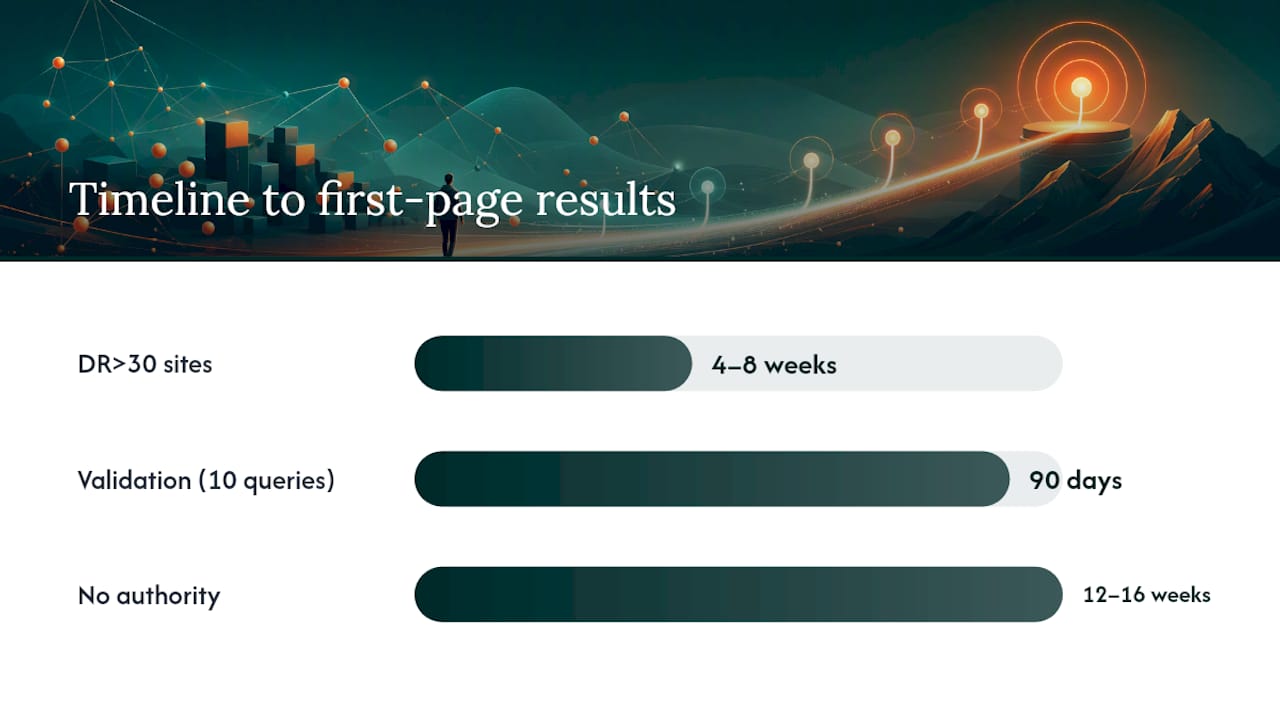
The speed-first approach works best as a validation tool. If you can reach page one for ten long-tail queries within 90 days, you have confirmed the niche is winnable and the content strategy is sound. That is the moment to invest in durability: deeper pillar content, more authoritative backlinks, and expanded cluster coverage.
The mistake most site owners make is treating speed as the end goal rather than the signal. A site that ranks fast for thin content will also lose those rankings fast when competitors notice the gap and publish better answers. Speed gets you data; sustainability gets you a business.
Decision checklist:
- If you are holding first-page positions for 5+ cluster keywords: expand the cluster, add a second pillar topic.
- If impressions are growing but CTR is flat: fix title tags and meta descriptions before publishing more content.
- If rankings are stalling after 90 days: audit internal linking and check for intent mismatches.
- If you have an existing domain with authority: skip the long-tail-only phase and target mid-difficulty keywords from day one.
Domain age and existing authority compress the timeline. A site with a Domain Rating above 30 and an established niche focus can target keywords with difficulty scores of 30–40 and expect results within 4–8 weeks rather than 12–16.
Ranksector cuts the time between strategy and published content
The tactics in this article require consistent execution: publishing two to four posts per week, maintaining internal linking discipline, and running outreach in parallel. For a solo founder or a small team, that volume is where most niche site plans stall.
Ranksector automates the publishing side of this equation. The platform generates daily SEO-optimized articles calibrated to your niche and keyword cluster, publishes directly to your CMS, and surfaces internal linking suggestions on every new post. Its contextual backlink exchange network adds niche-relevant referring domains without manual outreach. Three features map directly to the tactics above:
- Publishing cadence: Daily article generation keeps crawl frequency high and cluster growth on schedule.
- Internal linking suggestions: Every new post gets linking recommendations that reinforce your topical cluster automatically.
- Backlink exchange: Contextual links from relevant domains, built into the platform, not sourced from link farms.
Run a free AI audit to see exactly where your niche site’s topical gaps and technical issues are before you publish another post.
Sources
- Why Some Small Websites Outrank Huge Brands (And How You Can Too) - Site Academy
- How To Rank a Niche Site on Google - AffiliateTacticHive
- Dominate a Micro-Niche First: Why Small SEO Wins Create Long-Term Authority
Recommended
- How Search Engines Rank Websites: 2026 Guide · Ranksector Blog — Ranksector
- Why Page Speed Affects Rankings: 2026 SEO Guide · Ranksector Blog — Ranksector
- Types of SEO Quick Wins for Faster Rankings in 2026 · Ranksector Blog — Ranksector
- Long-Tail Keyword Benefits for Small Sites: Win More Traffic · Ranksector Blog · Ranksector