
Why Keyword Intent Matters in Competitive SEO
Keyword intent is the single strategic filter that determines whether your traffic is useful and winnable. Match it, and you convert. Chase volume without it, and you burn resources on rankings that never pay off. That’s the core of why keyword intent matters in competition: it separates keywords worth fighting for from keywords that look good in a spreadsheet and do nothing in the real world.
The immediate, measurable effects of intent alignment are hard to ignore:
- CTR improves when your page type matches what the searcher expects to find.
- Relevance signals strengthen because dwell time rises and pogo-sticking drops.
- Conversion rates climb when content speaks to the user’s actual goal, not just the topic.
- Churn decreases because intent-matched content attracts buyers, not browsers.
- AI overview eligibility increases for pages that match the dominant format Google’s systems expect.
Your next three moves: audit your current keyword list by intent, remap content types to match each intent tier, and prioritize striking-distance gaps where you can win quickly.
Table of Contents
- Why keyword intent is the strategic filter your SEO needs first
- What are the main types of search intent, and what content wins each?
- How intent alignment reshapes competitive dynamics
- How do you determine keyword intent from a SERP?
- The intent-first competitive framework: Filter, Map, Prioritize, Execute, Measure
- Which KPIs actually measure intent-aligned performance?
- What are the most common mistakes teams make with keyword intent?
- Your 10-point intent-first checklist to apply this week
- Key Takeaways
- The part most SEO guides get wrong about intent
- Ranksector cuts the gap between intent analysis and published content
- Useful sources and tools to go deeper
Why keyword intent is the strategic filter your SEO needs first
Search intent is the user’s goal and desired outcome behind a query. Not the topic, not the keyword string — the why behind the search. Someone typing “project management software” might want to learn what it is, compare options, or buy a subscription. Same keyword, three different intents, three different winning page types.
That distinction is what separates intent from topical relevance and raw search volume. Topical relevance tells you whether a keyword fits your subject matter. Volume tells you how many people search it. Intent tells you whether those people are in a position to do what you need them to do. They are three separate decisions, and most teams collapse them into one, which is where the waste starts.
A practical example: “CRM software” might carry enormous volume, but the intent is split across researchers, evaluators, and buyers. A lower-volume query like “best CRM for five-person sales team” is almost entirely commercial-investigational. The second keyword is harder to rank for by volume metrics, yet it converts at a far higher rate because the intent is tight and specific.
Google’s Helpful Content system and AI overviews both reward pages that satisfy the full intent of a query, not just the keyword match. Mapping your page type to the intent the SERP expects is now as operationally important as the keyword itself.
What are the main types of search intent, and what content wins each?
The four core intent types cover most queries, but mixed and micro-intents are where competitive edges actually live. Here’s how each maps to content format and real query examples:
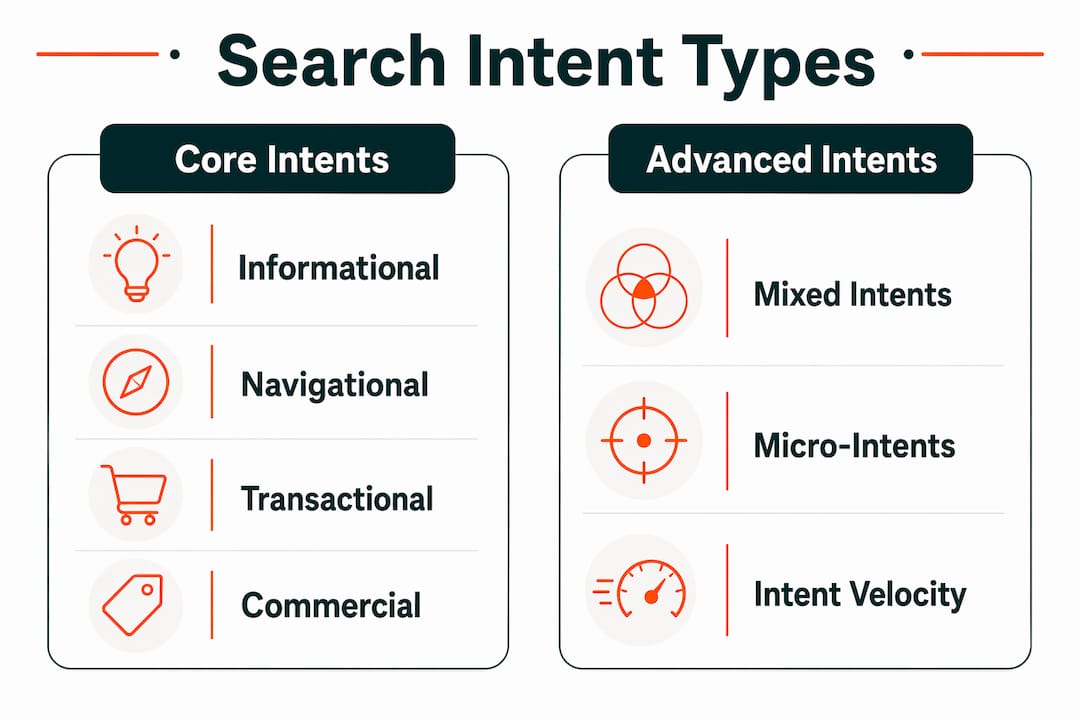
| Intent Type | Best Content Format | Example Query |
|---|---|---|
| Informational | Long-form guide, how-to, explainer, FAQ | “how does two-factor authentication work” |
| Navigational | Brand page, login page, direct URL | “Salesforce login” |
| Commercial / Investigational | Comparison article, review, roundup, vs. page | “best email marketing tools for SaaS” |
| Transactional | Product page, pricing page, free trial landing page | “buy HubSpot starter plan” |
| Mixed / Micro-intent | Hybrid page (guide + tool, comparison + CTA) | “keyword research tool” |
The commercial/investigational tier deserves extra attention for B2B SaaS teams. Queries like “[Tool A] vs [Tool B]” or “best [category] for [use case]” sit at the highest-value point in the funnel. A well-built high-intent commercial keyword page can outperform a generic pillar post in conversions by a wide margin, even with lower traffic.
Mixed intents are where teams most often misfire. “Keyword research tool” could mean someone wants to learn about the category, compare options, or sign up immediately. A content gap is frequently an intent gap: competitors win by matching the SERP’s micro-format — a free tool, a comparison table, a calculator — not just by covering the topic in long form. If the SERP shows a free tool in position one, a 3,000-word guide won’t beat it.
Pro Tip: For any keyword with mixed intent, check the top five SERP results and count how many are tools, guides, and comparison pages. The dominant format tells you what Google has decided the primary intent is — build to that format first.
How intent alignment reshapes competitive dynamics
Intent alignment doesn’t just improve rankings. It changes the economics of your entire content program.

When a page matches the user’s intent precisely, behavioral signals shift in your favor. Dwell time increases because the content delivers what the searcher came for. Pogo-sticking — the pattern of clicking back to the SERP immediately — drops. Both signals feed into Google’s quality assessments, and pages that hold users tend to hold rankings. Prioritizing search intent over raw keyword metrics improves conversion and marketing efficiency in a way that volume-chasing simply cannot replicate.
The paid search angle is equally direct: intent alignment tells you where to concentrate budget and where to pull it. High-volume, low-intent keywords drain paid budgets fast. When you know a keyword’s intent doesn’t match your conversion path, you can redirect that spend to auctions where the fit is tight and the buyer is ready.
Consider a before/after scenario. A SaaS team had a blog post ranking position 14 for “project management templates.” The page was a long-form guide. The SERP was dominated by free downloadable template files. After rebuilding the page as a template library with a free download CTA, the page moved to position four and the conversion rate on that page improved significantly. The keyword didn’t change. The intent match did.
Competitive advantages from intent alignment compound over time:
- Faster ranking wins on striking-distance keywords because you’re not fighting format mismatches.
- Sustainable topical authority because each page reinforces the cluster’s intent coherence.
- Better conversion yield per organic session because traffic arrives with the right expectation.
- Lower content churn because intent-matched pages stay relevant longer than volume-chased posts.
How do you determine keyword intent from a SERP?
The most reliable method starts with the SERP itself, not a tool label. Tools can classify intent, but the SERP is the ground truth of what Google has decided the dominant intent is for any given query.
Step-by-step SERP analysis:
- Run the query in an incognito window in the target market’s locale. Note the page type of the top five organic results: guides, product pages, comparison articles, tools, or local listings.
- Check SERP features. FAQ boxes suggest informational intent. Product carousels signal transactional. Review snippets point to commercial/investigational. Knowledge panels indicate navigational or branded queries.
- Read the query modifiers. Words like “best,” “top,” and “vs” signal commercial intent. “How to,” “what is,” and “why” signal informational. “Buy,” “price,” “discount,” and “near me” signal transactional. “Login,” “[brand name],” and “[brand] + feature” signal navigational.
- Scan the top-ranking titles and meta descriptions. The language Google surfaces tells you what format and angle it rewards.
- Check for intent consistency. If positions 1–5 are all the same format, intent is clear. If they’re mixed, you’re dealing with a multi-intent keyword and need to decide which intent to serve.
Worked example: Query — “content brief template.” Running this in the US, the SERP shows a free downloadable template in position one, two how-to guides with embedded templates, and one comparison of content brief tools. The dominant intent is commercial/investigational with a strong transactional pull toward free resources. The winning page type is a free template with supporting guidance, not a pure long-form explainer.
SERP feature analysis yields high-confidence intent signals for page-type mapping. Tools like Google Search Console, Semrush, and Ahrefs can layer in volume and difficulty data once you’ve confirmed the intent — but the SERP inspection comes first.
Tools checklist for intent analysis:
- SERP inspection: Google Search (incognito), SERP simulators
- Volume and difficulty: Ahrefs, Semrush, Google Keyword Planner
- Intent classification: Semrush’s keyword intent labels, Ahrefs’ intent filter
- Competitive gap discovery: Ranksector’s keyword gap tools, competitor keyword gap analysis
- Free quick checks: Google Search Console (CTR vs. position anomalies), free keyword research methods
Pro Tip: Save a SERP snapshot for every target keyword before you publish. When you revisit rankings three months later, the snapshot tells you whether the SERP’s intent has shifted — which is often why a page that ranked well starts to slip.
The intent-first competitive framework: Filter, Map, Prioritize, Execute, Measure
This five-stage framework gives your team a repeatable process for turning keyword intent into competitive wins. Each stage has a single purpose, and the order matters.
-
Filter — Disqualify keywords you cannot realistically serve. If your site can’t satisfy the intent (wrong page type, wrong product fit, wrong funnel stage), remove the keyword from the roadmap regardless of volume. Keyword intent should be used as a strategic filter before volume or difficulty enters the conversation.
-
Map — Assign a page type to every surviving keyword. Use the SERP-first method above. The output is a keyword list with an intent label and a recommended content format for each entry.
-
Prioritize — Score each keyword using an intent score template (see below) and rank by strikeable opportunity. Pages already ranking positions 11–20 with a format mismatch are your fastest wins.
-
Execute — Build or rework the page to match the mapped intent and format. Write the brief, design the format, place internal links from high-authority pages in the same cluster.
-
Measure — Track intent-specific KPIs (CTR, conversion rate for the intent cohort, dwell time, SERP feature capture). Iterate based on what the data shows, not what the original brief assumed.
Intent score template
| Field | What to assess |
|---|---|
| Intent fit | Does your site’s product/content realistically serve this intent? (1–5) |
| Conversion fit | Does this intent align with a conversion path you own? (1–5) |
| SERP difficulty | How competitive is the dominant format in the SERP? (1–5, inverted) |
| Intent velocity | Is this intent growing in search frequency? (rising / stable / declining) |
| Business value | Revenue or lead impact if you rank and convert? (low / medium / high) |
Score each keyword across these five fields. Keywords with high intent fit, high conversion fit, low SERP difficulty, rising velocity, and high business value are your first-quarter targets.
Intent velocity deserves its own explanation. Competitors with higher intent velocity win niche micro-intents by surfacing and owning small but high-fit queries before others react. You can detect rising micro-intents by monitoring Google Trends for query variants, watching “People Also Ask” boxes for new question patterns, and tracking Reddit and community forums for emerging terminology. When you spot a rising micro-intent, publish fast and in the right format. The window before competitors notice is often short.
For execution, use internal linking from your highest-traffic authoritative pages to pass topical trust to a new intent-focused page. This top-down PageRank flow accelerates ranking for strike targets significantly faster than building a new page in isolation.
Pro Tip: When intent shifts in a SERP — for example, a query that used to favor guides now favors tools — don’t delete the old page. Redirect it to a new tool or hybrid page and preserve the link equity. Rebuilding from scratch wastes the authority you’ve already accumulated.
Which KPIs actually measure intent-aligned performance?
Tracking the right metrics is what separates intent-first teams from teams that just talk about intent. Standard traffic reports won’t show you whether your intent alignment is working. You need metrics tied to the specific behavior intent-matched pages should produce.

| Metric | Why it matters | How to measure | Cadence |
|---|---|---|---|
| Intent-appropriate CTR | Confirms your title/meta matches what the SERP expects | Google Search Console (CTR by page) | Weekly |
| Ranking in intent-appropriate SERP | Validates page type fit, not just keyword position | Manual SERP check + rank tracker | Bi-weekly |
| Conversion rate by intent cohort | Shows whether intent-matched traffic converts at a higher rate | GA4 goal completions segmented by landing page | Monthly |
| Dwell time / engagement rate | Signals whether the page satisfies the intent fully | GA4 engagement rate, average session duration | Monthly |
| SERP feature capture rate | Measures whether you’re winning featured snippets, FAQs, and carousels | Semrush / Ahrefs SERP feature tracking | Monthly |
| Topical cluster lift | Shows whether new intent pages lift rankings across the cluster | Rank tracker grouped by topic cluster | Quarterly |
Secondary KPIs worth monitoring: assisted conversions (intent-matched pages that appear in multi-touch paths), internal link equity flow (are your new pages receiving links from cluster hubs?), and search visibility share within your target topic clusters.
Attribution is the hard part. Tying intent-led changes to revenue requires you to segment conversions by the landing page’s intent type in GA4, then compare conversion rates before and after an intent rework. The limitation is time: intent changes take 6–12 weeks to fully register in rankings and behavioral data. Set a measurement window of at least eight weeks before drawing conclusions, and use Google Search Console’s performance comparison tool to isolate the change period.
What are the most common mistakes teams make with keyword intent?
The volume-first trap is the most expensive mistake in keyword research. Teams pull a list sorted by monthly search volume, pick the top 20, and start writing. High-volume keywords often contain multiple intents, and the converting subset may be a small fraction of total traffic. You end up ranking for a keyword and getting traffic that was never going to buy.
Common errors and their remedies:
Misreading mixed intents. A keyword like “email marketing” could be informational, commercial, or navigational depending on the user. Treating it as a single intent and building one page type will satisfy only part of the audience. The remedy: check the SERP, identify the dominant intent, and build to that format. If the intent is genuinely split, consider building two separate pages targeting different modifier variants.
Copying top keywords without matching page type. Seeing a competitor rank for a term and writing a similar article doesn’t work if the competitor is winning with a tool or calculator. The true content gap is a format gap, not a topic gap. Build the format the SERP rewards.
Assuming one intent per keyword forever. Intents shift. A query that was informational two years ago may now be dominated by commercial pages as the market matures. Check your top-performing pages quarterly to confirm the SERP intent hasn’t moved under them.
Ignoring paid search alignment. Intent analysis should inform paid bidding: invest more where intent and conversion fit align, and pull budget from high-volume, low-intent auctions where click costs are high and conversion rates are low.
For a deeper look at where keyword research goes wrong, the common keyword research mistakes guide covers the most frequent errors teams make before they even get to intent classification.
Your 10-point intent-first checklist to apply this week
This sequence is ordered by dependency. Complete each step before moving to the next.
-
Export your current keyword list from Google Search Console and your rank tracker. Include position, CTR, and impressions for every tracked keyword.
-
Classify each keyword by intent type using the SERP-first method: run the top five results, note the dominant page type, and label each keyword (informational, commercial, transactional, navigational, mixed).
-
Flag format mismatches — keywords where your current page type doesn’t match the dominant SERP format. These are your highest-priority rework targets.
-
Identify striking-distance targets — keywords ranking positions 11–20 with a clear intent match or a fixable format mismatch. These are your fastest wins.
-
Score each target using the intent score template from the framework section above (intent fit, conversion fit, SERP difficulty, intent velocity, business value).
-
Select your first three pages to rework this quarter using a simple priority matrix: highest combined score on intent fit + conversion fit + business value, lowest SERP difficulty.
-
Write a content brief for each page using this template:
-
Design the content format to match the SERP’s dominant type (guide, tool, comparison, template, calculator). Don’t default to long-form if the SERP rewards something else.
-
Place internal links from two to three high-authority pages in the same topic cluster to the new page before or at launch.
-
Set a monitoring cadence: check CTR and ranking weekly for the first four weeks, then shift to the full KPI dashboard monthly. Iterate based on behavioral data, not assumptions.
For the priority matrix, score each candidate page on a 1–5 scale across intent fit, conversion fit, and business value. Add the scores. The three pages with the highest totals are your Q1 targets. This keeps the decision objective and fast.
Key Takeaways
Keyword intent is the first filter in competitive SEO: apply it before volume, and every subsequent decision — content format, page type, budget allocation — becomes sharper and more defensible.
| Point | Details |
|---|---|
| Intent before volume | Disqualify any keyword you can’t serve and convert, regardless of traffic potential. |
| Format match wins SERPs | A content gap is usually a format gap; build the page type the SERP’s dominant results use. |
| Intent velocity creates edges | Monitor rising micro-intents in your niche and publish fast to own them before competitors notice. |
| Measure with intent-specific KPIs | Track CTR, conversion rate by intent cohort, and dwell time — not just rankings and traffic. |
| Ranksector accelerates execution | Ranksector’s automated content pipeline maps keyword intent to daily published pages, keeping your roadmap moving without manual bottlenecks. |
The part most SEO guides get wrong about intent
The conventional framing of keyword intent treats it as a tagging exercise — you classify keywords, you label them, you move on. That framing misses the competitive mechanism entirely.
Intent is not a label you apply after you’ve chosen your keywords. It’s the filter you run before you choose them. The sequence matters more than the classification system. Teams that classify intent after selecting keywords are still optimizing for volume; they’ve just added a taxonomy layer on top of the same flawed process.
The second thing most guides underweight is intent velocity. Spotting a rising micro-intent six weeks before your competitors do and publishing the right format immediately is worth more than ranking for a high-volume term after a six-month content war. The window is real, it’s measurable via Google Trends and community monitoring, and most teams don’t have a process for it.
The third gap: format is as important as intent type. Two pages can both target “informational” intent and produce wildly different results if one is a 2,000-word guide and the other is a free calculator. The SERP tells you which format wins. Reading the SERP before writing the brief is not optional — it’s the whole method.
Intent-first SEO isn’t a philosophy. It’s a prioritization system that makes every hour your team spends on content more likely to produce a ranking, a conversion, and a defensible position in your niche.
Ranksector cuts the gap between intent analysis and published content
Running an intent-first content program is straightforward in theory. The bottleneck is execution speed: by the time most teams finish auditing, briefing, writing, and publishing, the micro-intent window has closed and a competitor has claimed the position.
Ranksector is built specifically for that gap. The platform runs competitor-driven keyword research, maps intent to content format, and publishes fully formatted, SEO-optimized articles daily — directly to your CMS. For B2B SaaS teams that need to maintain publishing velocity without scaling headcount, that’s a concrete operational advantage over building the same pipeline manually or through a traditional agency.
The AI audit tool diagnoses intent mismatches and content gaps across your existing pages, giving you a prioritized list of rework targets before you commit to a full roadmap. If you want to see the full pipeline in action, the agency product page covers how Ranksector handles intent mapping, content production, internal linking, and backlink exchange for teams that need consistent output at scale. Start with a free trial and run your first intent audit this week.
Useful sources and tools to go deeper
The sources and tools below support the methods covered in this guide. Each is selected for practical utility, not just authority.
Foundational reading:
- Keyword Intent: What It Is and How to Use It in Your SEO Strategy — Ahrefs’ practitioner guide covering the intent-first filter, classification methods, and common traps. The most direct reference for the framework in this article.
- Search Intent: What It Is and Why It Matters for SEO — Moz’s overview of SERP feature analysis and page-type mapping. Useful for understanding how AI-driven overviews change intent resolution.
- Rethinking Your Keyword Strategy: Why Optimizing for Search Intent Matters — Search Engine Land’s case for intent-first prioritization and its impact on conversion and paid search efficiency.
- The Revolutionary Competitor Keyword Gaps Method for SEO Domination — The source for intent velocity, micro-intent gap analysis, and format-gap competitive tactics.
- How Search Intent Drives Content Strategy in 2026 — Ranksector’s guide to aligning content format with intent signals, with examples for B2B SaaS teams.
Recommended tools:
- Google Search Console — CTR and impression data by page; the fastest way to spot intent mismatches between your page type and SERP expectations.
- Semrush — Intent classification labels on keyword data, SERP feature tracking, and competitive gap analysis.
- Ahrefs — Intent filter in Keywords Explorer, content gap tool, and SERP history for tracking intent shifts over time.
- Google Trends — Intent velocity monitoring; track query variants and rising micro-intents in your niche.
- Spark Concept’s idea checker — Useful for rapid prototyping of interactive formats (calculators, tools) when the SERP’s dominant intent calls for a functional page rather than a guide.
- Ranksector’s free tools — Quick-start intent and keyword gap checks for teams that want to test the method before committing to a full pipeline.
Recommended
- Types of High-Intent Commercial Keywords: SEO Guide · Ranksector Blog — Ranksector
- Common Keyword Research Mistakes Businesses Make in 2026 · Ranksector Blog — Ranksector
- How Keyword Cannibalization Affects Rankings in 2026 · Ranksector Blog — Ranksector
- How Search Intent Drives Content Strategy in 2026 · Ranksector Blog — Ranksector