
Long-Tail Keyword Benefits for Small Sites: Win More Traffic
Yes, small sites should prioritize long-tail keywords. They are the fastest, most reliable route to qualified traffic and real conversions for low-authority domains. A new site chasing “project management software” will wait years for a page-one result. A site targeting “best project management software for freelance designers” can rank in weeks.
TL;DR:
- Long-tail phrases have lower keyword difficulty, meaning small sites can actually compete
- Searchers using specific queries convert at a higher rate than those using broad terms
- AI Overviews and voice search increasingly favor specific answers, giving small sites a citation edge
- Start with multiple related long-tail phrases per page, validate real demand before writing, and use Google Search Console as your first discovery tool
The tactical verdict: identify three validated long-tail targets this week, draft one cluster page, and check indexability before you hit publish.
Table of Contents
- Why long-tail keywords benefit small sites more than head terms
- The core benefits of long-tail keywords for small sites
- Real long-tail keyword examples across U.S. niches
- How to find long-tail keywords your small site can actually rank for
- How to target long-tail keywords on a small site
- What metrics to track and when to expect results
- The compounding advantage: what the research actually shows
- Common mistakes small sites make with long-tail keywords
- Tools and free resources to build your long-tail strategy
- Your 30/60/90-day action plan for long-tail SEO
- Key Takeaways
- The part most guides skip about long-tail strategy
- Ranksector makes the 30/60/90 plan hands-free
- Useful sources and further reading
Why long-tail keywords benefit small sites more than head terms
Long-tail keywords are search queries with relatively low monthly search volume, high specificity, and clear user intent. The working definition that matters for small sites is not simply “longer phrases.” It is specificity plus low competition plus measurable demand. A phrase can be four words long and still be a head term if millions of pages compete for it. A phrase can be three words and be a genuine long-tail opportunity if it targets a narrow intent with few authoritative incumbents.
Head terms like “running shoes” or “email marketing” attract enormous search volume but also attract massive competition from established domains with years of backlinks. Mid-tail terms narrow the field somewhat. Long-tail phrases, such as “best running shoes for flat feet” or “email marketing for nonprofit fundraising campaigns,” narrow it dramatically.
“Long-tail keywords have always been the underdog opportunity of SEO: low volume individually, but powerful in aggregate. What has changed is the length of the tail. As AI search encourages people to ask questions more expressively, queries are getting longer, more specific, and increasingly unique.” — Ahrefs Long-Tail Keyword Guide
Semrush’s Keyword Difficulty (KD) score is the fastest way to quantify this gap. A head term typically carries a KD above 70, which means you need substantial domain authority to compete. Long-tail targets often sit below 30, sometimes below 10. Google Search Console validates whether real demand exists for phrases you are already near-ranking for, making it the ideal starting point before you invest in any paid tool.

The core benefits of long-tail keywords for small sites
Long-tail strategy is not a consolation prize for sites that cannot compete on head terms. It is a deliberate, compounding approach that delivers outcomes head-term chasing cannot.
Easier to rank. Lower KD scores mean fewer authoritative pages blocking the top results. A new site with a domain rating in the 10–20 range has a realistic shot at page one for a KD-15 phrase. That same site has no realistic shot at a KD-75 term for years.

Higher conversion intent. When someone searches “affordable CRM for solo consultants,” they are close to a decision. Broad searches like “CRM software” indicate early-stage research. Specific queries signal buyers, not browsers. Long-tail conversions run higher than head-term conversions, according to SEOMohub’s sample comparison data.
AI Overview and featured-snippet potential. Question-form long-tails answered in 40–60 concise words are the clearest path to position zero and AI citations. AI Overviews now prefer specificity, and small sites that answer a narrow question precisely can earn a citation even when their overall domain authority is low.
Compounding traffic. No single long-tail page floods your analytics. But 20 well-targeted cluster pages, each pulling modest traffic, aggregate into a meaningful baseline. The math compounds as topical authority builds.
- Lower content cost per click: a 1,000-word focused page targeting a low-competition phrase often outperforms a 3,000-word generalist post chasing a head term
- Clearer editorial briefs: specific intent means you know exactly what the page must answer
- Measurable testing: narrow queries make it easy to isolate what is working
Statistic: SEOMohub’s comparison data shows long-tail conversion rates higher than those for equivalent head terms, with improved click-through rates for top-ranked results.
Real long-tail keyword examples across U.S. niches
The table below maps 15 example phrases to intent type and content format. Each phrase is a plausible low-competition target for a small U.S. site.
| Long-Tail Phrase | Niche | Intent Type | Best Content Format |
|---|---|---|---|
| best budget espresso machine under $200 | E-commerce / Coffee | Commercial | Comparison post |
| how to fix a leaking kitchen faucet yourself | Home services | Informational / Question | How-to guide |
| affordable SEO audit for small business owners | SaaS / Services | Commercial | Landing page |
| what is the difference between LLC and sole proprietor | Legal / Finance | Question | FAQ article |
| gluten-free meal prep ideas for beginners | Food / Health | Informational | Listicle |
| best CRM for freelance graphic designers | SaaS | Commercial | Comparison post |
| how to start a Shopify store with no inventory | E-commerce | Question | Step-by-step guide |
| local plumber in Austin TX for emergency repairs | Local services | Transactional | Local landing page |
| dog training tips for reactive rescue dogs | Pet / Hobby | Informational | Long-form guide |
| cheap email marketing tools for nonprofits | SaaS / Nonprofit | Commercial | Comparison post |
| how to write a cold email that gets replies | B2B / Marketing | Question | How-to guide |
| best hiking trails near Denver for beginners | Travel / Outdoor | Informational | Listicle |
| when to hire a bookkeeper for a small business | Finance | Question | FAQ article |
| printable budget worksheet for college students | Education / Finance | Informational | Resource page |
| how to get more Google reviews for a restaurant | Local / Marketing | Question | How-to guide |
One cluster example: a single page targeting “best CRM for freelance graphic designers” can also rank for “CRM for freelancers,” “simple CRM for solo consultants,” and “affordable CRM for creative professionals.” These supporting variants do not each need their own page. Clustering them reduces keyword cannibalization and strengthens topical authority signals.
How to find long-tail keywords your small site can actually rank for
Discovery does not require an expensive tool subscription. The most reliable workflow combines free signals with one paid layer for validation.
-
Start with Google Autocomplete. Type your seed term into Google and note every suggestion. These are real queries people are typing. Add modifiers like “for beginners,” “under $100,” “near me,” or “without” to surface more specific variants.
-
Mine People Also Ask (PAA). Every PAA box is a pre-validated question long-tail. Click one answer to expand the box and reveal more related questions. Screenshot or copy the ones that match your niche.
-
Check Google Search Console first. Search Console queries show you phrases your site already appears for, even faintly. Filter for pages ranking in positions 8–20. Those are your fastest wins: real demand, real impressions, and a small push can move them to page one.
-
Use Semrush’s Questions filter. In the Keyword Magic Tool, apply the Questions tab to your seed term. Filter by KD below 30 and volume above 50. This surfaces phrases with measurable demand and realistic competition for a small site.
-
Run competitor gap analysis. Enter a competitor’s URL into Semrush or Ahrefs and filter their ranking keywords by low KD and low volume. You are looking for phrases they rank for that you do not. This is one of the fastest ways to find untapped keyword gaps in your niche.
-
Mine forums and communities. Reddit, Quora, and niche Facebook groups surface questions people ask in their own words. These unfiltered queries often reveal long-tail phrases that no keyword tool has cataloged yet.
-
Validate before you write. A phrase that sounds specific is not automatically a long-tail opportunity. 43% of targeted keywords in one audit had zero measurable search volume because they were invented or never checked. Run every candidate through Search Console or a paid tool to confirm at least 50 monthly searches before committing to a page.
Pro Tip: Set a Search Console filter for “Impressions > 10, Position > 10” on your existing pages. Any query meeting that threshold is already generating interest. Optimizing those pages for their actual ranking queries is faster than building new pages from scratch.
How to target long-tail keywords on a small site
The biggest structural mistake small sites make is writing one page per keyword. That approach fragments topical authority and creates thin pages that rarely rank.
Cluster first, then publish
Target 8–25 related long-tail queries per page rather than one phrase per post. A page about “email marketing for nonprofits” can address “best email tools for nonprofits,” “how to write fundraising emails,” “nonprofit email marketing tips,” and “email marketing for small charities” simultaneously. Clustering related queries on one page builds topical authority and reduces the risk of your own pages competing against each other.
Content types that work
Short how-to guides, Q&A sections, product comparison pages, and local landing pages are the formats that match long-tail intent most cleanly. Each format has a natural structure that search engines can parse. A Q&A section with clear H2 question headings and concise answers of 40–60 words is the most direct path to featured snippets and AI citations.
On-page priorities
Use your primary long-tail phrase in the H1, the meta title, and the first paragraph. Place supporting variants naturally in H2 subheadings and body copy. Add FAQ schema markup to Q&A sections. Schema is one of the highest-leverage technical moves for small sites because it unlocks rich results that take up more SERP real estate and pull more clicks.
Internal linking matters more than most small sites realize. Link each cluster page to related cluster pages using descriptive anchor text. This signals topical depth to Google and helps crawlers find every page you publish.
“Covering the full cluster of intent around a topic, not just the phrases that show up in a keyword tool, is what ‘thorough’ means in 2026.” — Ahrefs Long-Tail Keyword Guide
What to skip early. Do not spend your first six months chasing millisecond-level Core Web Vitals improvements. 80% of technical SEO impact for small sites comes from four things: indexability, correct schema, mobile usability, and fixing broken internal links. Fix those first, then worry about advanced performance tuning.
What metrics to track and when to expect results
Patience is the most underrated part of a long-tail strategy. Set expectations clearly before you start.
Primary KPIs to track:
- Impressions per target query (Search Console Performance report)
- Average position for each cluster’s primary phrase
- Click-through rate (CTR) per page
- Organic sessions from long-tail landing pages
- Conversion rate per query cluster (email signups, form fills, or sales)
Realistic timeline. Expect little movement in the first few months. Compounding gains typically become visible around a year. The ability to attempt broader mid-tail or head terms arrives later with consistent clustering work. This is not a flaw in the strategy. It is how domain authority accumulates.
Statistic: Practitioner data shows that small sites following a consistent long-tail clustering approach see compound traffic gains become measurable around month 12, with head-term viability emerging near month 24.
Early signals to watch. A page moving from position 25 to position 12 in Search Console within 60 days is a strong positive signal, even if clicks are still low. Impressions rising on a cluster page before clicks follow is normal. Track impressions first, then position, then CTR, then clicks. That sequence is how long-tail pages mature.
For attribution, group queries by cluster rather than tracking individual keywords. A cluster page targeting “email marketing for nonprofits” might rank for 30 related phrases. Measuring the page’s total organic sessions and conversions gives a more accurate picture than obsessing over one phrase’s rank.
Pair Search Console data with SEO quick wins like refreshing meta titles and adding internal links to pages already showing early impressions. These low-effort updates can accelerate movement on pages that are already gaining traction.
The compounding advantage: what the research actually shows
The most underestimated part of a long-tail strategy is aggregation. Site owners see 80 monthly visits from one cluster page and feel underwhelmed. They miss the math: 20 such pages produce 1,600 monthly visits. Forty pages produce 3,200. The individual numbers look small; the portfolio does not.
The sweet spot for low-authority domains is roughly 50–200 monthly searches per phrase. Below 50, demand may not be real. Above 200, competition starts climbing. Targeting phrases in this band gives you measurable demand with realistic ranking probability.
| Metric | Head Term | Long-Tail Phrase |
|---|---|---|
| Monthly search volume | 10,000–100,000+ | 50–200 |
| Keyword difficulty (KD) | 60–90 | 5–30 |
| Conversion rate | ~1–2% | ~4–8% |
| Time to rank (new site) | 18–36 months | 2–6 months |
| AI citation likelihood | Low (high competition) | High (specific answers) |
| Content length needed | 2,000–5,000+ words | 500–1,500 words |
AI search amplifies this advantage. AI Overviews prefer specificity and are more likely to cite small sites that precisely match a narrow query. A small site answering “how to write a grant proposal for a community garden” has a real shot at an AI citation. That same site has no shot at being cited for “grant writing tips.”
The practical recommendation: aim for 10–15 validated long-tail targets per quarter, organized into two or three cluster pages. That pace is sustainable for a solo operator and compounds meaningfully over 12 months.
Common mistakes small sites make with long-tail keywords
Most long-tail failures trace back to a handful of repeatable errors. Recognizing them early saves months of wasted effort.
-
Writing for invented phrases. The most expensive mistake is publishing a page for a query nobody searches. Always validate demand before writing. If Search Console shows zero impressions after 60 days of indexing, the phrase likely has no real volume. 43% of targeted keywords in one audit had zero measurable search volume. The fix: run every candidate through Search Console or a paid tool and confirm at least 50 monthly searches.
-
Publishing thin single-phrase pages. A 300-word page targeting one exact phrase rarely ranks and signals low quality to Google. Cluster 8–25 related queries per page and write to satisfy the full intent, not just the primary phrase.
-
Targeting the wrong intent. A page built for informational intent (“what is a CRM”) will not convert visitors who are searching with commercial intent (“best CRM for small business”). Check the top-ranking pages for your target phrase before writing. If they are all product pages, your blog post will not rank there. Match your content format to what Google is already rewarding.
-
Neglecting indexability and schema. A perfectly written cluster page that carries a stray “noindex” tag earns nothing. Before publishing, confirm the page is indexable, has a submitted sitemap entry, and carries appropriate schema markup. These four technical checks take under 10 minutes and prevent the most painful ranking failures.
-
Ignoring common keyword research mistakes like targeting near-synonyms as separate pages. Two pages targeting “freelance CRM” and “CRM for freelancers” will cannibalize each other. Merge them into one cluster page.
Tools and free resources to build your long-tail strategy
You do not need a full enterprise stack to run an effective long-tail program. The right combination of free and paid tools covers discovery, validation, and monitoring without breaking a small-site budget.
Free tools that cover the essentials:
- Google Search Console: Your first stop for demand validation and near-win query discovery. No other free tool shows you what your site already ranks for.
- Google Autocomplete and PAA: Pre-validated question phrases, zero cost, available on every search.
- Reddit and Quora: Unfiltered, real-language queries from your audience. Search your niche topic and read the questions people actually ask.
- Yoast SEO (WordPress plugin): Helps with on-page optimization, readability scoring, and schema setup for small WordPress sites. The free version handles the basics well.
Paid tools worth the investment:
- Semrush: The Keyword Magic Tool’s Questions filter and KD filter together surface viable long-tail candidates faster than any free alternative. The Keyword Gap report identifies phrases competitors rank for that you do not.
- Ahrefs: The Matching Terms report and Questions tab work similarly to Semrush. Strong for SERP analysis to validate intent before writing.
How to combine them efficiently. Start with Search Console to find near-win queries on your existing pages. Use Google Autocomplete and PAA to expand your seed terms. Run the strongest candidates through Semrush or Ahrefs to confirm KD and volume. Publish cluster pages, then monitor impressions weekly in Search Console.
Pro Tip: In Semrush’s Keyword Magic Tool, set KD to “Easy” (under 29) and volume to “50–500.” That filter alone surfaces the most viable long-tail targets for a low-authority site in under two minutes.
Your 30/60/90-day action plan for long-tail SEO
This plan is built for a solo operator or small team with limited hours per week. Each phase builds on the last.
30-day checklist (Discovery and Foundation)
- Open Google Search Console and export all queries with impressions above 10 and position above 10. These are your fastest optimization targets.
- Choose one core topic relevant to your site and run it through Google Autocomplete, PAA, and Semrush’s Questions filter.
- Select three validated long-tail phrases with 50–200 monthly searches and KD below 30.
- Draft one cluster page targeting all three phrases plus five to eight supporting variants.
- Before publishing: confirm the page is indexable, add FAQ schema, check mobile rendering, and verify internal links point to it from at least two existing pages.
60-day checklist (Publish and Link)
- Publish four to six cluster pages, each targeting a distinct intent cluster.
- Build a simple internal linking map: every new cluster page links to two related cluster pages, and at least two existing pages link back to each new one.
- Check Search Console weekly. Note any new impressions on published pages, even small ones.
- Update meta titles on existing pages that are already ranking in positions 8–20 for relevant queries. A stronger title tag often moves these pages up without any content rewrite.
90-day checklist (Iterate and Expand)
- Identify the two or three cluster pages with the most impressions. Add supporting content: expand the FAQ section, add a related how-to, or build a comparison table.
- Run a competitor gap analysis using Semrush or the competitor research guide to find new cluster opportunities your competitors are ranking for.
- Track conversion rate per cluster, not per individual keyword. Set up a simple goal in Google Analytics tied to each cluster page’s primary conversion action.
- Plan the next quarter’s targets: 10–15 new validated phrases organized into two to three new cluster pages.
Time budget: Plan for roughly four to six hours per week. Two hours for discovery and planning, two to three hours for writing and on-page setup, and one hour for monitoring and iteration. That pace is sustainable and compounds meaningfully over 12 months.
Key Takeaways
Long-tail keywords are the primary SEO lever for small sites because they combine low competition, high conversion intent, and compounding traffic in a way that head terms cannot deliver for low-authority domains.
| Point | Details |
|---|---|
| Target the 50–200 search sweet spot | Phrases in this volume range have real demand and low enough competition for new sites to rank. |
| Cluster 8–25 queries per page | Grouping related long-tails on one page builds topical authority and avoids cannibalization. |
| Validate before you write | Confirm measurable search volume for every phrase; 43% of targeted keywords in one audit had zero real demand. |
| Expect compounding, not instant results | Little movement in the first six months is normal; compound gains become visible around month 12. |
| Ranksector automates the cluster approach | Ranksector publishes daily SEO-optimized articles built around competitor-driven keyword research, making the 30/60/90 plan hands-free for small teams. |
The part most guides skip about long-tail strategy
The conventional advice on long-tail SEO is technically correct but practically incomplete. Every guide tells you to target low-competition phrases. Fewer explain why most small sites still fail at it.
The failure is not in the keyword selection. It is in the volume of execution. A single cluster page does not move the needle. Ten cluster pages start to. Twenty create a real traffic base. The math is straightforward, but the commitment is not. Most small site owners publish three or four long-tail pages, see modest early results, and pivot to chasing a head term because the numbers feel more exciting.
That pivot is where the compounding stops. The sites that win with long-tail SEO are not the ones with the best individual pages. They are the ones that kept publishing cluster pages consistently for 12 to 18 months while their competitors chased vanity metrics.
There is also an underappreciated AI angle. AI Overviews do not favor the biggest domains. They favor the most precise answers. A small site that answers “how to set up payroll for a two-person LLC in Texas” with a clear, concise, well-structured page can earn an AI citation that a major HR platform’s generic payroll guide will not. That is a structural advantage that did not exist three years ago, and most small sites are not using it deliberately yet.
The 30/60/90 plan in this article is not a shortcut. It is a realistic pace for building the kind of topical depth that search engines and AI systems reward. Start narrow, stay consistent, and measure clusters rather than individual keywords.
Ranksector makes the 30/60/90 plan hands-free
Publishing 10–20 cluster pages per quarter is the right strategy. Finding the time to research, write, and publish them consistently is where most small teams stall. Ranksector solves that specific problem.
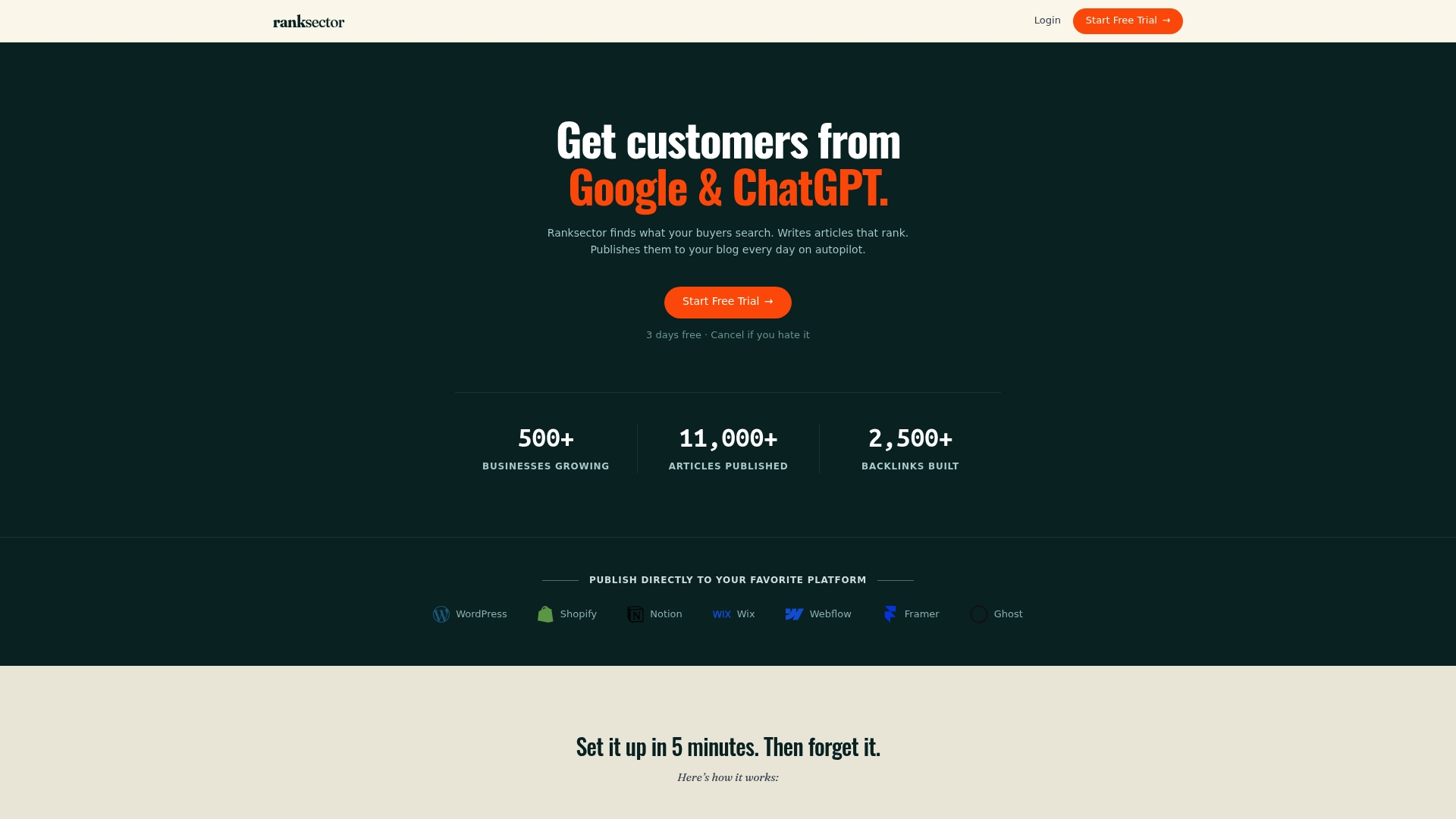
Ranksector publishes daily SEO-optimized articles for B2B SaaS companies and small sites, combining competitor-driven keyword research with a backlink exchange system that builds domain authority without manual effort. With over 11,000 articles already published, the platform handles the cluster-building work that this guide describes, at a pace no solo operator can match manually. You get targeted content every day, built around the long-tail phrases your competitors are ranking for, without hiring a writer or managing an editorial calendar.
If you want to test the approach before committing, start with Ranksector’s free tools to run a quick keyword discovery on your niche. For a faster assessment of where your site stands and which long-tail opportunities are closest to ranking, the AI audit surfaces those gaps in minutes.
Useful sources and further reading
- Long-Tail Keywords: What They Are and How to Get Search Traffic From Them — Ahrefs’ comprehensive breakdown of long-tail types, discovery methods, and SERP analysis
- Long-Tail Keywords in 2026: Complete Strategy + Free Tool — SEOMohub’s data on AI citation behavior, clustering recommendations, and conversion comparisons
- Long Tail Keywords Guide for Small Sites (2026) — Writesy’s audit findings on the 50–200 search volume sweet spot and zero-demand keyword failures
- Long-Tail Keywords: Why Small Businesses Win — GrowWithSakib’s practitioner timeline guidance for realistic ranking expectations
- Longtail Keywords: How to Find and Use Them in 2026 — Neal Schaffer’s guide to Search Console discovery and cannibalization prevention
- Technical SEO for Small Sites — Pfender Marketing’s focused checklist for the technical priorities that actually matter for small sites
- Find Untapped Keywords: Competitor Research Guide — Ranksector’s step-by-step process for surfacing competitor long-tail gaps
- Why Long Tail Keywords Beat Head Terms in 2026 — Ranksector’s comparison of long-tail vs head-term strategy for low-authority sites
- Common Keyword Research Mistakes Businesses Make in 2026 — Ranksector’s guide to avoiding the pitfalls covered in this article
- Google Search Console (free) — your primary tool for demand validation and near-win query discovery; check the Performance report weekly
Recommended
- Why Long Tail Keywords Beat Head Terms in 2026 · Ranksector Blog — Ranksector
- Types of SEO Quick Wins for Faster Rankings in 2026 · Ranksector Blog — Ranksector
- Keyword Position Tracking: A 2026 Guide for SEO Specialists · Ranksector Blog — Ranksector
- Rank on Google With a Low Budget: 2026 Guide · Ranksector Blog — Ranksector