
Why Long Tail Keywords Beat Head Terms in 2026
Long-tail keywords outperform head terms on every metric that actually moves revenue: conversion rate, ranking speed, and traffic quality. Long-tail queries account for the vast majority of all search queries, yet most SEO budgets pile into the 8.2% of head terms where billion-dollar brands have already planted their flags. That misallocation is expensive.
Here is what the data shows:
- Conversion rate advantage. Long-tail keywords convert at a substantially higher rate compared to broad head terms. That gap is not a rounding error.
- Ranking speed. New content can rank for long-tail queries within weeks or months. Most page-one results for head terms are two to three years old, built on domain authority that takes years to accumulate.
- Compound cluster effect. Ranking for one well-chosen long-tail keyword rarely means ranking for just one query. The average top-ranking page ranks for hundreds of related keywords, so each piece of content you publish compounds over time.
- AI search alignment. Google’s AI Mode uses query fan-out, expanding a single user query into multiple related sub-queries [how to choose long-tail keywords]. Long-tail content that covers those sub-queries gets cited in AI-generated answers, opening a traffic channel that head-term pages rarely capture.
- Competition gap. Most U.S. keywords get fewer than 10 monthly searches, meaning the long-tail space is vast and mostly uncontested.
What head terms and long-tail keywords actually are
The terminology gets misused constantly, so a clear definition matters before going further.
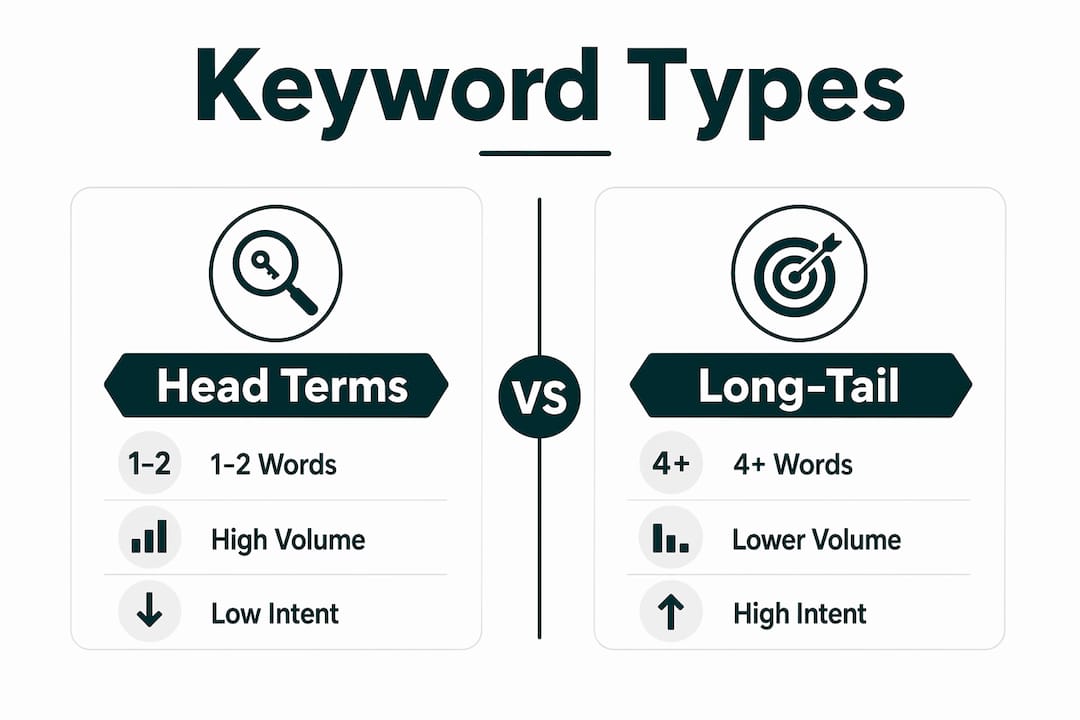
Head terms are short, broad queries, typically one or two words, with high search volumes and very low intent specificity. “Shoes,” “CRM,” and “insurance” are classic examples. They attract enormous traffic, but the people behind those searches could be researching, browsing, or just curious. You cannot tell what they want.
Long-tail keywords are more specific queries, often four or more words, with lower individual search volumes and much clearer intent. “Best CRM software for small real estate teams with email integration” is a long-tail keyword. The searcher has already made several decisions before they typed that phrase.
The most common misconception is that word count defines the category. It does not. The defining trait is search volume relative to the head term, not phrase length. A one-word term in a niche industry can be long-tail. A five-word phrase about a trending product might not be.
Quick examples:
- Head term: “running shoes” (100,000+ monthly searches, ambiguous intent)
- Long-tail: “best zero-drop trail running shoes for plantar fasciitis under $150” (low volume, high purchase intent)
- Head term: “email marketing” (broad research intent)
- Long-tail: “email marketing automation for e-commerce stores under 500 subscribers” (specific, transactional intent)
There is also a useful distinction between two types of long-tail keywords. Topical long-tail keywords represent a unique topic in their own right. Supporting long-tail keywords are just less popular variations of a broader query and often share the same keyword difficulty as the head term they shadow. Targeting topical long-tail keywords gives you a genuine competitive opening. Supporting ones often do not.
How head terms and long-tail keywords compare
The strategic differences between these two keyword types run deeper than search volume alone.

| Metric | Head terms | Long-tail keywords |
|---|---|---|
| Typical word count | 1–2 words | 4+ words |
| Monthly search volume | Hundreds of thousands | Relatively low |
| Keyword difficulty | Very high | Low to moderate |
| User intent clarity | Weak | Strong |
| Average conversion rate | Low single digits | Significantly higher |
| Ranking timeline | Years | Much shorter |
| Competition level | Often highly competitive | Generally lower |
A few points from that table deserve more context.
The keyword difficulty gap is what makes long-tail terms accessible to newer sites. High-difficulty head terms require comprehensive content and large backlink profiles that take years to build. Long-tail terms let you compete with focused, well-written content and moderate authority.
The intent gap explains the conversion gap. Someone searching “shoes” could be doing anything. Someone searching “buy waterproof trail running shoes for wide feet” has already narrowed their options, set a constraint, and is close to a decision. That specificity is why long-tail traffic converts at a dramatically higher rate.
Traffic quality also affects bounce rates. Head-term visitors who land on a page that does not match their undefined intent leave quickly. Long-tail visitors arrive already aligned with what you offer, so they stay longer and engage more.
One misconception worth addressing: long-tail keywords are not always low-value just because they carry low volume. Estimated search volumes consistently underreport actual search activity, especially for intent-driven queries. If the commercial intent is strong, the conversion math works even at modest traffic levels.
Why long-tail keywords matter more than ever in 2026
The SEO environment in 2026 has shifted the value of long-tail targeting from “useful tactic” to “core strategy.” Two forces are driving that shift.
The first is AI-powered search behavior. ChatGPT, Perplexity, and Google’s AI Mode all use query fan-out, a technique where the AI expands a user’s prompt into multiple related sub-queries before synthesizing an answer. Those sub-queries are almost always long-tail phrasings. Targeting long-tail keywords increases your chances of matching one of those sub-queries and appearing inside the AI-generated response, which is a brand citation channel that head-term pages rarely reach.
The second force is the shift from volume math to intent math. The SEO paradigm is moving away from chasing raw search volume toward mapping user intent precisely. Head terms attract research-mode visitors. Long-tail terms attract decision-mode visitors. That difference shows up directly in pipeline.
“You will never rank for ‘running shoes.’ You can absolutely rank for ‘best trail running shoes for plantar fasciitis under 200 dollars,’ and that searcher is far more likely to actually buy. The longtail argument is not about volume math. It is about competition you can win and visitors who convert. That is where the head-keyword strategy quietly fails, and where most teams stop the analysis right before the part that would have made them money.” — Neal Schaffer
Long-tail keywords also build topical authority faster than head-term campaigns. A cluster of tightly related long-tail pages signals to Google that your site covers a topic thoroughly, which eventually helps you compete for the broader head terms too. The path to head-term authority often runs through long-tail content first.
One important nuance: purely informational long-tail queries have lost some visit value as AI Overviews now answer those questions directly without sending clicks. The long-tail strategy still pays well for commercial and transactional queries, comparison content, and bottom-of-funnel buyer guides, where Google surfaces conventional results rather than AI summaries.

Best practices for using long-tail keywords
Knowing why long-tail keywords win is only half the job. Here is how to put that knowledge to work.
1. Prioritize buying intent over word count or volume. A six-word query with no commercial signal (“how to cook turkey tail mushroom kabobs”) will not convert. A shorter query like “turkey tail mushroom spawn” that clearly indicates purchase intent will. Focus on keywords that reflect high buying intent, not just specificity.
2. Use the right discovery tools. Semrush and Ahrefs both surface long-tail keyword opportunities through their keyword explorer features. Filter by low keyword difficulty and look for question-based queries, which tend to be conversational and intent-rich. Google’s “People Also Ask” and autocomplete suggestions are free starting points that often surface queries your competitors have missed.
3. Build dedicated pages for each target query. Sprinkling a long-tail keyword across an existing broad-topic page rarely works. Google’s algorithm ranks pages that satisfy search intent completely, and a diluted broad page cannot do that for a specific query. Dedicated content pages tailored to specific long-tail queries consistently outperform the “sprinkle” approach.
4. Group related long-tail keywords into clusters. A single well-structured page can rank for dozens of related queries if each section addresses a distinct sub-question. Build content around a cluster of related long-tail terms rather than a single phrase, and you capture more total traffic than any single-keyword page could.
5. Track rankings at the long-tail level. Standard rank trackers default to head terms. Set up keyword position tracking for your long-tail targets specifically, so you can see which clusters are gaining traction and where to publish next.
6. Monitor AI search behavior. Query fan-out means the sub-queries your content needs to cover are evolving. Review Google Search Console regularly for new queries your pages are already ranking for, and expand content to cover adjacent intent signals you had not originally targeted.
7. Balance long-tail wins with a long-term head-term plan. Long-tail clusters build the topical authority that eventually lets you compete for head terms. Treat them as the foundation, not the ceiling. As your domain authority grows from long-tail wins, use competitor keyword research to identify which head terms are becoming reachable.
Pro Tip: When evaluating a long-tail keyword with low reported search volume, check the SERP. If the top results are product pages or bottom-of-funnel content, the commercial intent is real regardless of what the volume tool says. Intent confirmed by the SERP beats a volume number every time.
Empirical insights on long-tail keyword effectiveness in 2026
The performance data for long-tail keywords is consistent across multiple sources, and the picture it paints is clear.
| Metric | Finding | Source |
|---|---|---|
| Share of all searches | 91.8% are long-tail queries | Backlinko analysis of 306M keywords |
| Average conversion rate | ~36% for long-tail vs. ~2.35% for head terms | Strategy Tech SEO |
| Cluster ranking effect | Top-ranking pages rank for ~400–1,000 related keywords | Ahrefs analysis |
| Keyword variety | Most U.S. keywords get fewer than 10 monthly searches | Ahrefs |
| Ranking gain | Long-tail keywords have faster ranking speed than head terms | Topicfinder |
The conversion gap is the figure that should reset your keyword priorities. Long-tail keywords convert at roughly 2.5 times the rate of head terms across most industry benchmarks. In some contexts, the gap is wider. That is not a minor efficiency gain. It means the same content investment produces more leads, more sales, and more pipeline when pointed at long-tail queries.
Practitioners who work with intent-driven long-tail clusters consistently find that actual search volumes exceed tool estimates for high-intent queries. Keyword tools measure recurring searches, but they miss one-off queries, AI-generated sub-queries, and voice searches that collectively represent real demand. If the intent is strong and the SERP confirms commercial activity, the investment is justified even when the reported volume looks thin.
The AI search dimension adds another layer. Commercial and transactional long-tail keywords retain strong value even as AI Overviews absorb clicks from purely informational queries. Product pages, comparison guides, and buyer-intent content still surface in conventional results for these terms, because Google has more reason to show purchasable options than to summarize an answer. That is where the long-tail strategy continues to compound.
Understanding how search intent shapes content decisions is what separates teams that get results from teams that get traffic. Volume is easy to measure. Intent is what converts.
Pro Tip: Avoid “supporting” long-tail keywords, which are just low-volume variations of a head term with the same keyword difficulty. They look easy but offer no real competitive advantage. Focus on topical long-tail keywords that represent a distinct search intent and a genuine ranking opportunity.
Ranksector automates the research, writing, and daily publication of long-tail content clusters for B2B SaaS teams, so you capture these opportunities without building a content team from scratch. Explore Ranksector’s free SEO tools to see how intent-driven keyword targeting works in practice.
Key Takeaways
Long-tail keywords beat head terms because they target decision-ready searchers, face far less competition, and compound ranking benefits across clusters of related queries.
| Point | Details |
|---|---|
| Conversion rate advantage | Long-tail keywords convert at a substantially higher rate compared to head terms, driving more pipeline. |
| Ranking speed | New content can rank for long-tail queries within weeks; head-term page-one results are typically two to three years old. |
| Cluster compound effect | The average top-ranking page ranks for 400–1,000 related keywords, multiplying the return on each piece of content. |
| AI search alignment | Google’s query fan-out generates long-tail sub-queries; covering them earns brand citations inside AI-generated answers. |
| Intent over volume | Most U.S. keywords get fewer than 10 monthly searches, making the long-tail space vast, uncontested, and worth targeting. |
Recommended
- Why Keyword Research Drives Content Decisions in 2026 · Ranksector Blog — Ranksector
- Common Keyword Research Mistakes Businesses Make in 2026 · Ranksector Blog — Ranksector
- Winning Keywords Niche Market Analysis: 2026 Guide · Ranksector Blog — Ranksector
- Find Untapped Keywords: Competitor Research Guide · Ranksector Blog — Ranksector