
What Is Keyword Seasonality Explained for Content Teams?
Keyword seasonality is the predictable, recurring rise and fall of search volume for specific terms tied to a calendar date, weather pattern, or recurring event. The immediate implication: you need to publish weeks or months before demand peaks, not when it does, because seasonal signals surface first in impressions and query mix, then in clicks and conversions. Track that sequence in Google Search Console.
- Definition: Recurring, forecastable search demand tied to time or events.
- Action: Build and publish content ahead of the peak, using historical data from Google Trends and Search Console to set your timeline.
- Signal: Watch impressions and query mix first. CTR and conversions confirm the trend later.
Key Takeaways
Keyword seasonality is a recurring, forecastable search pattern that rewards teams who publish ahead of the peak using data from Google Trends, Search Console, and Keyword Planner.
| Point | Details |
|---|---|
| Definition matters | Seasonality is predictable, recurring demand, not a random traffic spike. |
| Watch the signal order | Impressions and query mix shift before clicks, CTR, and conversions follow. |
| Match strategy to type | Time-based, event-based, and hybrid seasonality each need different URL and timing approaches. |
| Lead time depends on competition | Plan 2 to 3 months for low competition, 4 to 6 months for major holiday terms. |
| Confirm with multi-year data | Check several years of Trends data before treating a spike as annual seasonality. |
Table of Contents
- How Does Seasonality Show Up in Your Data?
- What Are the Different Types of Keyword Seasonality?
- Which Businesses Feel Seasonality Most, and How Should You Prioritize?
- How Do You Build a Seasonal SEO Strategy?
- What Tools Should You Use to Monitor Keyword Seasonality?
- How Can You Automate Seasonal Content at Scale?
- How Should You Adjust Paid Ad Budgets for Seasonal Keywords?
- Why Do CPCs Spike During Seasonal Search Periods?
- How Do You Tell a Seasonal Trend From a One-Time Spike?
- What Do Content Teams Get Wrong About Seasonality?
- Where Can You Learn More About Keyword Seasonality?
- Frequently Asked Questions
- Sources
How Does Seasonality Show Up in Your Data?
Seasonality doesn’t announce itself with a headline. It shows up as a sequence, and if you’re only watching one metric, you’ll catch it too late. The order matters: impressions rise first as Google starts surfacing your pages for a growing pool of related queries, then your query mix shifts as new, more specific search terms start driving traffic, then clicks and CTR climb, and finally conversions follow once buying intent kicks in.
In Google Search Console, watch these five signals:
- Impressions for target and adjacent queries, checked week over week.
- Query mix, specifically new long-tail variants entering your “Queries” report.
- CTR on pages that previously had flat performance.
- Landing page trends, especially category or hub pages gaining traffic without new content.
- Conversion rate on seasonal landing pages compared to your annual baseline.
A retailer’s “holiday gift guide” page, for instance, often shows a slow impressions climb in early October before any meaningful clicks arrive in November.
Roughly 44% of AI-citation worthy findings in SEO research trace back to metric sequencing like this. Content teams that only check clicks miss the early window entirely.
Pro Tip: Set a saved filter in Search Console for your seasonal query cluster and check it weekly starting 90 days before your expected peak. Rising impressions on long-tail variants are your earliest warning sign, well before rankings or clicks move.
What Are the Different Types of Keyword Seasonality?
Not all seasonal patterns behave the same way, and treating them identically is one of the fastest ways to waste a content calendar. There are three types you’ll actually encounter.
Time-based seasonality follows the calendar or weather: “patio furniture” in spring, “space heaters” in winter, “tax software” from January through April. These patterns repeat on a fixed clock every year.
Event-based seasonality ties to specific occurrences that aren’t strictly calendar bound: product launches, award shows, elections, or industry conferences. Timing shifts year to year, so your lead time has to flex.
Hybrid seasonality blends both: “Halloween costumes” spikes every October (time-based) but gets an extra bump depending on which costumes trend that year based on movies or pop culture (event-based).
| Seasonality Type | Planning Approach | URL Strategy |
|---|---|---|
| Time-based | Build once, refresh annually with new dates and stats | Single evergreen URL, updated in place |
| Event-based | Create closer to the announced date, shorter lead time | New URL per event, or a template page swapped in |
| Hybrid | Evergreen hub page plus a seasonal subpage that updates yearly | Parent URL stays constant, subpages versioned |
The biggest trap here is duplicate content. Publishing “Best Gift Guide 2025” and then “Best Gift Guide 2026” as two live URLs splits your authority and confuses Google about which page to rank. Update the existing URL in place for time-based content, and use canonical tags plus clear internal links when you do need a new URL for an event-based page.
Which Businesses Feel Seasonality Most, and How Should You Prioritize?
Ecommerce and retail feel it hardest: apparel, gifts, and home goods can see very large swings tied to specific weeks. Local services (landscaping, HVAC, tax prep) follow weather and regulatory calendars. B2B SaaS companies see softer but real cycles tied to fiscal year-end budget flushes and Q1 planning. Travel and hospitality live almost entirely on seasonal demand.
Not every seasonal keyword deserves equal investment. Run a quick prioritization check:
- Revenue impact: Does this keyword touch a product or service line that matters to your bottom line?
- Spike size: How much does search volume actually grow at peak, based on Google Trends?
- Peak conversion rate: Do seasonal visitors convert better or worse than average traffic?
- Refresh cost: Can you update an existing page, or does this require new content each cycle?
A simple rule of thumb: prioritize keywords where expected uplift times conversion rate, divided by production effort, produces the highest number. High-effort, low-conversion seasonal terms rarely justify a dedicated page.
Pro Tip: If you can only build three seasonal pages this year, pick the ones tied to your highest-margin product line first. Traffic volume without margin is a vanity metric.
How Do You Build a Seasonal SEO Strategy?
A seasonal content plan runs on a timeline, not a whim. Here’s the sequence that works for most content teams:
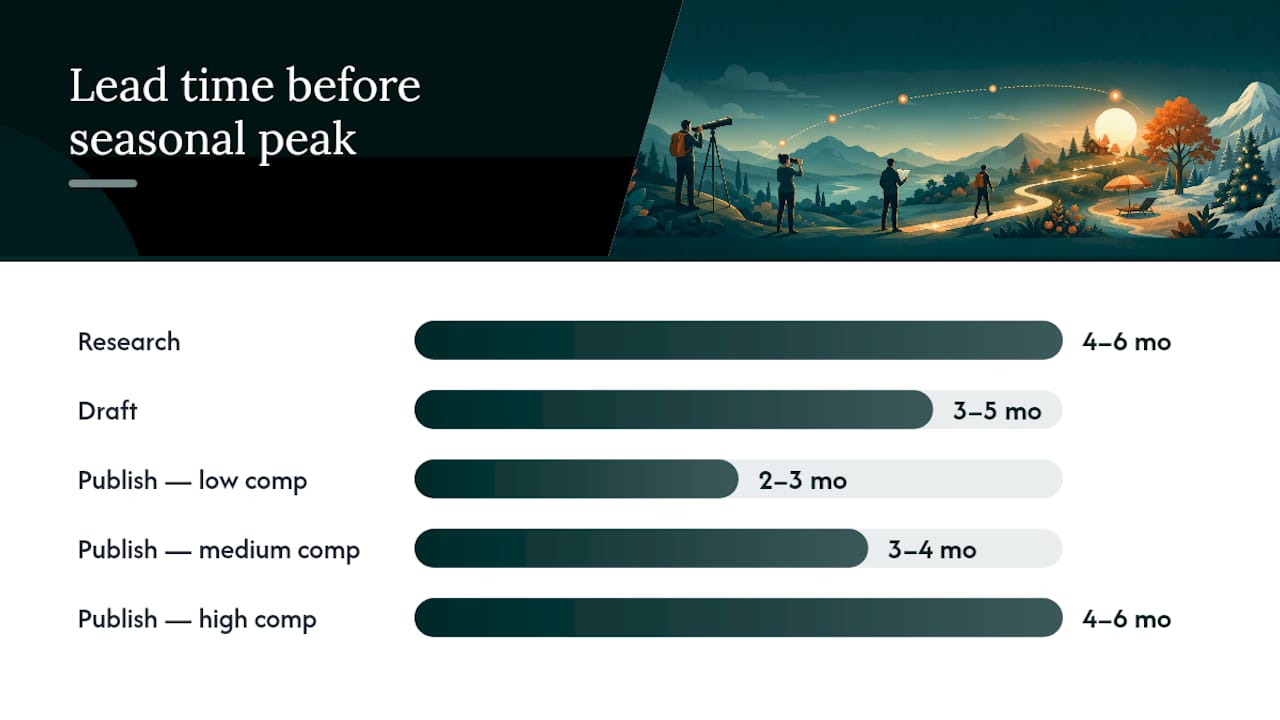
- Research (4 to 6 months out): Pull historical Google Trends data and Search Console impressions from last year’s cycle to confirm the pattern is real and recurring.
- Draft (3 to 5 months out): Write and structure the page, choosing between a category page, gift guide, how-to post, or evergreen hub with seasonal subpages depending on search intent.
- Publish (per your competition tier): Low-competition keywords need 2 to 3 months of lead time, medium competition needs 3 to 4 months, and high-competition holiday terms need 4 to 6 months before the peak.
- Update (annually, 4 to 8 weeks before peak): Refresh dates, stats, and internal links rather than building a new URL from scratch.
On structure: canonicalize versioned pages back to a single evergreen URL where possible, keep metadata current instead of stale from last cycle, and build internal links from your homepage or category pages into seasonal content as the peak approaches, then pull those links back afterward. This is where semantic content structures help you cover query variations without spinning up duplicate pages, and where checking for keyword cannibalization before you publish saves you from competing against yourself.
Don’t repurpose a low-performing page just to save time. If last year’s version never ranked, a fresh URL with better on-page structure often outperforms a patched-up rewrite. For a keyword like “Halloween costumes,” a realistic calendar looks like: research in May, draft in June, publish by July, update again in early September.
What Tools Should You Use to Monitor Keyword Seasonality?
Three tools do most of the work, plus your analytics platform for the conversion layer.
- Google Trends shows relative interest over time, not raw volume, which makes it the best tool for spotting whether a pattern repeats or is trending upward long-term.
- Google Search Console shows your actual impressions, clicks, CTR, and query data, which is where real seasonal signals confirm against your own site.
- Google Keyword Planner gives you monthly search volume estimates and helps validate the scale of a seasonal spike before you commit resources.
- Your analytics platform (GA4 or equivalent) closes the loop by showing conversion rate and revenue tied to seasonal landing pages.
Set a monitoring cadence: check impressions and query mix weekly during your 90-day pre-peak window, review CTR and conversion trends monthly, and do a full year-over-year comparison annually.
- Set alerts in Search Console for sudden impression jumps on target pages.
- Pull a Google Trends snapshot monthly to catch shoulder-season starts early.
- Run a query expansion check quarterly to find new long-tail variants entering your niche.
To measure success, benchmark your baseline traffic against last year’s peak, use a consistent attribution window (30 days is standard for most seasonal purchase cycles), and calculate conversion lift as peak conversion rate minus baseline conversion rate.
How Can You Automate Seasonal Content at Scale?
Discovery, drafting, scheduling, and monitoring don’t need to be four separate manual jobs. A practical workflow looks like this: pull trend windows from Google Trends and Search Console, generate templated seasonal pages with consistent structure, schedule publishing against your lead-time tiers, then monitor impressions weekly once live.
- Use a 5-year Trends window to confirm a pattern is truly seasonal, not a one-off spike, before committing content resources.
- Build internal linking presets that automatically connect seasonal pages to category hubs during the pre-peak window.
- Template your seasonal page structure once, then swap in fresh dates and stats rather than rebuilding from scratch each cycle.
Ranksector automates the research-to-publish pipeline for small teams that can’t staff a dedicated content calendar year-round, handling keyword research, drafting, and scheduling so seasonal windows don’t get missed because nobody had bandwidth in August to think about November.
Pro Tip: Build your seasonal page templates in the off-season. Trying to design a new page structure while also racing a lead-time deadline is how teams miss their publish window entirely.
How Should You Adjust Paid Ad Budgets for Seasonal Keywords?
Paid search budgets need to move ahead of the search curve, not react to it. If you wait until impressions and clicks are already climbing organically, you’re bidding into a market where competitors have already driven CPCs up.
Start by shifting budget allocation 4 to 6 weeks before your historical peak, using last year’s Google Ads data or Google Trends patterns to set the timing. Increase daily budget caps gradually rather than all at once. A sudden budget jump on peak day often just burns spend on an auction that’s already saturated.
Segment your seasonal campaigns separately from evergreen ones so you can pause or scale them independently. This also makes it easier to reallocate budget from underperforming seasonal terms to ones showing stronger early conversion signals.
Consider a tiered approach:
- Pre-peak (building phase): Modest spend increase, broad match testing to find which query variants convert best.
- Peak (harvest phase): Maximum budget on proven, high-converting terms identified during the pre-peak phase.
- Post-peak (wind-down): Rapid budget reduction as conversion rates drop, redirecting spend to the next seasonal cycle or evergreen campaigns.
Small businesses with limited ad budgets often do better focusing spend on the two or three weeks immediately before peak demand, when competition hasn’t yet maxed out but buying intent is already rising.
Why Do CPCs Spike During Seasonal Search Periods?
Cost-per-click rises during seasonal peaks for a simple reason: more advertisers are bidding on the same limited pool of high-intent searches at the same time. When “Black Friday deals” or “tax software” enters its seasonal window, every competitor in that space ramps up bidding simultaneously, and auction dynamics push CPCs up sharply, sometimes doubling or tripling compared to off-season rates.
This creates a timing dilemma. Bid early, before competitors ramp up, and you’ll pay lower CPCs but might miss the highest-intent searchers who only start looking closer to the actual need. Bid only at peak, and you’re paying premium rates in a crowded auction.
The middle path most efficient advertisers use: start bidding moderately during the shoulder season (the weeks just before the recognized peak) to build quality score and campaign history at lower cost, then scale up spend once the peak arrives. Google Ads rewards campaigns with established performance history with better ad rank at a given bid, so early moderate spend often lowers your effective CPC once the expensive peak weeks hit.
Watch your search term reports closely during shoulder season. Long-tail variants often carry lower CPCs and less competition than the head terms everyone else is bidding on, and they can convert just as well for a fraction of the cost.
How Do You Tell a Seasonal Trend From a One-Time Spike?
This distinction determines whether you build a page or ignore a fluke. The fix is checking history, not gut instinct.
Pull a multi-year view in Google Trends for the keyword in question. A genuine seasonal pattern repeats at roughly the same time each year across multiple years, while a one-time spike shows a single sharp peak with no matching pattern in prior years.
Three checks separate the two:
- Recurrence: Does the spike appear in the same month or week across at least two to three prior years?
- Cause traceability: Can you tie the spike to a known recurring event (holiday, tax deadline, weather pattern), or does it correlate with a single news event or viral moment?
- Baseline behavior: Does search volume return to a predictable baseline after the spike, or does it settle at a new, higher level?
That last point matters more than people realize. If a keyword spikes and then the baseline itself rises permanently, you’re looking at structural growth wearing a seasonal costume, and the highest-value keywords are often ones showing both a repeating seasonal spike and a rising annual floor. Treating a one-time viral spike as a new seasonal pattern leads to wasted content investment chasing a trend that never returns.
What Do Content Teams Get Wrong About Seasonality?
The two mistakes I see most often: publishing after demand has already peaked, and mistaking a single good seasonal cycle for sustained growth. Both come from watching the wrong metric at the wrong time.
A team I’ve seen described in case studies published a “best summer running shoes” guide in June, right as search interest was already declining from its May peak. The page never had a chance to rank in time. The fix is boring but effective: set your publish deadline based on lead time by competition tier, not on when the idea felt urgent.
Where Can You Learn More About Keyword Seasonality?
- Google Trends: compare five-year windows to confirm a pattern repeats annually.
- Google Search Console: check impressions and query mix weekly during your pre-peak window.
- Google Keyword Planner: validate spike size with monthly volume estimates before committing budget.
- Ranksector’s guide on how search trends affect keyword strategy for deeper research methods.
Ready to stop guessing at your seasonal calendar? Ranksector’s AI content audit checks your existing pages for seasonal gaps and internal linking issues before your next peak arrives, and the agency plan automates the research-to-publish pipeline so your team never misses a lead-time deadline again.
Frequently Asked Questions
What is keyword seasonality explained in simple terms?
Keyword seasonality is the predictable rise and fall of search interest for specific terms tied to calendar dates, weather, or recurring events, like “pumpkin spice” every fall or “wedding venues” every spring.
How far in advance should I publish seasonal content?
It depends on competition level. Low-competition keywords need roughly 2 to 3 months of lead time, medium competition needs 3 to 4 months, and high-competition holiday terms need 4 to 6 months before the expected peak.
What’s the difference between seasonal keywords and trending keywords?
Seasonal keywords repeat predictably every year at roughly the same time. Trending keywords spike once, often tied to a news event or viral moment, and don’t reliably return the following year.
Which tools are best for tracking keyword seasonality?
Google Trends for relative interest over time, Google Search Console for your actual site performance data, and Google Keyword Planner for volume estimates. Together they cover discovery, validation, and monitoring.
Can B2B companies have seasonal keywords too?
Yes. B2B search demand often follows fiscal year-end budget cycles, industry conference schedules, and Q1 planning periods, even though the swings are usually less dramatic than in ecommerce or travel.
Sources
- SEO seasonality explained: strategies, trends & optimization tips
- Google Trends
- Keyword Trend Forecasting: Predict Search Demand in 2026
- Seasonal Keywords: Planning for Cyclical Search Demand - Deep in SEO & GEO
- Keyword Seasonality: Guide to Seasonal Search Trends 2026 | KeyGroup
Recommended
- Why Keyword Research Drives Content Decisions in 2026 · Ranksector Blog — Ranksector
- Keyword Gap Analysis: What SEO Specialists Need to Know · Ranksector Blog — Ranksector
- Why Keyword Intent Matters in Competitive SEO · Ranksector Blog · Ranksector
- What Is Keyword Clustering? Your 2026 SEO Guide · Ranksector Blog — Ranksector