
Semantic SEO: Optimize for Topics, Not Just Keywords
Semantic SEO is the practice of optimizing content for topics, entities, and user intent rather than isolated keywords, so search engines and AI systems can understand what your page is about and surface it across a broader set of related queries. The immediate checks on any existing page: do your headings reflect a topic concept rather than a single phrase? Does the body use entity-rich language (named concepts, attributes, and relationships)? Is there at least one piece of structured data, such as Article or FAQ schema? Those three signals tell Google’s Knowledge Graph whether your content belongs in a semantic neighborhood or sits in isolation.
- Topic-focused headings: each H2 should answer a distinct question within the broader topic, not just repeat a keyword variant.
- Entity-rich language: name the concepts, tools, standards, and relationships your topic involves; don’t describe them vaguely.
- Structured data: at minimum, add Article schema to editorial pages and FAQ schema to any page with question-and-answer content.
Pro Tip: Run a quick audit by pasting your page’s H2s into a list. If every heading reads like a keyword variation of the same phrase, you have a keyword-focused page, not a topic-focused one. Rewrite each heading to answer a distinct user question.
Key Takeaways
Semantic SEO is the highest-leverage content investment available to marketing teams right now, because it serves organic search, AI Overviews, voice assistants, and featured snippets from a single, well-structured content architecture.
| Point | Details |
|---|---|
| Optimize for topics, not keywords | Build hub-and-cluster architectures that cover a concept from multiple angles, not isolated keyword pages. |
| Entity signals drive AI citations | Named entities, schema markup, and entity-rich anchor text determine whether AI answer engines include your content. |
| 35% of U.S. adults own smart speakers | Voice and conversational queries require direct answer sentences and FAQ sections on every major page. |
| Measure clusters, not pages | Track impressions and position across the full topic cluster in Search Console, not just the hub URL. |
| Ranksector scales the output | Automated daily publishing with competitive keyword research keeps your cluster growing without manual sprints. |
Table of Contents
- What is semantic SEO and how does search understand meaning?
- Why semantic SEO changes what you can rank for
- Core semantic SEO tactics that actually move the needle
- How to find semantic keywords and build topic clusters
- Which schema types strengthen your semantic signals
- How to measure semantic SEO results and set realistic timelines
- Research and E-E-A-T signals that support AI citation eligibility
- A step-by-step checklist to convert one page this afternoon
- Common mistakes that stall semantic SEO progress
- How voice search and AI assistants are reshaping semantic strategy
- How semantic SEO fits into your broader content marketing strategy
- Why semantic SEO is the framework that actually scales
- Daily topic-focused publishing without the manual grind
- Sources
What is semantic SEO and how does search understand meaning?
Search no longer matches documents to queries by counting keyword occurrences. It matches meaning to meaning. Modern search engines represent both queries and content as vector embeddings, numerical coordinates in a high-dimensional space, so a page about “content marketing for SaaS” and a query for “how do B2B companies attract organic traffic” can land close together even without sharing a single word.
Google’s Hummingbird update was the first major signal that keyword matching was giving way to intent parsing. RankBrain added machine-learning-based query interpretation, and BERT brought transformer-based natural language processing that reads full sentences rather than individual terms. Each update moved retrieval closer to how a human reader understands context.
Entity recognition is the practical layer underneath all of this. Search engines identify named concepts (people, places, products, events, abstract ideas) and map them to nodes in the Knowledge Graph. When your page explicitly names and defines those entities, links them to related concepts, and marks them up with schema, the page’s embedding clusters near the high-intent queries you want to rank for. Without those signals, even well-written content can sit in an ambiguous semantic neighborhood.
The flow looks like this: a user submits a query, the search system parses intent and identifies the core entities, it retrieves content whose embeddings cluster near those entities, and then an AI synthesis layer (Google’s AI Overviews, Bing’s AI features) assembles an answer from the highest-confidence sources. Microsoft’s Bing AI features make this pipeline visible: the system reads meaning, not markup, which is why semantic clarity at the content level matters as much as technical optimization.
Pro Tip: Think of your page as a node in a graph. Every internal link, every named entity, and every schema property is an edge connecting that node to a semantic neighborhood. Sparse nodes rank narrowly; well-connected nodes rank broadly.
Why semantic SEO changes what you can rank for
Semantic optimization increases topical relevance, improves your chances of appearing in AI-generated answers, and expands your coverage across long-tail query variants you never explicitly targeted. That last point is where the real traffic upside lives.
A keyword-focused page targets one phrase. A topic-focused page, built around a concept and its related entities, can surface across dozens of related queries because search systems recognize it as an authoritative source on the concept itself. Search Engine Journal explains that AI answer engines retrieve content classified by topical authority, not by exact-match presence, which means semantic structure is now a prerequisite for AI Overview inclusion.
The measurable outcomes you can expect:
- Impressions growth across a topic cluster as supporting pages index and reinforce the hub’s authority.
- CTR gains from featured snippets and People Also Ask boxes, which favor direct, entity-rich answers.
- AI Overview and answer engine appearances for pages with clear entity signals and layered structured data.
- Long-tail coverage from related queries you didn’t write for but whose intent your content satisfies.
- Voice search eligibility, since 35% of American adults own a smart speaker and voice queries are almost always conversational and intent-driven rather than keyword-driven.
Understanding how search trends affect your keyword strategy helps you see why conversational and AI-driven queries are growing faster than traditional head-term searches. Optimizing for topics rather than isolated phrases is the structural response to that shift.
Core semantic SEO tactics that actually move the needle
The five tactic groups that matter most: topic hubs and cluster pages, entity-rich writing, schema markup, internal linking, and FAQ/Q&A sections. Each solves a different problem in the semantic signal chain.
| Tactic | Intent coverage | Effort | Expected impact | Tools needed | When to prioritize |
|---|---|---|---|---|---|
| Topic hub + cluster pages | Broad, covers all subtopics | High (content creation) | High, sustained authority gain | SERP analysis, content planning tool | Long-term authority building |
| Entity-rich writing | Precise, concept-level | Low-medium (editing) | Medium, faster indexation | Entity extractor, Search Console | Any page, immediately |
| Schema markup | Structured, AI-answer eligible | Low (technical) | Medium-high, snippet and AI gains | Schema validator, CMS plugin | Pages targeting featured snippets |
| Internal linking | Reinforces cluster signals | Low (linking audit) | Medium, distributes authority | Site crawler, link audit tool | After cluster architecture is set |
| FAQ / Q&A sections | Question-intent, voice-ready | Low (content addition) | Medium, PAA and snippet gains | SERP scraper, PAA tools | Low-hanging wins on existing pages |
Topic hubs establish a central page that covers the concept comprehensively. Supporting cluster pages go deeper on each subtopic and link back to the hub. Backlinko’s semantic SEO guide describes this as creating topic-focused content that aligns with user intent across a network of related pages, not just a single optimized URL.
Entity-rich writing means naming the concepts your topic involves. Instead of “a popular tool for tracking rankings,” write “Google Search Console’s Performance report.” Specificity is what creates entity signals.
Schema markup is the most direct way to tell search engines what type of content a page contains and what entities it references. Article, FAQ, Organization, and Person schema are the starting points for most editorial sites.
Internal linking reinforces semantic neighborhoods. A hub page that receives contextual links from ten cluster pages sends a much stronger topical signal than a standalone page with no internal link context.
Pro Tip: The most common cluster mistake is weak anchor text on internal links. “Click here” or “learn more” carries no semantic signal. Use anchor text that names the concept the linked page covers, such as “semantic keyword clustering” or “FAQ schema implementation.”
How to find semantic keywords and build topic clusters
The goal is a topic map of questions, entities, and subtopics rather than a flat list of isolated keywords. A topic map tells you what to write, how to structure it, and which pages to link together.
Step-by-step workflow:
- Start with a seed concept, not a keyword. “Semantic SEO” is a concept; “what is semantic SEO” is one query expression of it.
- Query the SERP for your seed and collect every People Also Ask question, related search suggestion, and featured snippet format you see.
- Mine Google Search Console for queries your existing pages already receive impressions for. Queries with impressions but low clicks are often semantically adjacent topics you haven’t addressed directly.
- Use a query discovery tool (SERP analysis platforms, autocomplete scrapers) to expand the list with question variants and long-tail expressions.
- Run an entity extractor on your top-ranking competitors’ pages to identify which named entities appear consistently across high-ranking results.
- Cluster the terms into subtopics. Group by shared intent and entity overlap, not by surface-level word similarity.
- Map each cluster to a page type: hub page for the core concept, supporting pages for each subtopic, and FAQ additions for question-intent variants.
Mini walkthrough: Seed query: “content marketing for SaaS.” SERP reveals PAA questions including “how do SaaS companies do content marketing,” “what metrics matter for SaaS content,” and “how long does SaaS SEO take.” Related searches surface “SaaS blog strategy,” “B2B content funnel,” and “SaaS organic growth.” Search Console shows impressions for “SaaS content calendar” and “B2B blog frequency.” Cluster these into three subtopics: strategy and planning, metrics and measurement, and publishing cadence. Each subtopic becomes either a supporting page or a FAQ section on the hub.
Neil Patel’s LSI and semantic SEO guide recommends combining intent-focused copy with topical coverage to help search engines index content for a broader set of related queries, which is exactly what this clustering process produces.
Pro Tip: Don’t cluster by keyword volume alone. A subtopic with lower search volume but strong entity overlap with your hub often drives more topical authority than a high-volume tangent that doesn’t reinforce the core concept.
Which schema types strengthen your semantic signals
Structured data helps search engines and AI systems understand entity types and relationships. Add schema where it maps directly to your content type; don’t add it speculatively.
- Article schema: marks editorial content as a named creative work with an author, publisher, and publication date. This is the baseline for any blog post or guide.
- FAQ schema: marks question-and-answer pairs, making them eligible for People Also Ask boxes and AI-generated answer inclusion. Add it to any page with a Q&A section.
- Organization schema: establishes your brand as a named entity with a URL, logo, and contact information. This anchors your site in the Knowledge Graph.
- Person schema: marks author pages with name, credentials, and social profiles. Directly supports E-E-A-T signals for content that benefits from author authority.
- WebPage / CreativeWork schema: adds page-level metadata (description, keywords, about) that reinforces topical classification.
Layering these types is high-leverage. A page with Article + FAQ + Organization schema sends three distinct entity signals simultaneously, which Backlinko notes is a strong technical tactic for pages intended to win AI citations.
Validate your markup with Google’s Rich Results Test or the Schema Markup Validator before publishing. The most common errors are missing required properties (Article needs author, datePublished, and publisher) and mismatched entity types (marking a FAQ section as a HowTo). Search Console’s Enhancements report will flag live errors after indexation.
Pro Tip: Semantic-rich metadata in your page’s description and title tags also matters for AI Overviews. Read why meta descriptions matter after AI Overviews launched to understand how concise, entity-rich summaries improve snippet selection.
How to measure semantic SEO results and set realistic timelines
Expect measurable signals in Google Search Console within 6–12 weeks for indexation effects and 3–6 months for authority-driven ranking gains. That’s the honest timeline for most sites making structural changes to existing content.
KPIs to track:
- Impressions for topic clusters: rising impressions across a cluster’s pages (not just the hub) indicate the semantic neighborhood is being recognized.
- Average position for related queries: track position for the full cluster of queries, not just the primary keyword.
- CTR from featured snippets and PAA boxes: a direct measure of whether your structured answers are winning SERP features.
- Organic sessions from cluster pages: the business outcome that validates the strategy.
- AI Overview and answer engine appearance rate: track manually or with a rank tracker that flags AI-generated answer inclusions.
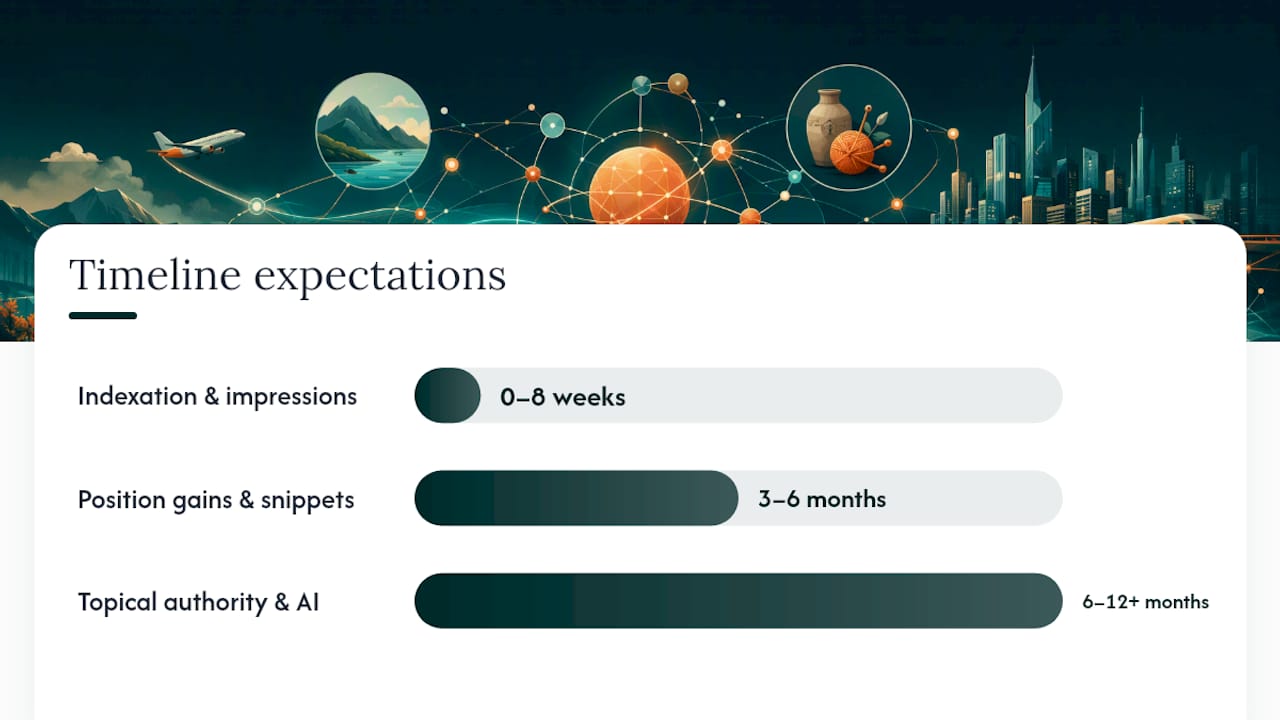
Timeline expectations:
- 0–8 weeks: indexation of new or updated pages, initial impressions for entity-rich content, schema validation in Search Console.
- 3–6 months: measurable position improvements for related queries, cluster pages beginning to support hub authority, featured snippet appearances.
- 6–12+ months: sustained topical authority, broad long-tail coverage, consistent AI Overview inclusion for high-confidence pages.
The effort difference between a small in-house edit (updating H2s, adding FAQ schema, strengthening internal links on one page) and a full cluster build (10–15 pages, hub architecture, layered schema) is significant. A single-page edit can show indexation signals in weeks; a cluster build takes months to mature but compounds over time. When your team is publishing fewer than two topic-focused articles per week, the compounding effect stalls. That’s the point where automated content publishing becomes worth evaluating seriously.
Research and E-E-A-T signals that support AI citation eligibility
AI answer engines prioritize meaning, entity clarity, and structured signals over raw keyword matches. That’s not a theory; it’s the operational reality of how LLM-based retrieval works.
E-E-A-T (Experience, Expertise, Authoritativeness, Trustworthiness) is Google’s framework for evaluating content quality, and its signals map directly onto semantic SEO tactics. Author bio pages with Person schema, on-site case studies with specific outcomes, and Organization schema that ties your brand to a verifiable entity all contribute to the trust layer that AI systems use when selecting sources for generated answers.
The practical implications:
| E-E-A-T signal | Semantic SEO tactic | Why it matters for AI citations |
|---|---|---|
| Author expertise | Person schema + author bio page | Establishes a named, credentialed entity as the content source |
| Topical authority | Hub-and-cluster architecture | Signals depth of coverage across a concept |
| Structured data | Article + FAQ + Organization schema | Gives AI systems machine-readable entity relationships |
| Internal citation | Contextual internal links with entity-rich anchor text | Reinforces conceptual neighborhood and source credibility |
What AI search engines look for when choosing citations breaks down the specific signals that influence AI source selection, including entity clarity, structured data presence, and topical depth. These align precisely with the semantic SEO tactics covered here.
A step-by-step checklist to convert one page this afternoon
An editable checklist of high-impact steps you can complete in a single session, applied to one existing page:
- Map the target concept. Write one sentence describing what the page is about as a concept, not as a keyword. If you can’t do this, the page’s focus needs clarifying before any other edit.
- Harvest related queries. Pull the page’s current queries from Google Search Console’s Performance report. Note every query with impressions but a position below 20.
- Rewrite H2s as topic questions. Each H2 should answer a distinct question within the concept. Replace keyword-variant headings with question-format headings that match PAA patterns.
- Add entity definitions and attributes. For every named concept in the body, add at least one attribute (a date, a relationship, a function). “Hummingbird” becomes “Google’s Hummingbird update (2013), which shifted ranking from keyword matching to intent parsing.”
- Add or update schema. Add Article schema if missing. Add FAQ schema to any Q&A section. Validate with the Rich Results Test.
- Strengthen internal links. Add at least two contextual internal links from cluster pages to this hub, using entity-rich anchor text.
- Update the meta description. Write a 150-character summary that names the core entity and the primary user question the page answers.
- Submit for indexing. Use Google Search Console’s URL Inspection tool to request re-indexing after changes are published.
Example: A page titled “SEO Tips for Startups” gets its H2s rewritten from “Keyword Research Tips” to “How do startups find low-competition keywords?” The body adds entity attributes for Google Search Console, Ahrefs, and Semrush. FAQ schema is added for the Q&A section. Two internal links from related cluster pages are added with anchor text “startup keyword research” and “low-competition SEO tactics.” The meta description is updated to: “Startups can rank faster by targeting low-competition keywords using Google Search Console and Ahrefs — here’s the process.”
Pro Tip: Don’t try to fix every page at once. Run this checklist on your three highest-impression, lowest-CTR pages first. Those pages already have search engine attention; semantic improvements there produce faster measurable results than starting with pages that have no impressions at all.
Common mistakes that stall semantic SEO progress
The most damaging mistake is confusing topical breadth with topical depth. Adding more sections to a page doesn’t create semantic authority; adding more specific, entity-rich content does. A 4,000-word page that repeats the same vague claims in different headings ranks no better than a 1,200-word page that names entities, answers distinct questions, and links to supporting cluster pages.
Weak cluster architecture is the second common failure. Many sites build a hub page but never create the supporting cluster pages that reinforce it. A hub with no cluster is just a long page. The semantic neighborhood signal comes from the network, not the hub alone.
Duplicated topic coverage across multiple pages confuses search engines about which page to rank. If you have three pages that all address “semantic keyword research” with similar content, none of them will rank well. Consolidate overlapping pages, use canonical tags where consolidation isn’t practical, and make sure each page in a cluster covers a distinct subtopic.
Schema errors are more common than most teams realize. Missing required properties, incorrect entity types, and schema that doesn’t match the visible page content all reduce the signal value of structured data. Validate every schema implementation before publishing and monitor Search Console’s Enhancements report for live errors.
Finally, treating semantic SEO as a one-time project rather than an ongoing content architecture practice means the gains plateau. Topical authority compounds when you keep publishing cluster pages; it stagnates when you stop.
How voice search and AI assistants are reshaping semantic strategy
Voice queries are longer, more conversational, and more intent-specific than typed searches. “Best CRM for small business” becomes “What’s the best CRM for a five-person sales team that doesn’t want to pay per user?” That shift in query structure means FAQ sections, question-format headings, and direct answer sentences are no longer optional for sites that want voice and AI assistant visibility.

Smart speaker ownership reaches 35% of American adults, and voice assistants on mobile devices extend that reach further. Every voice answer is pulled from a source that the AI system has classified as authoritative on the concept being asked about. That classification is semantic, not keyword-based.
The practical adjustment is straightforward: write one direct answer sentence at the top of each major section, formatted so it can stand alone as a complete response to the section’s question. This serves both featured snippet selection and voice answer extraction. Microsoft’s Bing AI features demonstrate how conversational AI search works in practice: the system synthesizes answers from sources it trusts on the topic, and trust is established through entity clarity and topical depth, not keyword density.
AI assistants also surface content from sources that appear consistently across a topic cluster. A single well-optimized page is less likely to be cited than a site with multiple pages covering the same concept from different angles. That’s another argument for cluster architecture over isolated page optimization.
How semantic SEO fits into your broader content marketing strategy
Semantic SEO is not a separate discipline from content marketing; it’s the structural layer that makes content marketing work at scale. Every content marketing decision, what to write, how to organize it, how to link it together, has a semantic SEO implication.
Topic clusters are the natural unit of both content marketing and semantic SEO. A content calendar built around topic clusters produces a coherent editorial program and a semantic architecture that reinforces topical authority. The two goals are the same goal expressed differently.
Technical SEO and semantic SEO overlap at schema markup and metadata. A technically sound site with clean crawlability and fast load times gives semantic signals the best chance of being read and acted on. Semantic improvements on a technically broken site produce limited results.
Search Engine Journal’s semantic SEO guide argues that topic clusters and entity signals improve ranking and AI-answer eligibility simultaneously, which means the content investment serves multiple channels: organic search, AI Overviews, voice assistants, and featured snippets. That multi-channel return is what makes semantic SEO the highest-leverage content investment for most marketing teams.
The integration with paid search is also worth noting. Paid campaigns that drive traffic to semantically optimized landing pages benefit from higher Quality Scores (Google rewards relevance between ad copy, landing page content, and user intent) and better post-click engagement because the page actually answers the question the ad implied.
Why semantic SEO is the framework that actually scales
Most SEO advice treats content as a collection of individual pages competing for individual keywords. Semantic SEO treats content as a network of related concepts competing for topical authority. That’s not a subtle difference; it’s a fundamentally different way of thinking about what you’re building.
The keyword-page model breaks down at scale because you eventually run out of high-volume keywords to target, and every new page you add competes with your existing pages for the same narrow queries. The topic-network model compounds because every new cluster page strengthens the hub’s authority and opens coverage for queries you never explicitly targeted.
What I’ve seen consistently is that teams who make the shift to topic-focused publishing don’t just rank for more queries. They rank for better queries, the ones where the user is further along in their decision process and more likely to convert. A page that ranks for “what is semantic SEO” attracts researchers. A cluster that covers semantic SEO from definition through implementation attracts practitioners who are ready to act.
The automation question is real. Building and maintaining a topic cluster manually requires consistent publishing, which most small marketing teams can’t sustain. That’s not a failure of strategy; it’s a resource constraint. The answer isn’t to publish less; it’s to find a way to publish consistently without burning out the team.
Daily topic-focused publishing without the manual grind
Keeping a semantic content program running requires consistent output, and that’s where most small teams stall. Writing one hub page is manageable. Writing the ten cluster pages that give it authority, then updating them as the topic evolves, is a different kind of commitment.
Ranksector is built for exactly this situation. Instead of hiring a content agency or burning your team on weekly article sprints, you get daily AI-generated, fully formatted, SEO-optimized articles published directly to your CMS, each one built around competitive keyword research drawn from your market and your competitors. The backlink exchange network grows your domain authority in parallel, without manual outreach. The large number of articles published across the platform means the system is proven at scale, not theoretical.
The difference from manual work is concrete: manual semantic content programs require a content strategist, a writer, an editor, and a technical SEO to coordinate on every cluster page. Ranksector handles the research, writing, formatting, internal linking suggestions, and publishing in one workflow. Editorial oversight still matters, and the platform is designed to support it, not replace it.
Start with Ranksector’s free tools to see how automated topic-focused publishing fits your current content program.
Sources
The sources below are worth bookmarking whether you’re a content strategist building cluster architecture or a technical SEO implementing schema at scale.
- Semantic SEO: Optimize for meaning, not just keywords — Search Engine Land
- Semantic SEO — Backlinko
- 7 ways to use semantic SEO for higher rankings — Search Engine Journal
Recommended
- Why Keyword Intent Matters in Competitive SEO · Ranksector Blog · Ranksector
- Types of SEO Quick Wins for Faster Rankings in 2026 · Ranksector Blog — Ranksector
- How Keyword Cannibalization Affects Rankings in 2026 · Ranksector Blog — Ranksector
- Why Long Tail Keywords Beat Head Terms in 2026 · Ranksector Blog — Ranksector