
How Search Trends Affect Your Keyword Strategy
Search trends are live signals of user intent that directly shape which keywords deserve your attention, when to publish, and how to structure content for maximum organic reach. Understanding how search trends affect keyword strategy separates reactive content teams from those that consistently capture traffic before competitors do. Tools like Google Trends, Semrush, and platforms like Ranksector give you the data to act on these signals with precision. The core principle is simple: keyword strategy built on static volume data alone decays. Trend-aware strategy compounds.
How do search trends affect keyword strategy in practice?
Search trends reflect real-time shifts in what users want to know, buy, or solve. When those shifts happen, the keywords that drive traffic change with them. A keyword that performed well six months ago may now face declining interest, while a rising term in the same category could deliver outsized returns with far less competition.
Targeting keywords with 80% year-over-year growth yields better ROI than chasing high-volume stable terms. That matters because emerging keywords carry lower competition, giving you a window to build topical authority before the market catches up.

The practical impact shows up in three areas: keyword selection, content timing, and content structure. Trend data tells you which terms are gaining momentum. Timing data tells you when to publish. Structural signals tell you what format and depth users expect. Ignoring any one of these makes your keyword strategy less effective than it could be.
Pro Tip: Treat keyword strategy as a living document, not a one-time deliverable. Schedule a monthly review of your top 20 target keywords against Google Trends to catch momentum shifts early.
What are the key types of search trends and how do they inform keyword choices?
Not all trends behave the same way, and treating them as identical is one of the most common mistakes in search behavior analysis. There are three distinct trend types you need to recognize.
Rising trends show sustained upward momentum over weeks or months. These represent genuine shifts in consumer interest and are the most valuable for long-term keyword investment. An example is the multi-year growth in searches for “AI content tools” as the category matured.
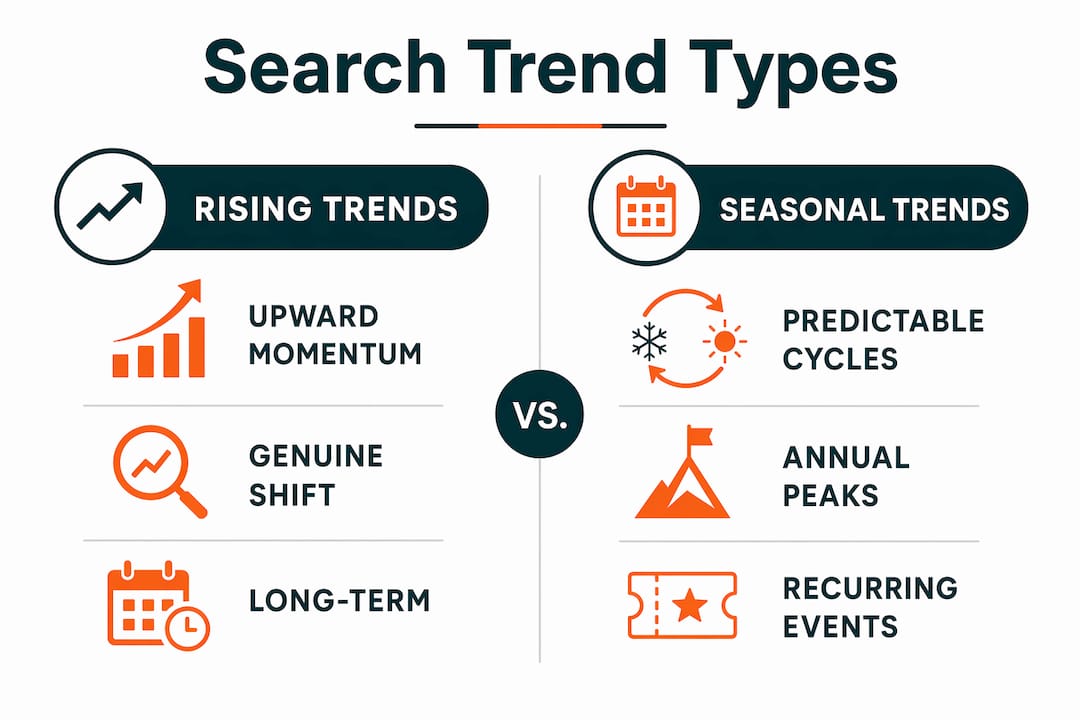
Seasonal trends follow predictable annual cycles. Tax software queries spike every january through april. Retail gift terms peak in november and december. Recognizing these patterns lets you plan content 4–8 weeks ahead of the cycle, which aligns with the 4–12 week indexing lag that SEO content requires before ranking.
Reflexive spikes are the trickiest. Search spikes often reflect real-time reactions that capture the window between a stimulus and a formed opinion. A news event, a viral post, or a product launch can trigger a spike that disappears within days. These are rarely worth building content around unless you can publish within 24 hours and have strong domain authority.
Here is how each trend type maps to keyword strategy decisions:
- Rising trends: Build pillar content and supporting cluster articles. Invest in backlinks early.
- Seasonal trends: Plan content 6–8 weeks before the peak. Refresh existing articles rather than creating new ones each year.
- Reflexive spikes: Monitor for patterns. If the same spike recurs across multiple events, it signals an emerging category worth targeting.
- Declining trends: Audit existing content. Redirect or consolidate pages targeting terms that have lost sustained demand.
Pro Tip: Use Google Trends’ “Related queries” section filtered to “Rising” to find subtopics gaining traction before they appear in traditional keyword volume tools.
How to use Google Trends and Semrush together for keyword validation
Google Trends functions as a forecasting layer that signals demand direction, not absolute search volume. This distinction is critical. A score of 100 in Google Trends means peak relative interest, not 100 searches. It tells you the direction of demand, not the size.
The right workflow combines Google Trends with a volume and competition tool like Semrush. Here is a practical four-step process:
- Identify a rising topic in Google Trends. Use the “Search topics” view rather than “Search terms” to capture broader intent signals and avoid keyword-specific noise.
- Validate volume and competition in Semrush. Pull the keyword difficulty score and monthly search volume. A rising trend with low difficulty is your highest-priority target.
- Check SERP composition. Look at what content types rank: articles, product pages, videos, or forums. This tells you the format users expect and the intent behind the query.
- Assess regional relevance. Google Trends lets you filter by country and metro area. A trend surging in one region may not justify national content investment.
| Signal | Google Trends | Semrush |
|---|---|---|
| Demand direction | Yes | No |
| Absolute search volume | No | Yes |
| Keyword difficulty | No | Yes |
| Regional breakdown | Yes | Limited |
| SERP composition | No | Yes |
The table above shows why neither tool alone is sufficient. Google Trends without volume data leads to chasing interest that may not convert. Semrush without trend data leads to targeting keywords that are already past their peak.
Pro Tip: When comparing two competing keyword options in Google Trends, use the “Compare” feature to see which term has stronger momentum over the past 90 days. Momentum often predicts where volume will shift next.
Why 90-day keyword re-audits are non-negotiable for SEO performance
Keyword strategy adjustments cannot wait for annual reviews. Search intent shifts faster than most content calendars account for, and the cost of ignoring those shifts compounds over time.
A 90-day keyword re-audit cycle is the industry standard for maintaining visibility and detecting intent shifts before they cause traffic loss. The trigger point is an impression drop of more than 20% in Google Search Console. That drop signals either a ranking change, an intent shift, or a trend reversal. Each requires a different response.
Delaying beyond three months creates a harder recovery. Delay beyond 90 days requires costly backlink efforts to reverse a downtrend, while an early refresh can correct course with content updates alone. The math strongly favors proactive audits.
A practical audit workflow looks like this:
- Pull impression data from Google Search Console for all target keywords over the past 90 days.
- Flag keywords with declining impressions and cross-reference against Google Trends to determine if the decline is trend-driven or a ranking issue.
- Review SERP composition for flagged keywords. If the top results have shifted from articles to videos or product pages, your content format may no longer match intent.
- Update or consolidate underperforming content. Refreshing an existing article is faster and often more effective than publishing a new one.
- Identify new rising terms from your trend monitoring and add them to the next content cycle.
You can find a detailed breakdown of the metrics that predict article rankings in this ranking metrics guide from Ranksector, which covers impression signals alongside other performance indicators.
Pro Tip: Set a recurring calendar reminder every 90 days to run your audit. Pair it with a Google Trends review of your top 10 keywords to catch momentum shifts before they show up as impression drops.
How AI and semantic forecasting are changing trend-driven keyword strategy
The shift from keyword matching to intent understanding is the defining change in SEO practice right now. SEO and GEO now operate as sequential layers where AI recommendation depends on both technical discovery and content trust. Getting indexed is not enough. Your content must also be recognized as authoritative by AI-driven search interfaces.
Semantic forecasting takes trend analysis one step further. Instead of reacting to what users are searching today, you model what they will search next based on rising related topics, community signals, and entity relationships. This is where long-tail keywords aligned with conversational queries become especially valuable. They match the natural language patterns used in AI interfaces like ChatGPT and Perplexity, and they carry lower competition than head terms.
“The shift from keyword matching to semantic forecasting gives strategists an advantage by anticipating consumer demand before it peaks in traditional search data.”
Practical recommendations for integrating trend data with AI-era SEO:
- Build content clusters around rising entities, not just individual keywords. Entity optimization improves AI discoverability.
- Use community sources like Reddit to identify conversational queries before they appear in Google Trends. These pre-opinion signals give you a 2–4 week head start.
- Align your content with Google’s E-E-A-T signals. AI systems prioritize content from demonstrably authoritative sources. The 2026 E-E-A-T guide from Ranksector covers the specific signals that matter most.
- Treat keyword research as a content driver rather than a pre-publication checklist. Trend data should inform your editorial calendar, not just individual articles.
Common pitfalls when using search trends for keyword decisions
The biggest mistake in trending keywords analysis is treating every spike as an opportunity. Misuse of trend data leads to chasing transient noise rather than sustained demand. A spike driven by a news cycle or a social media moment rarely produces lasting traffic, even if you publish quickly.
Here are the most common pitfalls and how to avoid each one:
- Publishing at the peak. SEO content takes 4–12 weeks to rank. Publishing when a trend peaks means you arrive after the traffic has already passed. Publish 4–8 weeks before the predicted peak instead.
- Ignoring context. A spike in searches for a health-related term may reflect public anxiety rather than commercial intent. Always check the broader social and economic context before investing in trend-driven content.
- Skipping volume validation. A rising trend with no search volume is a signal without an audience. Always confirm volume in Semrush or a comparable tool before committing resources.
- Treating all spikes equally. A term that spikes once is noise. A term that spikes repeatedly across different events is a category in formation. Track recurrence, not just magnitude.
- Neglecting existing content. New trend-driven articles compete with your own existing pages if you have not audited for keyword cannibalization first. Consolidate before you create.
Key Takeaways
Trend-aware keyword strategy consistently outperforms static volume-based approaches because it aligns content timing, topic selection, and format with real user demand.
| Point | Details |
|---|---|
| Trends signal demand direction | Use Google Trends for timing and momentum, not as a replacement for volume data from tools like Semrush. |
| Publish 4–8 weeks early | SEO content requires 4–12 weeks to rank, so publishing at a trend peak means arriving too late. |
| Run 90-day keyword audits | Impression drops over 20% trigger a manual SERP review; early audits reverse downtrends without costly link building. |
| Rising keywords beat stable ones | Keywords with 80% year-over-year growth deliver better ROI than high-volume terms with flat trajectories. |
| Community signals lead Google | Reddit and forums surface conversational queries 2–4 weeks before they appear in Google Trends data. |
The uncomfortable truth about trend-chasing in SEO
Trend data is genuinely useful. I have seen content teams double organic traffic by getting ahead of a rising keyword category six weeks before competitors noticed it. But I have also watched those same teams burn weeks chasing spikes that evaporated before a single article ranked.
The uncomfortable truth is that most marketers use trend data as a shortcut rather than a forecasting tool. They see a spike, write an article, and wonder why the traffic never comes. The discipline is in the interpretation, not the data collection. Google Trends is telling you about human curiosity in real time. That curiosity does not always translate into sustained search demand, and it almost never translates into traffic if you publish reactively.
What actually works is building a flexible content calendar with reserved slots for trend-responsive content, running your 90-day audits without skipping them, and treating community signals from Reddit and niche forums as your early warning system. The difference between ranking and being clicked matters here too. A trend-driven article that ranks for a term with mismatched intent will not convert, no matter how well-timed the publication was.
The marketers who consistently win with trend-driven keyword strategy are the ones who combine speed with judgment. They move fast on rising trends, but they validate intent, check volume, and audit for cannibalization before they publish. That combination is harder than it sounds, and it is exactly why most teams do not do it consistently.
— Savannah
How Ranksector helps you act on search trends faster
Staying ahead of search trends requires consistent execution, and that is where most content teams fall short. Ranksector automates the heavy lifting by combining competitor-driven keyword research with daily article publication, so your blog stays active even when your team is stretched thin.
Ranksector has published over 11,000 SEO-optimized articles for B2B SaaS companies, with a built-in backlink exchange that grows domain authority without manual outreach. For teams that need to act on trend signals quickly, the AI audit tool detects keyword impression drops and intent shifts before they become traffic problems. You can also explore the free SEO tools to start integrating trend data into your keyword workflow today.
FAQ
What is the difference between a rising trend and a seasonal trend?
A rising trend shows sustained upward momentum over months and signals a genuine shift in user interest. A seasonal trend follows a predictable annual cycle and requires advance content planning rather than a new long-term strategy.
How often should I update my keyword strategy based on search trends?
A 90-day re-audit cycle is the recommended standard. Impression drops of more than 20% in Google Search Console should trigger an immediate SERP review regardless of the scheduled cycle.
Can Google Trends replace a keyword research tool like Semrush?
No. Google Trends signals demand direction but does not provide absolute search volume or keyword difficulty scores. Use both tools together for accurate keyword validation.
How do I avoid chasing transient search spikes?
Check whether a spike recurs across multiple events before investing in content. Single-event spikes are usually noise. Validate any rising term with volume data and review the social or economic context driving the spike.
How do community platforms like Reddit help with keyword strategy?
Reddit and forums surface conversational queries before they appear in Google Trends, giving you a 2–4 week head start on emerging intent. These signals are especially useful for identifying long-tail keywords aligned with AI search interfaces.
Recommended
- Common Keyword Research Mistakes Businesses Make in 2026 · Ranksector Blog — Ranksector
- Why Keyword Research Drives Content Decisions in 2026 · Ranksector Blog — Ranksector
- Find Untapped Keywords: Competitor Research Guide · Ranksector Blog — Ranksector
- Free Keyword Research: A Practical Guide for Creators · Ranksector Blog — Ranksector