
Keyword Gap Analysis: What SEO Specialists Need to Know
Keyword gap analysis is defined as the process of identifying search queries where your competitors rank in the top 20 positions but your site lacks presence or ranks significantly weaker. The industry term for this practice is “competitive keyword gap analysis,” and it sits at the core of any data-driven SEO content roadmap. Rather than guessing what to write next, you use competitor ranking data to surface real opportunities with proven search demand. Ranksector builds this exact logic into its content automation workflow, connecting competitor keyword research directly to published articles. The result is a focused content plan that cuts through noise and targets gaps with the highest return.
What is keyword gap analysis and how does it work?
Keyword gap analysis works by comparing your domain’s keyword rankings against those of your competitors, then isolating the terms where they outperform you. Turning competitor data into a prioritized content roadmap is the core output of this process. Without it, content planning relies on instinct rather than evidence.
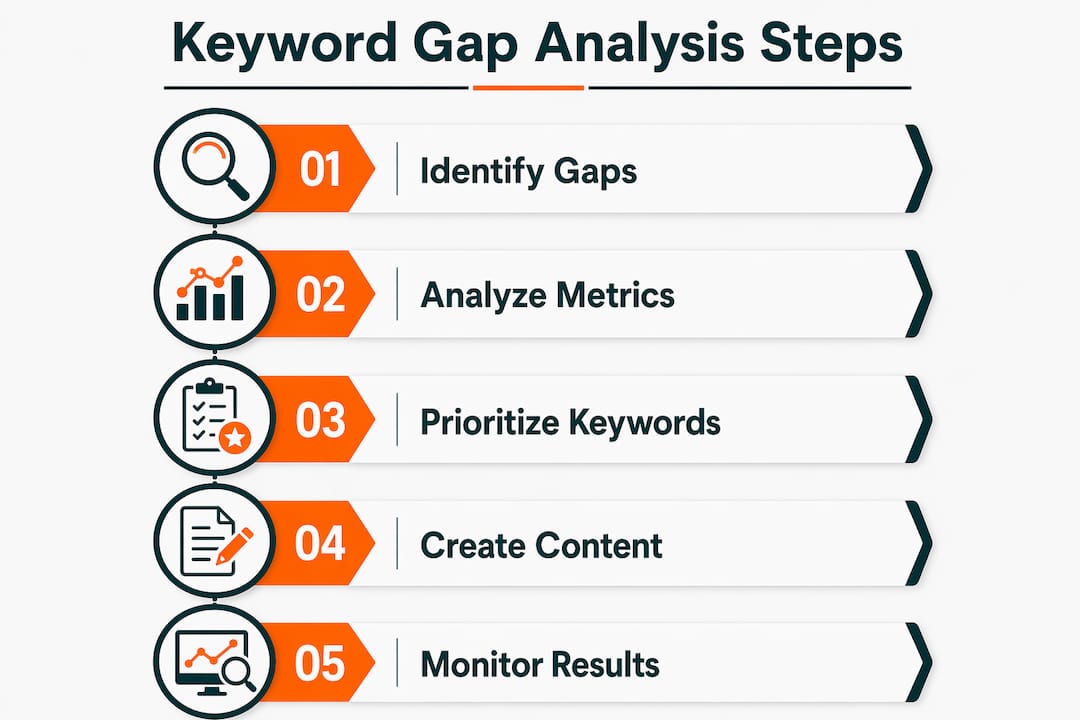
The standard workflow follows a clear sequence:
-
Enter your domain and competitor domains into a keyword gap tool. Most platforms accept two to five competitor URLs at once, giving you a broad comparison set.
-
Filter for “missing” and “weak” keywords. Missing keywords are terms your competitors rank for and you do not appear for at all. Weak keywords are terms where you rank outside the top 10 while a competitor holds a top-three spot.
-
Sort by search volume and keyword difficulty (KD). High-volume terms with a KD score your domain can realistically compete for are your primary targets. KD and personal keyword difficulty scores factor in your site’s topical authority, not just raw competition data.
-
Export the filtered list and group by topic cluster. Grouping related terms together reveals content themes rather than isolated keywords. A cluster around “SaaS onboarding” might contain 15 related queries you can address in two or three articles.
-
Prioritize by topical relevance and business fit. A keyword with 8,000 monthly searches means nothing if it attracts an audience that will never buy your product. Filter your export by terms that align with your funnel stage and product category.
-
Validate with SERP inspection. Before committing to a keyword, check the actual search results page. If the top results are all enterprise tools and your site is early-stage, the gap may not be winnable yet.
Pro Tip: Focus first on high-volume gaps where competitors rank in positions 1–3 and your site is completely absent. These represent the clearest signal that demand exists and you are missing it entirely.
What metrics actually matter in gap analysis?

Search intent is the most important metric in any keyword analysis, and volume is a distant second. Effective keyword analysis weighs intent, competition, and relevance together rather than treating volume as the primary signal. A keyword with 500 monthly searches and clear commercial intent outperforms a 10,000-search informational term for most B2B SaaS companies.
The key factors to evaluate for each gap keyword are:
- Search intent: Is the query informational, navigational, commercial, or transactional? Match the intent to your content type before building a page.
- Keyword difficulty: KD scores estimate how hard it is to rank based on the authority of current top-ranking pages. A score above 70 is generally difficult for newer domains.
- Personal keyword difficulty (PKD): PKD adjusts the difficulty score based on your specific domain’s topical authority. A term with KD 55 might have a PKD of 30 for your site if you already publish heavily in that niche.
- Domain authority fit: Chasing keywords dominated by sites with domain ratings above 80 when your own is below 40 wastes resources. Target gaps where the ranking pages are closer to your authority level.
- Business relevance: Every keyword on your list should connect to a product, service, or audience segment you actually serve.
- SERP feature presence: If a keyword triggers featured snippets, People Also Ask boxes, or video carousels, your content format needs to match what Google is already rewarding.
“Keywords are not inherently good or bad. Their value depends entirely on alignment with business goals, domain authority, and real-world search intent. A keyword that converts for one site may be worthless for another.”
Topical authority compounds over time. When you build content clusters around related gap keywords, each new article reinforces the others. A site that publishes 10 articles on SaaS pricing signals deeper expertise than one that publishes a single high-volume piece. Prioritizing keyword clusters over isolated terms produces stronger long-term ranking gains.
Common mistakes that undermine keyword gap analysis
The most frequent mistake is treating keyword gap analysis as a one-time task. Competitors publish new content, earn new rankings, and shift their focus constantly. A gap that did not exist six months ago may now represent your biggest missed opportunity. Running the analysis quarterly is the minimum for active SEO programs.
The other major errors follow a predictable pattern:
- Chasing volume without checking intent. Ignoring intent in favor of volume is the primary reason high-volume gap keywords fail to convert. A keyword like “project management” has enormous volume but almost no commercial specificity for a niche SaaS tool.
- Skipping SERP inspection. Raw keyword data does not tell you who currently ranks or why. SERP analysis contextualizes the data and reveals whether the gap is actually winnable for your domain.
- Creating keyword cannibalization. Producing multiple pages targeting the same intent splits your ranking signals and stalls progress. Before creating a new page, check whether an existing page already targets the same query.
- Ignoring long-tail clusters. Marketers often fixate on head terms with the highest volume. Long-tail keyword clusters frequently convert better and face less competition, making them faster wins for growing sites.
- Treating gap analysis as separate from content strategy. The output of a gap analysis should feed directly into your editorial calendar. If the keyword list sits in a spreadsheet and never becomes content, the analysis produced no value.
Pro Tip: Before publishing any new page targeting a gap keyword, search that query yourself and read the top three results. If your planned content does not clearly answer the query better than what already ranks, revise your angle before you write a word.
Avoiding common keyword research mistakes requires treating gap analysis as an ongoing discipline, not a quarterly checkbox.
What tools support keyword gap analysis?
The two most widely used platforms for gap analysis are Semrush Keyword Gap and Ahrefs Content Gap. Both allow you to compare domains and filter results by missing or weak keywords, with sorting by volume, KD, and ranking position. The core difference is in analysis depth: Semrush Keyword Gap operates at the domain level, while Ahrefs Content Gap can compare individual URLs, which is useful when you want to analyze a single competitor page rather than their entire site.
| Feature | Domain-level tools | URL-level tools |
|---|---|---|
| Scope | Full site keyword comparison | Page-by-page gap identification |
| Best for | Broad content strategy | Targeting specific competitor pages |
| Output | Missing and weak keyword lists | Granular content opportunity data |
| Typical use case | Quarterly gap audits | Article-level competitive research |
Google Search Console adds a layer that paid tools cannot replicate. It shows you which queries your site already appears for, including low-impression terms you may not know about. Combining Search Console data with a gap analysis tool gives you a complete picture: what you rank for, what you are missing, and where competitors are pulling traffic you should be capturing.
For teams running competitor SEO research at scale, the workflow matters as much as the tool. Exporting gap data into a shared content calendar, tagging each keyword by cluster and funnel stage, and assigning ownership to specific articles turns raw data into a publishing plan.
Key Takeaways
Keyword gap analysis is the most direct method for converting competitor ranking data into a content plan that targets proven search demand.
| Point | Details |
|---|---|
| Core definition | Gap analysis finds queries where competitors rank in the top 20 and your site does not. |
| Intent over volume | Search intent determines keyword value more than raw monthly search volume. |
| Avoid cannibalization | Never create two pages targeting the same intent; it splits ranking signals and stalls both pages. |
| Use layered tools | Combine Semrush or Ahrefs gap data with Google Search Console for a complete picture. |
| Repeat the process | Run gap analysis at least quarterly, as competitor rankings and content shift continuously. |
Why most teams underuse their gap data
The gap analysis itself is rarely the problem. What I see consistently is that teams run a thorough analysis, export a solid keyword list, and then let it sit. The spreadsheet becomes a graveyard of good intentions. The actual bottleneck is execution: turning a list of 200 gap keywords into published, ranking content requires sustained output that most small teams cannot maintain manually.
The other pattern I notice is overconfidence in high-volume terms. A keyword with 15,000 monthly searches looks like a prize until you inspect the SERP and find that every ranking page belongs to a domain with a rating above 85. The real wins in gap analysis almost always come from the middle of the list: moderate volume, manageable competition, and clear commercial intent. Those are the terms that move the needle for growing sites.
Layering competitive SERP analysis on top of gap data is what separates teams that rank from teams that plan. The gap tells you what to target. The SERP tells you how to win it. Both steps are necessary, and skipping the second one is where most execution falls apart.
— Savannah
How Ranksector turns gap analysis into published content
Identifying keyword gaps is only half the work. The harder part is publishing enough content to capture those opportunities before your competitors do.
Ranksector automates the full cycle: competitor-driven keyword research, article creation, and daily publication, all without requiring a dedicated content team. The platform has published over 11,000 SEO-optimized articles for B2B SaaS companies, and its backlink exchange system builds domain authority alongside content volume. You can start by exploring Ranksector’s free SEO tools to surface your own keyword gaps, or run an AI-powered audit to see exactly where your content strategy has holes worth filling.
FAQ
What is keyword gap analysis in SEO?
Keyword gap analysis is the process of identifying search queries where competitor sites rank in the top 20 positions and your site does not appear or ranks significantly lower. The output is a prioritized list of content opportunities grounded in real competitor data.
How often should you run a keyword gap analysis?
Running gap analysis at least quarterly is the standard for active SEO programs. Competitor rankings shift continuously, so gaps that did not exist six months ago may now represent significant missed traffic.
What is the difference between missing and weak keywords?
Missing keywords are terms your competitors rank for and your site does not appear for at all. Weak keywords are terms where your site ranks outside the top 10 while a competitor holds a top-three position.
Why does search intent matter more than search volume?
High-volume gap keywords frequently fail to convert when the intent behind the query does not match your product or content. A lower-volume keyword with clear commercial intent produces better results than a high-volume informational term for most B2B sites.
Can keyword gap analysis cause keyword cannibalization?
Yes. If you create multiple pages targeting the same intent to fill gaps, those pages compete against each other in search results. Always check whether an existing page already targets a gap keyword before building a new one.
Recommended
- How to Find Keyword Gaps Competitors Miss: A SaaS SEO Workflow · Ranksector Blog — Ranksector
- Rank for Competitor Traffic Keywords: 2026 SaaS Guide · Ranksector Blog — Ranksector
- Find Untapped Keywords: Competitor Research Guide · Ranksector Blog — Ranksector
- Keyword Opportunity Identification Guide for SEO Pros · Ranksector Blog — Ranksector