
Competitive SERP Analysis Best Practices for SEO Teams
Competitive SERP analysis is defined as the process of identifying which domains rank for your target keywords and understanding why they outperform you. The most effective competitive SERP analysis best practices center on per-keyword competitor identification, not broad domain assumptions. Google ranks content based on complex ecosystem trust patterns, meaning your real competitors shift by keyword, location, and search intent. Ranksector’s content workflows are built around this reality, treating each keyword as its own competitive battlefield rather than a static list of industry rivals.
1. Identify your true SERP competitors per keyword
Your business competitors and your SERP competitors are rarely the same list. True SERP competitors are domains that overlap with your keyword rankings, regardless of industry or business model. A SaaS company selling project management software might compete on certain keywords against a productivity blog, a university research page, or a news outlet.

The standard practice in 2026 is to analyze the top 5–10 recurring domains per keyword cluster rather than per domain. This gives you a precise picture of who actually holds the ground you want.
To identify your real SERP competitors:
- Pull the top 10 results for each target keyword manually or with a rank tracker
- Note which domains appear across multiple keywords in your cluster
- Flag domains that rank for your keywords but operate in unrelated industries
- Segment competitors by keyword intent: informational, commercial, and transactional
- Repeat this process across device types and geographic locations
Pro Tip: Run your top 20 keywords through a SERP glossary reference to confirm you are interpreting search intent correctly before building your competitor list.
2. Use a 4-step framework for structured SERP analysis
A repeatable framework turns SERP research from a one-off task into a systematic process. The 4-step SERP analysis framework covers competitor discovery, content ecosystem review, gap analysis, and opportunity scoring.
Step 1: Identify top-ranking domains and entities
List the domains that consistently appear in positions 1–10 for your keyword set. Note the entity types: publishers, brands, aggregators, or user-generated content platforms. This tells you what Google trusts for this topic.
Step 2: Analyze the content ecosystem
Go beyond reading competitor articles. Map their content structure, heading depth, media use, internal linking patterns, and word count ranges. Content ecosystems often require structural or site architecture changes, not just content updates, to overcome entrenched competitors. A page ranking in position 1 may hold that spot because of topical authority built across 40 supporting articles, not because of one great post.
Step 3: Conduct gap analysis
Identify subtopics your competitors cover that you do not. Also look for subtopics nobody covers well. These gaps are your fastest path to rankings. Use the “People Also Ask” section in Google to surface questions competitors have answered only partially.
Step 4: Score opportunities by intent and difficulty
Rank each gap by three factors: how well it aligns with your audience’s intent, how difficult the keyword is to rank for, and how many resources you need to produce a competitive piece. This scoring prevents you from chasing high-difficulty keywords when lower-effort wins are available.
| Scoring Factor | What to measure |
|---|---|
| Intent alignment | Does the keyword match what your audience actually needs? |
| Competitive difficulty | How many strong domains hold the top 5 positions? |
| Asset requirements | Does ranking require video, data, or original research? |
| Time to rank | Is this a quick win or a 6-month content build? |
3. Perform SERP gap analysis to find hidden opportunities
SERP gap analysis uncovers the blind spots in your content strategy and your competitors’ strategies. A blind spot keyword is one where a competitor ranks without having built content specifically for it. That accidental ranking signals weak coverage you can directly target.
The “People Also Ask” box is one of the most underused tools for gap discovery. Each PAA question represents a subtopic Google has confirmed users want answered. If your competitors’ pages answer those questions only in passing, you can build a dedicated section or standalone article that answers them thoroughly.
Practical steps for gap analysis:
- Export your competitors’ ranking keywords using a keyword research platform
- Filter for keywords where they rank in positions 4–20 (weak rankings you can displace)
- Cross-reference with PAA questions for your core topics
- Check which subtopics appear in competitor H2 and H3 headings but lack supporting depth
- Flag any keyword where no competitor has original data, a case study, or a unique angle
Pro Tip: Use a keyword gap workflow to systematically document blind spot keywords before your content calendar is set. This prevents you from planning content that duplicates what already ranks.
The real advantage in SERP competition comes from offering unique, deeper content, not copying what already ranks. Filling a gap with a slightly better version of an existing article rarely moves rankings. Filling it with original data, a clearer structure, or a perspective no competitor has taken is what actually works.
4. Track SERP features, volatility, and competitor momentum
Modern SERPs are not static lists of 10 blue links. Featured snippets, knowledge panels, local packs, image carousels, and AI Overviews each occupy real estate that used to belong to organic results. Ignoring these features means misreading the competitive environment entirely.
Monitoring SERP volatility tells you when Google is actively reconsidering who should rank for a keyword. Tracking ranking spikes and content updates of competitors lets you reverse-engineer what triggered a position jump. If a competitor gained 15 positions after a content redesign, that is a signal worth investigating.
Key elements to monitor:
- Which SERP features appear for your target keywords (snippets, PAA, local packs)
- Which competitors own those features and what content format they used
- Weekly ranking fluctuations for your top 50 keywords
- Competitor content update frequency and the timing of their ranking changes
- AI Overview citations: which domains get cited and what content format they use
Running “pre-flight” checks across AI-enhanced search engines before you build new content is now a standard practice. Checking how Google AI Overviews and Perplexity fragment and cite content tells you what structure and depth your piece needs to earn a citation.
5. Build a workflow for ongoing SEO competition research
One-time SERP analysis is a snapshot. Ongoing monitoring is a competitive advantage. Backlink overlap analysis combined with regular SERP tracking gives you a continuous read on where competitors are gaining ground and where they are losing it.
A practical ongoing workflow looks like this:
- Weekly: Check ranking changes for your top 50 keywords and flag any competitor movement above 5 positions
- Monthly: Audit competitor content updates, new pages, and backlink acquisitions in your keyword space
- Quarterly: Run a full gap analysis to identify new blind spots and emerging subtopics
- Per campaign: Conduct a pre-flight SERP check before publishing any new content
Ranksector’s free SEO tools support this kind of continuous monitoring without requiring a full enterprise platform budget. For teams that need deeper tracking, Ranksector’s competitor SEO research guide maps out the full methodology for 2026.
Checking for keyword cannibalization is also part of a healthy ongoing workflow. When two of your own pages compete for the same keyword, you split authority and reduce the chance either one ranks well.
6. Analyze SERP topology to spot structural weaknesses
SERP topology refers to the content cluster patterns, format signals, and structural features that define who ranks and why. Most SEOs focus on content quality, but topical authority and structural SEO features are often the actual barriers to ranking. A competitor may hold position 1 not because their article is better written, but because they have 30 supporting articles that build topical depth across the subject.
To analyze SERP topology for a keyword cluster:
- Map the internal linking structure of the top 3 ranking pages
- Count how many supporting articles each competitor has on related subtopics
- Identify whether top-ranking pages use schema markup, structured data, or FAQ sections
- Note the average content depth: are top results 800-word overviews or 3,000-word guides?
Understanding this topology tells you whether you need to write one great article or build out an entire content cluster to compete. Trying to rank a single page against a competitor with a 40-article topical cluster is like trying to win a relay race by running only one leg.
7. Monitor competitor keyword rankings regularly
Tracking your competitors’ keyword rankings over time reveals strategic patterns that a one-time audit misses. A competitor who consistently gains rankings in a specific subtopic is signaling where they are investing. That is information you can use.
The standard approach is to track the top 3–5 SERP competitors per keyword cluster on a weekly basis. You are looking for ranking velocity, not just position. A competitor moving from position 8 to position 3 over four weeks is worth more attention than one sitting at position 2 for six months.
Pair ranking data with content change detection. When a competitor’s ranking improves, check whether they updated their page. If they added a new section, changed their title tag, or built new backlinks, that combination is your signal to investigate and adapt.
8. Use untapped keyword research to stay ahead
The most overlooked part of competitive SEO research is finding keywords your competitors have not targeted yet. These untapped keyword opportunities exist in every niche. They tend to cluster around emerging subtopics, long-tail variations, and questions that appear in PAA but have no dedicated content ranking for them.
Identifying these keywords before competitors do gives you a first-mover advantage. You build topical authority in a space before it becomes contested. By the time competitors notice the traffic opportunity, you already hold the ranking.
The process is straightforward: pull PAA questions for your core keywords, check whether any dedicated pages rank for those questions, and build content that answers them directly. Combine this with competitor traffic keyword research to find keywords driving traffic to competitors that you have not yet targeted.
Key Takeaways
Competitive SERP analysis works best when it combines per-keyword competitor identification, content ecosystem mapping, gap analysis, and ongoing ranking monitoring into one repeatable workflow.
| Point | Details |
|---|---|
| Per-keyword competitor identification | Analyze the top 5–10 recurring domains per keyword, not your industry rivals list. |
| 4-step analysis framework | Cover competitor discovery, content ecosystem review, gap analysis, and opportunity scoring. |
| SERP gap analysis | Target blind spot keywords and PAA subtopics competitors cover weakly or not at all. |
| SERP feature and volatility tracking | Monitor snippets, AI Overviews, and ranking spikes to catch competitor momentum early. |
| Ongoing workflow | Run weekly ranking checks, monthly content audits, and quarterly full gap reviews. |
What I’ve learned from watching SEOs misread their competition
The most common mistake I see is SEOs building their competitor list from a CRM or a sales deck. They define competitors by business category, then wonder why their content never ranks. Your SERP competitors are whoever Google puts in the top 10 for your keywords. That list changes by keyword, by location, and sometimes by the day of the week.
The second mistake is metric replication. An SEO sees a competitor ranking at position 1 with a 2,500-word article and a domain rating of 60, so they write a 2,600-word article and build 10 backlinks. That logic misses the point entirely. What you should be studying is the content ecosystem behind that ranking: how many supporting pages does the competitor have, what schema markup do they use, and what trust signals does Google associate with their domain?
The mindset shift that actually produces results is moving from “how do I match this competitor” to “what can I offer that this competitor cannot?” That might mean original data, a more specific audience angle, or a content format nobody in the space has tried. The real advantage in SERP competition comes from depth and differentiation, not duplication.
Execution is where most analysis dies. You can produce a perfect gap analysis and a flawless opportunity score, but if it sits in a spreadsheet for three months, a competitor will fill that gap before you do. Build your analysis directly into your content calendar. Treat every gap you find as a deadline, not a suggestion.
— Savannah
How Ranksector fits into your competitive SERP workflow
Keeping up with competitive SERP analysis while also publishing consistent content is a real resource problem for lean SEO teams.
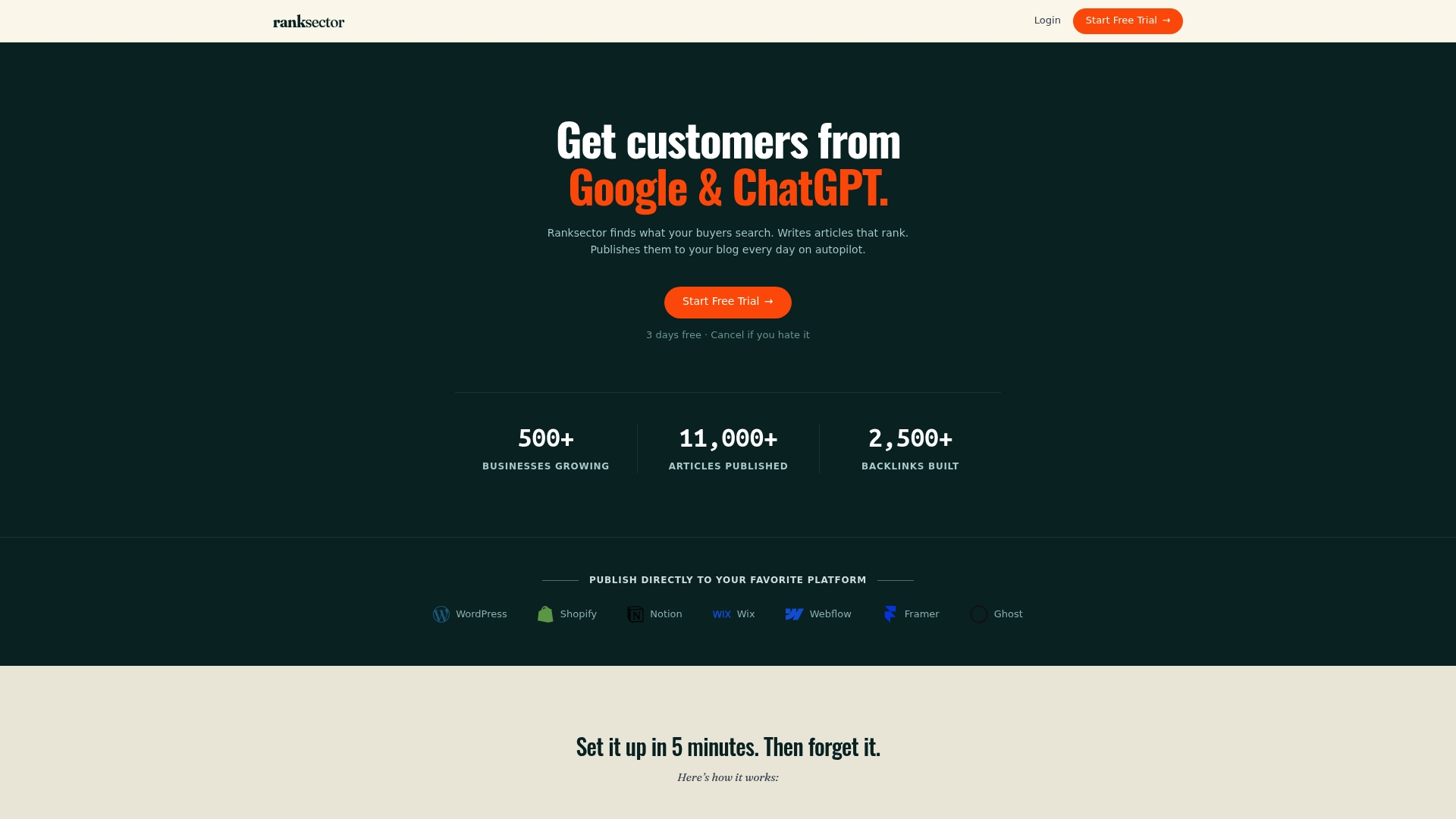
Ranksector addresses this directly. Its free SEO tools support keyword research and competitor monitoring without requiring an enterprise budget. The AI audit analyzes your site against competitor and SERP data to surface structural gaps you can act on immediately. For agencies managing multiple clients, Ranksector’s agency product integrates competitive analysis into a publishing workflow that runs daily. With over 11,000 articles already published through the platform, Ranksector delivers the content volume that competitive SERP analysis demands.
FAQ
What is SERP competitive analysis?
SERP competitive analysis is the process of identifying which domains rank for your target keywords and understanding the content, structure, and trust signals that drive their rankings. It goes beyond tracking positions to examine content ecosystems and SERP feature ownership.
How do I identify my true SERP competitors?
Pull the top 10 results for each target keyword and note which domains appear repeatedly across your keyword cluster. True SERP competitors are defined by keyword overlap, not by industry category.
How often should I run a competitive SERP analysis?
Run weekly ranking checks for your top keywords, monthly content audits for competitor updates, and a full gap analysis every quarter. Pre-flight checks before publishing new content are also standard practice in 2026.
What is a SERP gap analysis?
SERP gap analysis identifies keywords and subtopics where competitors rank weakly or not at all, giving you clear targets for new content. Blind spot keywords and “People Also Ask” questions are the two most productive sources for gap discovery.
Why do SERP competitors differ from business competitors?
Google ranks content based on relevance and trust signals, not on business category. A blog, a university page, or an unrelated brand can outrank you for a keyword your direct business rivals never target.
Recommended
- How Competitor SEO Research Works: 2026 Guide · Ranksector Blog — Ranksector
- Rank for Competitor Traffic Keywords: 2026 SaaS Guide · Ranksector Blog — Ranksector
- How to Spot Keyword Cannibalization in Five Minutes · Ranksector Blog — Ranksector
- Monitor Competitor Keyword Rankings: 2026 Guide · Ranksector Blog — Ranksector