
Rank on Google With a Low Budget: 2026 Guide
You can rank on Google without a large budget. The most effective low-budget approach combines three things: targeting keywords already ranking in positions 11–20 via Google Search Console, publishing content on a consistent weekly schedule, and running a lean AI-powered tool stack that costs a fraction of what agencies charge. Small businesses following this method have successfully moved page-two content to page one in a relatively short time, without paying for expensive retainers.
Here is what the core approach looks like in practice:
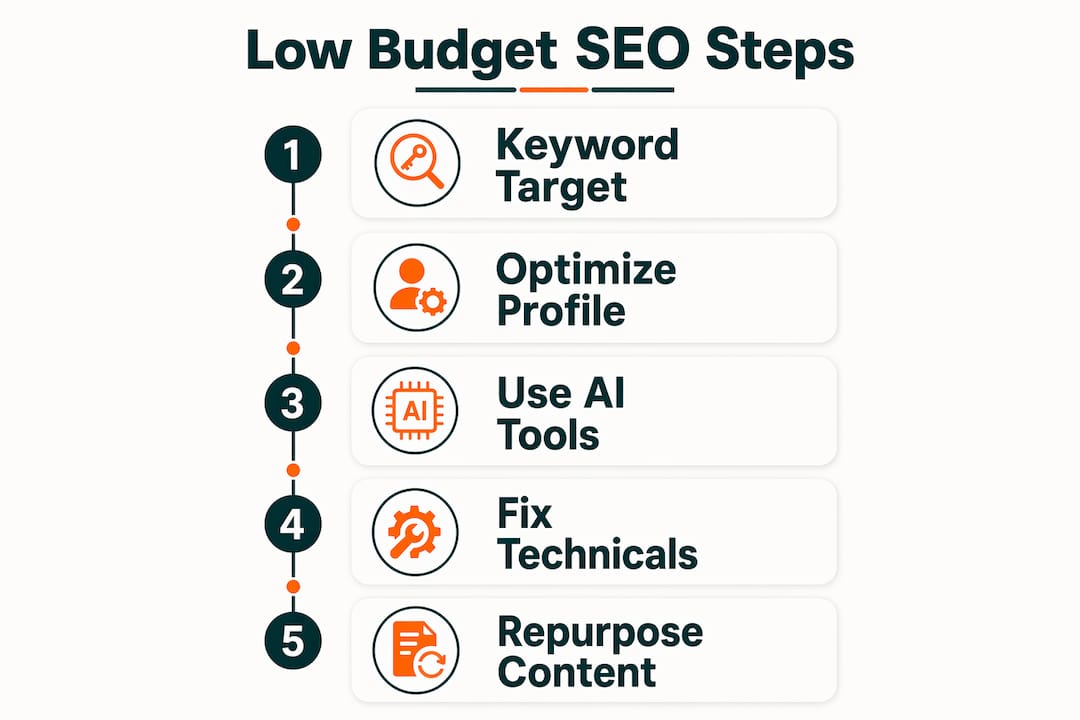
- Target position 11–20 keywords first. Google Search Console shows you which pages are almost ranking. These are your fastest wins, not brand-new keywords you have never touched.
- Optimize your Google Business Profile. For local businesses, an accurate and complete profile drives visibility in map packs and local search results at zero cost.
- Use a focused AI tool stack. Tools like SurferSEO or Frase score your content against live search results for $89–$139 per month. A disciplined AI SEO stack with these tools covers every major deliverable for small businesses at about $190 per month—96% less than a traditional agency—with higher output if used in a consistent weekly workflow.
- Publish on a weekly cadence. Topical depth and publishing consistency matter more than budget size in 2026. Irregular publishing kills momentum.
- Handle technical SEO basics for free. Google’s PageSpeed Insights and Screaming Frog’s free tier (up to 500 URLs) catch the issues that actually affect rankings.
- Link internally with intention. Adding three contextual internal links per 1,000 words is among the highest-leverage SEO actions available to a small team.
- Skip cheap SEO packages. Monthly packages priced at rock-bottom rates rarely include the time or strategic work needed to move rankings.
- Keep your weekly time investment realistic. A focused 2–5 hours weekly beats sporadic bursts of effort every time.
How much does SEO actually cost for a small business?
Most small businesses assume SEO requires a $3,000-per-month agency retainer. It does not. The realistic range runs from $0 (your time plus free tools) to around $600 per month for a more structured program. According to widely cited industry benchmarks, small businesses should allocate roughly 6–12% of revenue to digital marketing, with 30–60% of that going toward SEO. For a business with modest revenue, allocating a portion of the budget toward SEO can range up to several hundred dollars per month.
Free tools cover more ground than most owners realize. Google Search Console, Google Analytics 4, PageSpeed Insights, and Google Business Profile together handle keyword tracking, technical audits, traffic measurement, and local search visibility at no cost. The gap between free and paid tools is mostly speed and competitor data, not fundamental capability.
Paid tools become worth it once you hit a ceiling with free options. A practical AI tool stack, combining an AI writing model, an on-page scoring tool like SurferSEO or Frase, and a WordPress SEO plugin like Rank Math or SEOPress, costs about $190 per month—significantly less than a typical agency retainer of $3,000–$7,500 a month, while delivering greater content output with a disciplined workflow.
Where small businesses waste money is on cheap monthly SEO packages. Experts consistently warn against packages priced at the very low end of the market. These rarely include enough strategic time to produce meaningful ranking improvements, and they often lock you into contracts with nothing to show for it. The distinction between cheap and cost-effective SEO comes down to whether real work is being done on your specific pages and keywords.
Time is also a budget item. A business owner spending four hours per week on SEO is making a real investment, even if the dollar cost is low. Accounting for that time honestly helps you decide when it makes sense to bring in a tool or a specialist for a specific task.
Proven practical low-budget SEO tactics to implement in 2026
Target your position 11–20 keywords first
The fastest path to more organic traffic is improving pages that are already close to ranking. Open Google Search Console, go to Performance, sort by position, and filter for queries between positions 11 and 20 with more than 50 impressions per month. These keywords are your highest-ROI targets because Google already considers your page relevant. You just need a small push.
For each page you identify, do the following:
- Add additional relevant content to improve the page quality to the thinnest section of the page, including specific data, examples, or answers to related “People Also Ask” questions.
- Rewrite the title tag to include the target keyword naturally and stay under 60 characters. Add a year or a specific benefit if it fits.
- Update the meta description to be more compelling, mentioning a concrete result or benefit.
- Fix the URL structure if it is long or unclear. Short, keyword-focused URLs perform better.
- Add 3–5 internal links from related pages on your site, using descriptive anchor text.
Pro Tip: Republish the updated page with a new “last modified” date. Google tends to recrawl recently updated pages faster, which accelerates the ranking improvement.
Optimize your Google Business Profile for local SEO
If your business serves a local area, Google Business Profile is the single highest-return free tool available. An accurate, complete profile with your correct Name, Address, and Phone number (NAP) across all directories drives map pack visibility without any paid spend. Inconsistent NAP data across the web confuses Google and suppresses local rankings.

Keep your profile updated with current hours, photos, and service descriptions. Encourage satisfied customers to leave reviews, since review volume and recency both influence local ranking. Responding to reviews, even briefly, signals to Google that the profile is actively managed.
Use AI tools for content creation and on-page scoring
AI writing tools like Claude or GPT-based models cut content drafting time dramatically. The key is treating AI output as a first draft, then spending 30–40 minutes editing it into your voice, adding real examples, and verifying facts. This workflow produces publishable content far faster than writing from scratch.

For on-page scoring, SurferSEO or Frase analyze the live search results for your target keyword and tell you which entities, subtopics, and keyword variations to include. You go from guessing what Google wants to seeing a clear scorecard. Frase is stronger for generating content briefs; Surfer is better for live editing against the SERP.
Fix technical SEO basics with free tools
Technical issues block rankings regardless of how good your content is. Run these checks using free tools:
- PageSpeed Insights: Check your Largest Contentful Paint (LCP should be under 2.5 seconds), Cumulative Layout Shift (CLS under 0.1), and Interaction to Next Paint (INP under 200ms). Slow pages lose rankings, especially on mobile.
- Screaming Frog (free up to 500 URLs): Crawl your site for broken internal links, missing title tags, duplicate H1 tags, and redirect chains. Most small business sites have at least a few of these.
- Google Search Console Coverage report: Check for pages accidentally marked noindex, canonicalization errors, and crawl issues. “Crawled but not indexed” often means thin content that needs expanding.
For a deeper walkthrough of these checks, the technical SEO basics guide on the Ranksector blog covers each step clearly.
Build backlinks without a budget
Guest posting, business directory submissions, and local partner outreach remain the most reliable free link-building methods for small businesses. Each approach takes time but costs nothing:
- Guest posting: Find relevant blogs in your niche that accept contributions. Offer a specific, useful article idea rather than a generic pitch.
- Directory submissions: Submit your business to industry-specific and local directories. Each submission earns a backlink and reinforces your NAP data.
- Local partner outreach: Reach out to complementary businesses, suppliers, or associations for link exchanges or co-authored content.
- Broken link building: Use Ahrefs’ free backlink checker to find competitor pages with broken inbound links, then reach out to those linking sites with your relevant content as a replacement.
Add schema markup for free
Schema markup helps Google and AI search engines understand your content structure. Every blog post should include BlogPosting schema with author, publisher, datePublished, dateModified, and image fields. FAQ sections should carry FAQPage schema. Rank Math and SEOPress handle all of this through a WordPress interface, with no coding required. Rank Math’s free tier covers the basics; SEOPress costs $59 per year for the full version.
Repurpose content and use user-generated content
A single well-researched article can become a LinkedIn post, a short video script, a Twitter thread, and an email newsletter. Repurposing extends the reach of content you have already created without additional research time. User-generated content, such as customer reviews, forum answers, or community Q&As embedded on your site, adds fresh text that Google indexes and that builds E-E-A-T signals over time.
Avoid cheap SEO packages
A $99-per-month SEO package cannot fund the hours of strategic work needed to move rankings. These packages typically automate low-value tasks like directory submissions to irrelevant sites or generate thin content that Google ignores. Worse, some use link schemes that risk manual penalties. If you cannot do the work yourself, invest in a specific, scoped project with a reputable specialist rather than an open-ended cheap retainer.
How AI-driven search changes the game for small budgets
AI search engines now answer a substantial portion of queries directly on the results page through AI Overviews, ChatGPT Search, and Perplexity. These engines do not rank pages the way classic Google does. They rank passages, pulling the clearest, most self-contained answer from a page and citing it directly. This shift actually favors small businesses that write clearly and structure content well, rather than those with the biggest link budgets.
Here is what you need to do to show up in AI-generated answers:
- Write self-contained answer paragraphs. Each important answer in your post should be a clearly defined paragraph of suitable length to convey the point effectively. Longer and the engine truncates it; shorter and it picks a competitor’s version.
- Use bold lead-ins before explanations. The bold text signals to AI engines where the answer begins. Format direct answers as a bold phrase followed by the explanation.
- Ship an
llms.txtfile at your site root. This is the AI-era equivalent ofrobots.txt. It signals to AI crawlers which passages on your site are citable. Two hours of setup, with ongoing benefit. - Maintain weekly publishing cadence. Consistent publishing and topical depth are what AI engines reward. A site that covers a topic thoroughly and updates regularly gets cited more often than one with sporadic, shallow content.
- Keep E-E-A-T signals strong. Add author bios with real credentials, cite sources, and include first-hand examples. AI engines are trained to prefer content that demonstrates genuine experience and expertise.
- Use schema markup for FAQ sections. Even though Google reduced FAQ rich results in general search, FAQPage schema is still what AI engines parse when deciding whether to cite your answer.
- Pair AI drafting with human editing. AI-generated content that reads as purely machine-written tends to lack the specificity and voice that earns citations. A 30-minute human editing pass adds the proof points and perspective that make a passage worth citing.
For a practical breakdown of which AI tools fit a small team’s workflow, the best AI SEO content tools guide on Ranksector’s blog covers the current options clearly.
How to measure SEO progress without spending on analytics
Google Search Console and Google Analytics 4 are the primary free platforms for tracking SEO performance. Together they cover everything a small business needs: keyword positions, impressions, click-through rates, organic traffic volume, technical errors, and backlink data. You do not need a paid analytics subscription to run a serious SEO program.
The metrics that actually matter for a low-budget approach:
- Position 11–20 keyword movement: Track whether your targeted pages are moving toward page one. This is the clearest signal that your content refreshes are working.
- Impressions and click-through rate (CTR): A page with high impressions but low CTR has a title or meta description problem, not a ranking problem. Fix the copy before adding more content.
- Organic traffic growth by page: Identify which pages are gaining traffic month over month. Double down on those topics.
- Coverage report errors: Check weekly for new crawl errors, noindex issues, or pages dropping out of the index.
- Core Web Vitals scores: PageSpeed Insights shows whether your technical fixes are holding. A drop in LCP or INP scores often precedes a ranking drop.
Set realistic timelines. Early traction typically appears in months 3–6, with compounding returns building through months 6–12. Chasing week-over-week position changes leads to over-optimizing and wasted time. A simple weekly routine, 30 minutes checking Search Console on Monday and 60 minutes improving one page mid-week, produces steadier gains than irregular deep dives.
When to consider upgrading to paid tools: once you are consistently hitting page two for properly optimized pages and cannot diagnose why competitors are ahead, competitor backlink data becomes genuinely useful. At that point, a starter-tier paid tool makes sense. Until then, the free stack is sufficient.
Export your Search Console data monthly to a Google Sheet. This creates a simple progress record without paying for a reporting tool. Screenshot key metrics before and after major content updates so you can measure the impact of specific changes.
The disciplined AI-powered workflow that outperforms agencies
The core finding from practitioners working in 2026 is direct: the barrier to ranking is not budget, it is cadence and topical depth. An AI tool stack costing about $190 per month produces more content, faster, than a $3,000–$7,500 monthly agency retainer. The constraint shifts from “can I afford the work” to “can I run a consistent five-hour weekly block.”
The weekly workflow that practitioners report as most effective breaks down like this:
- Monday (60 minutes): Open Search Console. Filter for queries with over 100 impressions and a CTR under 1.5%. These are pages almost ranking where the title is failing. Add five new target keywords to your pipeline using SERP research.
- Tuesday and Wednesday (90 minutes each): Write two articles. Use an AI model for the draft, then spend 30–40 minutes editing, adding two personal proof points, and inserting two internal links to existing posts. Publish with schema handled by Rank Math or SEOPress.
- Thursday (45 minutes): Refresh one older post ranking between positions 8 and 20. Rewrite the title and meta description. Add 400 words of fresh content to the thinnest section. Republish. This single move has lifted content from page two to page one within six weeks in documented practitioner workflows.
- Friday (30 minutes): Internal linking sweep. For each article published this week, find three older posts on related topics and add a contextual link from those older posts into the new one. Most small business owners skip this step entirely.
The six-tool stack that covers every deliverable a traditional agency produces:
| Tool category | Example | Monthly cost |
|---|---|---|
| AI writing model | Claude or GPT-5 | $20 |
| On-page SEO scoring | SurferSEO or Frase | $89–$139 |
| SERP scraping | Apify | — |
| WordPress SEO plugin | Rank Math or SEOPress | Free or $59/year |
| Indexing API | IndexNow + Google Indexing API | Free |
| Analytics | Google Search Console | Free |
The 80/20 rule applies directly here. Focusing on position 11–20 keywords, identified through Search Console, delivers faster ranking gains than chasing competitive head terms from scratch. Most of the growth available to a small business site sits in that near-ranking range, not in brand-new keyword territory.
For small businesses that want the publishing cadence without managing the workflow manually, Ranksector automates daily SEO-optimized article publication with built-in keyword research and a backlink exchange system. It is built specifically for teams that cannot dedicate five hours a week to content operations but still need consistent topical depth to compete.
Ranksector handles the publishing cadence for you
The hardest part of a low-budget SEO approach is not the strategy. It is showing up every week to publish, refresh, and link. Most small teams have the intent but not the bandwidth.
Ranksector automates the entire content production and publishing workflow: keyword research driven by competitor analysis, daily SEO-optimized article publication, and a backlink exchange system that builds domain authority without manual outreach. Over 11,000 articles published. Domain ratings that move fast.
If you want to see what consistent, AI-powered publishing looks like for your site, explore Ranksector’s free tools and run your first audit today.
Key Takeaways
The most effective low-budget SEO approach in 2026 combines position 11–20 keyword targeting, a consistent weekly publishing cadence, and a lean AI tool stack costing around $190 per month.
| Point | Details |
|---|---|
| Target near-ranking keywords | Focus on positions 11–20 in Google Search Console for the fastest ranking gains. |
| Keep tool costs lean | A disciplined AI SEO stack costs around $190 per month—a fraction of the $3,000–$7,500 agency retainers—yet delivers more efficient weekly output. |
| Publish on a weekly schedule | Consistent cadence and topical depth matter more than budget size in 2026. |
| Avoid cheap SEO packages | Low-priced monthly packages rarely include enough strategic work to move rankings. |
| Measure with free tools | Google Search Console and Google Analytics 4 cover all core SEO metrics at no cost. |