
Rank for Competitor Traffic Keywords: 2026 SaaS Guide
Competitor traffic keywords are the search terms your rivals rank for that you currently do not, and capturing them is one of the fastest ways to grow organic visibility without starting from scratch. Tools like SEMrush, Ahrefs, and Moz make it possible to rank for competitor traffic keywords by exposing exact gaps between your domain and theirs. The process is called keyword gap analysis, and when done correctly, it turns your competitors’ content investments into a roadmap for your own. This guide walks through every step, from tool selection to content execution.
What tools do you need to rank for competitor traffic keywords?
Keyword gap analysis requires three inputs: your own domain data, at least two to three competitor domains, and a tool capable of comparing them side by side. Without baseline data on your own rankings, you cannot identify what is missing versus what is simply underperforming.
The three most widely used tools for this work are SEMrush Keyword Gap, Ahrefs Content Gap, and Moz True Competitor. Each approaches the comparison differently.

| Tool | Key Feature | Free Trial | Best For |
|---|---|---|---|
| SEMrush Keyword Gap | Missing and Weak keyword filters | 7 days | Full gap workflow |
| Ahrefs Content Gap | Page-level and domain-level gaps | Limited free tier | Content-focused teams |
| Moz True Competitor | Authority-weighted competitor matching | 30 days | Domain authority context |
SEMrush’s Keyword Gap and Ahrefs’ Content Gap tools expose “Missing” and “Weak” keyword sets by comparing your domain against up to five competitors at once. “Missing” means your site does not rank at all for that term. “Weak” means you rank, but far below your competitors. Treating these as two separate backlogs is the correct approach, because the content fix for each is different.
Before running any analysis, confirm you have:
- At least two to three true search competitors (not just business competitors)
- Your own domain verified in the tool
- A working understanding of keyword difficulty (KD) scores and search volume metrics
- Access to SERP results for manual verification
Basic SEO literacy matters here. A KD score of 60 means nothing without knowing whether the pages currently ranking are thin, low-authority content or established editorial pieces.
How to run a competitor keyword gap analysis step by step
HubSpot frames the standard SEO competitor workflow as five stages: identify search competitors, run the gap analysis, evaluate SERP intent, analyze competitor content, and benchmark backlinks. Each stage feeds the next.
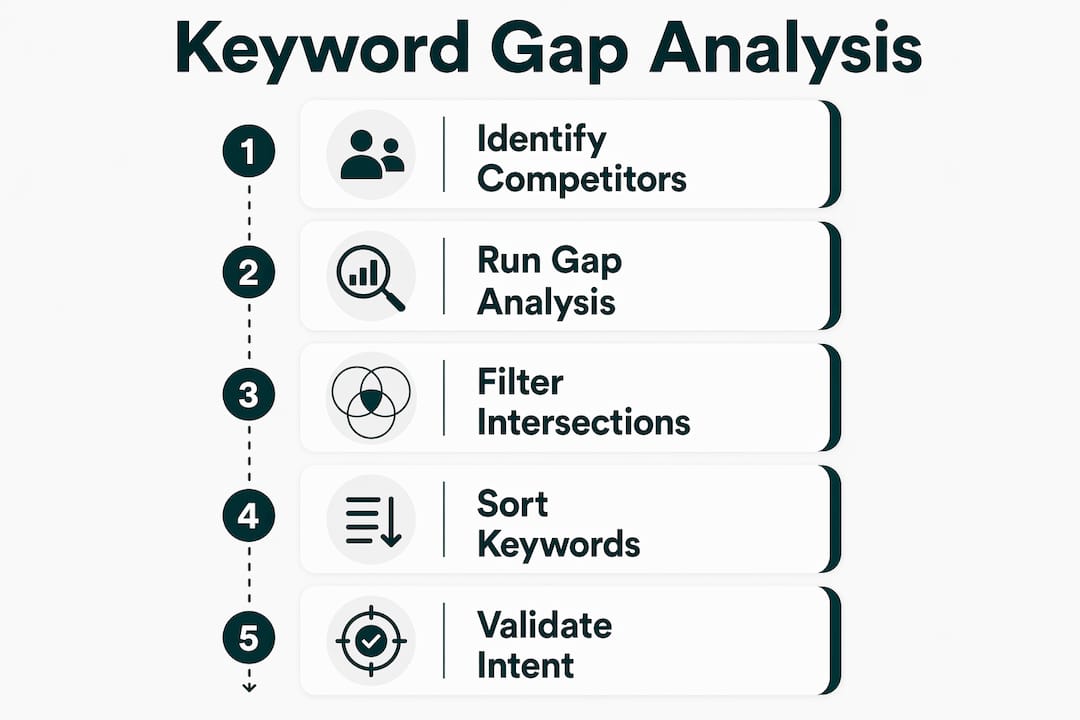
Step 1: Identify your true search competitors. Your business competitors and your search competitors are often different. Search Google for your top five target keywords and note which domains appear consistently. Those are your real SERP rivals.
Step 2: Run the keyword gap analysis. Enter your domain and two to four competitor domains into SEMrush Keyword Gap or Ahrefs Content Gap. Filter for “Missing” keywords first, then “Weak” keywords. Export both lists separately.
Step 3: Filter by competitor intersection. Multi-competitor intersection filters help eliminate chasing less valuable or niche terms that won’t provide scalable traffic. If only one competitor ranks for a term, it may be an idiosyncratic keyword with limited opportunity. Focus on terms where two or more competitors rank.
Step 4: Sort by search volume and difficulty. Filter keyword gaps by competitor ranking position in the top 1–20, then sort by search volume descending and KD ascending. This surfaces high-return targets efficiently.
Step 5: Validate intent manually. Open the top three to five SERP results for each shortlisted keyword. Confirm the content format, page type, and topic angle before committing to production.
| Step | Objective | Action |
|---|---|---|
| Identify search competitors | Find true SERP rivals | Google your core keywords, note recurring domains |
| Run gap analysis | Surface missing and weak keywords | Use SEMrush or Ahrefs gap tools |
| Apply intersection filter | Remove noise | Keep only keywords ranked by 2+ competitors |
| Sort by volume and KD | Prioritize high-return targets | Filter top 1–20 positions, sort by volume |
| Validate SERP intent | Confirm content fit | Manually check top results for format and angle |
Pro Tip: Set the competitor intersection filter to “2 of 3” or “3 of 4” competitors. Keywords that appear in multiple competitors’ rankings are broadly accepted opportunities, not outliers.
How do you evaluate SERP intent before targeting a keyword?
Search intent matching is the critical gatekeeper to winning keywords. Match your content type to the dominant SERP content before investing any production time. Getting this wrong means publishing a page that Google will never rank, regardless of how well it is written.
Search intent falls into four categories. Informational queries expect blog posts, guides, or explainers. Transactional queries expect product or pricing pages. Commercial investigation queries expect comparison pages, reviews, or “best of” lists. Navigational queries expect brand pages. In B2B SaaS, winning competitor keywords commonly requires content that satisfies commercial investigation, mapping evaluation content types to SERP intent rather than generic pages.
Keyword difficulty scores are relative metrics based on ranking pages’ authority. A manual SERP check can reveal winnable keywords that appear difficult at first glance. If the top three results are thin blog posts from low-authority domains, the KD score is misleading. That is a realistic target.
Common intent matching pitfalls to avoid:
- Publishing a blog post when the SERP shows only product pages
- Targeting a navigational keyword with a generic informational article
- Writing a generic overview when the SERP rewards detailed comparison content
- Ignoring featured snippets, which signal a specific answer format Google prefers
- Assuming a high KD score means the keyword is unwinnable without checking actual page quality
Pro Tip: Sort your shortlist by KD descending, then manually check the top five results for the highest-difficulty keywords. You will often find that two or three have weak content from low-authority sites, making them far more accessible than the score suggests.
How to prioritize and build content that closes keyword gaps
Treat “missing” and “weak” keyword findings as distinct content backlogs. Missing keywords call for new pages. Weak keywords require updating existing content to close gaps. Mixing these workflows creates confusion and wastes production time.
For B2B SaaS teams, the content format must match the buying cycle stage. A keyword like “best project management software for agencies” signals commercial investigation. A keyword like “how to set up project management workflows” signals informational intent. Both require different page structures, different calls to action, and different internal linking strategies.
Topical clusters outperform isolated pages. Publishing one strong pillar page on a topic, supported by three to five related cluster pages, builds the content depth that Google rewards. A single page targeting one competitor keyword rarely outranks a site with ten interconnected pages on the same topic.
Backlink benchmarking completes the picture. Check the referring domain count for the top-ranking pages on your target keywords. If those pages have 40 referring domains and yours has 5, content quality alone will not close the gap. You need a parallel link-building effort.
- Separate your keyword list into “new page” and “update existing page” buckets
- Map each keyword to a search intent category and content format
- Group related keywords into topical clusters before assigning production
- Write or update content to match the dominant SERP format exactly
- Benchmark backlinks for each target keyword and set a realistic link-building goal
- Publish, index, and monitor ranking movement over 60–90 days
- Revisit competitor gap analysis quarterly to catch new keyword shifts
Pro Tip: Set a calendar reminder to re-run your gap analysis every 90 days. Competitors publish new content constantly, and the keyword landscape shifts. What was a “missing” keyword last quarter may now be a “weak” keyword after a partial ranking gain.
For a deeper look at finding untapped keywords through competitor research, Ranksector’s blog covers the full workflow with SaaS-specific examples.
Key takeaways
Ranking for competitor traffic keywords requires a structured gap analysis workflow, strict intent matching, and separate content plans for missing versus weak keywords.
| Point | Details |
|---|---|
| Use gap analysis tools | SEMrush Keyword Gap and Ahrefs Content Gap expose missing and weak keyword sets efficiently. |
| Filter by competitor intersection | Keep only keywords ranked by two or more competitors to avoid chasing low-value outliers. |
| Match content to SERP intent | Publish the content format the SERP already rewards, not the format you prefer. |
| Separate missing from weak keywords | New pages fix missing keywords; content updates fix weak ones. Never mix these workflows. |
| Benchmark backlinks alongside content | Content quality alone won’t outrank pages with significantly more referring domains. |
Why most SaaS teams get competitor keyword analysis wrong
Most teams run a keyword gap analysis once, export a list of 500 keywords, and then do nothing with it. The list sits in a spreadsheet while the team debates priorities. Six months later, the competitors have published 30 more articles and the gap has widened.
The real problem is not the analysis. It is the absence of a repeatable workflow that connects the gap findings to actual content production. I have seen SaaS marketing teams spend three hours in SEMrush and then hand a raw keyword list to a writer with no intent context, no format guidance, and no backlink benchmark. The resulting content rarely ranks.
The other mistake is treating keyword difficulty as a hard barrier. Checking actual SERPs for low-authority or weak content reveals winnable keywords that appear difficult at first glance. A KD of 65 means nothing if the top result is a 500-word article from a domain with a rating of 12. That page is beatable with a well-structured 1,500-word piece and five solid backlinks.
The shift that changes results is moving from three visibility layers to a single organic ranking view. In 2026, your competitor may rank on page one organically, appear in an AI-generated answer summary, and dominate a Reddit thread on the same topic. Targeting only the organic keyword misses two thirds of their actual visibility. Mapping all three layers before you prioritize gives you a far more accurate picture of where the real gaps are. For teams building this kind of multi-channel view, the AI adoption roadmap from BizDev Strategy offers a practical framework for assessing AI-generated and social discussion visibility alongside organic rankings.
The teams that consistently close keyword gaps share one habit: they treat competitor analysis as a recurring process, not a one-time project.
— Savannah
Ranksector’s tools for closing competitor keyword gaps
Ranksector is built specifically for B2B SaaS teams that need a steady output of SEO-optimized content without dedicating hours each week to keyword research and production.
The platform combines competitor-driven keyword research with automated article creation and a backlink exchange system. That means you get a continuous pipeline of content targeting the exact gaps your competitors are filling, without managing the workflow manually. Ranksector has published over 11,000 articles for clients and consistently delivers measurable domain rating growth. Start with the free SEO tools to run your first competitor keyword gap analysis, or explore the AI audit to get a full picture of where your site stands against competitors right now.
FAQ
What are competitor traffic keywords?
Competitor traffic keywords are search terms your rivals rank for in organic search that your site currently does not rank for or ranks poorly on. Identifying them through keyword gap analysis reveals specific content opportunities.
How do I find keywords my competitors rank for?
Use SEMrush Keyword Gap or Ahrefs Content Gap, enter your domain alongside two to four competitor domains, and filter for “Missing” and “Weak” keyword sets. For a detailed walkthrough, the SaaS keyword gap workflow on Ranksector’s blog covers the full filtering process.
What is the difference between missing and weak keywords?
Missing keywords are terms your site does not rank for at all, requiring new page creation. Weak keywords are terms you rank for but far below competitors, requiring content updates to existing pages.
How do I know if a competitor keyword is winnable?
Check the keyword difficulty score as a starting filter, then manually review the top five SERP results. If ranking pages are thin, low-authority content, the keyword is winnable regardless of how high the KD score appears.
How often should I run a competitor keyword gap analysis?
Run a full gap analysis every 90 days. Competitors publish new content continuously, and quarterly reviews catch new gaps before they compound into large visibility deficits.
Recommended
- How to Find Keyword Gaps Competitors Miss: A SaaS SEO Workflow · Ranksector Blog — Ranksector
- How Competitor SEO Research Works: 2026 Guide · Ranksector Blog — Ranksector
- Find Untapped Keywords: Competitor Research Guide · Ranksector Blog — Ranksector
- Ranking vs Clicks: Why SaaS Pages Need More Than Position · Ranksector Blog — Ranksector