
Search Visibility Score Explained for Digital Marketers
Search visibility score is defined as the percentage of potential organic clicks your website captures across a tracked set of keywords, weighted by each keyword’s search volume and expected click-through rate. Tools like Semrush, Moz, and AgencyAnalytics calculate this metric to give you a single number that reflects your site’s overall presence in unpaid search results. Unlike raw rankings, the score accounts for user behavior. A position-one ranking on a high-volume keyword moves the needle far more than a position-eight ranking on a niche term. For digital marketers and business owners, understanding what is search visibility score means understanding how much of your market’s attention you actually own.
What is search visibility score and how is it calculated?
The search visibility score combines three inputs: keyword rankings, keyword search volumes, and expected click-through rates by position. The formula works like this: for each tracked keyword, the tool takes your ranking position, applies the average CTR for that position, and multiplies it by the keyword’s monthly search volume. It then divides your total weighted clicks by the maximum possible clicks if you ranked first for every keyword. The result is a percentage representing your share of potential clicks.
The calculation varies slightly across tools, but the core logic stays consistent. Semrush computes a weighted average where top positions disproportionately influence the final score. A jump from position four to position one on a keyword with 10,000 monthly searches moves your score far more than holding position one on a keyword with 200 searches. That weighting is intentional. It reflects how real users behave on a search results page.
Here is a simplified version of how the score builds up:
- List your tracked keywords. Pull the keywords you want to rank for, not every keyword you accidentally rank for.
- Record your current ranking position for each keyword in the target search engine.
- Apply the average CTR for that position. Position one earns roughly 10 times the clicks of position ten.
- Multiply by monthly search volume to get weighted click potential per keyword.
- Sum all weighted clicks and divide by the theoretical maximum if you ranked first for every keyword.
- Express the result as a percentage. That is your visibility score.
Pro Tip: When setting up rank tracking in Semrush or a similar tool, build your keyword list around commercial and informational terms your buyers actually search. A list padded with branded terms will inflate your score and mask real performance gaps.
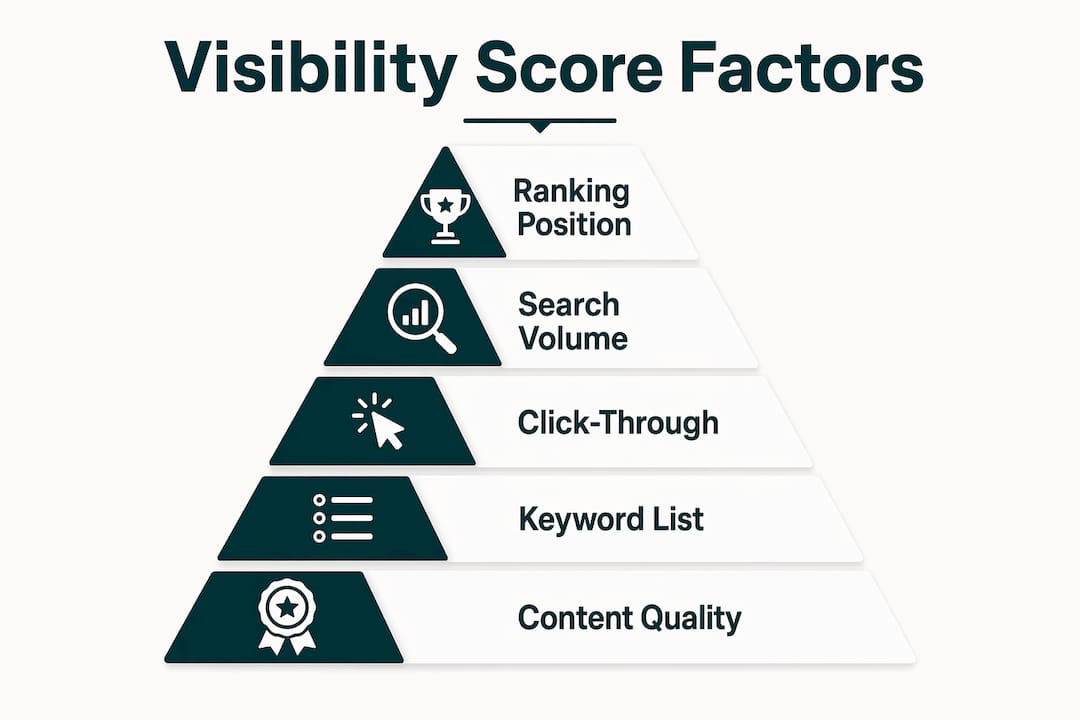
What factors affect search visibility score?
Several variables push your score up or down, and not all of them are obvious. The biggest driver is your ranking position on high-volume keywords. Small improvements near position one meaningfully increase your visibility score because CTR weighting is exponential, not linear. Moving from position three to position one on a competitive keyword can double your contribution from that single term.

Keyword selection itself shapes the score just as much as rankings do. Including too many branded keywords can artificially inflate your score, masking true organic performance. If your tracked list is 80% brand-name queries, your score looks strong even when your non-branded SEO is weak. Separate your branded and non-branded keyword sets and track them independently.
Key factors that affect your score:
- Keyword search volume. High-volume keywords carry more weight in the calculation. Ranking for a 5,000-search-per-month term matters more than ranking for a 50-search-per-month term.
- Ranking position. Positions one through three capture the majority of clicks. Positions below ten contribute almost nothing to your score.
- Search intent alignment. Ranking for keywords that match your page content reduces bounce rates and signals relevance to Google, which supports sustained rankings.
- Keyword cannibalization. Two pages competing for the same keyword split ranking signals and lower both pages’ positions, dragging down your overall score.
- SERP features. Featured snippets, knowledge panels, and AI Overviews can absorb clicks before users reach organic results, reducing the actual CTR at each position.
A visibility score around 50% is considered good; above 50% is excellent. The score reflects potential exposure, so treat it as a directional benchmark rather than an absolute target.
How does search visibility score compare to other SEO metrics?
Search visibility score and Google Search Console metrics measure different things. Understanding the difference prevents you from drawing the wrong conclusions from either one.
| Metric | What it measures | Scope | Best used for |
|---|---|---|---|
| Search visibility score | Weighted click share across tracked keywords | Your chosen keyword list | Trend tracking, competitive benchmarking |
| Google Search Console impressions | How often your pages appear in search | All keywords Google tracks | Broad discovery and coverage analysis |
| Google Search Console CTR | Percentage of impressions that result in clicks | All keywords Google tracks | Identifying underperforming pages |
| Average position (GSC) | Mean ranking across all tracked queries | All keywords Google tracks | Diagnosing ranking drops |
| Raw keyword ranking | Your position for a single keyword | One keyword at a time | Monitoring specific target terms |
Search Console aggregates metrics for all keywords, including ones you never intentionally targeted. Visibility score focuses only on the keyword list you control and curate. That distinction matters. Search Console tells you what is happening across your entire site. Visibility score tells you how well you are performing on the keywords that actually drive your business.
The two metrics work best together. Use Search Console to spot unexpected ranking drops or new keyword opportunities. Use visibility score to track your progress on the terms that matter most to your growth goals. Combining them with keyword-level ranking data gives you a complete picture of your organic search performance.
What strategies improve search visibility score effectively?
Improving your score requires a focused approach. Spreading effort across hundreds of low-volume keywords produces minimal movement. Concentrating on a smaller set of high-volume, high-intent keywords where you already rank on page one produces the fastest gains.
Practical strategies that move the score:
- Push page-two rankings to page one. Keywords ranking in positions 11–20 contribute almost nothing to your score. Moving them to positions 6–10 creates measurable improvement. Moving them to positions 1–3 creates significant improvement. Ranking on page one is the threshold that matters.
- Fix keyword cannibalization. When two pages compete for the same keyword, consolidate them or clearly differentiate their intent. Cannibalization dilutes ranking signals and suppresses both pages.
- Target keywords with commercial intent. High-volume keywords with clear buyer intent drive both visibility score and actual conversions. Informational keywords build authority but convert less directly.
- Improve on-page relevance. Pages that match search intent rank higher and hold their positions longer. Update thin content, add depth, and align your page structure with what the top-ranking pages deliver.
- Build topical authority through consistent publishing. Sites that cover a topic thoroughly across multiple articles rank for more keywords in that topic cluster, raising the total weighted click potential.
Pro Tip: Audit your tracked keyword list every quarter. Remove keywords you have no realistic chance of ranking for and add keywords where you are already in positions 11–20. A well-maintained keyword list makes your visibility score a more accurate signal.
Visibility score is also a forward-looking KPI. Organic search visibility represents potential exposure rather than just tracking exact positions. That means improving it now builds the foundation for traffic gains over the next several months, not just the current reporting period.
Key Takeaways
Search visibility score is the most useful single metric for tracking your SEO progress across a curated keyword set, but it requires careful setup and consistent interpretation to deliver real value.
| Point | Details |
|---|---|
| Core definition | Visibility score measures your weighted share of potential clicks across tracked keywords. |
| Calculation inputs | Rankings, keyword search volumes, and position-based CTR expectations combine to produce the score. |
| Branded keyword risk | Tracking mostly branded terms inflates the score and hides true organic performance gaps. |
| Score benchmarks | A score around 50% is good; above 50% is excellent, per Search Engine Land guidance. |
| Best used alongside | Pair visibility score with Google Search Console data and keyword-level rankings for full context. |
Why I think most marketers misread their visibility score
The number itself is not the problem. The problem is how most teams report it. A rising visibility score feels like proof that SEO is working, and sometimes it is. But I have seen scores climb steadily while actual organic traffic stayed flat or declined. The reason is almost always keyword list composition. The tracked list was too branded, too narrow, or filled with keywords the site ranked for but never converted from.
Visibility scores estimate potential click share, but actual traffic and business impact depend on landing page relevance, conversion rate, and offer quality. Separating share of visibility from actual outcomes is the discipline most reporting skips. When you present a rising visibility score to leadership without tying it to traffic or pipeline, you are reporting a proxy metric as if it were a result.
The healthiest way to use this metric is as a planning tool. When your score drops, it tells you where to investigate. When it rises, it tells you which keyword clusters are gaining ground. What it does not tell you is whether any of that translates to revenue. That connection requires you to map visibility changes to Search Console click data and then to your actual conversion funnel. The teams that do this well treat visibility score as one layer of a three-layer diagnostic, not as the headline number.
— Savannah
How Ranksector helps you build and maintain search visibility
Improving your search visibility score requires consistent, well-targeted content published at a pace most small teams cannot sustain manually.
Ranksector automates that process for B2B SaaS companies. The platform publishes daily SEO-optimized articles built around competitor keyword research, so your site gains coverage on the high-volume terms that move your visibility score. With over 11,000 articles already published across client sites, Ranksector has a track record of increasing domain ratings quickly. You can start with the free SEO tools to audit your current visibility gaps, or explore the agency service if you want a fully managed content and visibility growth program.
FAQ
What is a good search visibility score?
A visibility score around 50% is considered good, and above 50% is excellent. The score reflects potential exposure across your tracked keyword set, so context and keyword list quality matter as much as the number itself.
How is search visibility score different from keyword ranking?
A keyword ranking tells you your position for one specific term. Visibility score combines rankings, search volumes, and expected CTR across all tracked keywords into a single weighted percentage, making it better for trend analysis and benchmarking.
Why does my visibility score not match my actual traffic?
Visibility score measures potential exposure, not confirmed clicks. Actual traffic depends on landing page relevance, SERP features like AI Overviews that absorb clicks, and whether your tracked keywords align with real buyer intent.
Which tools calculate search visibility score?
Semrush, Moz, and AgencyAnalytics each calculate a version of the visibility score. The formulas differ slightly, but all three combine ranking position, keyword search volume, and expected CTR to produce a weighted percentage.
How often should I check my search visibility score?
Monthly tracking is sufficient for most teams. Weekly checks are useful during active content campaigns or after a site migration, when you need to catch ranking drops before they compound.
Recommended
- Ranking vs Clicks: Why SaaS Pages Need More Than Position · Ranksector Blog — Ranksector
- How to Spot Keyword Cannibalization in Five Minutes · Ranksector Blog — Ranksector
- ChatGPT vs Google Search: How the Same Query Gets Interpreted Differently · Ranksector Blog — Ranksector
- Why meta descriptions matter more after AI Overviews for SaaS SEO · Ranksector Blog — Ranksector