
How SEO Works Without Paid Ads for B2B SaaS
You can build sustainable, compounding organic traffic for a B2B SaaS without paid ads by combining technically sound pages, depth-first content, deliberate internal linking, and scalable automation. Unlike paid ads, which stop delivering the moment your budget runs out, organic search creates durable assets that keep working months after you publish them.
The four levers your team controls are:
- Technical SEO: Crawlability, Core Web Vitals, canonical rules, and sitemap health
- On-page depth and content: Intent-matched pages that answer the full question, not just the keyword
- Internal linking and architecture: Deliberate links that pass authority across your topic cluster
- Backlinks and domain authority: Earned links from genuinely useful assets
Your immediate next step: run a technical audit in Google Search Console and write one depth-page brief this week. Both take under four hours and give you a clear baseline before you publish anything new.
Table of Contents
- How does organic search actually drive traffic to your SaaS site?
- What are the four core organic channels and how should you prioritize them?
- What content strategy replaces paid ads for a SaaS team?
- How do you scale content output without a large writing team?
- How do you build backlinks without paying for them?
- How long does organic SEO take and what should you measure?
- Your 30–90 day implementation checklist
- What mistakes kill organic SEO momentum for SaaS teams?
- Key Takeaways
- Why automation changes the math for small SaaS teams
- Ranksector handles the production so your team handles the strategy
- Useful sources
How does organic search actually drive traffic to your SaaS site?
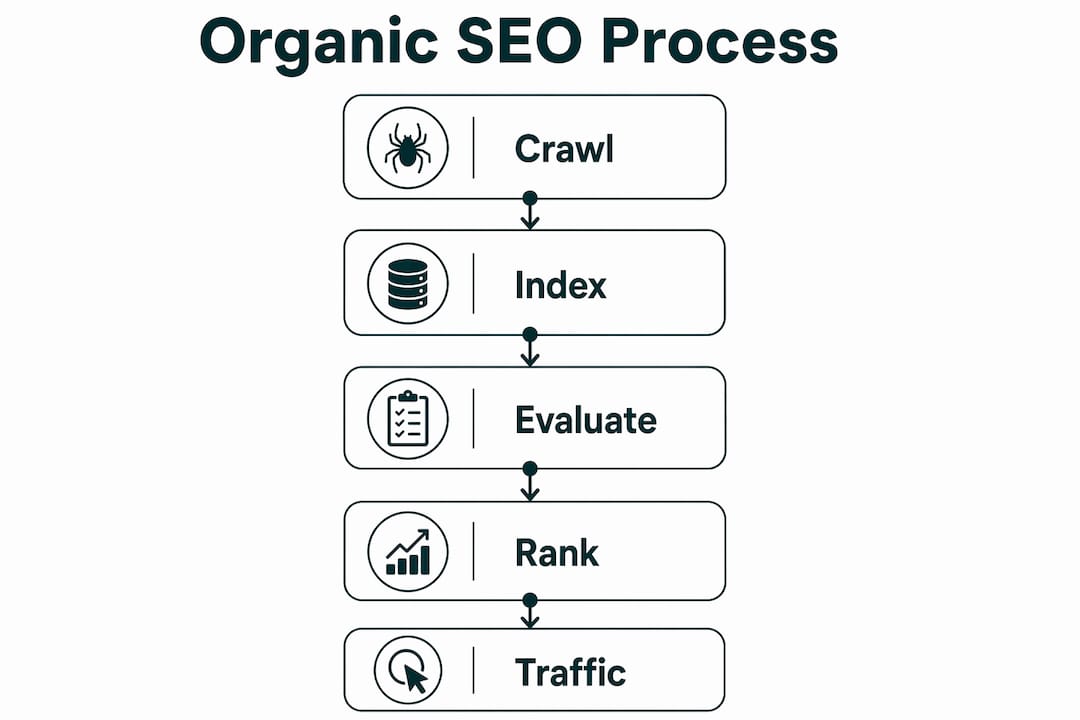
The flow is straightforward: Google crawls your pages, indexes them, processes queries, surfaces results, and a user clicks through to convert. Every stage has a different bottleneck, and knowing which one you’re stuck at saves weeks of guessing.
Search engines evaluate hundreds of signals grouped into four categories: relevance, technical health, authority, and experience. Indexability comes first. A page that can’t be crawled can’t rank, no matter how good the content is. For SaaS landing pages specifically, client-side rendering is a common trap: if your JavaScript loads content after the initial HTML, Googlebot may never see it.
The compounding behavior is what separates organic from paid. Paid ads act like a faucet: traffic stops when spending stops. Organic pages accumulate signals over time, clicks, dwell time, and backlinks, so a page published today may rank significantly higher six months from now without any additional work.
Pro Tip: Prioritize indexability before content volume. Use Google Search Console’s Coverage report to identify any “Discovered — currently not indexed” pages and resolve crawl path issues before scaling output.
What are the four core organic channels and how should you prioritize them?
For a small SaaS team, the sequence matters as much as the tactics. Fix technical foundations first, then build depth pages with strong internal linking, then pursue authority.
Technical SEO
Technical health is a prerequisite, not a nice-to-have. Before content can compound, the site must be indexable, fast, and structurally clean. Focus on:
- Crawlability and indexation (robots.txt, XML sitemap, no accidental noindex tags)
- Core Web Vitals, especially Largest Contentful Paint on product and pricing pages
- Canonical tags to prevent duplicate content across trial, pricing, and feature variants
- Server-side rendering for dynamic SaaS pages where JavaScript is heavy
On-page content and depth
Shallow posts don’t build topical authority. The DEPTH Stack principle is direct: one exceptional, comprehensive page that satisfies all facets of user intent outperforms many average pages. For SaaS, that means use-case pages, integration docs, and troubleshooting guides that answer the full question, not just the head term.
Internal linking and architecture
Internal linking is often the most overlooked lever. Deliberate, intent-mapped links signal canonical pages to Google and move authority from established hubs to newer content. Every new page should receive at least one link from an authoritative existing page on day one.

Backlinks and authority
Quality beats quantity. One editorial link from a credible SaaS publication does more than twenty directory submissions. Build assets worth citing, then earn links that reinforce the topics you need to own.
What content strategy replaces paid ads for a SaaS team?
The lead claim: one deep, intent-matched pillar page plus a cluster of supporting pages outperforms a higher volume of shallow posts every time. Map your content to the buyer journey before you write a single brief.
Intent architecture:
- Awareness: Problem-definition posts, “what is X” guides, industry benchmarks
- Consideration: Comparison pages, use-case walkthroughs, integration guides
- Decision: Pricing pages, ROI calculators, case study landing pages
- Retention: SDK docs, troubleshooting guides, changelog posts
Product-led content examples for SaaS:
- Use-case pages targeting “[your tool] for [industry]” queries
- Integration pages that attract developer and technical intent
- Troubleshooting guides that capture high-intent, low-competition searches
- API and SDK documentation that earns links from developer communities
Brief creation checklist:
- Define the primary search intent (informational, commercial, or transactional)
- List the proof elements the page needs (data, screenshots, examples)
- Map the SEO metadata (title tag, meta description, primary and semantic keywords)
- Assign internal links: which hub page links in, which cluster pages link out
- Set a refresh date (90 days for fast-moving topics, 180 days for stable ones)
Pro Tip: Publish your first depth page on the highest-volume topic you can credibly own. Treat it as the authority anchor for your entire cluster. Every subsequent page links back to it, and you monitor it weekly for ranking drift.
Search intent mapping is the step most SaaS teams skip. They target keywords without understanding whether the searcher wants a definition, a comparison, or a vendor. Getting this right is what separates pages that rank from pages that sit.
How do you scale content output without a large writing team?
Scaling is possible with programmatic pages and automated production, but quality controls are mandatory. Speed without editorial standards produces content decay faster than it produces rankings.
Where programmatic SEO fits for SaaS:
- City or industry landing pages (“project management software for construction firms”)
- Templated integration and connector pages
- Feature comparison pages built from structured data
Pitfalls to avoid: Thin templated pages with no unique value get flagged for content decay quickly. Every programmatic page needs at least one differentiating data point or insight that a competitor’s template doesn’t have.
Practical automation stack:
- Structured data source (a spreadsheet or CMS with unique variables per page)
- Template engine that injects variables into a pre-approved editorial frame
- Human review pass for E-E-A-T signals before publishing
- Google Search Console indexing workflow: manually request indexing for up to 8 high-value URLs per day after publishing
- Publishing pipeline with automatic internal link injection from your hub pages
Ranksector’s free SEO tools can support parts of this workflow for teams that want to reduce manual setup time.
How do you build backlinks without paying for them?
Earn links with genuinely useful assets, then do outreach aligned to the asset. The sequence matters: build first, pitch second.
Tactics that work for B2B SaaS:
- Data studies and benchmarks: Original research attracts editorial links from publications covering your industry
- Integration and ecosystem pages: Listing your tool’s integrations earns co-marketing links from partners
- Developer resources: API docs, SDKs, and open-source tools attract links from developer communities without any outreach
- HARO-style media outreach: Respond to journalist queries in your category to earn authoritative editorial mentions
- Editorial partnerships: Guest contributions to SaaS-focused publications build both authority and referral traffic
Domain rating rises when you earn links that reinforce the topics you’re trying to own. A link from a tangentially related site adds less than one from a publication your buyers already read.
Avoid artificial link networks. Google’s manual actions for unnatural links can suppress an entire domain, and recovery takes months. The risk-adjusted return on link schemes is negative.
How long does organic SEO take and what should you measure?
Expect meaningful traction after several months for initial impressions and clicks. Compounding gains, where new content ranks faster because of accumulated domain authority, typically appear after that window.
| Dimension | Organic SEO | Paid Ads |
|---|---|---|
| Time to first results | Several months | Days |
| Cost shape | Upfront time investment, lower ongoing cash | Continuous cash spend per click |
| Traffic durability | Compounding; persists after work stops | Stops when budget stops |
| Risk profile | Content decay, algorithm updates | Budget exhaustion, auction volatility |
KPIs to track:
- Impressions and click-through rate by page (Google Search Console)
- Assisted conversions and MQLs from organic (GA4 or your CRM)
- Domain authority indicators (referring domain growth, not just raw link count)
- Indexed page count and crawl error rate
- Search visibility trends by topic cluster
Avoid single-session last-click attribution for organic. SEO influences buyers early, often through a blog post they read weeks before converting through a branded search or direct visit. Cohort-based funnel metrics and assisted conversion reports give a more accurate picture of organic’s actual contribution.
Your 30–90 day implementation checklist
- Connect Google Search Console and submit your XML sitemap
- Run a technical audit covering crawlability, Core Web Vitals, canonical tags, and indexation errors
- Fix P0 technical issues (pages blocked from indexing, broken internal links, redirect chains)
- Write one pillar page brief on your highest-priority topic cluster
- Publish the pillar page and manually request indexing in GSC
- Build internal links from three existing pages to the new pillar
- Create two cluster pages that support the pillar and link back to it
- Launch an indexing routine: request indexing for new URLs systematically after each publish
- Identify one linkable asset (a data study, integration list, or developer resource) and begin outreach
- Set up a monthly KPI review covering impressions, assisted conversions, and indexed page count
Pro Tip: Treat your first pillar page as the authority anchor for the entire cluster. Set a calendar reminder to audit it at 90 days: check for ranking drift, intent mismatch, and any outdated data. Protecting this page protects the whole cluster.
For a faster start on technical SEO basics, the Ranksector blog covers the foundational checklist in detail.
What mistakes kill organic SEO momentum for SaaS teams?
- Publishing for volume before depth: Fifty thin posts produce less authority than five comprehensive ones. Fix by auditing existing content and consolidating weak pages before publishing new ones.
- Ignoring internal linking: New pages with no internal links are effectively invisible to Google. Every page needs at least one link from an established hub on day one.
- Skipping the indexing workflow: Publishing without requesting indexing leaves pages undiscovered for weeks. Use GSC’s URL Inspection tool systematically.
- Treating automation as autopilot: Programmatic pages without editorial review accumulate quality signals that hurt, not help. Build a human review step into every automated pipeline.
- Measuring sessions instead of outcomes: Session counts flatter SEO’s early performance. Track assisted conversions and MQL attribution to see actual business impact.
Avoid common keyword research mistakes like targeting only high-volume terms. A specific, problem-based query with lower volume often converts at a higher rate than a broad head term.
Key Takeaways
Organic SEO replaces paid ad dependency by building compounding assets: technically sound pages, depth-first content, deliberate internal linking, and a disciplined indexing workflow.
| Point | Details |
|---|---|
| Technical foundations first | Fix crawlability and indexation errors before scaling content output. |
| Depth over volume | One comprehensive pillar page builds more authority than many shallow posts. |
| Internal linking is a multiplier | Every new page needs at least one link from an established hub on publish day. |
| Expect 3–6 months for traction | Compounding gains appear after initial traction; measure assisted conversions, not just sessions. |
| Ranksector automates the pipeline | Ranksector publishes SEO-optimized articles regularly for small SaaS teams to accelerate domain growth hands-free. |
Why automation changes the math for small SaaS teams
Most SEO advice assumes you have a content team. The reality for small SaaS teams is that you have one or two people who also handle product, support, and growth. Manual blogging at the frequency SEO requires is simply not compatible with that constraint.
The honest tradeoff: building without paid ads preserves margins and creates owned assets, but it demands consistency. A team that publishes two posts and then goes quiet for three months gets nothing from organic. The compounding effect only kicks in when publishing is sustained.
Automation doesn’t replace editorial judgment. It removes the production bottleneck so that judgment can be applied to strategy, not to scheduling and formatting. The teams that win organic search treat content production as an operating system, not a project. That means templates, standards, indexing routines, and refresh schedules, running in the background while the team focuses on product.
The gap between knowing what to do and actually doing it at scale is where most SaaS teams stall. Closing that gap is an operational problem, not a knowledge problem.
Ranksector handles the production so your team handles the strategy
Daily content at the frequency organic SEO demands is the part most small SaaS teams can’t sustain. Ranksector solves that specific problem: it automates SEO-optimized article creation, publication, and indexing for B2B SaaS teams that don’t have a dedicated content operation.
With over 11,000 articles published and demonstrated domain rating growth for SaaS clients, Ranksector combines competitor-driven keyword research with a backlink exchange system so your domain builds authority without manual outreach. The result is a hands-free publishing pipeline that runs daily, tailored to your audience, without requiring a writer on staff.
If you’re a small SaaS team that needs consistent organic output without hiring an agency or building an internal team, explore Ranksector’s automation platform or start with the free SEO tools to see what your current site is missing.
Useful sources
Mechanics and organic strategy:
- What Is SEO? The Perfect Guide for Beginners — Network Solutions
- Organic Search: Strategies, KPIs and ROI — Incremys
- SEO vs. PPC: Understanding the Difference — Google
Content strategy and depth:
- Organic SEO Tips: The Complete Expert Guide — Authority Specialist
- How Search Intent Drives Content Strategy — Ranksector Blog
Programmatic SEO and indexing:
- Zero to Organic Growth With No Paid Ads — HyperNest Labs
- How to Rank Higher on Google Without Paying for Ads — Courier
Technical SEO:
- Technical SEO Basics for Entrepreneurs — Ranksector Blog
- Why SEO Beats PPC Long Term — Ranksector Blog
Recommended
- Free vs Paid AI SEO Tools: When Each Makes Sense for SaaS Teams in 2026 · Ranksector Blog — Ranksector
- AI SEO Platforms Compared: What SaaS Teams Should Actually Compare in 2026 · Ranksector Blog — Ranksector
- Ranking vs Clicks: Why SaaS Pages Need More Than Position · Ranksector Blog — Ranksector
- Why SEO Beats PPC Long Term: 2026 Expert Guide · Ranksector Blog — Ranksector