
Why Domain Rating Affects Rankings: 2026 SEO Guide
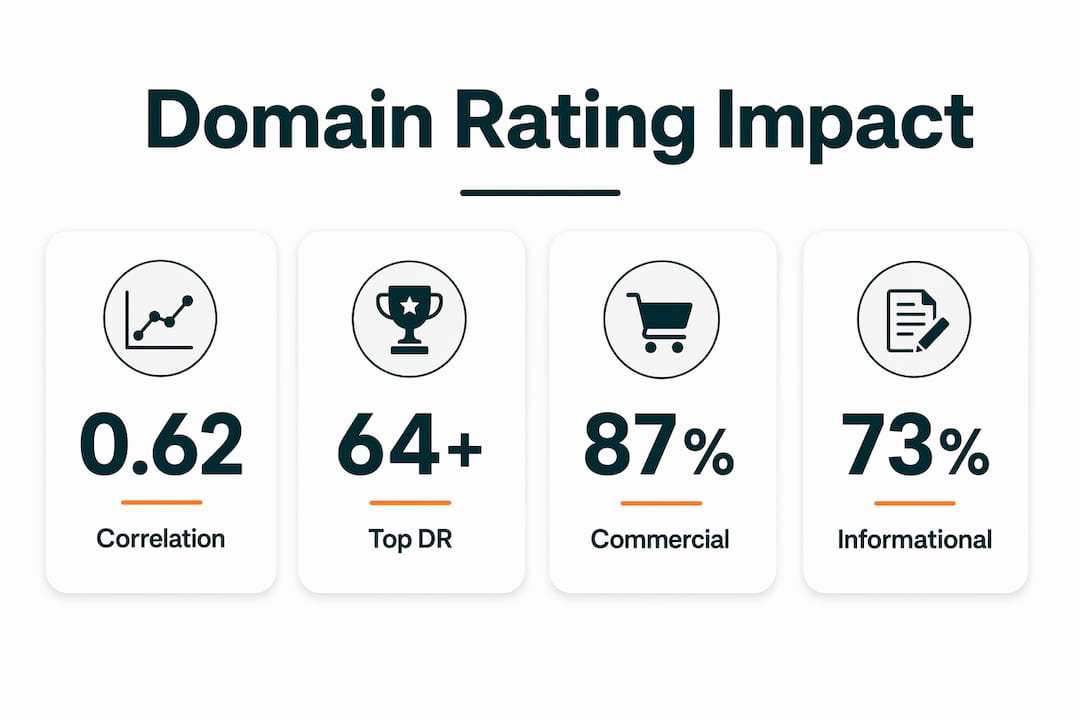
Domain Rating (DR) is a numerical score from 0 to 100 that measures a website’s backlink profile strength, and it strongly correlates with search engine rankings. A 2026 analysis of 50,000 pages found DR is the second-most predictive ranking signal after referring domain count, with a Spearman correlation coefficient of 0.62. That number tells you DR is not a coincidence metric. It reflects real link equity dynamics that search engines respond to. Understanding why domain rating affects rankings means understanding what DR actually measures, where it falls short, and how to use it without being misled by it.
Why domain rating affects rankings: the correlation explained
DR earns its predictive power because it measures backlink profile strength, and backlinks remain one of the most reliable signals of a page’s authority. The Spearman coefficient of 0.62 for DR versus ranking position is strong enough to matter and modest enough to remind you that DR is not the whole story.

Referring domain count edges DR out with a coefficient of 0.74. That gap is meaningful. It tells you that the number of unique sites linking to you predicts rankings slightly better than the quality score those links produce. Both signals work together, but volume of distinct sources carries more weight than the aggregate quality score alone.
The impact of domain rating also shifts depending on what you are trying to rank for. 87.4% of pages ranking top-10 for commercial-intent queries have a DR of 64 or higher. For informational queries, the bar drops considerably.
| Query intent | Average top-10 DR | Pages ranking top-10 with DR below 50 |
|---|---|---|
| Commercial | 67.4 | Not publicly listed |
| Informational | 51.8 | 73.4% |
That table has a direct implication for your strategy. If you run a B2B SaaS site targeting high-intent commercial keywords, you need a DR above 64 just to be competitive. If you are targeting informational queries, a DR in the 40s can still get you into the top 10. Knowing which threshold applies to your query type stops you from chasing a number you do not actually need.
Pro Tip: Before setting a DR target, identify whether your priority keywords are commercial or informational. The thresholds differ by more than 15 DR points, and targeting the wrong benchmark wastes link-building effort.
Is DR a direct Google ranking factor?
DR is not a direct Google ranking factor. Google does not use third-party metrics like Ahrefs DR or Moz Domain Authority in its ranking algorithms. That is a confirmed industry position, not speculation.
The reason DR still correlates with rankings is that it measures backlink quality and link propagation, which are the same raw inputs Google evaluates through its own proprietary system. DR is a proxy. It captures the same underlying dynamics that Google’s internal link equity calculations respond to, just through a different calculation method.
One study of 9,907 legal sites found that Moz Domain Authority showed almost zero correlation with ranking, at a coefficient of -0.0819. That result seems contradictory until you understand why. Legal sites often have strong brand authority and direct traffic signals that override backlink metrics. It shows that DR and similar scores are context-dependent, not universal predictors.
Here is what that means practically for website owners and digital marketers:
- DR is a diagnostic tool. Use it to assess your backlink profile relative to competitors, not as a target to hit for its own sake.
- Chasing DR alone produces vanity metrics. A site with a DR of 70 built on irrelevant or low-quality links will not outrank a DR 55 site with tight topical relevance.
- Google’s internal signals are more complex. Google’s link evaluation system uses proprietary complexity beyond what any third-party score captures.
- Use DR alongside organic traffic data. A rising DR with flat traffic signals that your link profile is growing but your content is not converting that authority into rankings.
Understanding domain rating significance means treating it as one instrument in a larger dashboard, not the only number that matters.
How topical relevance and content depth work alongside DR
DR measures backlink profile strength. It does not measure whether your content is relevant, thorough, or useful. That gap is where many high-DR sites lose rankings they should be winning.
Sites with high DR but poor topical alignment regularly miss ranking opportunities despite appearing authoritative on paper. A technology publication with a DR of 75 will not outrank a specialized SaaS blog with a DR of 52 on a narrow software topic if the SaaS blog has deeper, more relevant content. Search engines evaluate topical fit at the page level, not just the domain level.
Content depth carries its own correlation with rankings. The combined effect of backlinks and content depth explains 71% of ranking variance in 2026 SEO studies. Backlink count contributes the most at 0.74, DR contributes at 0.68, and content depth adds 0.62. No single factor dominates. They compound.
The practical implication is that link building and content creation are not separate workstreams. They reinforce each other. A page with strong topical authority earns links more naturally. Those links raise DR. Higher DR gives the page more ranking leverage. Breaking that cycle by focusing on one element alone slows the whole system down.
Here is how to integrate both signals effectively:
- Build content around topical clusters. Cover a subject area thoroughly before expanding to adjacent topics. Depth within a niche builds topical authority faster than breadth across many unrelated topics.
- Earn links from relevant sources. A backlink from a site in your industry carries more ranking weight than a link from a high-DR site with no topical connection.
- Monitor content depth alongside DR. Track word count, internal linking, and semantic coverage as indicators of content quality, not just backlink metrics.
- Use informational content as a DR entry point. Brands without enterprise-level DR can compete on informational queries where lower DR thresholds apply, then use that traffic to build authority over time.
Pro Tip: Check whether your highest-DR pages are also your highest-traffic pages. If they are not, your link profile and content strategy are misaligned. Fix the content first, then build links to it.
Practical strategies to improve DR and ranking performance
DR operates on a logarithmic scale. Moving from DR 20 to DR 40 is far easier than moving from DR 60 to DR 80. That scaling effect means the effort required per DR point increases exponentially at higher levels. Plan your link-building targets with that curve in mind.
One of the most common pitfalls is DR inflation from redirect chains. Expired domains with redirect chains can make a backlink profile look authoritative while delivering no real link equity or ranking benefit. Auditing your backlink profile for redirect-inflated links is a maintenance task, not a one-time fix. Pair that with technical SEO maintenance to keep your site’s overall health aligned with your link-building efforts.
Follow these practices to build DR that actually moves rankings:
- Prioritize topically relevant referring domains. One link from a site in your niche outperforms five links from unrelated high-DR domains.
- Target informational queries first. Pages ranking for informational terms need lower DR thresholds, making them faster wins that build domain authority over time.
- Audit for redirect chain inflation. Remove or disavow links that inflate DR without passing genuine link equity.
- Publish content that earns links naturally. Original research, data studies, and detailed guides attract backlinks without outreach.
- Track referring domain growth, not just DR. Referring domain count correlates with rankings at 0.74, making it a more direct signal than DR alone.
- Benchmark against actual competitors. Compare your DR to the sites ranking for your specific target queries, not industry averages.
Pro Tip: Use common SEO mistakes as a checklist when auditing your backlink profile. Redirect chain issues and irrelevant link acquisition are two of the most frequently overlooked problems that suppress rankings despite a decent DR score.
Understanding how search engines rank websites in 2026 requires treating DR as one input among several, not a shortcut to the top of the results page.
Key takeaways
Domain Rating correlates with rankings at 0.62 because it measures backlink quality, but referring domain count, topical relevance, and content depth all contribute to the 71% of ranking variance that backlinks and content explain together.
| Point | Details |
|---|---|
| DR is a proxy, not a direct signal | Google does not use third-party DR scores; DR works because it reflects the same backlink data Google evaluates internally. |
| Commercial queries need DR 64+ | 87.4% of top-10 commercial results have DR above 64; informational queries rank with DR below 50 in 73.4% of cases. |
| Topical relevance amplifies DR | High DR without content relevance produces missed rankings; link equity and content depth compound each other. |
| Logarithmic scale raises the cost | DR gains get harder at higher levels; plan link-building effort around the curve, not a flat target. |
| Redirect inflation is a real risk | Expired domain redirect chains inflate DR without passing real link equity or ranking benefit. |
DR is a compass, not a destination
I have worked with site owners who obsessed over their DR score the way some people obsess over a credit score. They would celebrate a jump from 42 to 48 while their organic traffic stayed flat. That disconnect is the clearest sign that DR is being misread.
DR tells you the direction your backlink profile is heading. It does not tell you whether that direction leads to rankings. I have seen a DR 35 site outrank a DR 60 competitor on a competitive SaaS keyword because the smaller site had tighter topical coverage and more relevant referring domains. The number on the dashboard looked wrong. The rankings told the real story.
The 2026 SEO environment rewards specificity. Broad authority built through unrelated backlinks is worth less than narrow authority built through relevant ones. If your DR is growing but your ranking versus click performance is not improving, the problem is almost never the DR score itself. It is the content those links are pointing to.
My advice: set a DR benchmark based on your actual competitors for your actual target queries. Build content that earns links within your niche. Then use DR as a quarterly health check, not a weekly obsession. The sites that rank well in 2026 are the ones that treat DR as one signal in a system, not the system itself.
— Savannah
How Ranksector helps you build DR that actually ranks
Building a backlink profile that moves rankings requires consistent, high-quality content published at a pace most small teams cannot maintain manually.
Ranksector automates daily SEO-optimized article publication for B2B SaaS companies, combining competitor-driven keyword research with a built-in backlink exchange system. That means your site earns topically relevant backlinks while your content library grows, without requiring a dedicated content team. With over 11,000 articles already published, Ranksector has a track record of increasing domain ratings quickly and in ways that translate to actual ranking improvements. Start with the free SEO tools to audit your backlink profile and DR baseline, or run a full AI-powered SEO audit to get a clear picture of where your link equity stands and what to fix first.
FAQ
What is Domain Rating and how is it calculated?
Domain Rating is a 0–100 score measuring a website’s backlink profile strength on a logarithmic scale. It is calculated by evaluating the quality and quantity of referring domains pointing to a site.
Does a higher DR guarantee better rankings?
No. DR correlates with rankings at 0.62 but does not guarantee them. Topical relevance, content depth, and referring domain count all contribute independently to ranking performance.
What DR do I need to rank on the first page?
For commercial queries, 87.4% of top-10 pages have a DR of 64 or higher. For informational queries, 73.4% of top-10 pages rank with a DR below 50.
Why does DR sometimes not match actual traffic or rankings?
DR measures backlink profile strength, not content relevance or traffic signals. A high DR built on irrelevant or redirect-inflated links will not produce proportional ranking or traffic gains.
How is DR different from Google’s own authority signals?
Google does not use third-party DR scores directly. DR acts as a functional proxy for Google’s internal link equity evaluation, but Google’s system includes proprietary signals that no third-party metric fully replicates.
Recommended
- How Search Engines Rank Websites: 2026 Guide · Ranksector Blog — Ranksector
- Why Ranking on Page One Matters in 2026 · Ranksector Blog — Ranksector
- Ranking vs Clicks: Why SaaS Pages Need More Than Position · Ranksector Blog — Ranksector
- Top 5 flyrank.com Alternatives in 2026 · Ranksector Blog — Ranksector