
Why SEO Beats PPC Long Term: 2026 Expert Guide
SEO beats PPC long term because organic rankings compound in value while paid clicks reset to zero the moment you stop spending. A business that invests consistently in SEO builds a growing portfolio of content, authority, and backlinks that keeps generating traffic without a per-click cost. PPC, by contrast, is a rental model: you pay for every visitor, and when the budget runs out, so does your visibility. The math favors SEO decisively over any horizon beyond 12 months, and AI search in 2026 has widened that gap further.
The core reasons SEO delivers sustained, cost-efficient growth:
- Compounding asset: Every optimized page, earned backlink, and schema markup keeps working after publication, with no ongoing cost per visitor.
- Falling acquisition costs: As organic traffic grows, your cost per acquisition drops month over month, unlike PPC where costs scale linearly with spend.
- Break-even within months: SEO typically breaks even at 3–6 months, then compounds from there.
- AI search amplification: The same content and structured data that earn Google rankings also feed ChatGPT, Perplexity, and Google AI Overviews, giving SEO multi-channel reach that PPC cannot match.
- Competitive moat: Competitors cannot buy their way into organic rankings the way they can outbid you in Google Ads.
Key stat: Average SEO ROI runs significantly higher than PPC over comparable budgets, per First Page Sage’s analysis of client campaigns spanning 2021–2025.
How speed to results and cost structure differ between SEO and PPC
PPC delivers first-page visibility the same day a campaign launches. Set up a Google Ads campaign with a reasonable budget, and your ad can appear at the top of search results within hours of approval. That immediacy is real and genuinely useful for new domains, product launches, and time-sensitive promotions.
SEO operates on a longer clock. New content takes days to weeks to get indexed, and newly indexed pages need weeks to months to accumulate enough authority to rank on page one. Competitive head terms can take 6–18 months of sustained work to reach the first page. Long-tail and local keywords, which carry real commercial value but face less competition, can rank within weeks on a technically sound site.
The cost structures are just as different as the timelines. PPC costs are immediate and predictable: if your average cost per click is $4 and you want 500 visits per month, you pay $2,000 that month. But after 12 months of that spend, you have paid $24,000 and own nothing. Stop paying tomorrow and traffic drops to zero the same day. SEO costs are front-loaded in content creation, technical work, and link building, but the rankings and content built by that investment keep generating traffic with no additional per-visit cost.
| Factor | SEO | PPC (Google Ads) |
|---|---|---|
| Time to first results | several months | Same day |
| Ongoing cost per visitor | essentially zero once ranked | variable per click cost (varies by industry) |
| Traffic when you stop spending | Gradual decline over months | Drops to zero immediately |
| Scalability | Compounds without proportional cost increase | Scales linearly with spend |
| Cost predictability | Stable after initial investment | Fluctuates with auction competition |
The scalability difference is where the long-term case for SEO becomes undeniable. PPC costs rise as more advertisers compete for the same keywords. WordStream’s benchmark data documents a consistent upward trend in cost per click across most industries, with significant year-over-year increases in some sectors. SEO’s cost per lead, by contrast, typically falls in years 2–3 as content compounds and authority grows.
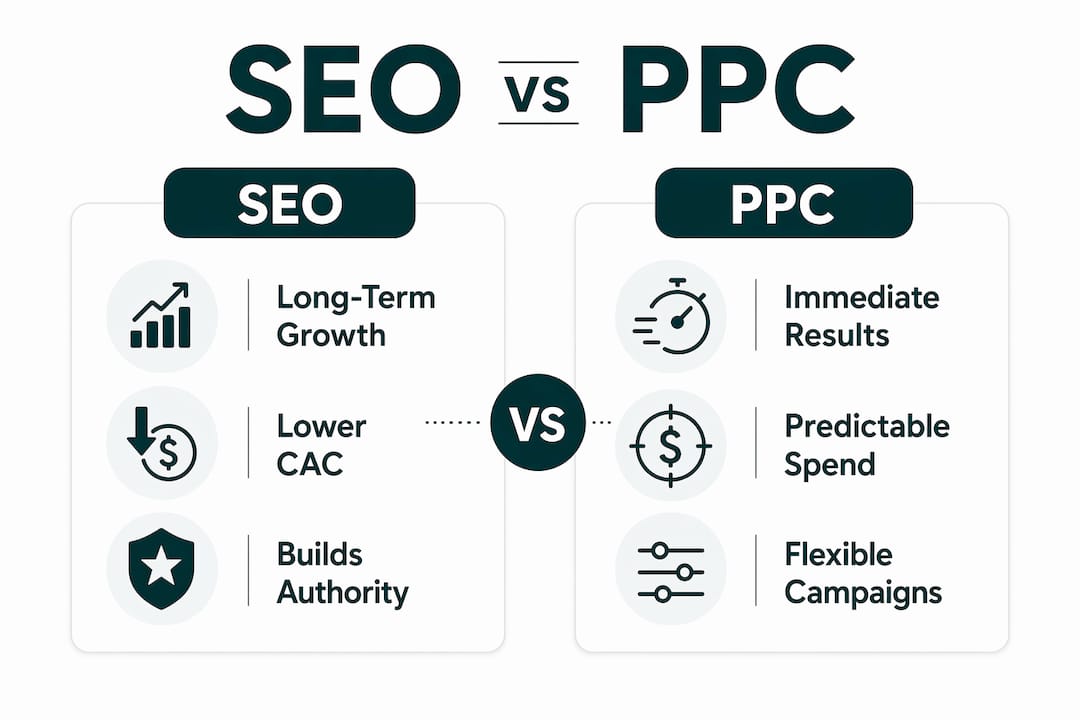
How ROI and customer acquisition cost diverge over time
The ROI gap between SEO and PPC widens every month past the 12-month mark. In the early stages, PPC looks better on a dashboard because it produces leads immediately while SEO is still building its foundation. By month 18, the picture reverses. By month 24, the difference is hard to argue with.

First Page Sage’s analysis of client campaigns from 2021 through 2025 puts average SEO ROI at approximately 748% versus approximately 200% for PPC on comparable budgets. Over 36 months, SEO generates approximately 3.75x more total revenue than PPC, with the gap still widening at the end of that period.
| Timeline | SEO cost per lead trend | PPC cost per lead trend |
|---|---|---|
| Months 1–3 | High (foundation phase) | Stable, predictable |
| Months 4–6 | Declining as pages rank | Rising with competition |
| Months 7–12 | Falling sharply | Continuing to rise |
| Year 2+ | Lowest, compounding | Highest, no ceiling |
The mechanism behind SEO’s falling customer acquisition cost is straightforward. A blog post published in january ranks for a handful of keywords by march, expands to more by june, and by december may rank for dozens of terms without any additional work. Backlinks earned from a guest post eight months ago still pass authority today. Domain authority rises over time, making every new piece of content rank faster than the one before it. None of these compounding effects exist in a PPC campaign. When you pause Google Ads, every one of them resets to zero.
On CAC: Even in SaaS, one of the most expensive organic lead categories, SEO produces leads roughly 57% cheaper than PPC per First Page Sage’s data. In real estate, organic leads cost 83% less than paid equivalents.
For B2B businesses with longer sales cycles, the CAC advantage compounds further. Organic visitors who discover your brand through informational content and return multiple times before converting carry a lower effective acquisition cost than a paid visitor who clicked once and bounced.
How SEO builds brand authority and competitive moats that PPC cannot replicate
SEO authority acts as a competitive moat in a way that paid advertising structurally cannot. A competitor can outbid you on Google Ads tomorrow morning. They cannot replicate 18 months of accumulated backlinks, topical authority, and domain trust overnight. That asymmetry is one of the most underappreciated strategic advantages of organic search.
The moat deepens through several compounding mechanisms:
- Domain authority: As your site earns more high-quality backlinks, every new page you publish ranks faster and higher than the previous one.
- Topical relevance: Publishing consistently on a subject signals to Google that your domain genuinely understands the space, making it harder for competitors to displace you across an entire topic cluster.
- Content age: 72.9% of pages ranking in Google’s top 10 are more than three years old, and the average number-one ranking page is five years old. Time in market is itself a ranking signal.
- User trust: Organic rankings are perceived as merit-based. Users understand that paid ads are purchased placements, which is why organic clicks tend to represent warmer prospects before any site interaction occurs.
- Brand familiarity: When prospects repeatedly see your brand answering their questions across multiple searches, trust builds before the first sales conversation.
SEO authority does require maintenance to hold. Technical audits, content refreshes, and freshness signals are necessary to prevent ranking decay over time. But the cost of that maintenance is a fraction of what PPC demands to sustain equivalent traffic. You are tending an asset, not renting one.
For a deeper look at how this plays out in competitive markets, the SEO competitive landscape in 2026 shows exactly how durable organic authority separates market leaders from followers.
When to choose PPC versus SEO based on your situation
Neither channel is universally superior for every business at every stage. The right choice depends on your timeline, budget stability, sales cycle, and how much competitive pressure you face.
Prioritize PPC when:
- You need leads this quarter and cannot wait 6 months for organic rankings to build.
- You are launching a new domain with zero organic authority.
- You are running a time-sensitive campaign: Black Friday, a product launch, a seasonal promotion.
- You want to test whether a keyword actually converts before committing to a 6-month SEO effort targeting it.
- Your sales cycle is under 14 days and bottom-of-funnel intent is the primary driver.
Prioritize SEO when:
- You have a 12-plus-month horizon and want compounding returns that outlast your spend.
- Your industry has high CPCs that make sustained PPC economically painful. Legal services average approximately $116 per lead from PPC; a firm spending $30,000 per month on Google Ads can often achieve better long-term returns by shifting a portion of that budget to SEO.
- Your sales cycle exceeds 60 days and trust-building content matters more than immediate conversion.
- You want visibility in AI search platforms like ChatGPT and Perplexity, where PPC has no presence.
- You are building a brand, not just generating clicks.
For professional service firms navigating this decision, the dynamics in law firm marketing: SEO vs PPC illustrate how high-trust industries benefit most from organic credibility over time.
The most effective approach for most growth-stage businesses is not a binary choice. Running both channels simultaneously, with PPC handling immediate lead flow while SEO builds the organic foundation, produces better total outcomes than committing to either alone.
How to integrate PPC and SEO for maximum marketing impact
PPC and SEO work best as complementary channels, not substitutes. The practical integration follows a phased approach that shifts budget as organic traffic matures.
- Months 1–3: PPC-heavy foundation. Allocate roughly 70% of your search budget to Google Ads for immediate lead generation. Use the remaining 30% to complete a technical SEO audit, build site architecture, and publish initial content.
- Use PPC as a keyword testing lab. Before committing to a 6-month SEO campaign on a competitive term, run PPC to test keyword conversion rates in weeks rather than months. This prevents wasted SEO effort on low-intent terms.
- Months 4–6: Balanced split. As organic traffic begins, move toward a 50/50 allocation. Feed PPC conversion data directly into your SEO content priorities, targeting terms that have already proven they convert.
- Months 7–12: Shift toward SEO. As organic rankings mature, reduce PPC spend on keywords where you now rank organically. Reallocate that budget toward high-intent bottom-of-funnel terms where organic hasn’t yet reached page one.
- Use remarketing to monetize organic visitors. Organic search cannot retarget. Once a user leaves your site, paid channels like Google Display bring them back. Even an SEO-dominant strategy benefits from maintaining a retargeting budget.
- Year 2 and beyond: SEO-dominant. Target 70–80% SEO, with PPC reserved for competitive terms, new product launches, seasonal pushes, and branded defense against competitor bidding.
Pro Tip: Track blended cost per lead across both channels monthly. As organic grows, this number should fall. If it isn’t falling by month 12, your SEO content strategy likely needs realignment with proven PPC conversion data.
The crossover point, where SEO starts delivering more traffic per dollar than PPC, typically occurs between months 10–14 for most industries. Beyond month 18, SEO almost always wins on a per-dollar-invested basis because organic visits keep arriving after spend stops.
Why AI search in 2026 makes SEO even more valuable
AI search has fundamentally changed the ROI equation for SEO. Google AI Overviews, ChatGPT Search, Perplexity, and Claude all rely on organic content signals to generate their answers. SEO is now a prerequisite for AI search visibility, and PPC offers no direct presence in any of these platforms.

The practical implication: a single well-structured, authoritative piece of content can now rank on Google, get cited in a ChatGPT response, appear in a Perplexity answer, and surface in a Google AI Overview. One asset, four discovery channels, all compounding simultaneously. PPC only serves Google and paid social platforms.
Key AI-driven SEO factors that amplify visibility in 2026:
- Structured data and schema markup: Pages with proper schema are more likely to be cited in AI Overviews and AI search responses. Schema added once keeps improving visibility indefinitely.
- Topical authority: AI platforms favor sources that demonstrate deep, consistent expertise on a subject, not isolated pages.
- Content quality signals: The same quality signals that earn Google rankings also earn AI citations. There is no separate AI optimization layer; strong SEO feeds both.
- Technical accessibility: Fast, well-structured, crawlable sites get indexed and cited across platforms more reliably.
- E-E-A-T signals: Experience, expertise, authoritativeness, and trustworthiness matter more in AI-generated answers than in traditional blue-link results.
For a detailed look at how AI-enhanced search affects rankings and what it means for your content strategy, the technical picture has shifted considerably from even two years ago.
PPC ads still appear above AI Overviews in Google results, which has actually increased click-through rates on ads for some queries. But AI search platforms like ChatGPT and Perplexity have no ad inventory at all. Every citation there is earned through organic authority.
How algorithm updates affect SEO stability versus PPC adaptability
Google’s algorithm updates create real risk for SEO. A core update can move rankings significantly in a short period, and businesses that have relied on a single content tactic or thin page quality can see traffic drop sharply. This is a genuine limitation of organic search that PPC does not share in the same way.
PPC is more adaptable to algorithm changes because it operates on a separate auction system. When Google updates its organic ranking factors, paid campaigns are unaffected. Advertisers can adjust bids, copy, and targeting within days. SEO recovery from a major update, by contrast, can take months of content improvement and technical remediation.
That said, the risk profile of algorithm updates is often overstated for businesses doing SEO correctly. Google’s core updates consistently reward the same fundamentals: high-quality content, strong technical performance, and genuine authority signals. Businesses that have built their organic presence on these foundations tend to hold rankings through updates, and sometimes gain from them as thin-content competitors lose ground.
The practical answer is to treat SEO maintenance as ongoing rather than one-time. Regular technical audits and content refreshes prevent the ranking decay that makes sites vulnerable to update impact. A site that is consistently updated and technically sound is far less exposed to algorithm volatility than one that was optimized once and left alone.
PPC’s adaptability is real, but it comes with a cost: every adaptation requires additional spend. Adjusting to a competitive shift in the auction means raising bids. SEO’s adaptation cost is editorial and technical work, not incremental ad dollars.
How lead quality and conversion rates compare between SEO and PPC over time
PPC converts at a slightly higher rate for bottom-of-funnel keywords in the short term. Someone clicking a Google Ads result for “buy enterprise CRM software” is expressing strong purchase intent, and a well-structured landing page can capture that efficiently. That conversion advantage is real and worth acknowledging.
Over time, however, organic leads tend to outperform paid leads on downstream metrics: retention, lifetime value, and referral rate. The reason is trust. Organic rankings are perceived as merit-based recommendations. Users who find your brand through consistent organic presence across multiple searches have typically consumed more of your content, understand your positioning better, and arrive with higher baseline confidence than someone who clicked an ad.
In industries where trust drives purchasing decisions, the gap is pronounced. First Page Sage’s data shows SEO converting at 3–7x the rate of PPC in categories like legal services, financial advisory, healthcare, B2B software, and real estate. These are precisely the industries where a prospect’s willingness to engage depends heavily on perceived credibility before the first conversation.
There is also an attribution problem that makes PPC look better than it often is. Analytics tools record the last click before a conversion. A prospect who discovers your brand through an AI recommendation, reads three of your blog posts, sees your social content, and then types your URL directly into their browser gets recorded as “direct traffic.” The SEO and content work that started that journey gets zero credit. SEO’s true impact is consistently 2–3x what dashboards show because last-click attribution was designed for a simpler world.
Data-driven examples of long-term SEO growth trends
The compounding nature of SEO shows up clearly in real campaign data. One SaaS company case documented in industry research started with $45,000 per month in combined PPC and SEO spend, generating 360 leads per month at a cost per lead of $125. Over 12 months of shifting budget progressively toward SEO as organic rankings built, monthly lead volume grew to 410 while total acquisition spend dropped to $22,000. Cost per lead fell from $125 to $54 over that period.
The trajectory followed a predictable pattern. In months 1–3, PPC carried the full lead load while the SEO foundation was built. By months 4–6, organic traffic reached meaningful volume and underperforming PPC campaigns were cut using keyword data the SEO work had surfaced. By months 10–12, organic traffic had reached 12,800 visits per month with 95 leads per month, and PPC spend had been reduced to focus exclusively on high-intent bottom-of-funnel terms.
The content compounding effect is equally concrete. A blog post published in january can rank for a handful of keywords by march, expand to more by june, and rank for dozens of terms by december without any additional work. Ahrefs found that a notable portion of surveyed SEOs report SEO takes several months to show results., with growth compounding from there. The pages that rank longest tend to rank widest, accumulating keyword coverage that no single PPC campaign can replicate at equivalent cost.
For B2B SaaS specifically, the long-term economics are compelling. The crossover point where SEO delivers more traffic per dollar than PPC typically arrives sometime after several months, with SEO dominating per-dollar value over a longer term. because organic visits keep arriving after spend stops.
Budget scalability and optimization challenges for sustained campaigns
Scaling SEO and PPC face fundamentally different constraints. PPC scales immediately but linearly: double your budget and you get roughly double the clicks, at the same or higher cost per click as competition for those keywords intensifies. There is no compounding return on additional spend. The ceiling is your budget, and the floor is zero the day you stop.
SEO scales nonlinearly, which is both its strength and its challenge. Between months 6–18, the compounding engine accelerates: existing content ranks for additional keywords without new investment, domain authority rises and makes new content rank faster, and internal links strengthen the entire site’s topical relevance. But that nonlinearity also means the early months feel slow and the returns are hard to predict precisely.
The optimization challenge for sustained SEO campaigns is consistency. The businesses that fail at SEO are usually the ones who expected Google Ads speed and pulled the plug at month 2 or 3, just before momentum was building. Maintaining investment through the foundation phase requires either a clear understanding of the compounding timeline or enough patience to let the data speak.
Budget allocation for most B2B businesses with a 12-plus-month horizon: a 60–70% SEO, 30–40% PPC split is defensible, with the PPC portion focused on high-intent bottom-of-funnel terms and retargeting. Adjust toward PPC if your sales cycle is under 14 days; toward SEO if it exceeds 60 days. As organic rankings mature on specific keywords, reduce PPC spend on those terms and reallocate toward keywords where organic hasn’t yet reached page one.
Pro Tip: Track organic traffic share as a percentage of total traffic monthly. Targeting 50%+ organic by month 12 is a reasonable benchmark for most B2B businesses running a balanced SEO and PPC program.
How market saturation and competition affect SEO and PPC effectiveness
In saturated markets, both channels get harder, but they get harder in different ways. PPC in a competitive market means rising CPCs with no ceiling. When more advertisers bid on the same keywords, auction prices climb. CPC rose for 86% of industries in 2024, and the trend has continued into 2026. In legal services, a single “car accident lawyer” click can cost $275. At those rates, PPC becomes economically unsustainable for most businesses without very high lifetime customer value.
SEO in a saturated market is harder to break into but more defensible once established. The businesses that have been investing in organic authority for years have built a moat that new entrants cannot replicate quickly. A competitor who starts their SEO today cannot replicate what you have built over 12 months. They have to go through the same compounding process, and by the time they catch up, you are 12 months further ahead.
The strategic implication is timing. The best time to start building organic authority was two years ago. The second best time is now. Every month of delay is a month competitors could be building the compounding advantage instead of you. In markets where CPCs are already high and rising, the case for shifting budget toward SEO becomes more urgent, not less.
AI Overviews have added a new competitive dimension. Informational queries that previously drove strong organic traffic are increasingly answered at the SERP level without clicks. Commercial and navigational queries, where purchase intent is explicit, have seen less disruption. SEO strategy in 2026 needs to weight commercial intent content more heavily than it did even two years ago, and search intent alignment has become a more critical factor in content planning.
Key Takeaways
SEO beats PPC long term because organic rankings compound in value, reduce acquisition costs over time, and build brand authority that paid campaigns cannot replicate.
| Point | Details |
|---|---|
| SEO ROI compounds decisively | Average SEO ROI runs approximately 748% versus approximately 200% for PPC over comparable budgets, with the gap widening past month 12. |
| Break-even is faster than expected | SEO typically breaks even at 3–6 months; after that, traffic and lead flow accelerate without proportional additional spend. |
| AI search amplifies SEO’s reach | The same content and schema that earns Google rankings also feeds ChatGPT, Perplexity, and Google AI Overviews, giving SEO multi-channel reach PPC cannot match. |
| Integration beats choosing one channel | PPC fills the lead pipeline during SEO’s ramp period and provides keyword conversion data that sharpens organic content strategy. |
| Ranksector accelerates the SEO timeline | Ranksector’s automated daily publishing and competitor-driven keyword research help B2B SaaS teams build organic authority faster without manual content effort. |
The case for betting on SEO in 2026, not against it
The conventional wisdom in performance marketing still treats SEO as the slow, uncertain option and PPC as the reliable workhorse. That framing made more sense a decade ago. The economics have shifted.
PPC costs have risen consistently across nearly every industry for years. The auction model has no natural ceiling, and as more businesses compete for the same high-intent keywords, the cost per lead climbs regardless of how well you optimize your campaigns. You can run excellent Google Ads and still watch your cost per acquisition rise year over year simply because the market got more competitive. That is a structural problem, not an execution problem.
SEO’s compounding dynamic runs in the opposite direction. The longer you invest, the cheaper each lead becomes. The more content you publish and the more authority you accumulate, the faster new content ranks. The businesses that understood this five years ago and committed to organic search are now generating leads at a fraction of the cost their PPC-dependent competitors pay. The moat they built is real, and it widens every month.
What I find most underappreciated in the SEO versus PPC debate is the AI search dimension. Marketers who think of AI Overviews and ChatGPT as threats to organic traffic are missing the bigger picture. These platforms cite authoritative content. They reward exactly what good SEO builds: depth, structure, trust signals, and topical expertise. A business with strong organic authority is not just ranking on Google. It is getting recommended by AI systems that have no ad inventory at all. That is a distribution channel that did not exist three years ago, and it is growing fast.
The businesses that will struggle in 2026 and beyond are the ones that kept deferring SEO investment because PPC was producing results today. PPC results are real. They are also temporary. Every dollar spent on organic authority is a dollar that keeps working after the campaign ends.
Ranksector publishes the SEO content your team doesn’t have time to write
Daily SEO content is what separates brands that compound organic authority from those that plateau. Most B2B SaaS teams know this and still fall behind, not because they lack strategy but because consistent publishing at scale requires more bandwidth than small teams have.
Ranksector solves the execution gap directly. The platform automates daily article creation and publication, with keyword research driven by competitor analysis so every piece targets terms your market is actually searching for. A built-in backlink exchange system grows domain authority without manual outreach. With over 11,000 articles already published across client sites and documented results in domain rating growth, Ranksector delivers what traditional agencies promise but rarely produce at this pace.
For B2B SaaS marketers who want the compounding benefits of SEO without building a content team, Ranksector’s agency platform is the hands-free alternative. You can also explore free SEO tools to see the platform’s capabilities before committing.
Recommended
- Keyword Position Tracking: A 2026 Guide for SEO Specialists · Ranksector Blog — Ranksector
- How Search Engines Rank Websites: 2026 Guide · Ranksector Blog — Ranksector
- Types of SEO Quick Wins for Faster Rankings in 2026 · Ranksector Blog — Ranksector
- Ranking vs Clicks: Why SaaS Pages Need More Than Position · Ranksector Blog — Ranksector