
Types of High-Intent Commercial Keywords: SEO Guide
High-intent commercial keywords are search queries that signal a user is actively evaluating options before making a purchase decision. They sit between pure research and direct buying, making them the most strategically valuable keyword category for digital marketers and SEO professionals. Understanding the types of high-intent commercial keywords gives you a precise framework for matching content to buyer readiness, which directly affects conversion rates and organic revenue. Tools like Ahrefs, Backlinko, and AIOSEO have each built classification systems around this concept that are worth knowing in detail.

1. What are the main types of high-intent commercial keywords?
Commercial investigation intent is the formal term Ahrefs uses for this keyword category. It describes queries where users evaluate options rather than simply searching for information or completing a transaction. Backlinko takes a broader view and classifies commercial intent into four distinct types: Buy Now, Product, Informational, and Tire Kicker. Each type reflects a different level of purchase readiness.
- Buy Now keywords include modifiers like “buy,” “coupon,” “discount,” and “order.” These signal the user is ready to act immediately. Example: “buy noise-canceling headphones online.”
- Product keywords focus on specific items or brands. Example: “Sony WH-1000XM5 review” or “best project management software.” These sit one step before purchase.
- Informational commercial keywords blend research with evaluation. Example: “how does CRM software work” from a buyer who is still learning but moving toward a decision.
- Tire Kicker keywords include terms like “free,” “torrent,” or “open source alternative.” These attract users unlikely to convert to paid customers.
The distinction between commercial and transactional intent trips up many SEO professionals. Transactional keywords signal immediate action (“buy now,” “add to cart”), while commercial keywords signal evaluation (“best,” “compare,” “review”). Both are high-intent, but they require different content formats and page types to rank effectively.
2. How do keyword modifiers signal commercial intent?
Modifiers are the fastest way to classify a keyword’s intent without guessing. AIOSEO identifies five core modifier categories that consistently signal commercial intent: best/top, vs, review, alternative, and feature/use-case fit. Each modifier reveals a specific stage in the buyer’s evaluation process.
- Best / Top: “Best CRM for small business” signals the user wants a ranked recommendation. Content that performs here is typically a listicle or comparison post.
- Vs: “HubSpot vs Salesforce” signals direct competitor comparison. The user has narrowed their options to two or three and wants a tiebreaker.
- Review: “Notion review 2026” signals the user is close to deciding and wants social proof or an expert opinion.
- Alternative: “Slack alternatives for remote teams” signals dissatisfaction with a current tool or a desire to explore the market before committing.
- Feature / Use-case: “CRM with pipeline automation” signals the user knows exactly what capability they need and is matching tools to that requirement.
SERanking confirms that SERP results for these modifier-driven queries predominantly feature evaluative content. That means listicles, comparison tables, and expert reviews dominate the first page. If your content does not mirror that format, ranking is unlikely regardless of keyword targeting.
The Tire Kicker modifier group deserves special attention. Queries containing “free,” “open source,” or “no cost” attract high traffic but low conversion. Targeting them burns content resources without producing revenue. Recognize them early and deprioritize them unless your business model specifically serves free users.
Pro Tip: Run your target keyword through Google and check the top five results. If they are all comparison posts or listicles, you are looking at a commercial intent keyword. If they are product pages or checkout flows, the intent is transactional.
3. Comparison of commercial keyword types by conversion and content format
Commercial keywords convert at roughly 2–5%, while transactional keywords convert at 5–15%. That gap exists because commercial keywords attract users still in evaluation mode. The right content format closes that gap by giving users the information they need to decide.
| Keyword Type | Typical Modifier | Conversion Rate | Best Content Format | Marketing Use Case |
|---|---|---|---|---|
| Buy Now | buy, order, discount | 5–15% | Landing page, product page | Direct response, paid search |
| Product / Review | review, best, top | 2–5% | Review post, listicle | Affiliate, organic SEO |
| Comparison | vs, compare, alternative | 2–5% | Comparison page, table | Mid-funnel nurture |
| Feature / Use-case | for [use case], with [feature] | 3–7% | Feature page, use-case guide | SaaS product marketing |
| Tire Kicker | free, open source, torrent | Below 1% | Blog post (awareness only) | Brand awareness, top of funnel |
Competition levels also vary significantly by type. Buy Now keywords carry the highest cost-per-click in paid search because advertisers know the user is ready to spend. Product and comparison keywords sit in the mid-range. Tire Kicker keywords are cheap to bid on but rarely justify the spend for revenue-focused campaigns.
For SaaS marketers, feature-fit and use-case keywords are often the most underused category. A query like “project management tool with time tracking” has lower search volume than “best project management software,” but the user is far more specific in their needs. That specificity translates to higher close rates when your content matches the requirement exactly.
4. How to cluster commercial keywords by decision frame
Clustering keywords by decision frame is the most effective way to build a content architecture around commercial intent. Practitioners group keywords into three primary decision frames: best-for-use-case, competitor comparison, and product alternatives. Each frame maps to a dedicated page template.
- Best-for-use-case cluster: Group all “best [product] for [audience/use case]” queries together. Build one authoritative listicle or comparison post per cluster. Example: “best email marketing tool for ecommerce” and “best email marketing software for small business” belong on the same page or in the same content cluster.
- Competitor comparison cluster: Group all “[Brand A] vs [Brand B]” queries. Build dedicated comparison pages for each pairing. These pages rank well because the query is highly specific and most brands avoid publishing direct competitor comparisons.
- Product alternative cluster: Group all “[Brand] alternative” queries. Build one alternatives page per major competitor in your space. These pages capture users who are already dissatisfied with a competitor and are actively looking for a switch.
Mixing conflicting intent on a single page weakens ranking potential. A page targeting both “buy CRM software” and “what is CRM software” sends mixed signals to search engines and fails to satisfy either user. Keep intent frames separate unless the SERP itself shows mixed results for a given query.
Pro Tip: Use Google Search Console to check which queries are already driving clicks to your existing pages. If a commercial modifier appears in those queries but your page is built for informational intent, you have a quick content update opportunity that can lift rankings without building a new page.
Revenue-connected KPIs are the right way to measure success from commercial keyword campaigns. Track demos requested, quotes submitted, and trial signups rather than just organic traffic. A keyword driving 200 monthly visits and 10 demo requests outperforms one driving 2,000 visits and zero conversions.
5. How to build a transactional keyword strategy alongside commercial keywords
Transactional keyword strategies work best when paired with commercial keyword content. The commercial content builds trust and educates the buyer. The transactional page closes the deal. Running both in parallel creates a full-funnel organic presence that captures users at every stage of the decision process.
For paid search, commercial keywords like “HubSpot alternative for startups” are worth bidding on even at lower conversion rates. The user is in active evaluation mode, and a well-targeted ad can pull them into your funnel before a competitor does. High-commercial-value keyword clusters built around pricing, comparison, and geographic modifiers consistently show the strongest connection to revenue-driving actions like demos and quotes.
Tracking assisted conversions in Google Analytics gives you a clearer picture of how commercial keywords contribute to revenue. A user who reads your “best CRM for startups” post and then converts three days later via a branded search is a commercial keyword conversion. Without assisted conversion tracking, that attribution disappears and you undervalue your commercial content.
For teams working on competitor keyword gaps, commercial intent queries are often the fastest wins. Competitors frequently publish product pages but neglect comparison and alternative content. That gap is your opportunity to rank for high-intent queries your competitors are leaving open.
Key takeaways
High-intent commercial keywords are most valuable when classified by modifier type and mapped to dedicated content formats that mirror what already ranks on the SERP.
| Point | Details |
|---|---|
| Four core keyword types | Backlinko’s Buy Now, Product, Informational, and Tire Kicker framework covers the full commercial intent spectrum. |
| Modifiers reveal intent | Terms like best, vs, review, and alternative each signal a distinct evaluation stage and require a matching content format. |
| Conversion rates differ | Commercial keywords convert at 2–5%; transactional keywords convert at 5–15%. Match content format to intent to close the gap. |
| Cluster by decision frame | Group keywords into best-for-use-case, competitor comparison, and alternative clusters, then build one dedicated page per cluster. |
| Measure with revenue KPIs | Track demos, quotes, and trial signups rather than traffic alone to accurately value commercial keyword performance. |
What I’ve learned from modifier-driven keyword classification
The biggest mistake I see SEO professionals make is treating commercial intent as a single category. They build one “best of” post and call it done. The reality is that a user searching “HubSpot vs Salesforce” is in a completely different mental state than someone searching “best CRM for small business.” The first user has already done their research and is choosing between two finalists. The second is still building their shortlist. Serving both with the same content format is like giving the same sales pitch to a cold lead and a contract-ready buyer.
Modifier-driven classification changed how I build content calendars. When you map every commercial keyword to its modifier type first, the right content format becomes obvious. You stop debating whether to write a listicle or a comparison page. The modifier tells you. “Best” means listicle. “Vs” means head-to-head comparison. “Alternative” means a challenger page that positions your product as the switch.
The part that surprises most practitioners in 2026 is how much SERP formats have shifted for commercial queries. AI-generated overviews now appear above traditional organic results for many evaluation-stage queries. That means your comparison and review content needs to be structured clearly enough for AI systems to extract and cite it. Short paragraphs, clear headers, and direct claims are no longer just good writing practice. They are a ranking requirement.
Watch out for intent drift in your keyword clusters. A keyword that was purely commercial two years ago may now show transactional results as the market matures. Audit your commercial keyword clusters quarterly and check whether the SERP format has shifted. Catching that drift early keeps your content aligned with what search engines are rewarding.
— Savannah
Ranksector’s approach to high-intent keyword targeting
Identifying and acting on the right commercial keywords is where most small SEO teams lose time. Ranksector automates the keyword research and content creation process for B2B SaaS companies, publishing daily SEO-optimized articles built around the exact modifier-driven intent categories covered here.
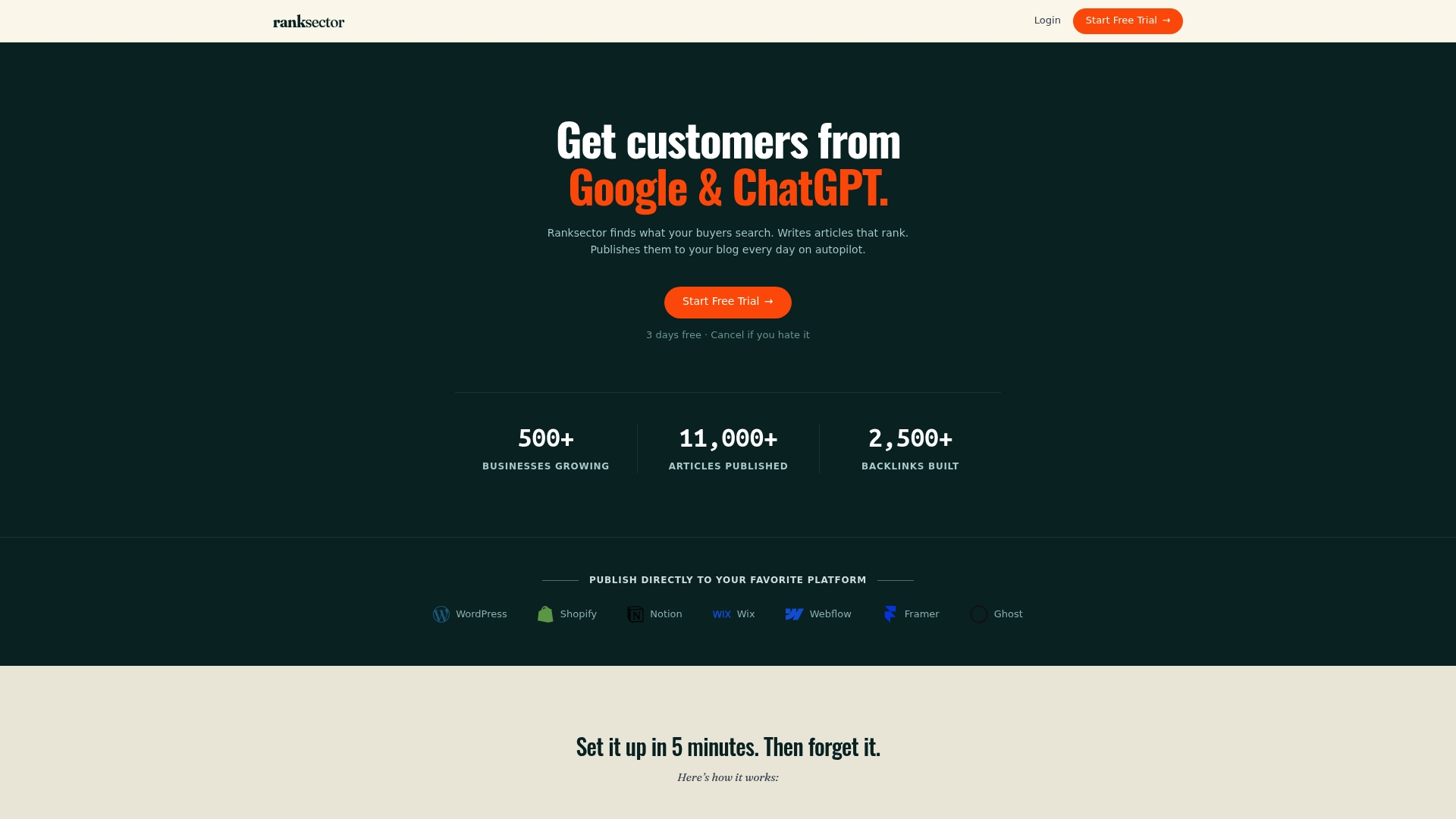
Ranksector’s platform combines competitor-driven keyword analysis with a backlink exchange system, so your content targets high-intent commercial queries and builds domain authority at the same time. With over 11,000 articles already published, the system is built for teams that need results without adding headcount. Access Ranksector’s free SEO tools to start identifying your highest-value commercial keyword opportunities today.
FAQ
What are high-intent commercial keywords?
High-intent commercial keywords are search queries that signal a user is evaluating options before purchasing. They typically include modifiers like “best,” “review,” “vs,” or “alternative” and sit between informational research and direct transactional queries.
How do commercial keywords differ from transactional keywords?
Commercial keywords signal evaluation intent and convert at roughly 2–5%, while transactional keywords signal immediate purchase intent and convert at 5–15%. Commercial keywords suit comparison and review content; transactional keywords suit landing pages and product pages.
What are the best high-intent keywords examples for SaaS?
Strong examples include “[Tool A] vs [Tool B],” “best CRM for startups,” “[Competitor] alternative,” and “project management software with time tracking.” Each modifier targets a specific decision stage in the SaaS buyer journey.
How do I avoid targeting tire kicker keywords?
Filter out queries containing “free,” “open source,” or “torrent” unless your product has a free tier. Backlinko’s framework labels these Tire Kicker keywords because they attract users with no purchase intent.
Should I mix commercial and transactional intent on one page?
Mixing intent on a single page weakens ranking potential. Keep commercial evaluation content and transactional conversion pages separate unless the SERP for that specific query already shows mixed results.
Recommended
- Common Keyword Research Mistakes Businesses Make in 2026 · Ranksector Blog — Ranksector
- Find Untapped Keywords: Competitor Research Guide · Ranksector Blog — Ranksector
- Free Keyword Research: A Practical Guide for Creators · Ranksector Blog — Ranksector
- How to Find Keyword Gaps Competitors Miss: A SaaS SEO Workflow · Ranksector Blog — Ranksector