
Free Keyword Research: A Practical Guide for Creators
Free keyword research is the process of discovering and analyzing relevant search terms using no-cost tools and methods to build an SEO strategy without paid subscriptions. Tools like Google Keyword Planner, Google Search Console, and Ubersuggest give content creators, digital marketers, and small business owners access to the same core data that expensive platforms charge hundreds of dollars per month to provide. The catch is that free tools cover up to 90% of premium feature requirements when combined strategically. That means the gap between a $0 research stack and a $200/month subscription is smaller than most people assume.
What is free keyword research and why does it matter?
Free keyword research, known in the industry as organic keyword analysis, is the practice of identifying which search queries your audience types into Google, then evaluating those queries by volume, competition, and intent before creating content around them. The goal is to rank in search results without guessing what people actually want to read.
For small businesses and solo content creators, the importance of keyword research cannot be overstated. Publishing content without keyword data is like opening a store in a location you have never scouted. You might get foot traffic, or you might get none. Keyword research removes that uncertainty by showing you where demand already exists.

The free SEO keyword strategy works because Google itself provides the most accurate data through its own tools. Google Keyword Planner, Google Search Console, and Google Trends are all free, and they pull directly from Google’s index. Third-party tools like Ubersuggest and AnswerThePublic layer on top of that data with additional filters and visualizations. No single tool does everything, but a coordinated stack covers every phase of research.
What are the best free keyword tools and how do they compare?
The best free keyword tools each serve a distinct purpose. Matching the right tool to the right task is the foundation of an effective free keyword research workflow.
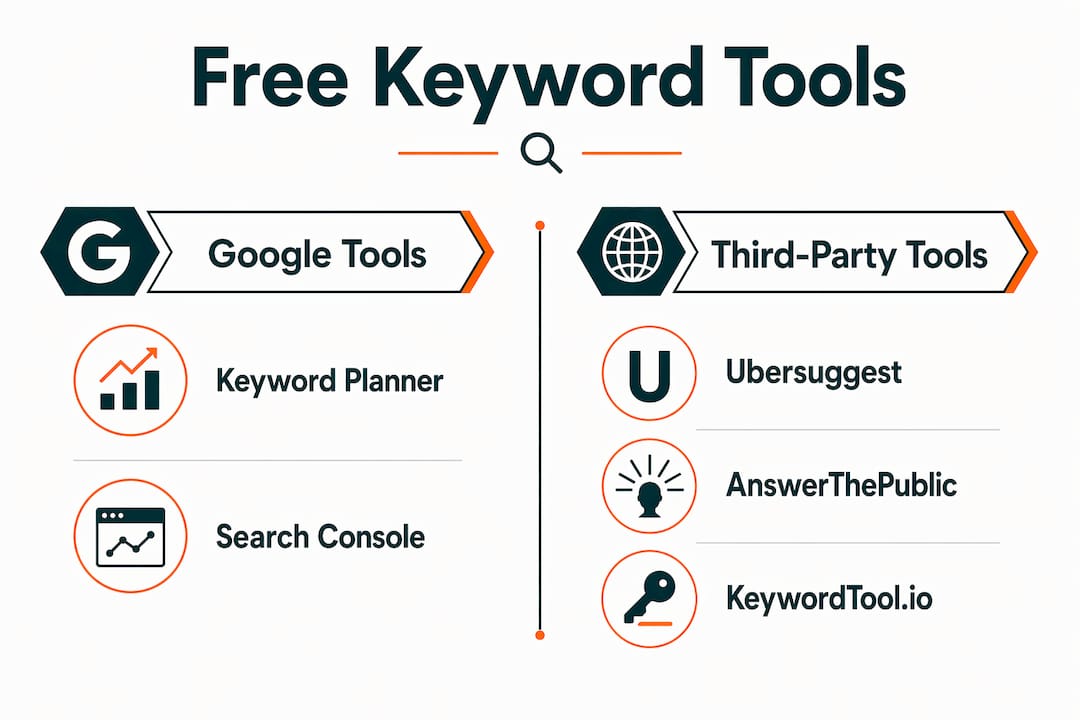
| Tool | Best use case | Key limit | Access requirement |
|---|---|---|---|
| Google Keyword Planner | Search volume and bid estimates | Requires Google Ads account | Free, no active campaign needed |
| Google Search Console | Existing ranking queries and click data | Only shows your own site data | Free, site verification required |
| Google Trends | Seasonal and trending topic discovery | No volume numbers | Free, no account needed |
| Ubersuggest | Keyword ideas and difficulty scores | ~40 daily searches on free tier | Free account required |
| AnswerThePublic | Question-based keyword discovery | 3 searches per day on free tier | Free, limited without account |
| Keyword Tool | Long-tail keyword suggestions | Export locked behind paywall | Free basic use |
Google Keyword Planner remains the most accurate free tool for search volume data, but it requires a Google Ads account. The good news: you can set up an account without running a single paid ad. Just pause any campaign before it spends money. That unlocks exact monthly search volume ranges for any keyword you enter.
Ubersuggest provides roughly 40 daily searches on its free tier, which makes it one of the more generous third-party options for beginners. It shows keyword difficulty scores alongside volume estimates, which helps you prioritize which terms are actually winnable.
Most free third-party tools cap users at 3 daily searches or 20 results per filter without a subscription. That limit sounds frustrating until you realize it just means you need a rotation strategy rather than a single go-to tool.
Pro Tip: Set up a simple spreadsheet with one tab per tool. Log your daily searches in each tab so you never waste a query on a keyword you already researched last week.
How to build a free keyword research workflow that actually produces results
No single free tool covers every keyword research task. Seed keyword discovery, volume estimation, intent mining, and competitive gap analysis each require a different tool. The solution is a task-matching workflow that assigns the right tool to each phase.
Here is a practical weekly workflow you can follow:
-
Seed keyword discovery (Monday, 20 minutes). Type your core topic into Google Autocomplete and note every suggestion. Do the same in AnswerThePublic using your 3 free daily searches. You are looking for question-based and long-tail variations you would not have thought of on your own. Combining Google Autocomplete with Keyword Planner and Search Console click data is the most effective free discovery method available.
-
Volume and difficulty estimation (Tuesday, 30 minutes). Take your seed list into Google Keyword Planner to get volume ranges. Cross-reference the most promising terms in Ubersuggest to get difficulty scores. Flag any keyword with a difficulty score below 40 and monthly searches above 500 as a priority target.
-
Intent mining (Wednesday, 20 minutes). Search each priority keyword in Google and study the top 10 results. Are they blog posts, product pages, or comparison articles? The format Google rewards tells you exactly what content type to create. This step costs nothing and takes less time than most people expect.
-
Competitive gap analysis (Thursday, 30 minutes). Open Google Search Console and filter your queries by impressions. Any keyword where you appear in positions 11 through 30 is a gap opportunity. You are already on Google’s radar for those terms. A targeted content update often moves them to page one faster than building a brand new page.
-
Keyword list validation and clustering (Friday, 20 minutes). Group your validated keywords by topic and intent. Assign one primary keyword and two to three supporting terms to each planned article. This is how you build topical authority rather than isolated rankings.
A typical professional free keyword workflow requires about 3 hours per week to generate 15 to 30 validated keywords. That output is enough to fuel a consistent publishing schedule for a small business blog.
Pro Tip: Batch your AnswerThePublic and Ubersuggest searches on the same day each week. Usage caps reset daily, so spreading searches across the week wastes your quota on low-priority terms.
Why search intent and keyword clustering determine ranking success
Keyword volume is a starting point, not a strategy. The two factors that actually determine whether a page ranks and converts are search intent and topical clustering.
Search intent describes what a user wants to accomplish with a query. Informational intent covers questions like “what is keyword research.” Commercial intent covers comparisons like “best free keyword tools.” Transactional intent covers purchase-ready queries like “buy SEO software.” Balancing informational and transactional keywords is what separates a traffic-generating blog from one that also drives revenue.
The most common mistake content creators make is writing a blog post for a transactional keyword. If someone searches “buy project management software,” Google knows they want a product page, not a 2,000-word explainer. Publishing the wrong content format for the intent is one of the fastest ways to guarantee a page never ranks, regardless of how well it is written.
Keyword clustering by intent and content format is critical to avoid this failure. Group your keywords not just by topic but by the type of page each one requires. Informational clusters feed your blog. Commercial clusters feed your comparison and review pages. Transactional clusters feed your product and service pages.
Topical authority and content clusters now carry more weight than targeting isolated high-volume keywords. Google rewards sites that cover a subject in depth across multiple related pages over sites that publish one high-volume article and stop. This means your free keyword research should always produce a cluster of five to ten related terms, not a single target keyword per article.
Practical tips to get more from free keyword tools
Getting the most from a free keyword research strategy comes down to a few specific habits that most beginners skip.
-
Mine your Search Console data first. Before you research any new keywords, filter Search Console queries by impressions and sort by click-through rate. Any query with over 500 impressions and under 3% click-through rate is a fast win. Update the meta title and description for that page to match the query more directly. This often produces ranking improvements within two to four weeks.
-
Never rely on a single tool. Each free tool has blind spots. Keyword Planner misses long-tail queries. AnswerThePublic misses volume data. Search Console only shows your own site. Rotating across tools fills those gaps and produces a more complete picture of any keyword opportunity.
-
Refresh your research every 90 days. Search behavior shifts. A keyword that had low competition six months ago may now be saturated. Google Trends is the fastest way to spot these shifts for free. Check your top 10 target keywords in Trends every quarter and retire any that show a consistent downward slope.
-
Use keyword prioritization frameworks to build your editorial calendar. Score each keyword by business relevance, ranking feasibility, and search volume. Publish in order of score, not in order of what feels interesting to write. This keeps your content calendar tied to actual SEO outcomes.
Pro Tip: When you find a keyword with strong impressions but low clicks in Search Console, check whether your meta description answers the search query directly. A one-sentence rewrite that mirrors the query language often doubles click-through rate without touching the article itself.
Key takeaways
Free keyword research works because combining Google’s native tools with specialized free platforms covers the full research workflow without a paid subscription.
| Point | Details |
|---|---|
| Multi-tool stack is required | No single free tool covers discovery, volume, intent, and gap analysis together. |
| Search intent drives format | Match your content type to intent or the page will not rank regardless of keyword quality. |
| Search Console is underused | Queries with high impressions and low clicks are the fastest ranking wins available for free. |
| Clustering beats single keywords | Group related terms into topical clusters to build authority across multiple pages. |
| Three hours per week is enough | A structured weekly workflow produces 15 to 30 validated keywords without paid tools. |
Why I stopped looking for the perfect free tool
The biggest shift in how I approach free keyword research came when I stopped trying to find one tool that did everything. For a long time, I kept testing new platforms hoping one would replace the whole stack. None of them did, and that search wasted more time than the research itself.
What actually works is treating free keyword research like a production line. Each tool handles one job. Google Autocomplete finds seed ideas. Keyword Planner validates volume. Search Console reveals what is already working. Ubersuggest fills in difficulty scores. When you assign tasks instead of searching for a single solution, the whole process takes under an hour per session.
The other thing I have learned is that intent matching is where most small business SEO falls apart. You can find the perfect keyword with solid volume and low difficulty, then write a great article, and still get no traffic because the content format does not match what Google expects for that query. Spending five minutes studying the top 10 results before writing saves weeks of wondering why a page is not ranking. That five-minute check is the highest-return habit in the entire free SEO keyword strategy.
— Savannah
Take your keyword research further with Ranksector
Running a free keyword research workflow manually takes discipline and time. Ranksector automates the parts that drain your schedule most, specifically keyword discovery driven by competitor analysis and daily SEO-optimized article publishing. If you are a content creator or small business owner who has validated your keyword strategy but struggles to publish consistently, Ranksector’s free SEO tools give you a no-cost starting point to accelerate your workflow. The platform has published over 11,000 articles and is built specifically for teams that cannot afford to treat content marketing as a full-time job. Try the free tools and see how much faster your keyword-to-content pipeline can move.
FAQ
What is free keyword research?
Free keyword research is the process of identifying and analyzing search terms your audience uses, using no-cost tools like Google Keyword Planner, Search Console, and Ubersuggest instead of paid platforms. When combined strategically, these tools cover up to 90% of what premium subscriptions provide.
How do I start keyword research with no budget?
Start with Google Autocomplete for seed ideas, validate volume in Google Keyword Planner, and check Google Search Console for queries your site already ranks for. This three-tool combination covers discovery, volume estimation, and gap analysis at zero cost.
What are the best free keyword tools for beginners?
Google Keyword Planner, Google Search Console, Ubersuggest, and AnswerThePublic are the strongest starting points. Ubersuggest offers roughly 40 daily searches on its free tier, making it one of the most accessible options for beginners building their first keyword list.
How often should I refresh my keyword research?
Refresh your keyword research every 90 days. Search trends shift, competition levels change, and new opportunities emerge regularly. Google Trends is the fastest free way to spot declining or rising interest in any keyword cluster.
What is the difference between keyword research and keyword analysis?
Keyword research is the process of finding potential search terms. Keyword analysis is the evaluation of those terms by volume, difficulty, and intent to decide which ones are worth targeting. Both steps are necessary, and both can be completed using free tools.