
60–90 Days Founder Led Startup Link Building Sequence
The fastest path to backlinks that move rankings is founder-led authority combined with a small set of relevance-first tactics, sequenced to your stage rather than run all at once. Skip the volume game. A dozen niche-relevant links from sites your buyers actually read will outperform fifty generic ones, with early signals showing up in 60 to 90 days if you track the right metrics and stay disciplined about where each link points.
TL;DR:
- Focus on relevance-first link building by targeting niche sites your buyers read rather than high domain rating sites with no topical connection.
- Prioritize building links from trusted sources and pages that directly target your specific keywords, especially in early stages.
- Use low-cost tactics like broken-link building, HARO, and resource page outreach, focusing on quality over quantity and relevance over volume.
- Track metrics such as new referring domains, relevance ratio, indexation rate, and 90-day link survival to measure campaign success accurately.
- Automate routine link placements with tools like Ranksector once content momentum is established, reserving founder-led outreach for high-impact opportunities.
Table of Contents
- Why Startup Link Building Works Differently Than Enterprise SEO
- What Should a Startup’s Link Building Look Like at Each Stage?
- Which Link-Building Tactics Actually Deliver for New Domains?
- What Kind of Linkable Asset Can a Startup Actually Build?
- How Do You Run Outreach Without Wasting Every Week on It?
- Which Metrics Actually Tell You a Link Campaign Is Working?
- What Publisher-Side Evidence Backs This Playbook?
- How Should Link Building Fit Into Your Broader Marketing Plan?
- How Do You Find Link Opportunities Competitors Already Proved Work?
- What Are the Legal and Ethical Limits on Link Building?
- When Should You DIY, Automate, or Bring in Outside Help?
- Where Does Ranksector Fit Into Your Link-Building Plan?
- Sources
- FAQ
Why Startup Link Building Works Differently Than Enterprise SEO
A brand-new domain has no history, no trust, and no topical footprint. Search engines have to figure out fast whether your site belongs in the conversation for your niche, and backlinks are the clearest signal they use to decide that. This is why link building for startups behaves so differently than it does for an established company sitting on ten years of domain history. You’re not reinforcing existing trust. You’re building it from nothing.
The concept that matters most here is proximity to trusted sources. A link from a site that Google already trusts, and that covers your exact topic, passes far more authority than a link from a random high-traffic blog with no thematic connection. This is the practical reason relevance beats raw domain rating for new domains: a DR 30 site your buyers actually subscribe to will do more for you than a DR 60 site that covers everything from recipes to crypto.
Timing matters too, and setting the wrong expectations kills momentum. Niche-relevant placements tend to produce visible movement for low-competition terms within 60 to 90 days. Competitive commercial keywords take longer, typically six to twelve months, because those terms have entrenched competitors with years of accumulated authority.
Three mistakes show up constantly in early-stage link building:
- Buying link packages or “guest post bundles” that ignore topical fit entirely.
- Pointing every single link at the homepage instead of the page that actually needs to rank.
- Treating link count as a KPI instead of relevance and placement quality.
Cheap mass outreach and bulk link purchases produce a lot of noise and very little ranking movement. Practitioners consistently report low return on that approach, and it carries real penalty risk on top of the wasted budget.
Pro Tip: Before you pitch a single site, write down the exact page you want to rank and the exact keyword you’re targeting with it. If you can’t answer both questions, you’re not ready to do outreach yet.
What Should a Startup’s Link Building Look Like at Each Stage?
Link building isn’t one static playbook. What works before you have paying customers looks nothing like what works once you’re closing six-figure deals. Startups that treat every stage identically waste budget on tactics that assume a level of brand recognition they don’t have yet.
Pre-PMF: build the foundation
At this stage you have no case studies, no customer logos, and often no traffic. Your job is to establish a baseline of legitimate, indexed links while your product finds its footing.
- Claim founder bylines on niche publications, even small ones, and write with a specific point of view rather than generic advice.
- Submit to relevant product directories and listing sites. Product Hunt, G2, and Capterra placements often carry solid authority and send real referral traffic on top of the link.
- Get listed on curated, editorially maintained directories in your specific category rather than mass-submission directories that accept anything.
- Answer HARO queries in your area of expertise, even two or three times a week, to build a small base of press mentions.
Budget here is usually modest, focusing mostly on founder time, with relatively low cash expenditure. Plan on three to five hours a week.
Early traction: targeted expansion
Once you have a working product and a few customers, you can support more ambitious tactics because you finally have something concrete to talk about.
- Pitch guest posts to mid-tier publications your buyers actually read, using real product data or a customer story as the hook.
- Run broken-link outreach against resource pages in your niche, replacing dead links with your own relevant content.
- Pursue co-marketing partnerships with complementary (non-competing) startups for reciprocal mentions and joint content.
- Test a handful of small paid placements on highly relevant mid-DR sites, which can be genuinely cost-effective when the audience fit is tight.
This is where budget usually increases to a few hundred to low thousands monthly, often split between a part-time freelancer for outreach and a small placement budget.
Scale: go after the placements that require leverage
Once you have revenue, a real customer base, and a story worth covering, digital PR becomes viable in a way it simply was not before. Funding announcements, major feature launches, and industry survey data all justify the investment because journalists need a reason to write about you, and “we exist” isn’t one.
At this stage you’re pursuing high-authority editorial placements, category roundups (“Best Tools for X”), and proactive PR around real news events. Budget typically runs into the mid-thousands per month, and this is usually the point where automating routine link maintenance, or bringing in outside help for volume, starts to make sense. Founder time becomes too expensive to spend on manual directory submissions when it could go toward the placements only a founder can land.
Which Link-Building Tactics Actually Deliver for New Domains?
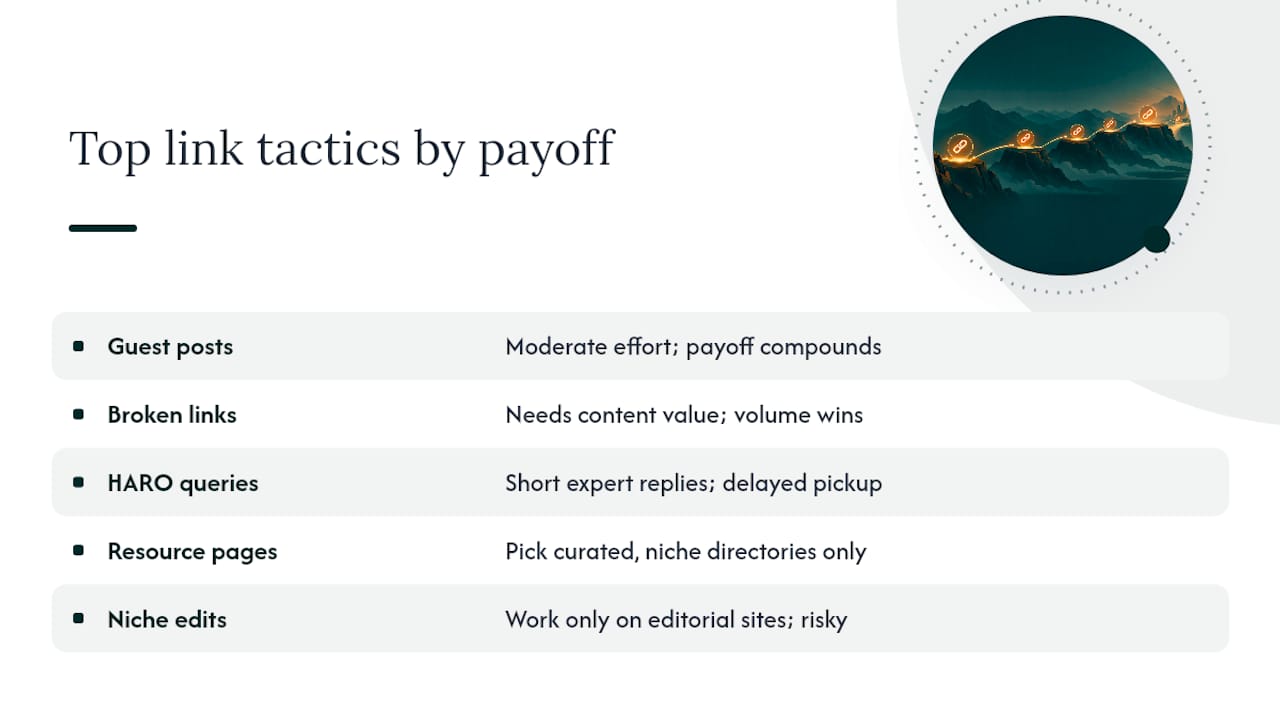
Not every tactic in the SEO playbook is worth a startup’s limited hours. Here’s what actually earns links when you have little brand recognition to trade on, ranked roughly by effort-to-payoff ratio.
Guest posts. Target publications your specific buyer persona reads, not generic “marketing blogs” with inflated traffic numbers. Before pitching, check three things: does the site publish other guest contributors regularly, does it cover your topic without being paid sponsored content, and does its audience overlap with your customer base. Use branded or topic-based anchor text rather than exact-match commercial keywords. Effort is moderate, cost is usually just time, and the payoff compounds if the relationship becomes recurring.
Broken-link building. This is one of the most underused tactics for a startup with zero brand recognition, because it succeeds or fails entirely on content value rather than who you are. Broken-link outreach works precisely because it doesn’t require existing authority to get a response. Find dead links on resource pages in your niche using a crawler or a browser extension, create or point to a page that’s a genuine replacement, and pitch the site owner with a short note: here’s the broken link, here’s the page that fixes it, no ask beyond a swap. Response rates are usually low, so volume matters, but each success is a clean, editorially earned link.
HARO and similar journalist query platforms. This tactic works for the same reason broken-link building does: editors care about a good quote, not your domain rating. Answer queries in your specific expertise area only, keep responses under 150 words, lead with the most quotable sentence, and include a one-line bio with a link. Track your submissions in a simple spreadsheet, because pickup often happens weeks after you submit, and you’ll lose track without a log.
Resource pages and directories. Selection criteria matter more than volume here. Look for pages that are curated and updated (check the last edit date if visible), sit on a domain relevant to your niche, and don’t accept every submission that comes in. A directory that lists literally anything for a fee isn’t worth the link.
Niche edits and content insertions. These are links inserted into existing published articles rather than new posts written for you. They can work, but only on sites with genuine editorial standards and only when the insertion is contextually natural. Paid insertions on link farms or sites that clearly exist to sell placements carry real risk. If the site’s entire content strategy looks built around selling links rather than serving readers, walk away.
Digital PR. This only pays off around a real news moment. Funding rounds, major product launches, and proprietary survey data are the three events that consistently justify a PR push because they give journalists an actual reason to cover you rather than a favor to grant you.
Podcast placements and founder bylines. These deserve special mention because they’re a two-for-one. Founder-led placements build durable E-E-A-T signals at the same time they produce a backlink, and unlike most tactics on this list, the value doesn’t decay once the link is live. A founder who shows up as a credible voice on five relevant podcasts builds recognition that keeps generating opportunities long after the original episodes are published.
What Kind of Linkable Asset Can a Startup Actually Build?
You don’t need a research department to create something people want to cite. You need one narrow, well-executed asset that says something nobody else has said with data behind it.
- A micro-survey of 50 to 150 people in your niche, asking three to five sharp questions, published as a short report with one clear headline stat.
- A simple calculator or estimator tool solving a real, narrow problem your buyers already have (pricing estimates, ROI math, time savings).
- A template or checklist tied directly to a task your audience does repeatedly, hosted as a standalone page rather than buried in a blog post.
- A changelog or integration page that becomes a natural citation point for anyone writing about the tools you connect with.
Original research and small proprietary datasets consistently earn more inbound links and editorial pickup than generic blog content, and the reason is straightforward: journalists and bloggers need a number to cite, and you’re handing them one they can’t get anywhere else.
A linkable asset only works if it clears a minimum bar. It needs a specific, quotable headline number or finding. It needs a clean, shareable URL, not a PDF buried behind a form. And it needs to actually answer the question its title promises, because a thin asset gets ignored the moment someone clicks through.
Building the asset is half the job. Promotion is the other half:
- Share it through your founder’s personal network first, before pitching press.
- Pitch it directly to journalists and bloggers who cover your specific niche, referencing the exact stat that fits their beat.
- Submit it as a HARO answer whenever a related query comes up.
- Ask early customers or partners to share it, since social proof from a recognizable name often triggers the first wave of pickup.
Once the asset earns links, use internal linking to route that authority toward your commercial pages. A well-linked calculator that internally points to your pricing or product page passes real value downstream instead of dead-ending on an orphaned tool page. Ranksector’s internal linking suggestions exist for exactly this problem: making sure authority you earn on one page doesn’t stay trapped there.
How Do You Run Outreach Without Wasting Every Week on It?
Outreach fails most often not because the pitch is bad, but because there’s no process behind it. Here’s a six-step workflow that keeps things moving without requiring dedicated software.
- Prospect. Build a list of sites using search operators, competitor backlink lookups, and niche directories.
- Qualify. Filter for audience overlap with your buyers, topical relevance to your page, real organic traffic, and a visible editorial policy (not a “write for us” page that just lists a PayPal link).
- Pitch. Send a short, specific email referencing their actual content, not a template blast.
- Follow up. One polite follow-up after five to seven days, then move on.
- Confirm. Once published, verify the link is live, dofollow (if that matters for the placement), and pointing where you asked.
- Index check. Confirm the page hosting your link is actually indexed by Google, since an unindexed page passes nothing.
Qualification filters matter more than list size. A hundred loosely relevant sites will waste more time than twenty tightly relevant ones.
Guest post pitch structure: open with a specific observation about their recent content, propose two to three headline options tied to gaps you noticed, and close with one relevant writing sample. Keep it under 150 words.
Broken-link pitch structure: name the exact broken link and its location, offer the replacement page in one sentence, and stop. No extra selling.
HARO reply structure: answer the question in the first sentence, back it with one specific detail or number, and add your one-line bio and link at the end.
On anchor text: early on, favor branded anchors (“Ranksector”) or natural topic phrases over exact-match commercial keywords, since an unnatural anchor profile on a young domain reads as manipulative. And be deliberate about destination. Homepage links are fine for brand signals, but a link meant to help you rank for a commercial keyword should point at the actual page targeting that keyword, whether that’s a product page, a comparison page, or a pillar guide.
Which Metrics Actually Tell You a Link Campaign Is Working?
Vanity metrics kill link-building programs faster than bad outreach does. Tracking the wrong numbers convinces founders they’re making progress when they’re not, or panics them into abandoning a campaign right before it pays off.
Four numbers matter more than anything else:
| Metric | What it tells you | Why it matters |
|---|---|---|
| New referring domains | Growth in distinct sites linking to you | Diversity of sources matters more than raw link count |
| Relevance ratio | Share of links from topically related sites | Predicts ranking impact better than domain rating alone |
| Indexed/live rate | Percentage of placements that are actually indexed | An unindexed page passes zero authority regardless of DR |
| 90-day link survival | Share of links still live three months later | Flags cheap placements that get pulled or deleted quietly |
Once you have those numbers, prioritize opportunities with a simple rubric: relevance, multiplied by editorial risk, multiplied by estimated impact, divided by cost and time required. A highly relevant placement on a reputable site that takes two hours of outreach beats a mediocre-fit placement that takes ten hours to land, even if the second site has a higher domain rating.
Watch for these red flags before accepting any placement:
- Your link gets inserted into a paragraph on a completely unrelated topic.
- The link sits in a site-wide footer or sidebar rather than in-content.
- The site links out to dozens of unrelated commercial pages in every post.
Set your reporting cadence around the realistic timeline: check referring domains and relevance ratio monthly, but don’t expect commercial keyword movement before the six-month mark. Relevance-first sequencing produces visible ranking change earlier than chasing high-DR links without topical context, which is the whole argument for building this way in the first place.
What Publisher-Side Evidence Backs This Playbook?
Ranksector has published more than 11,000 articles across client sites, which gives a genuinely large sample for observing which link patterns actually move rankings for young domains versus which ones just generate noise. Daily publishing at that scale, paired with a contextual backlink exchange network, is where the emphasis on relevance-first sequencing comes from directly.
The 90-Day Guarded Playbook reflects that same logic: start with topically tight placements, track referring domains and relevance ratio weekly, and only expand volume once early signals confirm the approach is working, rather than front-loading spend on unproven tactics.
Automation and backlink exchange tools fit best once you have a content engine running and need consistent cadence without burning founder hours on manual outreach. Founder-led placements, podcast appearances, and HARO responses should stay founder-owned for as long as the founder’s voice is still the company’s primary credibility asset, typically through pre-PMF and early traction.
- Daily publishing solves the consistency problem small teams can’t sustain manually.
- Backlink exchange removes the cold-outreach bottleneck for baseline relevance links.
- Automation frees founder hours for the placements only a founder can land.
How Should Link Building Fit Into Your Broader Marketing Plan?
Link building run in isolation from content and PR wastes most of its potential. Every tactic covered so far, guest posts, broken-link outreach, HARO, linkable assets, works better when it’s coordinated with what your content team and PR efforts are already doing, rather than treated as a separate workstream that only the SEO person touches.
Start with your content calendar. If your team is publishing consistently (daily, ideally, since organic growth compounds fastest with steady publishing cadence), each new article is a fresh linkable surface and a fresh HARO-response opportunity. Link building without a content engine behind it runs out of things to promote within a few months.
PR and link building should share a calendar too. A funding announcement or product launch is simultaneously a press opportunity and a link-building opportunity, but only if both teams know it’s coming at the same time. Coordinating a linkable asset release with a PR push around the same event multiplies the pickup either effort would get alone.
Finally, tie link targets to your SEO priorities directly. If your roadmap says a specific commercial page needs to rank this quarter, your outreach should be pointing links at that page, not scattering them across whatever content happens to exist. Treating link building as a standalone checkbox, disconnected from what content and PR are actually pushing that month, is why so many startup campaigns generate links that never move a single keyword that matters to revenue.
How Do You Find Link Opportunities Competitors Already Proved Work?
Competitive backlink analysis is the fastest shortcut to a qualified prospect list, because someone in your niche has already done the outreach legwork and gotten a “yes.”
Pull the backlink profile of two or three direct competitors, or of a slightly larger company serving an adjacent audience, and look for patterns rather than individual links. Which resource pages link to more than one competitor? Which podcasts have hosted multiple founders in your space? Which directories keep showing up across every competitor’s profile? Those repeated appearances are strong evidence that the site accepts pitches from companies exactly like yours.
Filter what you find through your own relevance lens rather than copying blindly. A competitor with broader market positioning might have earned links from sites that don’t fit your narrower niche, so cross-check every prospect against your actual buyer persona before adding it to your outreach list.
This process also surfaces gaps. If three competitors are all featured on a specific “Best Tools for X” roundup and you’re not, that’s a direct, actionable pitch target. If none of them have tapped a relevant HARO-style niche press outlet, that’s an opening nobody’s claimed yet. Competitive analysis works best as a discovery tool for opportunities, not a template to copy tactic-for-tactic, since your stage and budget may call for a different sequence than the competitor you’re studying.
What Are the Legal and Ethical Limits on Link Building?
Google’s guidelines on link schemes are specific enough that “I didn’t know” isn’t much of a defense if you get caught. Paid links that pass ranking credit without a nofollow, sponsored, or ugc attribute violate Google’s spam policies, and so do large-scale guest posting campaigns run purely to build links, link exchanges done at scale, and automated programs that generate links with no editorial judgment involved.
The practical risk isn’t abstract. A manual action or algorithmic devaluation can wipe out rankings a startup spent a year building, and recovery, if it happens at all, often takes months. This is precisely why the mass, low-quality outreach approach carries real downside beyond just wasted budget: it’s a genuine penalty risk, not just an inefficient use of money.
The safer standard is simple: would this link exist if search engines didn’t exist at all? A link earned because a journalist genuinely found your data useful passes that test. A link purchased from a site that sells placements to anyone with a credit card does not. When you’re evaluating a directory, a niche edit, or a paid placement, ask whether it’s disclosed properly if payment changed hands, and whether the content around your link is something an actual reader would want.
None of this means avoiding paid placements altogether. It means being honest about what they are, using proper attributes when required, and never letting volume targets push you into schemes that trade a short-term link for a long-term penalty.
When Should You DIY, Automate, or Bring in Outside Help?
Keep link building in-house while your founder’s voice is still the company’s main credibility asset. That’s most of pre-PMF and early traction, when a founder byline or podcast appearance does more than any agency placement could.
The switch point usually isn’t a calendar date. It’s a resource signal: marketing headcount grows past one or two people, product releases start outpacing your team’s capacity to write about them, or outreach volume needed to hit your targets exceeds what founder hours can realistically cover. That’s when automating routine placements, or handing volume work to an outside partner, starts returning more than it costs, while founder-led placements stay in-house because no automation replaces a founder’s actual voice.
— Savannah
Where Does Ranksector Fit Into Your Link-Building Plan?
Most of the tactics above take founder hours you don’t have unlimited amounts of. That’s the specific gap Ranksector fills: it publishes SEO-optimized articles daily and pairs that content engine with a contextual backlink exchange, so the baseline relevance-link work runs in the background while you spend your limited hours on founder-led placements only you can land.

The Pro plan runs $99 a month and includes daily article publishing, competitor-driven keyword research, and the backlink exchange network, all built around the relevance-first logic this article has walked through, without per-link fees or outreach overhead. If you’re not sure where your current content and link profile stands, the GEO Audit gives you a look at how your site is showing up before you commit to a plan.
Startups get the fastest return here when they already have a rough content cadence but not the hours to sustain it manually, or when founder time keeps getting eaten by directory submissions and basic outreach instead of the high-leverage placements covered earlier. If that sounds like where you are, start with the GEO Audit to see your current standing, then move to the Pro plan once you know exactly what needs fixing.
Sources
- Startup SEO Strategy: A Founder’s Playbook (Early Stage)
- Link Building for Startups: A Stage-by-Stage Playbook | Serpverse
- Link Building for Startups: Strategies When You Have No Authority
- Link Building for Startups: Build Authority From Zero
FAQ
How Much Does Link Building Typically Cost?
Costs range widely by stage: pre-PMF startups can run link building mostly on founder time with relatively low cash expenditure, while early-traction companies increase budget to a few hundred to low thousands monthly on a mix of freelance outreach and small paid placements. Scale-stage digital PR pushes run into the mid-thousands per month, typically justifying the cost around major news events. Ranksector’s Pro plan, which folds link-building support into daily content publishing, is listed at $99 a month.
Are Backlinks Still Relevant Today?
Yes. Backlinks remain one of the clearest trust signals search engines use to evaluate a new domain, and relevance-first links produce earlier visible ranking movement than chasing high-authority placements with no topical connection. What’s changed isn’t whether links matter, but how heavily search engines penalize obviously manipulative link schemes.
What Is Link Building and How Does It Work?
Link building is the practice of earning hyperlinks from other websites back to your own, which search engines read as a vote of trust and relevance. It works by combining content or relationships worth linking to (research, guest contributions, useful tools) with outreach to the sites whose audiences overlap with yours. For startups specifically, this means prioritizing topical fit over raw traffic or authority numbers when choosing which sites to target.
How Do You Become Effective at Link Building?
Start by mastering one tactic at a time rather than spreading effort across everything at once, since broken-link outreach and HARO responses are typically the fastest to learn with no existing authority. Track your qualification criteria (audience overlap, editorial standards, real traffic) consistently so you build judgment about which prospects are worth pitching. Tools like Ranksector’s backlink exchange can handle the baseline relevance-link volume while you develop skill at the higher-leverage founder-led placements.