
What Is a SaaS SEO Strategy That Drives Trials, Not Just Traffic?
A SaaS SEO strategy is an organic growth plan that prioritizes product-qualified traffic, trial signups, demo requests, and product-led leads, over raw visitor counts. It works by building and optimizing the specific surfaces buyers check before they convert: comparison pages, integration pages, pricing pages, and product-led tools, then backing them with technical SEO and measurement tied to pipeline, not pageviews.
If you’re running SEO for a SaaS product and still reporting on sessions and keyword rankings alone, you’re measuring the wrong thing. Here’s the verdict, distilled:
- Prioritize bottom-of-funnel (BOFU) pages over top-of-funnel blog volume
- Cover comparison, alternative, and integration pages where buyers actually decide
- Use SoftwareApplication schema so search engines and AI tools understand what you sell
- Track organic-sourced trials and pipeline value, not just rankings
- Build technical SEO that supports crawlability for JavaScript-heavy product pages
Your next move: audit your site for missing high-leverage surfaces, specifically comparison pages, integration hubs, and pricing visibility, before you write another top-of-funnel blog post.
Key Takeaways
A SaaS SEO strategy succeeds when it prioritizes BOFU conversion surfaces and AI visibility over raw traffic, and fails when teams optimize for rankings instead of pipeline.
| Point | Details |
|---|---|
| Define success by conversions | Track organic trials, demo requests, and pipeline value, not just rankings or sessions. |
| Fill BOFU gaps first | Build comparison, alternative, and integration pages before adding more top-of-funnel content. |
| Fix technical foundations | Ensure server-side rendering, schema, and crawlability so both search engines and AI tools can read product pages. |
| Match attribution to funnel length | Use 30 to 180 day attribution windows and multi-touch tracking for long SaaS sales cycles. |
| Automate execution with Ranksector | Ranksector handles daily content publishing, keyword research, and backlink exchange for teams without a full content staff. |
Table of Contents
- What Is SaaS SEO Strategy, Exactly?
- How Is SaaS SEO Different From Traditional SEO?
- Why Should SaaS Companies Invest in SEO?
- What Makes SaaS SEO Harder Than Other Industries?
- How Do You Map the SaaS Buyer Journey to Search Intent?
- How Should SaaS Companies Build a Keyword Strategy?
- How Do You Structure a SaaS Website for SEO and Conversions?
- What Technical SEO Does a SaaS Site Actually Need?
- What Link Building Strategies Actually Work for SaaS?
- How Do You Measure and Report SaaS SEO Performance?
- What Does a 90-180-360 Day SaaS SEO Roadmap Look Like?
- What Mistakes Should SaaS Companies Avoid in SEO?
- Which Tools Belong in a SaaS SEO Tech Stack?
- How Does Ranksector Help Execute a SaaS SEO Strategy?
- What Actually Moves the Needle in SaaS SEO
- Get Daily SaaS SEO Content Without Hiring a Content Team
- Sources
What Is SaaS SEO Strategy, Exactly?
SaaS SEO is the practice of ranking a software product’s website for the searches its buyers run at every stage of a subscription-based buying decision, then converting that traffic into trials, demos, or signups. It’s not generic SEO applied to a software company. It’s SEO built around a specific conversion event, usually a free trial, a demo booking, or a self-serve signup, and a specific set of page types that most other verticals don’t need: product pages, integration directories, comparison pages, and in-app documentation that sometimes ranks better than the marketing site itself.
The scope changes depending on how your business sells. A product-led company (think self-serve tools with a credit card checkout) needs SEO that gets someone from a search query to an active account in one session. A sales-assisted SaaS company, the kind with a “Book a Demo” button and a sales team, needs SEO that nurtures a buying committee across weeks or months. Both count as SaaS SEO. Both need different page architecture.
What counts as an “SEO surface” for a SaaS company is wider than most marketers assume:
- Marketing pages (homepage, solutions, pricing)
- Product pages and feature pages
- Integration and app-marketplace listings
- Documentation and help-center articles
- In-app onboarding content that search engines can crawl
The outcomes you’re optimizing for are measurable in ways traditional SEO rarely is: organic-sourced marketing-qualified leads (MQLs), the effect on customer acquisition cost (CAC), and multi-touch attribution that credits organic content across a 30 to 180 day sales cycle. Backlinko’s SaaS SEO framework makes the same point: audience and product fit matter more than volume.
How Is SaaS SEO Different From Traditional SEO?
Traditional SEO for an ecommerce site or a local business optimizes toward a single, often immediate transaction. SaaS SEO optimizes toward a recurring-revenue decision that a buyer rarely makes alone or in one sitting. That distinction changes almost every tactical choice you make.
Consider the practical contrasts:
- Conversion goal: a one-time purchase versus a trial, demo, or freemium signup that only becomes revenue months later
- Funnel length: days for retail, weeks to months for mid-market SaaS, sometimes a year-plus for enterprise software
- Buying committee: one shopper versus a mix of end users, technical evaluators, procurement, and a budget owner
- Conversion metric: transactions and average order value versus trial-to-paid rate, expansion revenue, and churn
Product complexity also reshapes technical priorities. A SaaS company usually needs SoftwareApplication schema, integration pages that document API compatibility, and product pages that render correctly even when built on a JavaScript framework that traditional crawlers historically struggled with. SEO Sherpa’s SaaS SEO guide frames this as three pillars working together: technical SEO, content strategy, and authority, because recurring revenue businesses can’t afford weakness in any one of them.
Pro Tip: The most common mistake teams make when they move from ecommerce or lead-gen SEO into SaaS is chasing keyword volume instead of conversion fit. A term with 200 monthly searches and high purchase intent, like “[competitor] alternative,” often outperforms a term with 5,000 searches and no buying signal. Rank the second term and you’ll get traffic. Rank the first and you’ll get trials.
Why Should SaaS Companies Invest in SEO?
Organic search compounds in a way paid acquisition never does. A blog post or comparison page you publish once keeps generating trials for years, while a paid campaign stops the day you stop paying. That compounding effect is the core financial case for SaaS SEO, and it shows up in a handful of KPIs that matter to a CFO, not just a marketing dashboard.
The metrics worth tracking:
- Organic-sourced trial and free-account signups
- Demo requests attributed to organic sessions
- MQL-to-SQL conversion rate by channel
- Customer acquisition cost (CAC) for organic versus paid
- Lifetime value (LTV) of organically acquired customers versus paid-acquired ones
The bigger shift changing the math: Gartner projects search engine query volume will fall by roughly 25% by 2026 as buyers shift toward AI chatbots and virtual agents for early-stage research. That means the SEO investment you make today needs to work in a classic search results page and in an AI-generated answer, since ChatGPT alone reached roughly 900 million weekly active users by early 2026. A SaaS company that ranks well in Google but never gets cited by an AI assistant is already losing a growing slice of product discovery.
The practical outcome for teams that get this right: lower blended CAC, a pipeline that doesn’t evaporate the moment ad spend pauses, and content assets that pay off for years instead of weeks.
What Makes SaaS SEO Harder Than Other Industries?
SaaS SEO carries a handful of structural challenges that catch teams off guard, especially those moving over from ecommerce or agency-style local SEO.
Long buying cycles. A mid-market SaaS deal can take three to nine months from first search to signed contract, which means your attribution model needs to credit a blog post someone read in month one for a deal that closes in month seven.

Multiple stakeholders. The person who searches “[category] software” is rarely the person who signs the contract. Your content has to speak to technical evaluators, end users, and budget owners without becoming three disconnected pages.
Complex product pages. A feature page for a workflow automation tool has to explain a genuinely complicated capability without turning into documentation, and without losing the searcher who just wants a straight answer.
JavaScript rendering and crawlability. Product pages built in React or Vue sometimes render blank to search crawlers if server-side rendering isn’t configured correctly, which quietly kills rankings on pages that should be converting.
Low-volume, high-value BOFU keywords. Terms like “[your category] for Shopify integration” might get 40 searches a month, but they convert at a far higher rate than a 10,000-volume generic term.
- Mitigation for crawlability: implement server-side rendering or dynamic rendering for public-facing product and pricing pages
- Mitigation for stakeholder complexity: build distinct page sections or dedicated pages for technical buyers versus economic buyers
- Mitigation for low-volume BOFU terms: prioritize by conversion potential, not search volume, when building your content calendar
Pro Tip: None of this is a solo marketing job. Engineering needs to sign off on rendering and site speed, product needs to validate feature claims on comparison pages, and support or documentation teams often hold the most search-worthy content you already have, buried in a help center that search engines barely crawl.
How Do You Map the SaaS Buyer Journey to Search Intent?
Every query a prospective customer types falls into one of three funnel stages, and mismatching content type to intent is the single fastest way to waste a content budget.
| Funnel Stage | Example Query Types | Best Page Type |
|---|---|---|
| Top of funnel (ToFu) | “What is [category] software,” “how to [solve broad problem]” | Pillar pages, educational guides |
| Middle of funnel (MoFu) | “[category] for [use case],” “best practices for [workflow]” | Use-case pages, solution pages |
| Bottom of funnel (BoFu) | “[competitor] alternative,” “[tool A] vs [tool B],” “[category] pricing” | Comparison pages, alternative pages, pricing pages |
| Product-adjacent / tool queries | “free [task] calculator,” “[category] template” | Product-led tools, templates, calculators |
Use this framework to audit what you already have before building anything new. Most SaaS marketing sites are overloaded with ToFu content, a dozen “what is X” guides, and starved of BoFu content, maybe one comparison page covering a single competitor.
- Map every existing page to a funnel stage using the table above
- Identify which BOFU query types (alternative, vs, pricing, integration) have zero coverage
- Build MoFu use-case pages only after BOFU gaps are filled, since they convert at higher rates per unit of effort
- Reserve ToFu pillar content for topics that support internal links into your BOFU pages, not as standalone traffic plays
The prioritization order matters more than the content itself. A single well-built comparison page targeting a query with real buying intent will often outperform ten new blog posts.
How Should SaaS Companies Build a Keyword Strategy?
Keyword strategy for SaaS starts by rejecting the assumption that higher search volume means higher value. A term with 300 monthly searches and a buyer actively comparing tools is worth more than a 10,000-volume term where nobody converts. Seobility’s SaaS SEO guide makes the same case: map every keyword to a funnel stage before you decide whether it’s worth pursuing.
Build a simple prioritization matrix with intent on one axis and commercial value on the other. A BOFU term like “[category] software for accountants” scores low on volume but high on commercial value. A ToFu term like “what is workflow automation” scores high on volume but low on immediate commercial value, useful for authority building, not for pipeline.
The workflow that produces a usable keyword list:
- Discovery: pull keyword data from Google Search Console (queries you already rank for), plus competitor research in SEMrush or Ahrefs to find gaps
- Intent labeling: tag every keyword as ToFu, MoFu, or BoFu using the query patterns from the buyer journey table above
- Persona mapping: assign each keyword to the stakeholder most likely to search it (technical evaluator, end user, economic buyer)
- Clustering: group related keywords into pillar-and-cluster sets so one page can rank for a family of related queries instead of building ten thin pages
- Sequencing: order the backlog by commercial value first, then by production effort, so BOFU pages ship before low-value ToFu content
Search operators help surface opportunities most teams miss:
site:g2.com "[your category]" alternativesto find review-platform gapsintitle:"vs" "[competitor name]"to find existing comparison content you’re not competing against yetinurl:integrations "[competitor]"to find integration-page opportunities
Both SEMrush and Ahrefs support competitor gap analysis that surfaces which BOFU keywords your competitors rank for and you don’t, which is usually a faster path to a prioritized backlog than starting from a blank keyword list.
How Do You Structure a SaaS Website for SEO and Conversions?
Content architecture for SaaS should look less like a blog and more like a funnel with pages instead of email sequences. The structure runs: homepage, then pillar pages covering broad category topics, then cluster articles that answer specific questions within each pillar, then BOFU surfaces (comparison, alternative, pricing pages), then product pages and tool pages that let a visitor act immediately.
Each page type has a job and a minimum content requirement:
- Pillar pages need comprehensive category coverage, internal links to every relevant cluster article, and a clear path to at least one BOFU page
- Comparison pages need a factual feature-by-feature breakdown, honest treatment of where a competitor genuinely wins, and a direct CTA to trial or demo
- Integration pages need setup instructions, a use-case example, and a link to documentation, since developers often land here mid-evaluation
- Product-led tool pages (calculators, free checkers, templates) need to work without a signup wall, since the tool itself is the marketing
Internal linking has to move visitors down the funnel deliberately, not just link everything to everything:
- Link every cluster article back to its pillar page and forward to at least one relevant BOFU page
- Place a contextual CTA (not a banner ad) inside the body of MoFu and BOFU content, tied to the specific problem that section addresses
- Add SoftwareApplication schema to product and pricing pages so search engines and AI systems can parse pricing tiers, ratings, and category correctly
- Use AggregateRating schema where you have genuine review data to display, since this often improves click-through in traditional results
Pro Tip: Read your comparison pages like a skeptical prospect would. If every comparison page on your site declares you the clear winner on every axis, buyers notice, and so do the people fact-checking your claims before a purchase decision. A comparison page that concedes one honest point of difference builds more trust than one that doesn’t. Ranksector’s guide to SEO content types for small teams walks through how to sequence pillar and tool pages without a large team.
What Technical SEO Does a SaaS Site Actually Need?
Technical SEO for SaaS starts with a question most marketing teams can’t answer without help from engineering: does Googlebot actually see the same page a human visitor sees? Many SaaS marketing sites are built on JavaScript frameworks that render content client-side, and if server-side rendering or pre-rendering isn’t configured, search crawlers may index a blank page.
Rank these tasks by impact, not by how satisfying they feel to check off:
- Server-side rendering (SSR) for public product and pricing pages — highest impact, engineering-heavy, fixes crawlability at the source
- SoftwareApplication and AggregateRating schema — quick win, moderate impact, helps both classic search and AI systems parse your product correctly
- XML sitemap health and canonical tags — quick win, prevents duplicate-content confusion across similar product or pricing pages
- Redirect audits — quick win, especially important after pricing-page or product-naming changes that SaaS companies make more often than other verticals
- Crawl budget management — engineering-heavy, matters mainly for large SaaS sites with thousands of documentation or help-center pages
The checklist to run quarterly:
- Confirm product and pricing pages render fully in Google Search Console’s URL inspection tool
- Audit for orphaned pages with no internal links pointing to them
- Verify canonical tags on any page with URL parameters (common on filtered product or pricing views)
- Check that demo and trial signup pages are crawlable, while account dashboards and authenticated app screens remain properly blocked from indexing
Gated content and private data need careful handling. You want search engines to crawl your demo request page and your free trial signup flow, since those pages carry conversion intent, but you never want a crawler indexing a logged-in customer dashboard. A noindex directive on authenticated routes, combined with a clean, crawlable public marketing funnel, solves this without extra engineering complexity. Ranksector’s breakdown of ranking versus clicking covers how metadata and schema affect click-through once a page does rank.
What Link Building Strategies Actually Work for SaaS?
Link building for SaaS works best when the asset earning the links is something people would link to even if SEO didn’t exist. That’s the difference between a manual outreach campaign that plateaus and a product-led asset that keeps earning backlinks for years.
Linkable assets that consistently work for SaaS companies:
- Free tools, calculators, and checkers that solve a narrow problem without a signup wall
- Templates and frameworks that professionals in your category actually reuse
- Original data studies pulled from your own product usage data, since journalists and bloggers cite original numbers far more readily than opinion pieces
- Integration pages that partner companies naturally link to from their own marketplace listings
- Developer documentation that other technical writers reference when explaining how to connect two tools
W3era’s SaaS SEO guide makes the case that product-led content compounds specifically because it earns links passively, a free tool keeps attracting backlinks long after you stop actively promoting it, unlike a guest post that earns one link and then sits static.
Scaling link acquisition without a dedicated outreach team usually means leaning on a few repeatable channels:
- Partner and integration pages, where the other company has a business reason to link back to you
- A contextual backlink exchange network, where relevant SaaS sites link to each other’s content within genuinely related articles, rather than cold outreach with a low response rate
- Guest contributions to technical or developer-focused publications, where your documentation or a genuinely useful framework earns a natural citation
Pro Tip: Track which of your existing pages already earn backlinks without any outreach at all. That’s usually your best signal for what kind of asset to build more of, whether that’s a free calculator, an original benchmark study, or a template nobody else in your category has published.
How Do You Measure and Report SaaS SEO Performance?
Measurement for SaaS SEO has to bridge two worlds that rarely talk to each other: search performance data and revenue data. Google Search Console tells you which queries are driving impressions and clicks. Your CRM tells you which of those clicks eventually became a closed deal, sometimes 120 days later.
Build your tracking stack around these four layers:
- GA4 event taxonomy that distinguishes trial starts, demo requests, and content downloads as separate conversion events, not one generic “goal completed” bucket
- Google Search Console for query-level impressions, click-through rate, and indexing health
- CRM UTM discipline so every organic session that becomes a lead carries source data all the way to closed-won or closed-lost
- Multi-touch attribution that credits organic content across the full sales cycle, not just the last click before signup
A working dashboard should show organic trial starts, pipeline value attributed to organic, CAC by channel, and time-to-PQL (product-qualified lead), side by side so a CMO can see the SEO line item next to the paid line item without translation.
| Metric | What It Tells You |
|---|---|
| Organic trial starts | Whether top-of-funnel content is reaching the right audience |
| Pipeline value from organic | Whether organic-sourced leads actually progress through sales |
| CAC by channel | Whether organic is cheaper per customer than paid, and by how much |
| Time-to-PQL | How long it takes an organic visitor to reach product-qualified status |
Attribution windows for SaaS need to stretch further than most marketing platforms default to. A 30-day attribution window, the default in many ad platforms, misses most of a typical 90 to 180 day SaaS sales cycle entirely. Report leading indicators (organic sessions on BOFU pages, trial starts) weekly, and lagging indicators (closed-won revenue attributed to organic) quarterly, since the lag between the two is the whole point of the long funnel.
What Does a 90-180-360 Day SaaS SEO Roadmap Look Like?
A prioritized roadmap keeps a SaaS SEO program from turning into an endless backlog of “someday” content. Five stages, sequenced by impact and dependency, work better than a flat to-do list.
Stage 1: Audit (weeks 1 to 4). Inventory every existing page, map it to a funnel stage, and identify BOFU gaps. Stage 2: Quick wins (weeks 4 to 12). Fix schema, canonical tags, and any broken crawlability on existing pages. Stage 3: Product surfaces (months 3 to 6). Build missing comparison, alternative, and integration pages. Stage 4: Authority (months 6 to 9). Launch product-led tools and begin structured link acquisition. Stage 5: Scale (months 9 to 12). Expand cluster content and refine based on measured pipeline contribution.
90-day checklist:
- Complete a full content and technical audit
- Fix schema markup and crawlability issues on top 20 pages by traffic potential
- Publish or update at least three comparison pages targeting BOFU intent
- Set up GA4 event tracking for trials and demo requests
180-day checklist:
- Launch at least one product-led tool or calculator
- Build out integration pages for your top five partner or marketplace connections
- Establish a contextual link exchange or partnership outreach cadence
- Report first-quarter organic pipeline data to leadership
360-day checklist:
- Expand cluster content around proven pillar topics
- Refine keyword prioritization based on which page types actually converted
- Audit and refresh underperforming BOFU pages
- Set next-year targets based on measured CAC and pipeline contribution from organic
Acceptance criteria at each milestone should be concrete: at 90 days, every priority page should be crawlable and schema-complete. At 180 days, at least one net-new product-led asset should be live and earning organic traffic. At 360 days, organic should show a measurable, reportable contribution to pipeline, not just a rankings report nobody outside marketing reads.
What Mistakes Should SaaS Companies Avoid in SEO?
The most expensive SaaS SEO mistake is publishing only top-of-funnel content while BOFU pages sit empty. It feels productive, blog posts get written, traffic charts go up, but trials don’t follow, because the pages that actually convert never got built.
Common failures and their fixes:
- Publishing only ToFu blog content → audit for BOFU gaps and prioritize comparison and alternative pages next
- Hiding pricing behind a “contact us” form → publish a transparent pricing page even if it shows ranges, since pricing queries carry strong buying intent
- Missing comparison pages for top competitors → build at least one comparison page per major competitor within the next quarter
- Weak or absent integration coverage → document every real integration with its own indexable page, not a buried list on one crowded page
- Missing or broken schema markup → implement SoftwareApplication schema and validate it with Google’s structured data testing tools
Watch your analytics for these red flags: low conversion rates on product pages despite decent traffic, high bounce rates on pages that should be converting, and, increasingly, low or zero citation when you check whether AI tools mention your product at all. Ranksector’s breakdown of common keyword research mistakes covers several of these intent-mapping failures in more depth.
Which Tools Belong in a SaaS SEO Tech Stack?
A workable SaaS SEO stack doesn’t need a dozen platforms. Five tools cover research, tracking, auditing, and execution.
- Google Search Console — free, essential, shows exactly which queries drive impressions and clicks to your live site
- Google Analytics (GA4) — tracks trial starts, demo requests, and downstream conversion events beyond simple pageviews
- SEMrush — competitor gap analysis and keyword research, particularly useful for finding BOFU terms competitors already rank for
- Ahrefs — backlink analysis and technical site audits, strong for identifying which pages earn links without outreach
- Ranksector — automated content production, publishing, and backlink exchange, built for teams that need daily output without a full-time content team
Each tool sits at a different stage of the workflow: SEMrush and Ahrefs handle research and competitive intelligence, Google Search Console and GA4 handle measurement, and Ranksector handles the execution layer, actually producing and publishing the content the research points you toward. If your budget is limited, prioritize free tools (Search Console, GA4) for measurement first, since you can’t improve what you can’t see, and add paid research or automation tools once you know where the gaps are. Ranksector’s comparison of free versus paid AI SEO tools walks through that budget decision in more detail.
How Does Ranksector Help Execute a SaaS SEO Strategy?
Everything in this guide, BOFU-first content, technical schema, consistent publishing, backlink authority, takes sustained execution. That’s where most small SaaS teams stall, not on strategy but on output.
Ranksector’s feature set maps directly onto the recommendations above:
- Daily AI-written, fully formatted long-form articles published automatically to your CMS
- Competitive keyword research based on market and competitor analysis, feeding directly into the BOFU-first prioritization this guide recommends
- A contextual backlink exchange network that builds domain authority without manual, one-off outreach campaigns
- Google Search Console integration so performance data flows back into one dashboard instead of a dozen exported spreadsheets
- Internal linking suggestions that help implement the pillar-to-BOFU architecture covered earlier
- AI and search engine visibility audit tools, relevant given the shift toward AI-driven product discovery
Integration works the way most SaaS marketing stacks already operate: articles publish directly to major CMS platforms, Search Console data connects for reporting, and internal linking suggestions slot new content into your existing pillar-and-cluster structure rather than sitting disconnected.
The decision point is mostly about resourcing. A team with a dedicated content strategist, an in-house writer, and engineering support on tap can build this in-house. A two-person marketing team at a growing SaaS company, the kind with no bandwidth to publish daily and no budget for a full-time content hire, is the scenario Ranksector was built for. Over 11,000 articles published across customers gives a sense of the volume this kind of automation makes possible for teams that would otherwise publish once a month if they’re lucky.
Pro Tip: If you’re evaluating whether to build this in-house or automate it, count how many BOFU pages, comparison, alternative, integration, pricing, your site is missing right now. If that number is higher than five and you have no dedicated writer, automation will close the gap faster than a hiring process will.
What Actually Moves the Needle in SaaS SEO
The biggest gap I see between SaaS SEO advice and SaaS SEO results is that most guides treat every page type as equally important. It isn’t. A single comparison page targeting “[competitor] alternative” will often move more trials in a month than ten generic educational posts published over a quarter. Volume-chasing feels like progress because the traffic charts move, but trials and demos are a different chart entirely.
The teams that get this right treat their BOFU gaps like a punch list, not a content calendar. Adding one solid integration page, one honest comparison page, or one pricing page with actual numbers on it tends to move conversion metrics faster than any amount of additional blog volume. That’s not a theory, it’s the pattern behind nearly every framework cited in this guide.

A week-one experiment worth running: pick your single highest-traffic blog post that has zero internal link to a BOFU page, and add one contextual link to your best comparison or pricing page. Watch what happens to that page’s assisted conversions over the next month.
Get Daily SaaS SEO Content Without Hiring a Content Team
Building the roadmap above, comparison pages, integration hubs, schema fixes, a steady publishing cadence, takes either a dedicated team or a lot of unpaid weekends. Ranksector is built for the small SaaS marketing team that has the strategy in this guide but not the headcount to execute it daily.
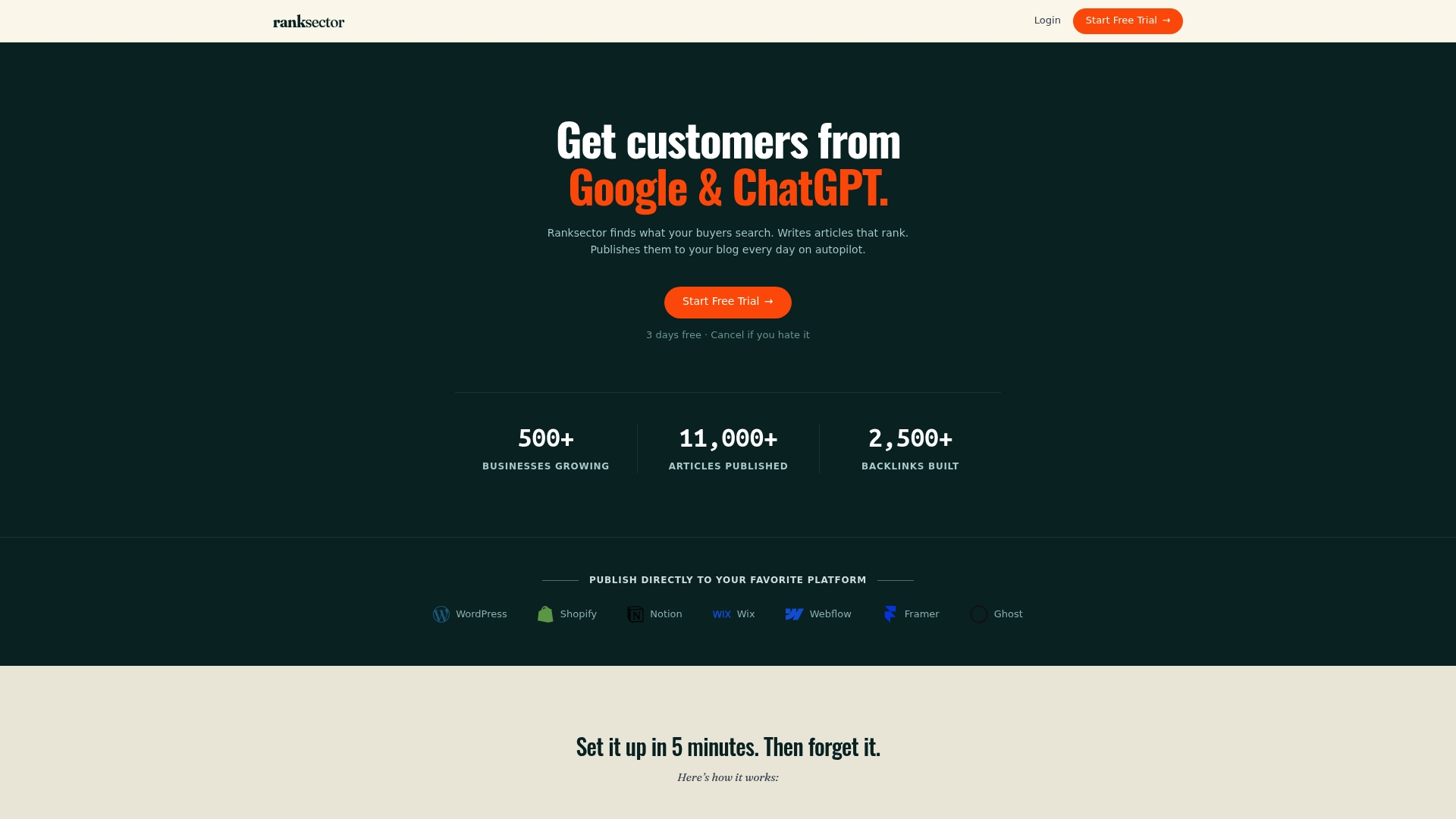
Ranksector automates the parts of this roadmap that eat the most time: daily AI-written articles published straight to your CMS, competitor-driven keyword research that feeds your BOFU-first priorities, and a contextual backlink exchange that builds domain authority without cold outreach. Reporting connects directly to Google Search Console, so you’re not stitching together spreadsheets to see whether organic trials are actually moving. Teams typically see their first wave of published BOFU and cluster content within the first weeks of onboarding, with backlink and domain-rating movement following as the exchange network activates.
Run a free AI visibility audit on your own site to see which of the surfaces covered in this guide, comparison pages, schema, crawlable product pages, you’re already missing, then explore Ranksector’s free tools to see the kind of product-led asset this guide recommends building.
Sources
- Gartner press release (2024-02-19): Gartner predicts search-engine volume will drop 25% by 2026
- ChatGPT reaches 900M weekly active users — TechCrunch
- Framework: SaaS SEO — ThatDevPro
Consult these alongside Gartner’s and TechCrunch’s data on AI-driven search behavior for a fuller picture of where SaaS SEO is headed through 2026.
Recommended
- How SEO Works Without Paid Ads for B2B SaaS · Ranksector Blog · Ranksector
- AI SEO Platforms Compared: What SaaS Teams Should Actually Compare in 2026 · Ranksector Blog — Ranksector
- SEO Content Types for Small B2B SaaS Teams in 2026 · Ranksector Blog · Ranksector
- SEO ROI Tracking for Bootstrapped Businesses: A Practical Guide · Ranksector Blog · Ranksector