
90 Day Guarded Playbook for Automated Link Building for SaaS Teams
The winning approach for automated link building in 2026 isn’t full autopilot or a return to manual outreach. It’s a guarded model: an agent handles prospecting and drafting, a human approves every send and every paid placement, and Google Search Console confirms the link actually lives. Ranksector’s own workflow is built around this loop, and it’s the practical option for small teams that want scale without the spam risk.
TL;DR:
- Automated link building in 2026 should involve human approval at key points, especially for outreach and payment decisions, to ensure quality and relevance.
- Verification through Google Search Console is essential to confirm that links are live, indexed, and tied to actual placements, not just reports.
- Effective campaigns require a 90-day monitoring cycle to identify and salvage lost or nofollow links before scaling efforts.
- Using discovery, outreach, and verification tools together, with controls on deliverability and moderation, minimizes risks like irrelevance or penalization.
- Ranksector’s system pairs automation with human oversight, leveraging direct GSC integration, and requires careful pilot testing to optimize verification and response metrics.
Table of Contents
- Why We Recommend a Guarded Model Over a Vendor Shopping List
- What Automated Link Building Is and the Main Automation Types
- How the Automation Workflow Actually Runs
- What Can Go Wrong and How to Guard Against It
- How to Evaluate Vendors Without Getting Sold a Story
- The 90-Day Playbook: From Pilot to Full Program
- Why This Model Reflects How Ranksector Actually Operates
- What Actually Matters Here (An Editorial Take)
- Start a Guarded Pilot With Ranksector
- Sources
Why We Recommend a Guarded Model Over a Vendor Shopping List
You could spend a week reading tool reviews and still end up with the wrong stack. That’s because most comparisons rank vendors by feature count, not by whether the workflow keeps you safe. A better question: does this tool let a human stop a bad send before it happens, and does it prove the link is real after the fact?
The guarded automation model works like this: an agent discovers prospects and drafts outreach, a person approves each message and each paid deal, a verification step confirms the placement went live, and monitoring flags it if the link disappears or turns nofollow later. Nothing sends without a person seeing it first. Nothing gets marked “done” until Search Console confirms it.
This matters more for the fit than any individual feature does. A five-person SaaS marketing team and a 200-person agency need very different things from an automation stack, even if they’re solving the same core problem.
Who this model fits best:
- Small SaaS marketing teams with one or two people owning link building alongside a dozen other tasks
- In-house SEOs at growth-stage companies who need volume but can’t risk a manual-outreach penalty or a deliverability blacklist
- Agencies managing multiple client campaigns who need standardized approval gates across accounts
Who should look at a different stack:
- Enterprise teams with dedicated PR staff who already run editorial relationships manually and just need contact enrichment
- Highly specialized niches (legal, medical, financial) where every placement requires subject-matter review beyond what a general approval gate catches
The tradeoffs are real. Full autonomy is faster but riskier. A pure human workflow is safer but caps your volume at whatever one or two people can physically send in a week. Pricing shapes follow the same split. Autonomous platforms often charge per successful placement, which sounds appealing until volume drops and the per-unit cost climbs. Outreach-OS platforms tend toward flat monthly seats. Discovery-only tools are usually the cheapest entry point but leave you doing the outreach work yourself.
What Automated Link Building Is and the Main Automation Types
Link building breaks into three distinct jobs: finding prospects, contacting them, and confirming the result. What’s changed in 2026 is that software now handles pieces of all three, but vendors package that automation very differently, and the packaging determines how much control you keep.
Four categories show up repeatedly in vendor claims:
- Autonomous agents run the full loop, discovery through outreach through follow-up, with minimal human input. Some platforms now pull editorial requests directly from journalist feeds, giving the agent live opportunities to react to rather than a static prospect list. Fast to deploy, but you’re trusting the agent’s judgment on tone, timing, and who gets contacted.
- Outreach operating systems handle campaign sequencing, templating, and reply tracking, but you supply the prospect list and approve sends. Slower to start, more control over voice and cadence.
- Discovery and enrichment tools focus narrowly on finding relevant sites and contacts, often via APIs that pull and enrich data at scale. You still need something else for outreach and verification.
- Verification and monitoring services check whether a placement is live, indexed, and still linking months later. Some tie results directly to your Search Console data, which is the clearest proof you can get that a link is real and indexed rather than just claimed by a report.
The quickest way to identify which type you’re looking at: read how the vendor describes success. If they talk about “campaigns sent” and “replies,” it’s an outreach OS. If they talk about “links delivered” with a flat monthly count, it’s likely an autonomous agent charging by output. If the pitch is entirely about lists and emails found, it’s a discovery tool with no outreach layer at all.
How the Automation Workflow Actually Runs
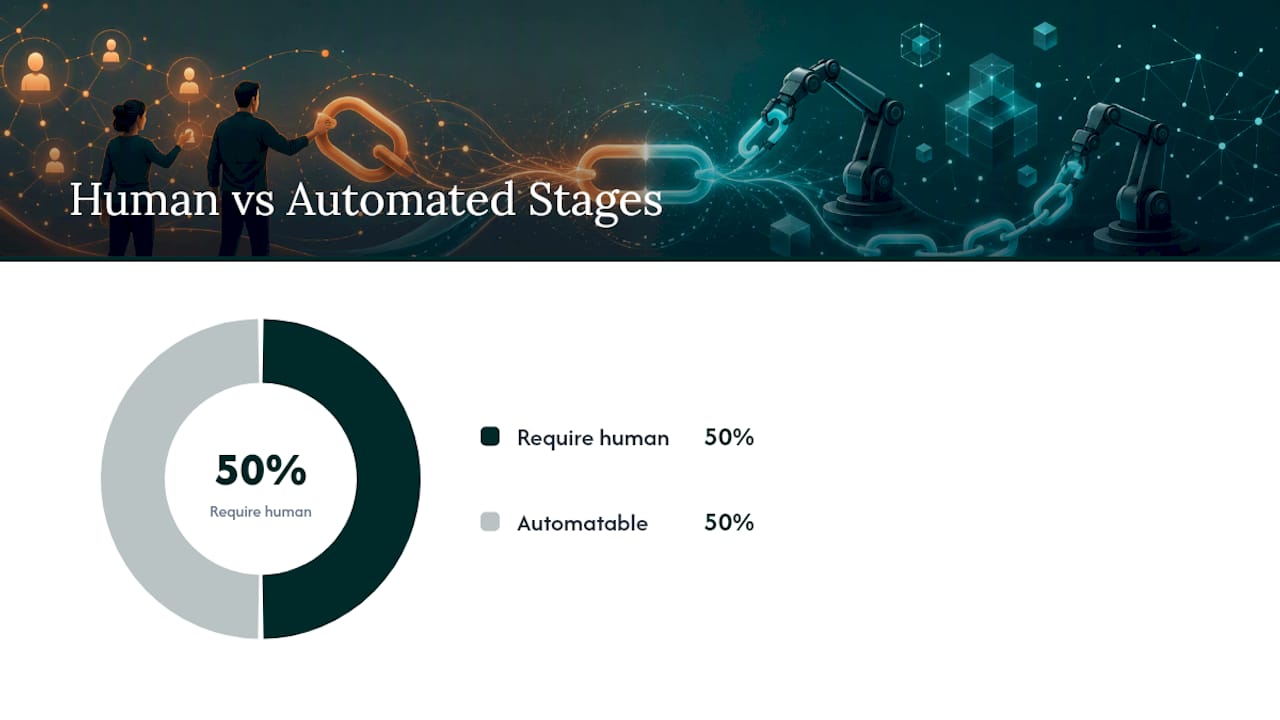
Six stages make up a defensible link building pipeline, and the right question at each stage is simple: does this need a human, or can software handle it safely on its own?
- Prospecting. Automation does the heavy lifting here. An agent pulls candidate sites using relevance and authority filters, often through APIs that query multiple data sources and enrich each result with traffic estimates and topical fit. No human review needed at this stage since nothing has been sent yet.
- Contact discovery and verification. Software finds email addresses and validates deliverability. Still automatable, though a quick spot-check on unusual domains catches false positives before they burn a Sand.
- Outreach drafting and sending. This is the first mandatory human gate. The agent drafts a personalized message, but a person reviews it before it goes out, especially for the first message in any new campaign or niche. Once a template proves itself across a batch, review can shift to spot-checking rather than line-by-line approval.
- Negotiation. Automated replies can handle routine counters (“can you also link from our homepage?”) using pre-set rules. Anything involving price, editorial control, or non-standard terms pauses for a human decision before payment moves.
- Verification. Confirm the link actually exists, is indexed, and points where it should. The strongest proof ties the placement back to your own Search Console data rather than trusting the publisher’s word or a third-party crawl.
- Monitoring. Links you don’t check again are links you don’t actually own. Recurring checks catch the ones that quietly go nofollow or vanish.
Deliverability deserves its own attention, because a scaled outreach program that torches your sender reputation isn’t scale, it’s self-sabotage. Warmed sending domains, volume caps that ramp up gradually instead of blasting from day one, and a verified sender architecture that keeps you off spam blocklists all protect the account you’re building outreach on top of. Automated systems that preserve your own inbox reputation and cap daily sends tend to see fewer complaints and better inbox placement over time, which compounds; a burned domain takes weeks to recover, if it recovers at all.
Pro Tip: Set up three reply buckets, not two. “Yes,” “No,” and “Needs a human,” rather than just yes/no. Ambiguous replies, counteroffers, or anything that smells like a negotiation get routed to a person immediately instead of sitting in a queue waiting for the agent to guess.
The stages that need a person are consistent across almost every legitimate program: the first send in a new campaign, any payment decision, and any reply that isn’t a clean yes or no. Everything else can run on rails once you’ve proven the templates and filters work.
What Can Go Wrong and How to Guard Against It
Automated programs fail in predictable ways, and every one of them has a known fix.
The primary risks:
- Low-quality or irrelevant links from sites that pass a basic domain-authority check but have no real topical connection to your niche
- Paid-link signals that show up when negotiation happens without editorial standards attached, turning a partnership into something that reads as a transaction
- Deliverability collapse from sending too fast, too soon, without warm-up controls
- Link attrition, where placements you counted months ago quietly disappear or switch to nofollow without anyone noticing
The guardrails that actually work:
- Set a domain rating floor and a topical relevance filter before prospecting even starts, not after a list comes back
- Run spam and PBN (private blog network) detection on any site your agent surfaces, rejecting patterns like thin content or link farms disguised as blogs
- Require human approval on every payment and every first-contact template, no exceptions
- Cap monthly spend per campaign so a runaway sequence can’t drain budget before someone notices
Monitoring cadence matters as much as any filter. Checking placements at 30, 60, and 90-day intervals catches the links that silently change status after the initial delivery, something a one-time confirmation will always miss. Verifying placements against Search Console data rather than a publisher’s screenshot is the difference between knowing a link is live and hoping it still is. Build a simple remediation playbook: flag anything that drops off at the 30-day check, request reinstatement at 60 days, and write off anything still missing at 90 rather than letting it linger as a phantom asset in your reporting.
How to Evaluate Vendors Without Getting Sold a Story
Demos are designed to make every platform look capable. The way past that is to bring your own test tasks instead of watching theirs.
Six axes matter more than any feature list:
- Discovery depth. Does the tool find sites you wouldn’t have found manually, or just the obvious top-10 results for your seed keywords?
- Contact verification. How does it confirm an email is real before your first send burns a domain’s reputation?
- Deliverability controls. Ask directly about warm-up periods, daily send caps, and how sender reputation is protected across campaigns.
- Approval UX. Can a human actually review and edit a draft in under a minute, or does the review process become its own bottleneck?
- Verification and reporting. Does it tie placements back to your Search Console property, or just self-report a link as “delivered”?
- Monitoring SLAs. What’s the recheck interval, and what happens when a link drops?
Bring a real prospect list to the demo and ask the vendor to run it live. Have them execute a verification pass on links you already suspect went stale. Ask to see the Search Console integration actually pull data from a connected property rather than a canned screenshot. Review aggregators like Capterra are useful for spotting recurring complaints across users, but treat every claim you read there as a hypothesis to test in your own pilot, not a verified fact.
Pricing shapes vary enough that comparing sticker price alone is close to useless. Some platforms charge per placement, which rewards them for volume over quality unless your contract has quality clauses. Others charge flat monthly fees regardless of output, which shifts risk onto you if the pipeline underperforms. Ask what happens contractually if a delivered link disappears within 90 days; a vendor with real confidence in their monitoring will have an answer ready.
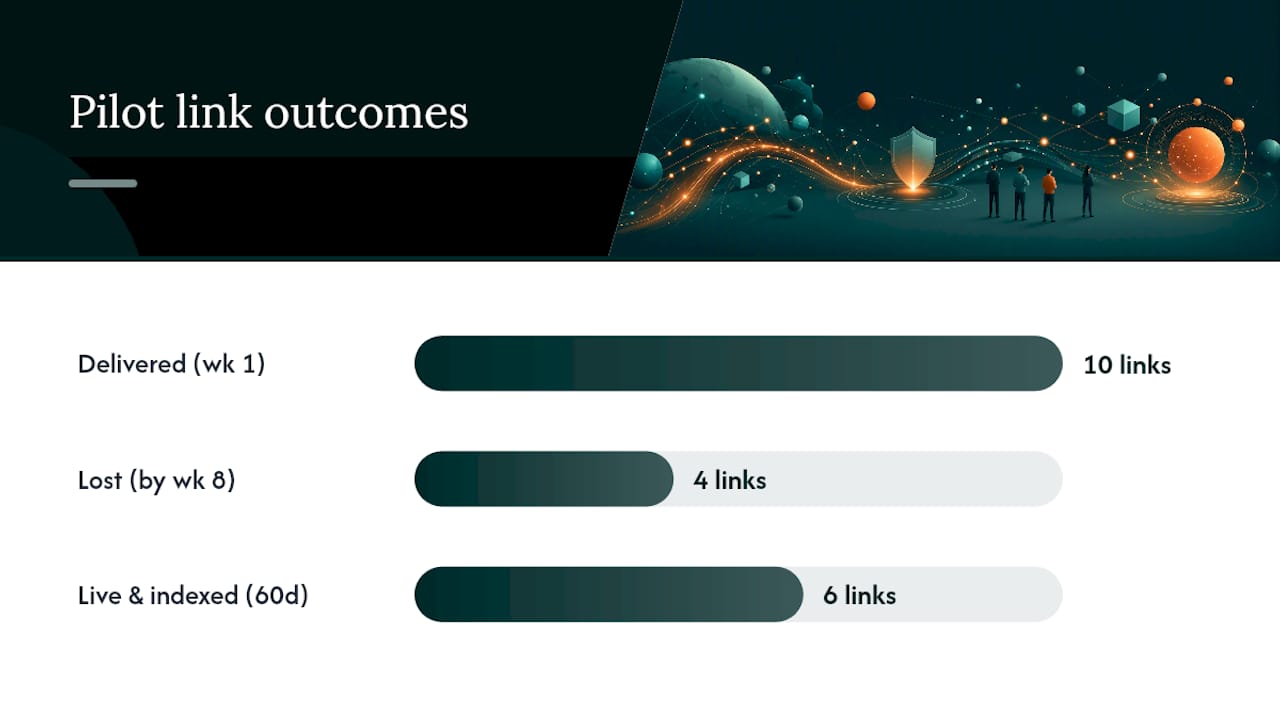
The clearest pilot signal isn’t the number of links delivered. It’s the reply-to-placement ratio and whether the links that do land are still live and indexed 60 days later. A platform that delivers ten links in week one and loses four of them by week eight taught you something a scoreboard number never would.
The 90-Day Playbook: From Pilot to Full Program
Before any campaign launches, clear four things off your desk.
Pre-launch checklist:
- Target pages identified and prioritized by the ones that need authority most, not just the newest content
- Content readiness confirmed, meaning the pages you’re pointing links at are actually worth linking to
- Approval gates staffed, meaning someone specific owns the daily review queue, not “the team” in general
- Sender domain warmed and volume caps configured before the first batch goes out
Weeks 1 to 4: pilot. Run one narrow campaign, one niche, one template family, capped at a modest daily send volume. Every message gets human review at this stage, no exceptions, because you’re establishing baseline reply rates and reviewing what a “good” prospect actually looks like for your niche. Track reply rate and placement rate weekly, not daily. Daily numbers are noise this early.
Weeks 5 to 8: scale the proven template. Once one template family shows a reply rate worth repeating, expand send volume gradually and shift review from line-by-line to spot-checking a sample of each batch. Add a second niche or content vertical if the first is performing. Begin the first verification pass on early placements at the 30-day mark.
Weeks 9 to 12: full monitoring cycle and iteration. Run the 60-day verification pass on the pilot batch and the 30-day pass on the scaled batch. Retire underperforming templates and reallocate budget toward whatever niche or angle is converting best. Build your first standardized reporting tile set for stakeholders.
KPIs worth tracking from week one:
- Reply rate (replies divided by sends, tracked weekly)
- Placement rate (live links divided by outreach attempts)
- Verified-live rate at 30, 60, and 90 days
- Cost per verified placement, not cost per delivered link
- Domain rating and topical relevance distribution across placements landed
Pro Tip: Report cost per verified placement, not cost per delivered link, in every stakeholder update. A “delivered” link that disappears by day 45 cost you money and taught you nothing except to distrust the report that called it delivered.
The full-program threshold is simple: don’t scale past your pilot’s proven template until the 30/60/90 monitoring cycle is running smoothly on the smaller batch. Scaling a broken review process just multiplies the mess.
Why This Model Reflects How Ranksector Actually Operates
Ranksector didn’t build its backlink exchange system as an afterthought bolted onto a content tool. The platform pairs automated prospecting with a human-reviewed exchange network, and every placement connects back to your own analytics dashboard with Google Search Console integration rather than a self-reported delivery count.
The checklist earlier in this guide maps directly onto how Ranksector’s system runs:
- Automation with approval gates: content and outreach drafts get generated automatically, but the exchange and publishing steps stay reviewable rather than fully hands-off
- Verification tied to your own data: GSC integration confirms placements against the property you actually control, not a vendor’s internal report
- Publishing built into the loop: direct publishing to major CMS platforms means the internal linking side of the equation, covered in Ranksector’s internal linking automation guide, stays connected to the same workflow instead of living in a separate tool
- Scale with a track record: the platform has published a significant volume of articles across its customer base, indicating that the automation and review process works effectively at scale
This article was edited under Ranksector’s editorial process by Savannah, who covers automation workflows and SEO tooling for the Ranksector blog, with a focus on where automated systems need human checkpoints to stay safe and effective.
What Actually Matters Here (An Editorial Take)
The conventional wisdom on link building automation still frames this as a speed argument: automate more, get more links, win faster. That framing misses the actual lesson from watching these programs run. Speed without a verification loop just produces more links you can’t verify, which is a reporting problem dressed up as a growth metric.
What’s underrated is how much the approval gate is doing. Not slowing things down, but training the system. Every human review of a first-contact draft teaches you something about what a good prospect looks like in your specific niche, something no autonomous agent knows on day one no matter how good its filters are.
Prioritize verification before you prioritize volume. A ten-link pilot with an honest 30/60/90-day audit tells you more about whether a platform works than a hundred-link month with no recheck ever will. Most teams get this backwards because delivered-link counts look better in a slide deck than verified-live rates do. That’s a reporting incentive problem, not a strategy one, and it’s worth fixing before you scale anything.
— Savannah
Start a Guarded Pilot With Ranksector
Ranksector gives you the guarded model this guide recommends without asking you to stitch together four separate tools. A pilot runs on Ranksector’s free tools entry point: connect your Google Search Console property, name your priority target pages, and let the backlink exchange network start surfacing relevant placements while approval gates keep every outreach draft in front of a person before it sends.
Early metrics to watch mirror the KPIs from the 90-day playbook above: reply rate on the exchange, verified-live placements at the 30-day mark, and how the domain rating trend on your target pages moves once the pilot ramps past its first batch. Teams evaluating an agency alternative can also review the agency-tier feature set for account structure and reporting cadence at scale. Sign up, link your GSC property, and pick two target pages to run the first campaign against this week.
Sources
For the technical foundation behind programmatic discovery and outreach integrations, MuleSoft’s explainer on what an API actually does is a solid starting point. Wikipedia’s overview of link building covers the discovery, outreach, and monitoring split referenced throughout this guide. Michigan Technological University’s SEO services page lays out verification practices worth adapting for your own monitoring cadence. For vendor category comparisons, SeoProfy’s roundup of link building tools and review aggregators like Capterra are useful for cross-checking claims before you commit to a pilot.
- What is an API | MuleSoft
- Digital & SEO services | Michigan Technological University
- Link building — Wikipedia