
Hands Free 2026 Strategy to Increase Domain Rating for B2B SaaS Teams
The fastest way to increase domain rating is to earn dofollow editorial backlinks from relevant, authoritative sites, publish link-worthy assets consistently, and fix internal linking and technical debt that’s leaking authority. Expect small wins within weeks and measurable movement in your score over three to twelve months. Benchmark your progress against your top five organic competitors, not an arbitrary number. Small teams without a content function can use a tool like Ranksector to keep the publishing engine running while they focus on outreach.
TL;DR:
- Earning dofollow backlinks from relevant, authoritative sites and fixing internal linking are the most effective ways to improve domain rating over three to twelve months.
- The domain rating score mainly reflects the quality, diversity, and trust signals of your backlink profile, not Google ranking factors directly.
- Building niche-relevant, high-quality links through original research, targeted outreach, and broken link reclamation generates more sustainable authority gains than low-quality link volume.
- Focusing on creating topic clusters with link-worthy assets and optimizing internal links ensures authority flows to pages that drive revenue.
- Regular backlink audits, fixing technical issues, and recovering lost links accelerate improvements more quickly than new outreach efforts.
Table of Contents
- What Domain Rating Actually Measures
- How Is Domain Rating Calculated? The Backlink Signals That Move It
- Your First 90 Days: A Prioritized Action Plan
- Earning High-Quality Backlinks Without Buying Them
- Building Topical Depth That Compounds Over Time
- Internal Linking: Get Authority to the Pages That Need It
- Auditing Backlink Health and Fixing Technical Blockers
- Tracking Progress: Metrics, Benchmarks, and Realistic Timelines
- What Publishing Consistency Actually Buys You
- Where to Focus When You’re a Team of One or Two
- A Hands-Free Way to Keep the Content Engine Running
- Sources
What Domain Rating Actually Measures
Domain Rating, Moz’s Domain Authority, and Semrush’s Authority Score are third-party proxies. None of them are Google ranking signals. Ahrefs built DR to estimate the strength of a site’s backlink profile on a 0 to 100 scale, and Moz built DA to predict how likely a site is to rank in search results. Google has never confirmed using either.
That doesn’t make them useless. These scores predict ranking potential and signal editorial trust to partners, journalists, and prospects evaluating whether to link to you. A B2B SaaS site pitching a guest post gets accepted more often with a respectable score attached to the domain.
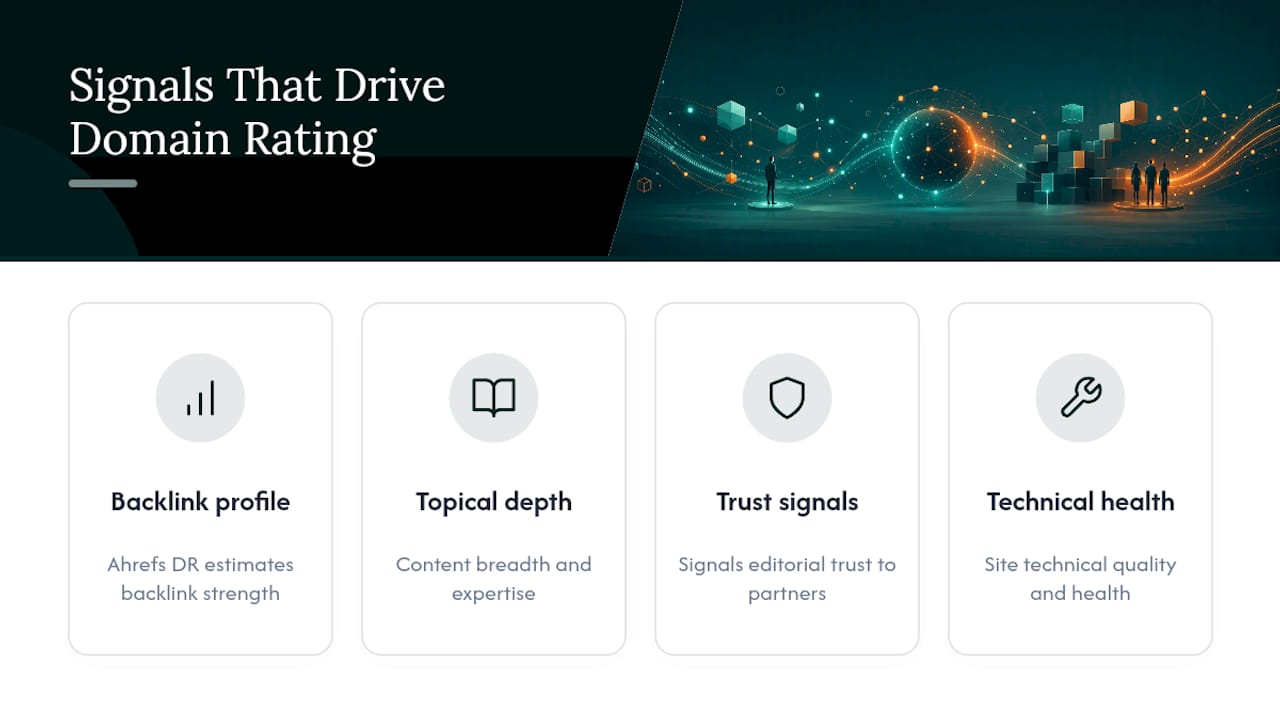
The metric reflects four things: the quality and diversity of your link profile, the topical depth of your content, trust signals across the site, and technical health. Chase those underlying signals and the score follows. Chase the score directly and you’ll likely end up with a manipulated link profile that decays the moment a search engine’s algorithm adjusts. A DR that is high sounds impressive in isolation, but its real value only shows up against your specific competitive set.
How Is Domain Rating Calculated? The Backlink Signals That Move It
Domain Rating and Domain Authority are both built from characteristics of your backlink profile, and four signals do most of the work:
- Root referring domains, not raw backlink count. A hundred links from ten unique domains carries far less weight than fifty links from fifty different domains. Diversity signals organic, distributed trust rather than one enthusiastic linker.
- The authority of the domains linking to you. Moz’s model also weighs how many outbound links those referring domains hand out. A page that links out to 400 other sites dilutes the equity it passes to each one.
- Dofollow versus nofollow attributes. Only dofollow links pass ranking equity in most scoring models. Ahrefs is explicit that DR moves only when you earn dofollow links from domains with established profiles.
- Logarithmic scaling. Moving from 20 to 30 takes far less link equity than moving from 70 to 80. Gains get harder as your score climbs, and a competitor’s own link growth can quietly erode your relative position even if your backlink count never drops.
Your First 90 Days: A Prioritized Action Plan
Don’t try to do everything at once. Sequence by effort versus payoff:
- Weeks 1 to 4: Run a backlink audit, reclaim unlinked brand mentions, fix broken redirects, and verify which existing links are actually dofollow.
- Months 1 to 3: Build one or two genuinely link-worthy assets and start outreach. Fix internal linking so authority flows to the pages that need it.
- Months 3 to 12: Expand topical clusters, run digital PR campaigns, and pursue partnership or integration link opportunities.
Earning High-Quality Backlinks Without Buying Them
Editorial backlinks still separate sites that grow steadily from sites that plateau. The tactics that work haven’t changed much in years, but the bar for “link-worthy” has risen.
Original research and data-driven tools remain the most reliable magnet. A survey of 500 practitioners, a free calculator, or a proprietary benchmark gives journalists and bloggers something concrete to cite. Backlinko’s compiled data shows original research and broken-link reclamation correlate consistently with measurable authority gains, while generic blog posts rarely earn citations on their own.
Practical tactics that produce dofollow links:
- Pitch specific story angles to niche publications instead of generic “we launched” press releases.
- Ask for dofollow placement on integration and partner resource pages when your product genuinely fits.
- Find broken links on relevant sites and offer your content as the replacement.
- Convert unlinked brand mentions into links by emailing the author directly.
A handful of contextual links from niche-relevant pages tends to outperform a pile of low-quality links from large directories that link out to hundreds of other sites. Quality concentration beats volume every time.
Pro Tip: Before you count any new link as a win, check its rel attribute and confirm the linking page is actually indexed. A launch directory listing that shows up in your backlink tool but carries a nofollow tag or sits on a deindexed page contributes nothing to your score.
Building Topical Depth That Compounds Over Time
Link-worthy content shares a few traits: it answers a question better than anything else ranking, it’s structured for easy citation, and it sits inside a cluster of related pages that reinforce each other.
- Choose asset types that earn links on their own merit. Original research, comprehensive pillar pages, free tools, and case studies with measurable outcomes attract citations that generic explainer posts don’t.
- Structure content as a topic cluster. Group related pages under a pillar and interlink them so search engines and readers see clear subject ownership, not scattered posts.
- Distribute deliberately. Build a prospect list of relevant writers and sites, send specific outreach messages referencing the exact data point you want cited, and seed the first mentions through your own channels like organic distribution tactics before expecting external pickup.
This is also where content type selection matters most for small teams: pick formats that are cheap to produce but genuinely citable, not just easy to publish.
Internal Linking: Get Authority to the Pages That Need It
External links only help if the authority they bring actually reaches your commercial pages. Start by finding your most-linked pages, often a popular blog post or tool, and use them as hubs that pass equity to pages that drive revenue.
- Build hub-and-spoke internal linking so authority flows from high-link pages down to pricing, product, and conversion pages.
- Use descriptive, varied anchor text rather than repeating “click here” across the site.
- Audit for orphan pages and thin content that receive links but pass nothing forward.
- Consolidate near-duplicate pages that split link equity, then test the change against ranking movement for the surviving URL.
Internal linking multiplies the value of external links rather than sitting apart from your authority-building work. Treat it as a monthly task, not a one-time cleanup, and revisit it as automated linking tools evolve.
Auditing Backlink Health and Fixing Technical Blockers
Some of the fastest legitimate DR gains come from cleanup, not new link acquisition:
- Run a backlink audit to flag toxic or spammy links, confirm which links are dofollow, and recover broken links or outdated redirects pointing to dead pages.
- Reserve disavow requests for genuinely harmful links. Most sites don’t need one, and using it too aggressively can strip value from links that were actually helping.
- Check indexation and canonicalization so search engines credit the right URL, confirm HTTPS is consistent site wide, and reduce heavy JavaScript rendering on pages you want crawled and linked to.
- Monitor lost links monthly. A competitor’s link growth can shift your relative position even when your own backlink count hasn’t changed.
Pro Tip: Recovering three or four broken backlinks from an old redirect chain often moves your score faster than a month of fresh outreach. Audit-first approaches frequently deliver the quickest wins precisely because they recover equity you already earned but stopped receiving.
Tracking Progress: Metrics, Benchmarks, and Realistic Timelines
Vanity metrics mislead teams into celebrating the wrong wins. Track what actually correlates with organic growth:
- Dofollow referring root domains, not total backlink count.
- Organic traffic specifically to the pages that received new links.
- Keyword rankings for the terms those pages target.
- Your DR, DA, or Authority Score trend across Ahrefs, Moz, and Semrush.
Realistic timelines matter here. Practitioner data suggests measurable score movement takes three to twelve months of consistent link acquisition and content expansion, not weeks. Small technical wins, like reclaiming a broken redirect, can show up faster.
Benchmark quarterly against your top five organic competitors rather than chasing an arbitrary target score. Similarweb’s guidance is direct on this: a DR of 75 is meaningless without knowing what your direct competitors are scoring in the same niche. Set your goals around closing that specific gap, and report progress on the same cadence every quarter using Google Search Console alongside whichever third-party tool you standardize on.
What Publishing Consistency Actually Buys You
An automated platform can publish thousands of articles for B2B SaaS clients through daily publishing paired with a backlink exchange system built to grow domain authority without a dedicated content hire. The mechanism behind why this works isn’t complicated: consistent publishing builds the topical depth that earns citations, and a standing backlink exchange gives small teams distribution they’d otherwise lack.
A practical 30/90-day split looks like this:
- What gets automated: daily article production, keyword research tied to competitor gaps, internal link suggestions, and backlink exchange matching.
- What the team still owns: approving published pieces, running direct outreach to publications, and deciding which partnership or integration links to pursue.
- By day 90: a growing content cluster, a cleaner internal link structure, and a small but real base of exchanged backlinks to build outreach from.
Where to Focus When You’re a Team of One or Two
If you’re running SEO solo or with a skeleton team, don’t spread effort across ten tactics at once. Start narrow: audit your existing backlinks and reclaim what you can, publish one genuinely link-worthy asset, pitch it to fifteen or twenty relevant sites, and tighten your internal linking while you wait for responses.
Give that one quarter to show up in your traffic and link data before you scale production or outreach volume. The mistake I see most often isn’t inaction, it’s the opposite: teams buying links, celebrating nofollow placements as real wins, or running broad vanity PR campaigns that generate mentions nobody can actually link to. None of that moves your score. Patient, narrow execution does.
— Savannah
A Hands-Free Way to Keep the Content Engine Running
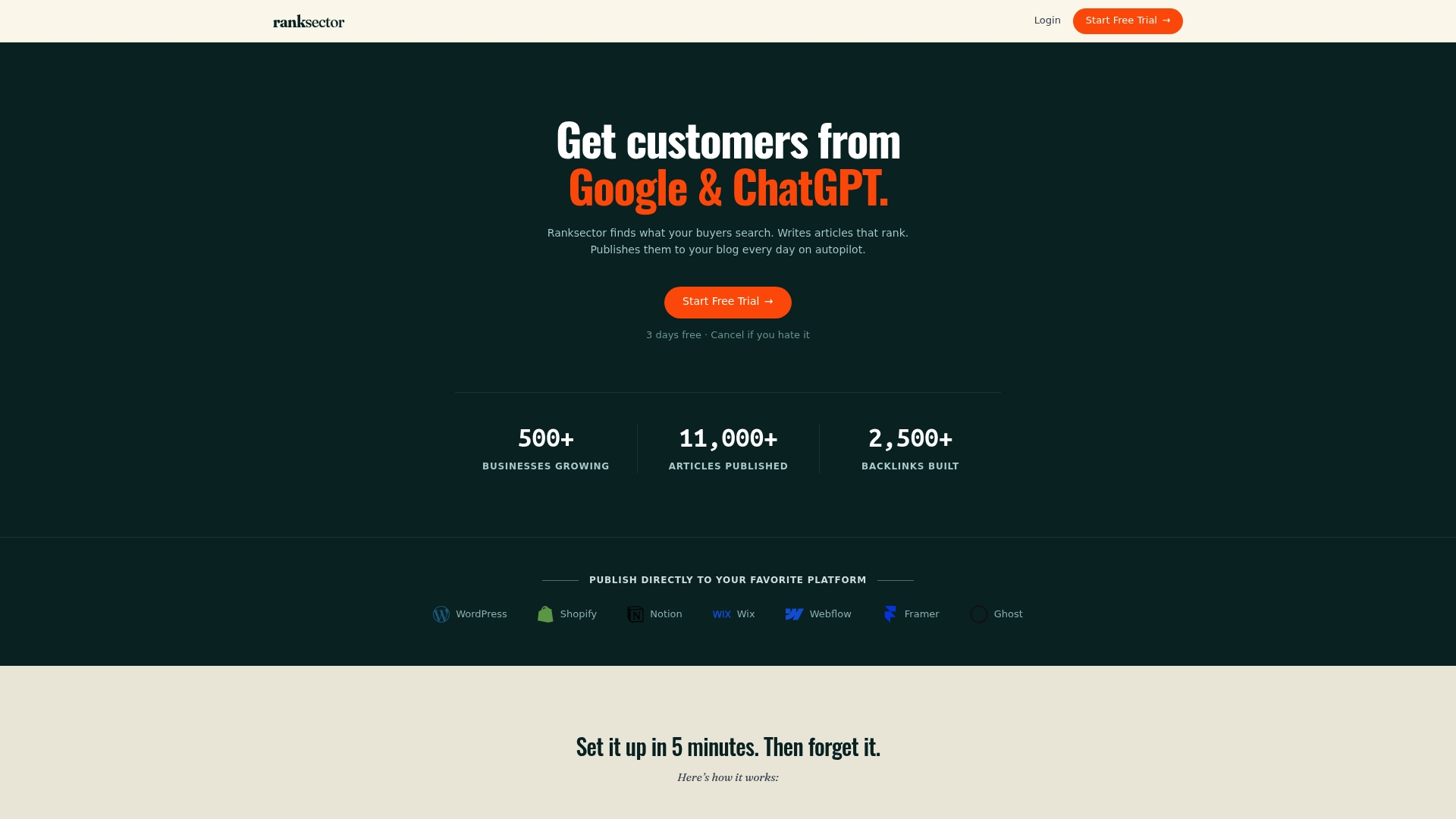
Ranksector exists for exactly the gap this article just described: teams that know what needs to happen (consistent publishing, link-worthy assets, a backlink exchange) but don’t have the headcount to execute it manually every week. Instead of hiring a writer or an agency retainer, This service automates daily article creation, keyword research based on competitor gaps, and connects you to a backlink exchange network built to grow domain authority.
If you’re publishing fewer than two or three articles a month right now, or if outreach keeps sliding because nobody owns it full time, that’s the signal you’re a fit. Start by checking your current backlink profile and technical gaps with the AI audit tool, then explore the agency-style product to see how automated publishing and link exchange work together for teams your size.
Sources
- Website Authority: How It Works and How to Improve It | Similarweb
- Domain Authority - Moz
- Backlinko — Increase Domain Authority
- How to Increase Website Authority (Domain Rating) — Ahrefs
Use Ahrefs or Moz for ongoing backlink audits and monitoring, since both track referring domain changes and lost links on a rolling basis.