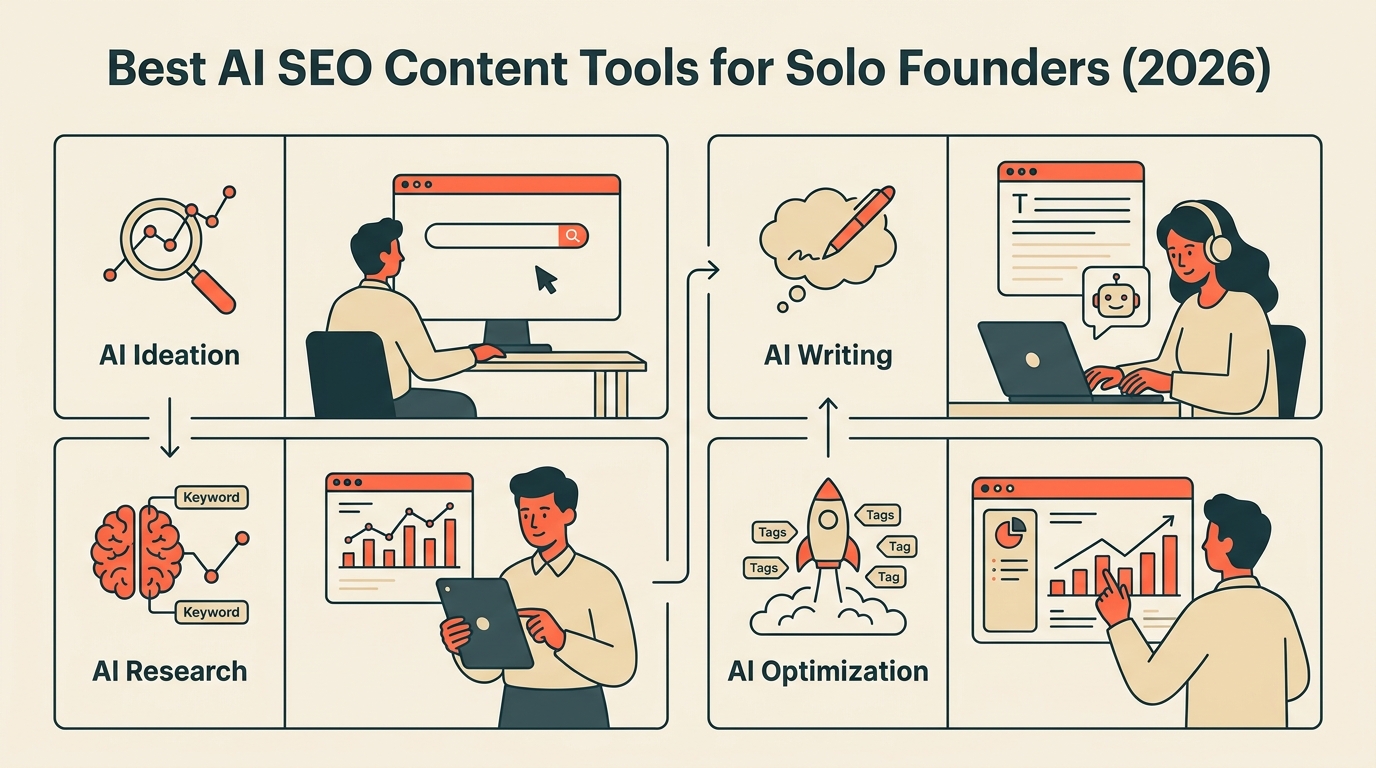
Best AI SEO Content Tools for Solo Founders: What to Use in 2026
✅ Best AI SEO content tools for solo founders (2026) quick guide
Best AI SEO Content Tools for Solo Founders (2026)
You have a product, a publishing plan, and about 4 hours a week to spend on content. You open a tab for keyword research, another for your AI writing tool, a third for your on-page optimizer, and somehow it is Tuesday afternoon and you have published nothing.
That is not a discipline problem. That is a workflow problem. The best AI SEO content tools for solo founders in 2026 are not the ones with the longest feature lists. They are the ones that remove the most manual handoffs from your specific bottleneck.
This guide cuts through the general roundups. It maps the manual workflow most founders still use, shows where time actually disappears, and gives you a decision framework for picking a lean stack that publishes consistently without requiring a team.
Why solo founders need a different AI SEO stack
The bottleneck is not writing speed
Most general AI writing tools solve for word output. That is rarely where solo founders lose time. The real friction lives in the handoffs: moving from keyword to brief, brief to draft, draft to optimized post, post to published URL with internal links attached.
Each handoff costs 15 to 30 minutes on its own. String five of them together and a single article takes 3 to 4 hours before it ever reaches a CMS.
A tool that writes faster but leaves all the handoffs in place saves you little.
General AI writers are not SEO tools
ChatGPT and Claude produce fluent prose. They do not pull live SERP data, score your content against ranking competitors, or auto-link to your existing articles. As Conductor notes, strong AI writing tools for SEO need to be grounded in real search demand and search intent, not blank-slate generation.
Using a general AI writer for SEO is like using a word processor to manage a database. It can technically do parts of the job. It is not built for the job.
Selection criteria that actually matter
When you are a team of one, the criteria shift. Speed matters. Accuracy matters. Cost matters. But the most important factor is automation depth: how many steps does the tool handle without you touching them?
- Speed: can you go from keyword to published draft in under 60 minutes?
- Accuracy: does the tool pull real SERP data or hallucinate competitor content?
- Cost: does the monthly price stay under $100 before you see a return?
- Automation depth: does the tool handle research, drafting, optimization, and publishing, or just one of those?
The best AI SEO tool for a solo founder is the one that removes the most work from the step where you are currently stuck, not the one with the most impressive demo.

The manual SEO content workflow most founders still use
Five tools, two days, one article
Here is the standard workflow in 2025 and still common in 2026: Ahrefs or Semrush for keyword research (30 to 45 minutes), a Google Doc for briefing (20 minutes), ChatGPT or Claude for drafting (30 minutes), Surfer or Clearscope for optimization scoring (20 to 30 minutes), then manual CMS publishing with internal links added by hand (20 minutes).
That is roughly 2 to 2.5 hours on a good day. On a bad day, with rewrites, it is closer to 4 hours per article.
At 1 article per week, that is 200 hours a year on content operations alone.
Where time actually disappears
The biggest time sinks are not the obvious ones. Drafting is fast with AI. The slow parts are context-switching between tools, reformatting outputs, and the internal linking step that almost everyone does last and does badly.
As covered in the internal linking automation guide, manual linking at publish time is where most solo-founder content loses SEO equity it should be passing between articles.
What is safe to automate versus what still needs you
Keyword clustering, brief generation, first-draft writing, on-page scoring, and internal link suggestions are all safe to automate. The SERP data is real. The logic is repeatable.
Brand voice calibration, editorial judgment on sensitive topics, and final accuracy checks still need a human. Automation should compress the pipeline, not erase the 10-minute review that catches a factual error before it ranks.
How the best AI SEO content tools compare
Comparing by workflow stage, not by brand
The Backlinko 2026 roundup segments tools by job: ChatGPT for drafting, Semrush AIO for visibility tracking, MarketMuse for topic planning, Clearscope for optimization. That framing is useful. It confirms that no single tool dominates every stage.
The question for a solo founder is not "which tool is best overall" but "which stage is my biggest bottleneck and which tool solves it fastest."
| Tool | Primary job | Solo-founder fit | Approx. monthly cost | Main trade-off |
|---|---|---|---|---|
| Ranksector Blog | End-to-end: research, draft, optimize, publish | Strong | Check current pricing | Less manual control per article |
| Clearscope | On-page optimization scoring | Moderate | ~$170/mo | No drafting; optimization only |
| MarketMuse | Topic authority and content planning | Moderate | ~$149/mo | Expensive for low-volume solo use |
| Surfer SEO | Content editor with SERP grading | Moderate | ~$89/mo | Still requires a separate drafting tool |
| SE Ranking AI | SEO platform with AI writing add-on | Moderate | ~$65/mo | Writing quality varies by niche |
| ChatGPT (GPT-4o) | Drafting and ideation | High for writing only | ~$20/mo | No SERP data, no CMS integration |
Pick tools by the workflow stage they fix, not by the brand name on the pricing page.

Best AI SEO content tools for solo founders in 2026 ✦
All-in-one automation: when you want the fewest moving parts
If your bottleneck is the full pipeline, not one specific step, an end-to-end platform wins. Averi positions SEObot as a fully autonomous system: keyword research, article generation, internal linking, and CMS publishing handled without manual input between stages.
Ranksector Blog works on the same operating model. You feed in a topic or keyword cluster, and the platform handles research, drafting, SEO scoring, and publishing to your CMS. The trade-off is control: you get speed and consistency, but you are trusting the platform's editorial logic rather than writing every sentence yourself.
This fits founders publishing 4 to 8 articles per month who cannot afford to spend 3 hours per article on operations.
Drafting assistants: when writing is your actual bottleneck
If you have research handled and just need faster first drafts, ChatGPT at $20 per month or Claude Pro at $20 per month are hard to beat on cost. Both produce usable drafts in under 10 minutes when given a detailed brief.
The gap is SEO grounding. Neither tool pulls live SERP data. Neither scores your draft against ranking pages. You still need a separate optimization step, which adds back 20 to 30 minutes per article.
As the free vs paid AI SEO tools guide covers, this combination works for founders on tight budgets but breaks down when publishing volume increases past 4 articles per month.
Optimization editors: when your drafts are good but rankings are not
Clearscope and Surfer SEO both score your content against the top 10 to 20 ranking pages for a target keyword. Clearscope's grading system is cleaner. Surfer's content editor integrates drafting and scoring in one view.
The trade-off: both tools cost $89 to $170 per month and do not write or publish. They are optimization layers, not workflow tools. If you are already spending $20 on ChatGPT and $89 on Surfer, you are at $109 per month before you have touched keyword research or publishing.
SEO intelligence suites: when you need SERP data first
SE Ranking and Semrush both offer AI writing add-ons layered onto their core SEO platforms. The advantage is data quality: keyword volumes, competitor gap analysis, and ranking tracking are all inside one tool.
The disadvantage for solo founders is price and complexity. Semrush starts at around $139 per month. SE Ranking's entry plan is around $65 per month. Both are built for teams managing multiple projects, and the UI reflects that. Overkill if you are publishing to one site.
When to choose automation over a human-first workflow
Content generation versus content operations
There is a difference worth naming. Content generation is writing words. Content operations is the system that gets those words researched, written, optimized, linked, and published on a schedule. AI tools often solve generation. Fewer solve operations.
Automation earns its cost when it compresses operations, not just generation. If a platform cuts your per-article time from 3 hours to 45 minutes, that is 2.25 hours returned per article. At 6 articles per month, that is 13.5 hours back.
Where automation is enough
Keyword clustering, content brief generation, first-draft writing, on-page SEO scoring, and internal link suggestions are all repeatable, rule-based tasks. Automation handles them well.
- Keyword clustering: grouping 50 to 200 keywords by intent takes 2 to 3 hours manually and about 3 minutes with a decent AI tool.
- Brief generation: pulling competitor headings, word counts, and entity lists is mechanical work. Automation does it faster and more reliably.
- Internal linking: matching new content to existing articles by topic proximity is a pattern-matching problem. Machines are better at it at scale.
Where human review still matters
Brand voice is the most common failure point in automated content. Generic outputs drift toward safe, bland language. If your brand voice is direct and opinionated, a 10-minute review pass to sharpen the opening and the CTA is worth keeping in the workflow.
Fact accuracy is the other non-negotiable. AI tools hallucinate statistics. Any article making specific claims about pricing, feature comparisons, or technical specs needs a human check before publishing. No automation layer removes that responsibility.
Automation should compress the workflow. It should not replace the 10-minute review that catches a wrong number before it ranks and gets cited.

A practical solo-founder stack for publishing steadily
The lean three-layer model
In my experience, the most effective solo-founder stacks follow a simple pattern: one tool for research and topic planning, one for drafting and optimization, one for publishing and internal linking. Three layers. Maximum two tools if one platform covers two layers.
Adding a fourth tool almost always adds overhead without adding output. As the solo founder SEO stack guide covers, the goal is a repeatable system, not a collection of subscriptions.
A weekly cadence that actually works
Here is a pattern that holds up at 4 articles per month with a lean stack:
- Monday, 30 minutes: pull keyword targets for the week from your research tool, confirm search intent, and queue the brief.
- Tuesday, 45 minutes: review the AI draft, adjust brand voice in the opening and CTA, fact-check any statistics.
- Wednesday, 15 minutes: run the optimization score, accept or reject suggestions, approve internal link placements.
- Thursday, 10 minutes: publish, set the meta description, confirm the URL structure is clean.
That is roughly 100 minutes per article. Not 4 hours. The difference is automation handling the mechanical steps between each stage.
The decision rule for staying lean
Before adding any new tool to your stack, ask one question: does this tool remove a step I currently do manually, or does it add a new step I would not otherwise need?
If the answer is "adds a step," skip it. If it removes a step that costs you more than the tool's monthly price in time, buy it. That is the only math that matters at this stage.
What to look for before you buy
The features that actually change results
Not all features on a pricing page affect publishing speed or ranking outcomes. These are the ones that do, based on what solo founders actually use week to week:
- CMS integration: does the tool publish directly to WordPress, Webflow, or your platform, or does it require a manual copy-paste step?
- Internal linking: does the tool suggest or auto-insert links to your existing content, or do you handle that manually after publishing?
- SEO scoring against live SERPs: does the tool pull real competitor data for the target keyword, or does it use a static model?
- AI search visibility: does the tool score for GEO and AEO signals alongside traditional SEO, given how AI search engines now surface content?
Features that look impressive but rarely move results
Plagiarism detection is usually redundant if you are reviewing AI output before publishing. "AI detection scores" are unreliable and not a ranking signal. Unlimited word counts sound attractive but mean nothing if the output quality is poor.
As covered in the AI SEO platforms comparison, the gap between a tool's feature list and what a solo founder actually uses week to week is often significant. Pay for what you will use in the first 30 days.
How to trial a tool properly
A free trial should prove workflow fit, not just features. Run one real article through the tool from keyword to published URL. Time each step. If the total time is not at least 30% faster than your current process, the tool is not solving your bottleneck. Move on.
Check the SEO.com AI tools directory and Firebear's AI SEO overview for current trial terms and feature comparisons before committing to any annual plan.
If a tool cannot help you publish one article faster during the free trial, it will not help you publish twelve articles faster at month three.
FAQ on choosing AI SEO content tools
Can AI SEO tools replace a human writer?
For standard informational and comparison content, AI tools can produce a publishable first draft in under 10 minutes. They do not replace editorial judgment on brand voice, accuracy checks, or nuanced opinion pieces. A useful heuristic: automate the draft, own the review. That split keeps quality up and time cost down.
How many tools does a solo founder actually need?
In my experience, two to three tools is the right ceiling. One platform that covers research and drafting, one that handles optimization and publishing, and optionally one for rank tracking. More than three tools usually means more time managing subscriptions than publishing content. The affordable AI blog automation guide has a budget-friendly version of this stack.
What is the difference between AI content writing and AI SEO optimization?
AI content writing generates words. AI SEO optimization scores those words against real SERP data and tells you what to change to rank. You need both, but they are different jobs. A tool that only writes and a tool that only optimizes each solve half the problem. Look for tools that connect the two steps, or accept that you will need one of each.
Are all-in-one AI SEO platforms worth it for solo founders?
Yes, when the alternative is paying for three separate tools that do not talk to each other. The math usually works out: three single-purpose tools at $30 to $89 each adds up to $90 to $267 per month with manual handoffs between them. An all-in-one platform at $80 to $120 per month that removes those handoffs is cheaper and faster. The trade-off is less granular control over each individual step.
Does Ranksector Blog handle internal linking automatically?
Yes. Ranksector Blog scans your existing content library and suggests or inserts contextually relevant internal links during the drafting and publishing step. This removes one of the most time-consuming manual steps in the solo-founder workflow, the post-publish linking pass that founders often skip or do inconsistently.
Ranksector Blog
Try Ranksector Blog on one real article this week: pick a keyword, let the platform handle research, drafting, SEO scoring, and CMS publishing, then compare the clock time against your current workflow. See how Ranksector Blog compresses the full pipeline so you can publish regularly without adding hours to your week.