
Scaling Content Production Strategies for Marketing Teams
The fastest way to scale content production without losing quality is to build a repeatable content engine before you add a single writer. That means documented briefs, objective quality gates, automated handoffs, and a standing maintenance allocation baked into your calendar from day one. Once that system exists, adding capacity multiplies output. Without it, adding writers multiplies rework.
Your three highest-leverage first moves:
- Standardize your brief using an 8-section template (keyword, intent, audience, funnel stage, competitive summary, required sections, sources, success metrics)
- Set 4 quality gates at brief approval, outline review, draft review, and pre-publish check
- Allocate 30% of production capacity to refreshes, consolidations, and pruning from week one
This week: run a 14-day content ops audit. Map every piece currently in flight, identify where it stalls, and note which steps have no documented owner. That audit is the foundation of your 90-day plan.
Table of Contents
- Why scaling content production is worth the investment
- What does a core content scaling strategy actually look like?
- Your 90-day playbook to build a content engine
- How AI content factories and horizon mapping protect quality at scale
- Which tools actually move the needle on throughput?
- How do you know if your content scaling is working?
- Copy-ready templates: brief fields, QA checklist, and publish gates
- Key Takeaways
- The part most teams get wrong when they scale
- Ranksector handles the publishing engine so you can focus on strategy
- Sources and further reading
Why scaling content production is worth the investment
Documented production systems make the difference between scaling that works and scaling that breaks. ScaleGrowth tracked 23 B2B content teams over 18 months and found that teams with a production system maintained an average quality score of 7.8/10 while scaling from 4 to 16 posts per month. Teams without systems dropped from 7.6/10 to 5.1/10 over the same period.
The business upside is real: faster organic traffic growth, predictable pipeline influence, and compounding domain authority as your content library matures. A well-run content engine also makes your editorial calendar a forecasting tool, not just a scheduling spreadsheet.
The downside of scaling badly is equally concrete. Editorial overhead becomes a bottleneck when briefing, reviewing, and approving are ad hoc. Quality drops fast, and search engines notice. Low-value volume can trigger ranking losses that take months to reverse.
Refreshing existing content is often the highest-ROI move in your arsenal. A HubSpot analysis cited by ScaleGrowth found that updated posts generated materially more organic traffic than new posts targeting the same keywords. That is why allocating at least 30% of your production capacity to maintenance is not optional — it is where your fastest wins live, with mature content programs often raising that share further.
What does a core content scaling strategy actually look like?
Think of it as five interlocking layers. Every team that scales successfully has all five in place.
1. Documented brief templates and a topic taxonomy. A brief removes ambiguity before a writer touches the keyboard. A topic taxonomy groups your content into clusters so you never commission two pieces that cannibalize each other. Together, they cut revision cycles significantly.
2. Objective quality gates at defined pipeline stages. Gates are pass/fail checkpoints, not editorial opinions. Brief approved? Outline reviewed? Draft cleared? Metadata present? Each gate has a named owner and a documented checklist. Without gates, quality depends on whoever happens to be paying attention that day.
3. Repeatable templates and modular content. A modular approach means a long-form guide can be broken into a LinkedIn series, a newsletter section, and a FAQ page without starting from scratch each time. This is how small teams repurpose one article into five or more assets without burning out.
4. Operational roles and clear ownership. Someone owns editorial intelligence (what to write and why). Someone owns production (briefs, scheduling, handoffs). Someone owns quality (gates and final approval). Mixing these roles in one person is fine at low volume; it breaks at scale.

5. Strategic allocation across three content horizons. Horizon 1 captures high-intent queries for near-term conversion. Horizon 2 builds topical authority over months. Horizon 3 creates durable assets that compound over years. Knowing which horizon a piece belongs to determines how much time and depth it deserves.
Pro Tip: Before adding any new tool or writer, map your current workflow in a single shared doc. You will immediately see where pieces stall — and that is exactly where to apply your first quality gate.
Your 90-day playbook to build a content engine
This plan is phased deliberately. Resist the urge to skip to Phase 3.
Phase 1 (weeks 1–4): document everything
- Build your 8-section brief template: primary keyword, secondary keywords, search intent, audience and funnel stage, competitive summary, required sections, differentiation angle, sources to use, internal links, and success metrics.
- Define your 4 quality gates with named owners and pass/fail criteria for each.
- Audit your editorial calendar. Per ScaleGrowth’s guidance, a functional calendar uses multiple pipeline stages, clear owners, and built-in escalation — not a topics-and-dates spreadsheet.
- Run a baseline audit: cycle time per piece, first-draft pass rate, and where pieces currently stall.
Phase 2 (weeks 5–8): validate the system
- Pilot the brief template on several pieces. Track gate pass rates and note every fail reason.
- Automate lightweight tasks: SERP snapshot pulls, metadata prefill, and publish-checklist generation.
- Identify which editorial tasks are pure overhead (formatting, link checks, metadata) and route them to automation or a junior role.
Phase 3 (weeks 9–12): add capacity into the system
- Add writers or AI agents into the documented workflow, not alongside it.
- Split editor roles: one structural editor (flow, argument, coverage) and one copy editor (accuracy, style, metadata).
- Launch your refresh cycle. Allocate a substantial portion of production capacity to refreshes and consolidations. Mature libraries often move to a balanced new-versus-maintenance split.
- Activate measurement loops: weekly cycle time, gate fail reasons, and refresh traffic uplift.
Stop doing these immediately:
- Ad hoc briefs written differently for every piece
- Hero edits where one senior person rewrites everything
- Meetings that review a single piece of content in real time
| Metric | What it measures | When to act |
|---|---|---|
| Cycle time | Days from brief to publish | Act if average exceeds your target cadence by 20% |
| First-draft pass rate | % of drafts that clear the draft gate without major revision | Act if below 60% — brief quality is the cause |
| Gate fail reasons | Which gate fails most and why | Act if the same reason appears 3+ times in a sprint |
| Refresh traffic uplift | Organic traffic change 30–60 days post-refresh | Act if uplift is flat — check keyword targeting and depth |
How AI content factories and horizon mapping protect quality at scale
Scaling in 2026 means building a multi-agent AI workflow, not just using a better single-model prompt. The AI content factory model assigns specialized agents to discrete stations: research, outlining, drafting, editing, and publishing, with human-in-the-loop checkpoints sitting between stations, not at the end. That structure is what keeps editorial quality intact as volume increases.
The key insight from multi-agent pipeline research is that quality degrades when a single model tries to do everything in one pass. Splitting tasks into specialized stations — with a human checkpoint between research and draft, and again between draft and publish — preserves the editorial judgment that search engines reward.
Model routing is the cost-control lever inside that factory. Cheap, fast models handle formatting, classification, metadata checks, and link validation. Frontier models are reserved for research synthesis and final drafts where reasoning quality matters. Running everything through a frontier model is expensive and unnecessary; running everything through a cheap model produces content that fails quality gates.
The three-horizon content map gives your factory its production schedule. Horizon 1 work (high-intent, conversion-focused) gets tighter briefs and faster turnaround. Horizon 2 work (topical authority) gets deeper research and more editorial review. Horizon 3 work (compounding assets like pillar pages and data studies) gets the most investment and the longest measurement window. Rebalance horizon weights quarterly based on your KPI data, not on gut feel.

Pro Tip: Run a quarterly horizon audit. Count how many pieces you published in each horizon last quarter. If a high majority are Horizon 1, you are over-indexed on short-term capture and under-building authority.
Practical safeguards against scaled-content penalties: every piece needs editorial approval before publish, every factual claim needs a cited source, and every piece needs a measurement tag so you can track its performance against its horizon goal.
Which tools actually move the needle on throughput?
Tool categories matter more than specific product names. Build your stack around these five functions:
- Content intelligence: decay detection and keyword gap analysis to identify what to refresh and what to create next
- Brief automation: tools that pull SERP data, auto-populate metadata fields, and generate outline scaffolds
- CMS publishing automation: direct API publishing to WordPress, Webflow, or your CMS of choice, eliminating copy-paste entirely
- Editorial QA: readability scoring, internal-link checks, and metadata validation at the gate stage
- Analytics integration: Google Search Console and GA4 connections that feed performance data back into your editorial calendar
For CMS automation specifically, publishing directly to Webflow without manual copy-paste is one of the highest-leverage single changes a small team can make. It removes a step that introduces formatting errors and delays.
| Stack tier | Team size | Core tools | Monthly investment |
|---|---|---|---|
| Lean | 1–3 people, under 10 pieces/month | Brief template (doc), SERP tool, CMS with native scheduling, GA4 | Low |
| Scale | 4+ people or 20+ pieces/month | Brief automation tool, multi-agent AI workflow, CMS publish API, QA tool, GSC integration | Moderate to high |
The selection principle: prioritize tools that enforce quality gates automatically and remove repetitive manual checks. Bells-and-whistles features that require manual operation do not scale. For affordable AI blog automation tools that fit lean team budgets, the options have expanded considerably in recent years.
The four-layer framework from Chief Content Marketer — editorial intelligence, production templates, mechanical distribution, and automated feedback — is a useful mental model for auditing your stack. If any layer is missing, that is where your throughput ceiling sits.
How do you know if your content scaling is working?
A functional content engine stabilizes in roughly 90 days. Ranking lifts from refreshed content often appear 30–90 days after publication. Compounding assets take longer, sometimes six months or more, but their traffic curves are steeper once they take hold.
Core KPIs to track from day one:
- Cycle time (brief to publish): your throughput baseline
- First-draft pass rate: the clearest signal of brief quality
- Editorial gate pass rates: where your process is leaking
- Time-to-rank: how long new pieces take to appear in top-20 positions
- Content-influenced conversions: pipeline touches attributed to content
- Refresh uplift: organic traffic change 30–60 days after a refresh
Use KPIs to trigger decisions, not just to report. If first-draft pass rate drops significantly, improve the brief before adding writers. If gate fail rates cluster at the outline stage, your topic taxonomy needs work. If refresh uplift is flat, check whether you are targeting the right keywords and adding enough new depth.
Fixing editorial overhead is cheaper and faster than adding headcount. A system-first approach reduces the number of editors you need because writers produce cleaner first drafts when the brief is precise. That is the cost lever most teams miss: they hire their way into a bottleneck instead of documenting their way out of one.
High-level cost shape: a lean team of two running a documented system can produce more quality output than a team of five operating ad hoc. The investment is in process design and tooling, not in headcount.
Copy-ready templates: brief fields, QA checklist, and publish gates
Content brief template (8 sections)
- Primary keyword and search intent (informational, commercial, transactional)
- Secondary keywords and related entities to include
- Audience and funnel stage (awareness, consideration, decision)
- Competitive summary (top 3 ranking pieces, their gaps, your differentiation angle)
- Required sections with suggested word counts per section
- Sources to use (named, linked, with the specific claim each source supports)
- Internal links (target pages and suggested anchor text)
- Success metrics (target ranking position, traffic goal, conversion event)
Editorial QA checklist
- Does the opening paragraph lead with the answer, not a definition or context-setting?
- Does every factual claim have a cited, linked source?
- Are all required sections present and at target depth?
- Does the piece pass a readability check (grade 10–12)?
- Are metadata fields complete: title tag, meta description, slug, OG image?
- Are internal links present and pointing to the correct target pages?
- Has a structural editor reviewed argument flow and coverage gaps?
- Has a copy editor reviewed accuracy, style, and grammar?
Publish gate (pass/fail)
- ☑ Primary keyword appears in the first 100 words
- ☑ At least two cited, linked sources present
- ☑ Readability score within target range
- ☑ Metadata complete and reviewed
- ☑ Internal links verified as live
- ☑ Structural and copy editor sign-off recorded
- ☑ Piece tagged to its content horizon for measurement
Key Takeaways
Scaling content production without losing quality requires a documented system first, then capacity — in that order, every time.
| Point | Details |
|---|---|
| System before headcount | Build documented briefs and quality gates before adding writers or AI agents. |
| 30% maintenance allocation | Reserve at least 30% of production capacity for refreshes and consolidations from week one. |
| 90-day stabilization | A functional content engine takes roughly 90 days to stabilize; expect ranking lifts 30–90 days after refreshes. |
| AI factory model | Use multi-agent workflows with human checkpoints, not single-model prompts, to protect quality at volume. |
| Ranksector automates the engine | Ranksector handles daily publishing, keyword research, CMS delivery, and backlink exchange for B2B SaaS teams running this playbook. |
The part most teams get wrong when they scale
The conventional wisdom says scaling content is a hiring problem. Bring in more writers, commission more pieces, hit a higher monthly number. That framing is wrong, and it is expensive to learn the hard way.
The real bottleneck is almost always editorial overhead: the time spent briefing, reviewing, revising, and approving. When you add writers without fixing that overhead, you do not multiply output. You multiply the number of drafts waiting for a senior editor’s attention. The queue grows, cycle times lengthen, and quality drops — not because the writers are bad, but because the system was never designed to handle the volume.
What actually works is investing in the brief before investing in the writer. A precise, 8-section brief does not just tell a writer what to cover. It pre-answers the questions that would otherwise require a revision cycle. It sets the quality bar before a word is written. Teams that do this consistently find that their first-draft pass rates climb, their editing time drops, and their editors can handle more pieces per week without burning out.
The other thing teams consistently underestimate is the value of the maintenance allocation. Refreshing a post that already ranks on page two is almost always faster and cheaper than writing a new post from scratch. The keyword targeting is already validated. The internal links are already in place. You are adding depth and recency, not building from zero. That is where the fastest traffic wins come from, and most teams leave them on the table because new content feels more productive than updated content.
Ranksector handles the publishing engine so you can focus on strategy
Daily publishing cadence, keyword research driven by competitor analysis, direct CMS delivery, and a backlink exchange network — these are the mechanical layers of a content engine that most B2B SaaS teams either skip or spend months building manually. Ranksector automates all of them in a single subscription, with over 11,000 articles already published and a track record of moving domain ratings quickly.
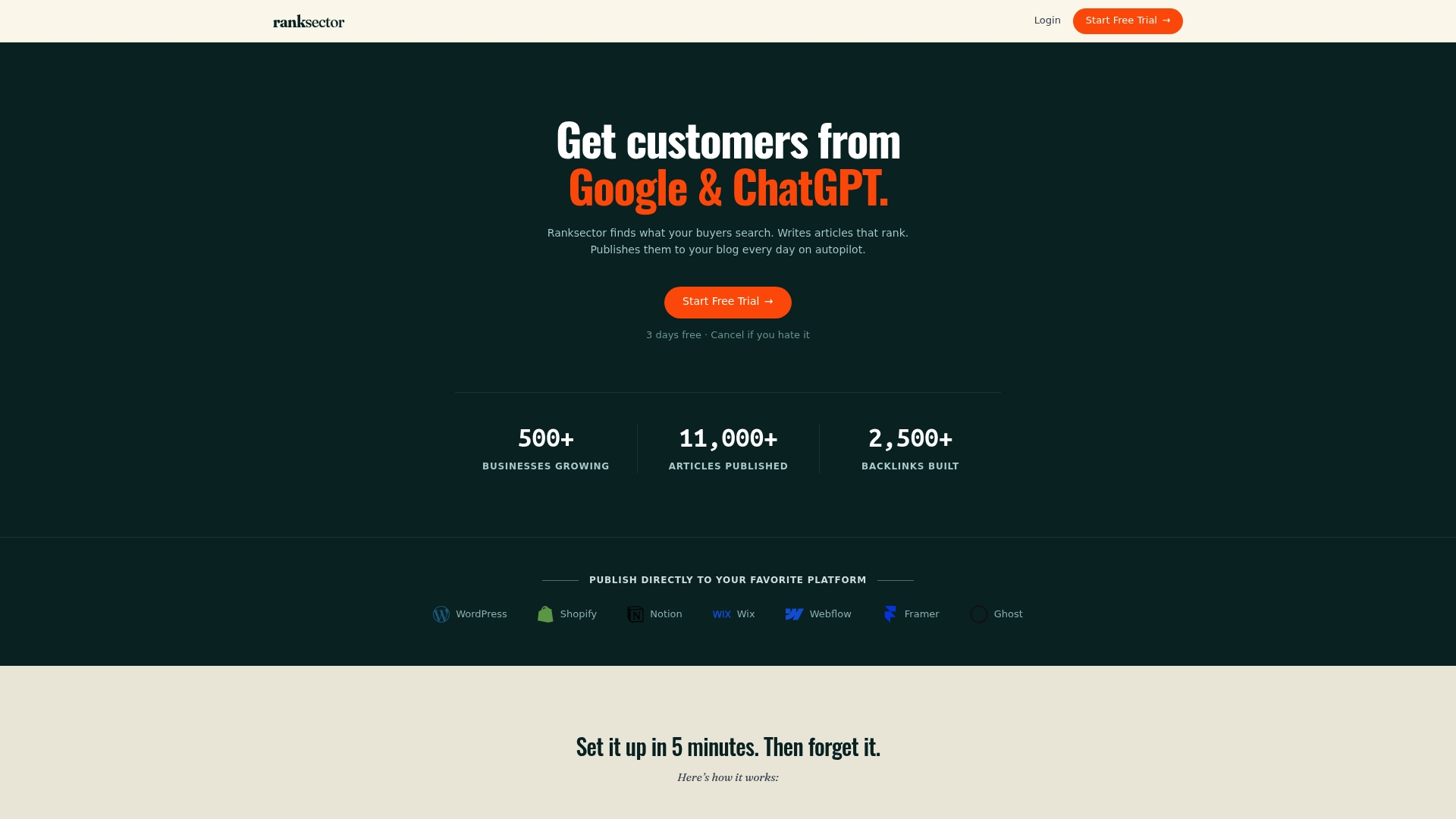
For teams running the 90-day playbook above, Ranksector accelerates Phases 2 and 3 directly: brief-to-publish automation removes the manual handoff bottleneck, the competitor-driven keyword research feeds your topic taxonomy, and the backlink exchange builds domain authority without a separate link-building operation. You keep editorial control over strategy and quality gates; Ranksector handles the production throughput.
If you want to see how automated publishing fits your current workflow, start with Ranksector’s platform to explore the full feature set, or run an AI content audit to benchmark your current setup before committing to a plan.
Sources and further reading
- The Content Engine: How to Build a System That Produces Without You — ScaleGrowth Digital. The primary research source for production system quality scores and editorial calendar design.
- How to Build an AI Content Factory (2026 Guide) — Pickaxe. Core reference for multi-agent workflows and model routing principles.
- How to Create a Content Strategy in 2026 (3 Horizons) — InstantPress. Source for the three-horizon content map framework.
- How to Scale Content Quality Without Scaling Your Headcount — Chief Content Marketer. Evidence for the four-layer framework and editorial overhead as the true scaling bottleneck.
- How to Scale Content Production Without Sacrificing Quality — Morrison. Source for the 70/30 and 60/40 maintenance allocation guidance.
- How to Create a Content Strategy That Drives Results — Harvard Business School Online. Foundational reference for content strategy structure and KPI alignment.
- Ranksector: AI blog publishing for SaaS — manual workflow vs. automation — Ranksector Blog. Practical guide to converting manual editorial workflows into automated publishing flows.
- Publishing cadence trade-offs: daily, weekly, and burst strategies — Ranksector Blog. Helps teams decide realistic cadence when scaling output.
- When to consolidate articles in SaaS SEO — Ranksector Blog. Decision guide for consolidation and pruning within a maintenance allocation.
Most important to read next: The Content Engine by ScaleGrowth Digital. It contains the 18-month quality score data and the editorial calendar framework that underpin the 90-day playbook above.
Recommended
- SEO Content Types for Small B2B SaaS Teams in 2026 · Ranksector Blog · Ranksector
- How to Publish to Webflow CMS Without Manual Copy-Paste · Ranksector Blog — Ranksector
- How to Repurpose One Article into 5 LinkedIn Posts Without Burning Out · Ranksector Blog — Ranksector
- Cheap Content Marketing SEO Results on Any Budget · Ranksector Blog — Ranksector