
SEO Content Types for Small B2B SaaS Teams in 2026
For small B2B SaaS teams, the key content types to prioritize include pillar pages, problem-solution blog posts, FAQ/answer capsules, short case studies, and comparison explainers. Regular publishing helps signal topical authority to Google. For quick wins, target keywords with moderate monthly search volumes and manageable difficulty, which can achieve rankings within a few weeks.
Your monthly content mix at a glance:
- Pillar page — establishes topical authority on your core problem; everything else links back to it
- Problem-solution blog post — targets a specific pain point your ICP searches for; drives organic traffic at mid-funnel
- FAQ/answer capsule — 40–60-word direct answers under question headings; built for AI citation and featured snippets
- Short case study — converts warm leads better than any other format; shows proof, not promises
- Comparison explainer — captures “X vs Y” and “best tool for Z” searches at the decision stage
Table of Contents
- What small business SEO content types actually do in the funnel
- How to match content format to buyer stage and conversion goal
- Publishing cadence, content mix, and quick-win keyword strategy
- How to automate SEO content safely without losing quality
- Operational templates: briefs, calendar, and on-page checklist
- How to measure whether your content automation is working
- Key Takeaways
- The format gap most small SaaS teams never close
- Ranksector handles the production layer so your team can focus on strategy
- Research sources and further reading
What small business SEO content types actually do in the funnel
Each format performs a different job. Treating them as interchangeable is one of the fastest ways to waste a small team’s publishing budget.
Pillar pages are your foundation. A substantial pillar article covering a broad topic, supported by several related posts of moderate length, produces the topical authority signal Google rewards. For a SaaS team, that might be “The Complete Guide to API Integration for HR Platforms” with supporting posts on specific integration errors, onboarding steps, and use cases by vertical.

Problem-solution blog posts are your traffic engine. They target a specific search query, answer it directly, and pull readers into your funnel. Example topics: “Why your SaaS onboarding drop-off spikes at day 3” or “How to automate user provisioning without an IT team.”
FAQ/answer capsules are your AI citation play. AI search engines favor direct-answer content with FAQPage schema. A 40–60-word answer placed immediately below a question-style subheading is trivially easy for ChatGPT, Perplexity, and Google AI Overviews to extract and cite. Every brief you write should include at least one answer capsule as a required field.
Short case studies close deals. A before/after narrative with measurable results is harder for any competitor to replicate than any other content type. For SaaS, structure it as: customer situation, the integration or workflow problem, the exact steps taken, and the quantified outcome.
Comparison explainers capture decision-stage traffic. “Webhook vs polling for real-time data sync” or “Single sign-on vs password manager for SaaS teams” are the kinds of queries your buyer types right before they evaluate vendors.
Pro Tip: Your product changelog is a content goldmine. Every feature release or bug fix maps to a user pain point someone is searching for. A short problem-solution post drafted from release notes can be automated, fact-checked in minutes, and published the same week the feature ships.
How to match content format to buyer stage and conversion goal
Format misalignment is a top reason content strategies fail. Writing an educational blog post for a transactional search, or burying a case study behind a gated form when the reader is still in awareness mode, kills both ranking and conversion.
| Buyer stage | Best content format | Primary KPI | Expected CTA |
|---|---|---|---|
| Awareness | Pillar page, how-to blog post, FAQ article | Organic sessions, impressions | Read more, subscribe |
| Consideration | Comparison explainer, case study, feature explainer | Time on page, MQL volume | Book a demo, download |
| Decision | Short case study, FAQ page, pricing explainer | Conversion rate, demo bookings | Start trial, contact sales |
Before choosing a format, ask three questions:
- What is the searcher’s intent — learn, compare, or buy?
- What action do you want them to take after reading?
- How will you measure whether this piece moved them closer to that action?
Red flags that signal format mismatch:
- A blog post written in sales-page voice for an informational keyword
- A case study published at awareness stage before the reader understands the problem
- An FAQ page with no schema markup (invisible to AI engines)
- A comparison page that never names a clear winner or next step
Pro Tip: Before republishing a post that underperforms, check intent first. If the keyword is transactional and you wrote a how-to guide, repurposing beats rewriting. Strip the educational framing, add proof elements, and redirect to a conversion page.
Publishing cadence, content mix, and quick-win keyword strategy
The minimum cadence for small business SEO is four articles per month. Consistency is more important than volume; teams are advised to publish at least four posts monthly to sustain momentum and build topical authority.
Sample monthly mix for a 4-post month:
- Week 1: Pillar or long-form supporting post (1,500–2,000 words) targeting a medium-competition keyword
- Week 2: Quick-win blog post (50–500 monthly searches, difficulty below 30) targeting a specific ICP pain point
- Week 3: FAQ/answer capsule article (800–1,000 words) structured for AI citation
- Week 4: Case study or feature comparison explainer targeting a decision-stage keyword
For quick-win keywords, expect first-page rankings in 4–8 weeks when your domain has even modest authority. Medium-term targets (difficulty 30–50) typically take 3–6 months. Authority-level keywords above difficulty 50 are a long game, worth pursuing only after your cluster is established.
| Keyword tier | Monthly search volume | Difficulty | Expected time to rank |
|---|---|---|---|
| Quick win | 50–500 | Below 30 | 4–8 weeks |
| Medium-term | 500–2,000 | 30–50 | 3–6 months |
| Authority | 2,000+ | 50+ | 6 months |
For more on cadence trade-offs, including burst vs. steady publishing strategies, Ranksector’s blog covers the practical implications for small teams.
Pro Tip: One pillar page can generate five or six answer capsules. Pull each H2 question from the pillar, write a 40–60-word direct answer, add FAQPage schema, and publish as a standalone FAQ article. Each one is a separate AI citation opportunity with almost no additional research.
How to automate SEO content safely without losing quality
AI-assisted workflows work best when automation handles brief generation and first drafts, and human editors add product accuracy and fact-checking. The failure mode is skipping the human layer entirely.
Production workflow for a 1–3 person team:
- Keyword clustering — group target keywords by topic and intent; assign one cluster per pillar
- Brief generation — auto-generate brief fields (keyword, intent, answer capsule, related questions, required data)
- AI first draft — accelerate drafting; do not publish without human review
- Expert edit — a product or domain expert checks facts, adds telemetry screenshots, and corrects any inaccuracies
- Answer capsule pass — confirm every H2 question has a 40–60-word direct answer and FAQPage schema
- Publish and internal link — add contextual links to the pillar and related posts before going live
- Monthly audit — reoptimize posts that have not moved after 8 weeks
Pre-publish quality checklist:
- ✅ Every factual claim verified against product documentation or a named source
- ✅ Answer capsule present under each question-style H2
- ✅ FAQPage schema added and validated
- ✅ Internal links to pillar and at least one related post
- ✅ Meta title and description written; target keyword in H1
- ✅ No AI-generated customer quotes or invented statistics
Governance table:
| Role | Responsibility | Sign-off required? |
|---|---|---|
| Content manager | Brief approval, calendar ownership | Yes, before drafting |
| AI/automation layer | Draft generation, brief population | No |
| Subject-matter expert | Fact-check, product accuracy | Yes, before publish |
| Editor/QA | Checklist completion, schema validation | Yes, final gate |
Ranksector integrates at the brief generation, draft acceleration, and publishing automation steps. With over 11,000 articles published and documented domain-rating increases for clients, it handles the production layer so your team focuses on expert editing and strategy.
Pro Tip: Set a hard rule: no AI-generated post publishes without SME sign-off on product claims. One inaccurate feature description does more damage to trust than a month of missed publishing targets.
Operational templates: briefs, calendar, and on-page checklist
Content brief fields (required for every post):
- Target keyword and search intent classification
- 40–60-word answer capsule (required, not optional)
- Three related questions for H2 subheadings
- Named data sources or product documentation to cite
- Required screenshots or telemetry visuals
- CTA and conversion goal
- Editorial owner and SME reviewer
Sample 4-post content calendar:
| Week | Title | Keyword | Format | Owner | CTA |
|---|---|---|---|---|---|
| 1 | Guide to SaaS API onboarding | API onboarding guide | Pillar post | Content manager | Book demo |
| 2 | Fix slow webhook delivery | Webhook latency fix | Quick-win blog | SME + editor | Read docs |
| 3 | FAQ: SaaS user provisioning | User provisioning FAQ | FAQ article | Editor | Start trial |
| 4 | Case study: 40% faster onboarding | Customer onboarding results | Case study | SME | Contact sales |
On-page SEO checklist:
- Target keyword in H1, meta title, and first 100 words
- Question-format H2 subheadings with answer capsules below each
- FAQPage schema validated in Google’s Rich Results Test
- Internal links to pillar page and at least two related posts
- Meta description under 160 characters with a clear benefit
- LCP under 2.5 seconds; no CLS above 0.1 (check via technical SEO basics)
- Image alt text on every visual
How to measure whether your content automation is working
Track these metrics monthly. Without a reporting cadence, you cannot tell whether a post underperformed because of keyword choice, format mismatch, or a quality problem.
Primary KPIs:
- Organic sessions per post (Google Search Console)
- Impressions and average position for target keywords
- MQL volume attributed to content CTAs (GA4)
- Conversion rate on decision-stage posts
Secondary KPIs:
- Time-to-first-page-one ranking per keyword tier
- Content production velocity vs. defect rate (posts requiring major post-publish corrections)
- AI citation appearances (track manually via Perplexity and ChatGPT spot checks)
Reporting cadence and ROI calculation:
| Metric | Reporting frequency | Target threshold |
|---|---|---|
| Organic sessions | Weekly | Upward trend by week 6 |
| Keyword positions | Monthly | Quick-win keywords on page 1 by week 8 |
| MQL volume | Monthly | At least 1 MQL per 4 posts published |
| Production defect rate | Monthly | Below 5% of published posts |
Content-level ROI is straightforward: divide your total monthly content production cost by the number of incremental MQLs generated. If automation cuts your cost per published article and MQL volume holds or grows, the workflow is working. For low-budget ranking tactics that complement this measurement approach, Ranksector’s blog covers the full picture.
Key Takeaways
For small B2B SaaS teams, five content types and a four-post monthly cadence are enough to build compounding topical authority when paired with quick-win keyword targeting and a quality-gated automation workflow.
| Point | Details |
|---|---|
| Prioritize five formats | Pillar pages, problem-solution posts, FAQ capsules, case studies, and comparison explainers cover the full funnel. |
| Publish at least four articles per month; steady output signals topical authority and sustains SEO momentum. | |
| Target quick-win keywords first | Keywords with 50–500 monthly searches and difficulty below 30 typically reach page one in 4–8 weeks. |
| Gate every AI draft with SME review | Automation handles briefs and drafts; a subject-matter expert must verify product claims before publishing. |
| Ranksector automates the production layer | With 11,000+ articles published, Ranksector handles brief generation, drafting, and publishing so your team focuses on quality and strategy. |
The format gap most small SaaS teams never close
Most small B2B SaaS teams I work with have the same blind spot: they produce content, but they produce it in the wrong format for the stage their buyer is actually in. A team will spend three weeks writing a detailed pillar page for a keyword their ICP searches only at the decision stage, then wonder why it drives traffic but no demos.
The fix is not more content. It is better format discipline. The quick-win keyword band (50–500 monthly searches, difficulty below 30) is where this discipline pays off fastest. A well-structured FAQ article targeting a specific integration question can move from draft to page one in under eight weeks, and it does so because the format matches exactly what the searcher needs at that moment. Pairing that with a pillar cluster and a monthly audit cadence is what turns a content program from a publishing exercise into a lead-generation asset.
Ranksector handles the production layer so your team can focus on strategy
Publishing four SEO-optimized posts per month sounds manageable until you account for keyword research, brief writing, drafting, expert review, schema markup, and internal linking. For a team of one or two, that is a full-time job on top of everything else.
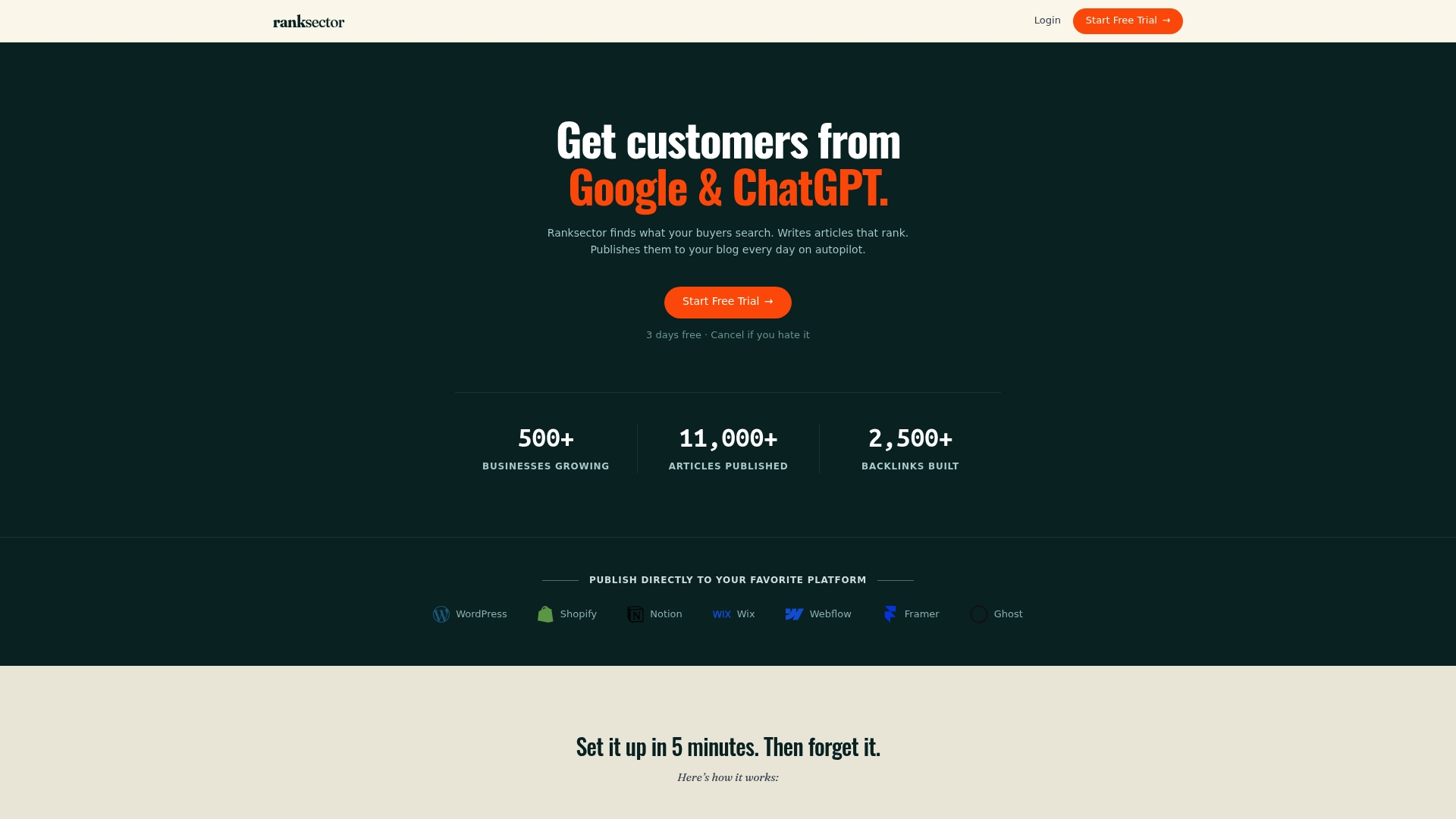
Ranksector automates brief generation, AI-assisted drafting, and publishing, including internal linking suggestions, so your team’s time goes to expert editing and strategy rather than production logistics, much like how LeadPilot’s cold email automation software streamlines sales workflows. With over 11,000 articles published and documented domain-rating increases for clients, the platform is built specifically for small B2B SaaS teams that need consistent output without a full content department. Use cases include launching integration announcement posts from release notes, scaling FAQ answer capsules across a product cluster, and producing case studies from customer interview transcripts.
Ready to see it in practice? Start with the agency product or run a quick AI content audit to identify your highest-priority content gaps first.
Research sources and further reading
- Small Business SEO: The 2026 Playbook | Rankeo — supports the 4/month minimum cadence claim
- SEO for Small Business in 2026: The AI-Assisted Playbook | OnyxRank — supports pillar cluster structure, answer capsule guidance, and automation workflow
- SEO Content Strategy for Small Business: The 2026 Guide | IAS Blog — supports quick-win keyword band (50–500 MS, difficulty below 30) and time-to-rank expectations
- How to Build an SEO Content Strategy That Ranks in 2026 | Client Magnet CRM — supports format misalignment as a top failure reason
- SEO Strategy for Small Business: A 2026 Step-by-Step Plan | Hasiburjoy — supports 40–60-word answer capsule structure and positioning under question headings
- Content Strategy for Small Business | Grow With Sakib — supports buyer-stage content mapping and GEO/AEO framework
- SEO Content Strategy for Small Business in 2026 | Tocayo — supports format-to-intent matching and content brief workflow
- Ranksector: Publishing Cadence Trade-offs — expands on cadence strategy for small teams
- Ranksector: AI Blog Publishing for SaaS SEO — details manual vs. automated steps in a SaaS publishing pipeline
- Ranksector: Types of SEO Quick Wins for Faster Rankings — expands on quick-win keyword selection tactics
Recommended
- Free vs Paid AI SEO Tools: When Each Makes Sense for SaaS Teams in 2026 · Ranksector Blog — Ranksector
- AI SEO Platforms Compared: What SaaS Teams Should Actually Compare in 2026 · Ranksector Blog — Ranksector
- AI Blog Publishing for SaaS SEO: Manual Workflow vs Automation · Ranksector Blog — Ranksector
- Schema Types for SaaS in 2026: What’s Worth Implementing and What to Skip · Ranksector Blog — Ranksector