
How Competitor SEO Research Works: 2026 Guide
Competitor SEO research is the practice of systematically analyzing your rivals’ keyword rankings, backlink profiles, content structures, and technical setups to identify gaps and opportunities in your own strategy. Understanding how competitor SEO research works gives you a map of what Google already rewards, so you can build toward those signals rather than guessing. 96.55% of web pages get zero search traffic, which means most content fails not from poor writing but from poor positioning. The tools that make this work, including Semrush, Ahrefs, and AI platforms like Claude, have made deep competitive analysis accessible to teams of any size.
What are the core components of competitor SEO research?
Competitor SEO research, also called competitive SEO analysis, covers five distinct layers. Each layer answers a different question about why a competitor ranks and what it would take to beat them.
Keyword gap analysis is the starting point. You compare your keyword rankings against a competitor’s and identify terms they rank for that you do not. Tools like Ahrefs and Semrush surface these gaps automatically. The goal is not to copy their keyword list but to find clusters where you have a realistic chance of ranking and where the traffic is worth the effort.

Backlink profile comparison goes deeper than domain authority scores. Exporting backlink data at the page level reveals exactly which links support a specific ranking URL, not just the domain overall. That distinction matters because a competitor’s homepage authority does not explain why a specific blog post ranks. You need to see which sites link to that post directly.
Content evaluation covers format, depth, and SERP feature ownership. You are looking at word count, heading structure, use of tables and lists, and whether the page holds a featured snippet. Featured snippets earn a 42.9% CTR, which drops the number one organic result’s CTR from 26% to 19.6% when a snippet is present. That shift alone justifies targeting position zero as a separate goal.
Technical SEO audits round out the picture. You check Core Web Vitals, crawl depth, schema markup, and mobile performance for competing pages. Core Web Vitals are a confirmed ranking factor, and bounce probability rises 32% when load time increases from one second to three seconds. If your competitors are slow and you are fast, that gap is a real advantage.
- Keyword gap analysis: find terms competitors rank for that you do not
- Page-level backlink export: identify precise link sources for specific ranking URLs
- Content audit: evaluate format, depth, and featured snippet ownership
- Technical audit: Core Web Vitals, schema, crawl depth, and mobile performance
- SERP feature mapping: identify which competitors own rich results and knowledge panels
Pro Tip: Run your keyword gap analysis at the subfolder level, not just the domain level. A competitor’s /blog/ subfolder often has a completely different keyword profile than their /product/ pages. Mixing both gives you a distorted picture of where they are actually winning.
How can AI tools speed up competitor SEO research?
AI tools have changed the pace of competitive analysis more than any other development in recent years. The most time-consuming part of traditional research was organizing raw keyword data into usable themes. That work now takes a fraction of the time.
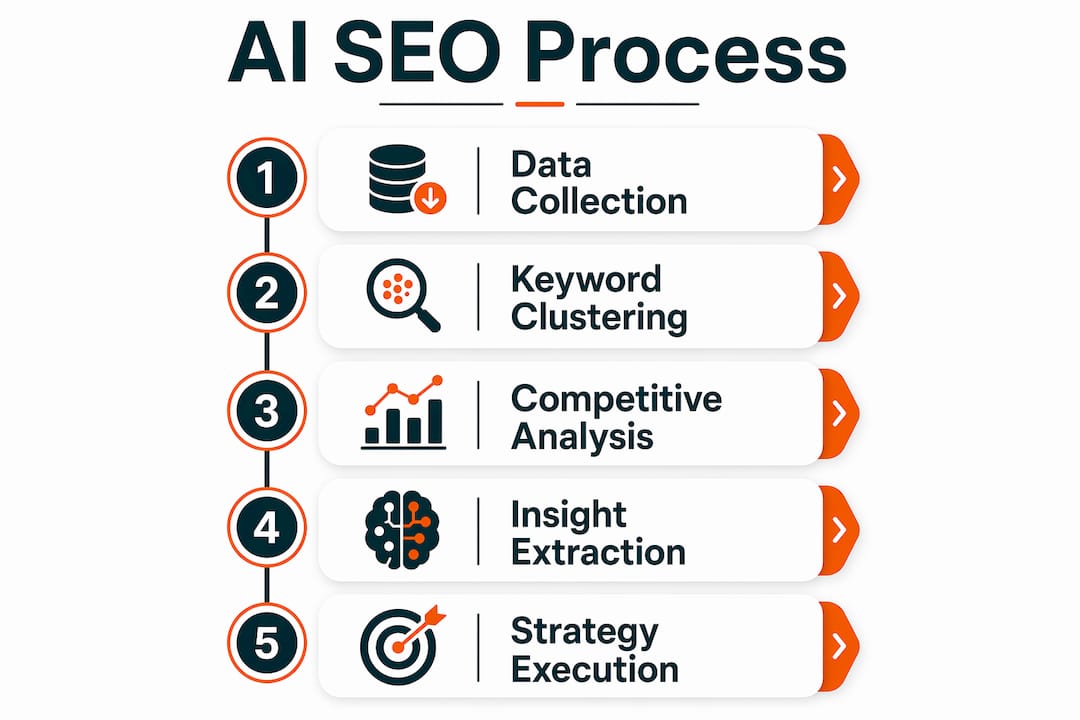
AI-assisted keyword clustering compresses hours of manual work into about 90 seconds. That is not a minor efficiency gain. It means a content strategist can process an entire competitor’s keyword profile in a single session rather than across multiple days. The time saved goes directly into interpretation and planning.
Here is a practical workflow for AI-assisted competitor research:
- Export keyword gaps from Ahrefs or Semrush as a CSV file, including volume and keyword difficulty scores.
- Feed the export into Claude or ChatGPT with a prompt asking it to cluster keywords by topic and search intent, then rank clusters by commercial relevance.
- Apply a validation filter by asking the AI to flag clusters where your domain has existing topical authority, since those are the fastest wins.
- Review backlink patterns by pasting a competitor’s top linked pages into an AI prompt and asking it to identify the content formats and topics that attract the most links.
- Cross-check AI outputs manually for any cluster where the business stakes are high. AI accelerates the work but does not replace judgment on strategic priorities.
AI-assisted clustering transforms raw data into thematic groups tiered by search intent and business relevance. That structure is what turns a spreadsheet of 500 keywords into a content roadmap you can actually execute.
Pro Tip: When using ChatGPT or Claude for keyword clustering, include the competitor’s domain name in your prompt and ask the AI to identify which clusters align with that competitor’s core product positioning. This surfaces the keywords they are defending most aggressively, which tells you where the real competition lives.
What do advanced tactics reveal about SERP dynamics and content longevity?
The age of competing content is one of the most underestimated factors in SEO planning. Nearly 60% of pages ranking in the top 10 are three or more years old. That means you are often competing against pages with years of accumulated links, engagement signals, and topical authority. Knowing this changes how you plan your content investment.
Tracking competitor ranking movements over time reveals more than just their current position. Ranking changes signal content investments, decay, and market repositioning. When a competitor suddenly gains 20 positions on a cluster of keywords, they have likely updated that content or run a link building campaign. When they drop, their content may be stale or a technical issue has emerged. Both scenarios are opportunities.
| Signal | What it means | What to do |
|---|---|---|
| Competitor gains rankings fast | Recent content update or link push | Audit their updated page and match or exceed the depth |
| Competitor loses rankings steadily | Content decay or technical issue | Target those keywords with fresh, well-structured content |
| Competitor owns featured snippets | Strong answer formatting | Reformat your content to directly answer the query in the first paragraph |
| Competitor cited in AI answers | High entity authority | Study their content structure and named entity usage |
An emerging layer of competitive intelligence involves AI search citations. Competitors cited in AI answers 8 out of 10 times have high entity authority worth studying. As AI-powered search tools like Perplexity and Google’s AI Overviews become more prominent, being cited in those answers is a new form of visibility. Monitoring which competitors appear in AI-generated responses tells you whose content structure and authority signals Google’s systems trust most.
You can track competitor content update frequency by checking the “last modified” date in their page source or using tools like Visualping. A competitor who updates their top 20 pages every quarter is playing a different game than one who publishes and forgets. Matching their cadence on your highest-value pages is a baseline requirement.
How do you turn competitor research insights into real strategies?
Data from competitor analysis only has value when it connects to a specific action. The gap between insight and execution is where most SEO programs stall.
Start with keyword prioritization. Not all gaps are worth filling. Rank your keyword clusters by two factors: commercial intent and competitive difficulty. A cluster with high purchase intent and a competitor difficulty score below 40 in Ahrefs is your first target. Clusters with high difficulty and low commercial intent go to the bottom of the list regardless of volume.
| Approach | Copying competitors | Reverse-engineering patterns |
|---|---|---|
| Goal | Match their content | Understand what Google rewards |
| Output | Similar pages with no differentiation | Original content built on proven signals |
| Risk | Duplicate content, no ranking advantage | Requires more analysis upfront |
| Long-term result | Stagnation | Compounding authority |
The goal is to reverse-engineer the patterns Google rewards, not copy competitors’ strategies. Copying produces pages that look like what already ranks but offer no reason for Google to prefer yours. Reverse-engineering means understanding why a page ranks, then building something that satisfies the same signals more completely.
For backlink acquisition, focus on shared referring domains. If three of your top competitors all have links from the same 15 domains, those domains are clearly relevant to your niche and open to linking to similar content. That list is your outreach priority, not a random list of high-authority sites.
On the technical side, use your competitor audit findings to set a performance baseline. If your competitors average a 2.1-second load time and yours is 3.8 seconds, closing that gap is a higher priority than publishing new content. Technical disadvantages compound over time.
Pro Tip: Use the content strategy alignment principle when building your content roadmap. Map each keyword cluster to a stage in your buyer’s journey before assigning it to a writer. This prevents you from creating content that ranks but attracts the wrong audience.
Key takeaways
Competitor SEO research works by identifying the specific signals Google rewards in your niche, then building content, links, and technical performance that meet or exceed those signals across every layer of your site.
| Point | Details |
|---|---|
| Start with keyword gaps | Use Ahrefs or Semrush to find high-intent keywords competitors rank for that you do not. |
| Export backlinks at page level | Page-level data reveals which links actually support specific rankings, not just domain authority. |
| Use AI to cluster faster | AI tools like Claude compress keyword clustering from hours to about 90 seconds. |
| Target featured snippets | Featured snippets earn a 42.9% CTR, making position zero more valuable than position one. |
| Treat research as ongoing | Competitor ranking shifts signal content updates and link campaigns worth monitoring continuously. |
The competitive intelligence habit most teams skip
Competitor SEO research is treated as a quarterly audit by most teams. That framing misses the point entirely. Competitive SEO intelligence is dynamic and ongoing. It signals broader business strategies, not just content calendars. When a competitor starts ranking aggressively for bottom-of-funnel terms, they are likely preparing a product push or responding to a sales gap. That is business intelligence, not just SEO data.
What I have found consistently is that the teams who treat competitor research as a live feed rather than a snapshot make better content decisions. They catch content decay in competitors before it becomes obvious. They spot new keyword clusters before they get competitive. They notice when a rival earns a featured snippet and respond within weeks rather than quarters.
The AI citation layer is the part most teams are not watching yet. Monitoring which competitors appear in Perplexity or Google AI Overviews for your core queries tells you whose entity authority is strongest right now. That is the next frontier of competitive positioning, and the gap between teams who track it and those who do not is widening fast.
Small technical wins also get overlooked. If your competitors are failing Core Web Vitals and you pass them, that is a durable advantage that compounds. You do not need to outwrite a three-year-old page if you can outperform it on every technical signal Google measures. The metrics that predict rankings in 2026 reward consistency across content quality, technical health, and link relevance together, not any single factor in isolation.
— Savannah
How Ranksector supports your competitor research workflow
Running competitor SEO research manually across keyword gaps, backlink profiles, and content audits takes real time. Ranksector is built for B2B SaaS teams who need that intelligence translated into published content without the manual overhead.
Ranksector combines competitor-driven keyword research with automated daily article publishing, so the insights you pull from competitor analysis feed directly into a content pipeline. With over 11,000 articles already published and a built-in backlink exchange system, it handles the execution side that most teams stall on. Whether you need free SEO tools to start your competitor analysis or a full agency-level content program, Ranksector gives small teams the output of a much larger operation.
FAQ
What is competitor SEO research?
Competitor SEO research is the process of analyzing rivals’ keyword rankings, backlinks, content, and technical performance to identify gaps and opportunities in your own SEO strategy.
Which tools are best for competitor SEO analysis?
Ahrefs and Semrush are the most widely used competitor analysis tools. AI platforms like Claude and ChatGPT accelerate keyword clustering and pattern recognition on top of that raw data.
How often should you run a competitor SEO audit?
Competitor SEO research works best as an ongoing process rather than a one-time audit. Monitoring ranking shifts monthly and running full audits quarterly gives you enough signal to act on without creating analysis overload.
Why do featured snippets matter in competitor research?
Featured snippets earn a 42.9% CTR, which drops the number one organic result’s CTR from 26% to 19.6%. Identifying which competitors own snippets for your target queries tells you exactly where to focus your content formatting efforts.
How does AI help with competitor keyword research?
AI tools like Claude and ChatGPT cluster keyword gap data by topic and search intent in about 90 seconds, replacing hours of manual spreadsheet work and producing a prioritized content roadmap directly from competitor data.
Recommended
- Find Untapped Keywords: Competitor Research Guide · Ranksector Blog — Ranksector
- How to Spot Keyword Cannibalization in Five Minutes · Ranksector Blog — Ranksector
- AI SEO Platforms Compared: What SaaS Teams Should Actually Compare in 2026 · Ranksector Blog — Ranksector
- Common Keyword Research Mistakes Businesses Make in 2026 · Ranksector Blog — Ranksector