
What Is Google E-E-A-T? Your 2026 SEO Guide
Google E-E-A-T is defined as a four-part framework — Experience, Expertise, Authoritativeness, and Trustworthiness — that Google’s human quality raters use to evaluate the credibility and usefulness of web content. Understanding Google E-E-A-T matters because it shapes how Google’s algorithms are trained and refined over time, even though it is not a direct ranking signal. Quality rater findings help Google improve its algorithms rather than serve as a mechanical ranking input. For content creators and digital marketers, this distinction changes everything about how you should approach content strategy in 2026.
What is google e-e-a-t and what do the four letters mean?
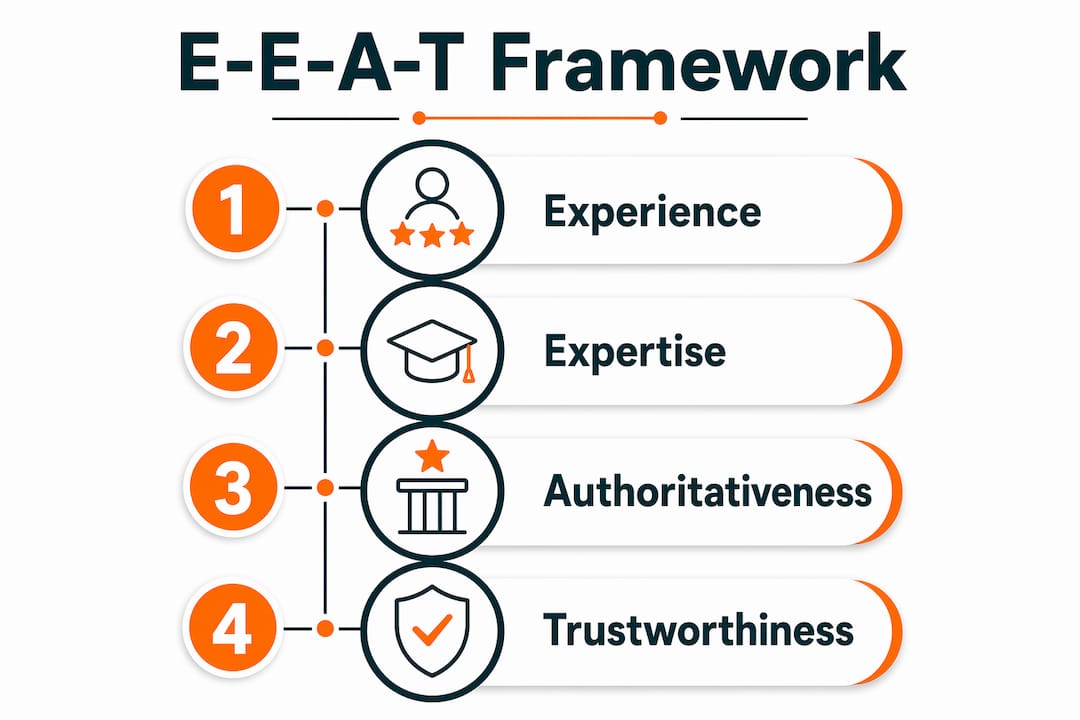
Google E-E-A-T stands for four distinct quality signals, and each one measures something different about your content and your site.
-
Experience refers to first-hand knowledge or direct interaction with a topic. A travel writer who has visited the destination they describe demonstrates experience. A financial blogger who has personally managed the investment strategy they explain demonstrates experience. This is the newest addition to the framework, added in December 2022 to distinguish lived knowledge from purely theoretical expertise.
-
Expertise refers to recognized skill or professional knowledge in a subject area. A licensed physician writing about drug interactions demonstrates expertise. A certified accountant explaining tax law demonstrates expertise. Expertise can be formal, such as a degree or license, or informal, such as years of documented practice in a field.
-
Authoritativeness refers to the reputation of the content creator or the website within its topic area. If other credible sites in your niche link to your content, cite your work, or reference your brand, that signals authority. It is built over time through consistent publishing, backlinks, and recognition from peers.
-
Trustworthiness is the most critical component of the four. Low trust can undermine an otherwise strong rating across the other three signals. Trust covers accuracy, transparency, site security, clear authorship, honest advertising practices, and whether users can rely on your content to be safe and factual.
Pro Tip: Think of Trust as the foundation. You can have deep expertise and strong authority, but if your site has no clear author, no contact information, and no citations, raters will score it low regardless.
The four signals work together rather than independently. A medical site staffed by real doctors that publishes inaccurate information still fails on Trust. A personal finance blog written by someone with no credentials but genuine lived experience can score well on Experience while needing to build Expertise signals over time.

How does google use e-e-a-t in search rankings?
E-E-A-T is not a direct algorithmic ranking factor. Google’s John Mueller has confirmed you cannot add EEAT to your web pages the way you add a meta tag or a schema markup. That statement cuts through a lot of SEO noise. Many marketers waste time chasing surface-level signals when the underlying quality of their content is the actual problem.
Here is how the process actually works:
- Google employs thousands of human Search Quality Raters worldwide who use the Search Quality Rater Guidelines as their evaluation manual.
- Raters assess pages and sites using E-E-A-T criteria and submit their evaluations.
- Google uses that aggregated feedback to train and refine its ranking algorithms.
- The algorithms then apply those learned quality signals at scale across billions of pages.
This means E-E-A-T influences rankings indirectly. Improving genuine quality signals on your site trains better algorithms, which in turn rewards sites that match those quality patterns.
E-E-A-T carries the most weight for Your Money or Your Life topics, commonly abbreviated as YMYL. These include health, finance, legal advice, safety information, and news. For YMYL content, raters apply stricter reliability standards because low-quality content in these categories can cause real harm to users.
“E-E-A-T is best treated as a qualitative checklist for content trust, authority, and experience that supports algorithmic ranking indirectly.” — Search Engine Land
The practical implication is clear. Treat E-E-A-T as a qualitative content checklist rather than a technical SEO task. Your goal is to make your site genuinely more credible, not to simulate credibility.
E-a-t vs. e-e-a-t: what changed and why it matters
The original framework was called E-A-T, covering Expertise, Authoritativeness, and Trustworthiness. Google introduced it in its Search Quality Rater Guidelines years before it became widely discussed in the SEO community. The framework worked well for evaluating professional and institutional content, but it had a gap.
Google recognized that first-hand experience is a distinct quality signal that expertise alone does not capture. A professional nutritionist can write about a diet plan with technical accuracy. Someone who has followed that diet for two years and documented their results brings a different kind of value. Both matter. Neither replaces the other.
| Signal | E-A-T (Pre-2022) | E-E-A-T (Post-December 2022) |
|---|---|---|
| Experience | Not evaluated separately | First-hand knowledge is a scored signal |
| Expertise | Formal or recognized skill | Still applies, now paired with Experience |
| Authoritativeness | Site and author reputation | Unchanged |
| Trustworthiness | Central quality signal | Remains the most critical element |
| Content example | Doctor writing about medication | Doctor who has treated patients with that medication |
The addition of Experience has real consequences for content strategy. Product reviews written by people who have actually used the product now score differently than reviews assembled from spec sheets. Travel guides written by people who have visited the location carry more weight than those compiled from other travel sites. This shift rewards original, first-person content and penalizes content that aggregates without adding genuine perspective.
How to improve e-e-a-t across your site
Building strong E-E-A-T is a site-wide effort, not a page-level fix. E-E-A-T is earned through consistent editorial quality, transparent authorship, and comprehensive topical coverage over time. Here is what that looks like in practice.
Establish clear, credible authorship
Every article on your site should have a named author with a bio that documents their relevant credentials or experience. Link author bios to their LinkedIn profiles, published works, or professional portfolios. If your content covers YMYL topics, include formal credentials such as certifications, licenses, or institutional affiliations.
Publish original, well-researched content
Original research, case studies, and first-person accounts are the clearest signals of genuine experience. Cite credible external sources such as peer-reviewed studies, government data, or recognized industry publications. Google’s own guidance emphasizes original value and real experience over content that simply reorganizes what already exists online.
Build site reputation through backlinks and mentions
Authority is built externally. When credible sites in your niche link to your content, that signals to Google that your site is a recognized source. Focus on earning links through original research, expert commentary, and content that other publishers want to reference. You can also explore directory submission tools to strengthen your backlink profile systematically.
Demonstrate trust at every touchpoint
| Trust Signal | What to Do |
|---|---|
| Transparent authorship | Name every author and link to their credentials |
| Accurate citations | Link to primary sources, not secondary summaries |
| Site security | Use HTTPS across all pages |
| Contact information | Publish a real address, phone number, or contact form |
| Editorial standards | Publish a corrections policy and update outdated content |
| Honest advertising | Disclose sponsored content and affiliate relationships |
Pro Tip: Audit your existing content for outdated statistics and broken citations. Stale data is a trust signal in reverse. Updating articles with current sources is one of the fastest ways to improve perceived reliability.
Shortcuts do not work here. John Mueller’s warning against fake EEAT tactics is direct: adding a fake author photo or inventing credentials is detectable and counterproductive. Quality raters are trained to spot surface-level signals that lack substance behind them.
Does e-e-a-t affect AI search results?
Google’s AI Overviews and AI Mode, both active in 2026, pull from sources that meet strong quality criteria. Google’s AI search guidance confirms that trustworthy, authoritative sources are prioritized when AI generates summaries and citations. This means E-E-A-T principles now apply to two separate goals: traditional search rankings and AI citation eligibility.
Content that is auditable, original, and well-cited aligns directly with what AI search systems need to summarize and reference your work. If your content cannot be verified, it will not be cited. If your authorship is unclear, AI systems have no basis to attribute the content to a credible source.
To position your content for AI search, structure it so that key claims appear early and are supported by named sources. Use clear headings that match user questions. Make your author credentials visible and verifiable. Understanding what AI search engines look for when choosing citations gives you a concrete framework for adapting your content to this new environment.
The overlap between E-E-A-T and AI search quality criteria is not a coincidence. Both systems reward the same underlying qualities: accuracy, transparency, original value, and credibility. Sites that have invested in genuine E-E-A-T signals are better positioned for AI-driven search than those that have relied on technical SEO alone. You can also review metrics that predict article rankings in 2026 to see how these signals translate into measurable outcomes.
Key takeaways
Google E-E-A-T is a human rater framework that shapes algorithm quality indirectly, and building it requires genuine, site-wide credibility rather than page-level tactics.
| Point | Details |
|---|---|
| E-E-A-T definition | Experience, Expertise, Authoritativeness, and Trustworthiness evaluated by human quality raters. |
| Not a direct ranking factor | Rater feedback trains Google’s algorithms rather than triggering direct ranking changes. |
| Trust is the foundation | Low trust scores undermine strong performance across the other three signals. |
| Experience was added in 2022 | First-hand knowledge became a scored signal in December 2022, rewarding original content. |
| Site-wide effort required | E-E-A-T is built through consistent authorship, sourcing, and topical authority across all pages. |
Why most SEO teams still get e-e-a-t wrong
I have reviewed content strategies for dozens of sites over the years, and the same mistake appears repeatedly. Teams treat E-E-A-T as a checklist to complete once and move on. They add an author bio, link to a few studies, and consider the job done. That is not how it works.
E-E-A-T is a reputation system. Reputation is built through consistent behavior over time, not through a single audit. The sites that rank well in competitive niches are the ones that have published accurate, well-sourced content for years, maintained transparent authorship, and earned genuine recognition from other credible sites.
The addition of Experience in December 2022 was a signal that Google is moving toward rewarding content that reflects real human engagement with a topic. That trend accelerates with AI search. As AI Overviews become the default entry point for many queries, the sites that get cited will be the ones with verifiable, original, and credible content. Generic content assembled from other sources will not make the cut.
My honest advice: audit your site for trust signals first. Check every author bio, every citation, every outdated statistic. Then build a publishing cadence that prioritizes depth and accuracy over volume. That is the strategy that holds up across algorithm updates, and it is the one that positions you for AI search citation as well.
— Savannah
Build content that passes google’s quality standards
If you are managing content for a B2B SaaS company or a growing blog, keeping every article aligned with E-E-A-T principles at scale is genuinely difficult. Ranksector’s AI content audit tool evaluates your existing content against quality signals connected to trust, authoritativeness, and credibility, then surfaces specific gaps you can address.
Ranksector also offers a suite of free SEO tools designed to help content teams improve quality signals without adding headcount. With over 11,000 articles already published for B2B SaaS clients, Ranksector brings a proven system to the challenge of maintaining consistent, high-quality content at scale. If you want your content to rank and get cited by AI search, start with an audit.
FAQ
What does e-e-a-t stand for in SEO?
E-E-A-T stands for Experience, Expertise, Authoritativeness, and Trustworthiness. Google uses this framework in its Search Quality Rater Guidelines to evaluate the overall quality and credibility of web content.
Is e-e-a-t a direct google ranking factor?
No. E-E-A-T is not a direct algorithmic ranking factor. Human quality raters use it to evaluate content, and that feedback informs how Google trains and refines its ranking algorithms over time.
What is the difference between e-a-t and e-e-a-t?
Google added “Experience” to the original E-A-T framework in December 2022. The new signal specifically rewards first-hand knowledge and direct interaction with a topic, which the original framework did not evaluate separately.
Which component of e-e-a-t matters most?
Trustworthiness is the most critical component. Low trust scores can undermine strong ratings across Experience, Expertise, and Authoritativeness, making it the foundation of the entire framework.
How do i demonstrate e-e-a-t on my website?
Publish content with named, credentialed authors, cite primary sources, keep information accurate and current, and build backlinks from credible sites in your niche. E-E-A-T is built site-wide through consistent quality, not through isolated page-level changes.