
Why Content Silos Hurt SEO: A Practical Guide for SEOs
Yes, overly strict content silos frequently hurt SEO. When a silo structure enforces rigid folder isolation and prohibits contextual cross-links, it creates orphan pages, starves important pages of internal link equity, and gives crawlers a fragmented view of your site’s topical authority. The problems compound as the site grows.
Three quick signals that your silo structure is working against you:
- Orphan pages in GSC Coverage: Open Google Search Console’s Coverage or Indexing report. If you find valid pages with zero internal links pointing to them, your silo rules are almost certainly the cause.
- Important pages buried more than 3 clicks from home: Any high-converting or high-priority page that requires multiple clicks to reach from the homepage is effectively invisible to both users and crawlers.
- Low internal link counts on conversion pages: If your best-performing product or service pages have very few internal links, they are not receiving the authority flow they need to compete.
If any of these apply to your site, keep reading.
Table of Contents
- What is silo SEO and where did the idea come from?
- Why do SEOs still use silo structures?
- How strict silos create concrete SEO problems
- Content silos vs. topic clusters: which structure fits your site?
- How to fix an existing siloed site without breaking rankings
- How to prove a silo is hurting your SEO
- What SEO practitioners say about the strict silo model
- Key Takeaways
- The silo debate misses the real question
- Ranksector helps you diagnose and fix silo problems faster
- Useful sources and further reading
What is silo SEO and where did the idea come from?
A content silo, in its strictest form, is a URL-folder-based architecture where content is grouped by topic into self-contained sections. Pages within a silo link to each other freely, but the defining rule is that silos do not link to each other. A legal services site might have /personal-injury/, /family-law/, and /estate-planning/ as separate silos, with every internal link staying inside its own folder.
The concept traces back to early-2000s SEO thinking, sometimes called the “semantic cocoon” approach. The logic was appealing when search engines were far less semantically aware: concentrate topical signals in one folder, keep PageRank flowing within a theme, and the folder itself would signal relevance. Folder depth and URL structure were treated as ranking signals in their own right.
Modern algorithms changed that calculus. Google’s BERT and MUM updates, along with entity-based ranking systems, evaluate topical authority through the density and quality of contextual relationships across a site, not through URL folder paths. Folder depth and URL slashes do not provide a ranking bonus; internal linking and content depth are the signals that actually move rankings. The folder-first silo is an architectural relic solving a problem that no longer exists in the same form.
Why do SEOs still use silo structures?
The appeal is real, and it is worth understanding before dismissing the approach entirely.
- Topical clarity: A strict hierarchy makes it obvious which section owns which topic. Editorial teams know exactly where new content belongs, which reduces publishing confusion on large sites.
- Reduced keyword cannibalization: When each silo owns a distinct theme, the risk of two pages competing for the same query drops. Done carefully, silos can prevent unintended cannibalization between closely related pages.
- Apparent PageRank concentration: The theory holds that keeping links inside a silo channels authority toward the pages that need it most within that theme, rather than diluting it across unrelated topics.
- Cleaner editorial governance: Ownership is clear. The team managing
/marketing/does not need to coordinate with the team managing/product/every time they publish.
The hub-and-spoke model proponents envision looks like this: a pillar page at the top of the folder, supporting cluster pages underneath, all interlinked in a tidy pyramid. For a very small site with a tightly scoped topic set, that structure can work cleanly. A five-page microsite covering one service in one city does not need cross-cluster bridges because there are no other clusters to bridge to.
The problems start when that same rigid logic is applied to a site with hundreds or thousands of pages.
How strict silos create concrete SEO problems
Orphan pages and internal link starvation
Audits of large sites using strict silo rules commonly find many orphaned pages and low internal-link counts on pages that should matter for conversion. The mechanism is straightforward: when a new piece of content logically belongs to two topics but the silo rule allows it to live in only one folder, the page gets one cluster’s links and zero from the other. Over time, dozens of pages end up with one or two internal links each, which is not enough for reliable indexation or authority flow.

PageRank dams and authority starvation
PageRank cannot be concentrated by banning links. When you prohibit cross-silo linking, you do not redirect authority toward your priority pages; you create dams where equity pools inside one folder and never reaches pages in adjacent topics that could genuinely benefit from it. Forbidding contextual cross-links prevents natural authority flow and reduces ranking opportunities across the site. A high-authority blog post in your /content-marketing/ silo that is directly relevant to a product page in /platform/ cannot pass any equity there, even though the connection would be natural and useful to the reader.
Crawl budget and indexing consequences
Search engines allocate crawl budget based on signals including internal link frequency and page depth. Nesting content deeper than 3–4 levels often buries important pages and harms discoverability and crawl efficiency. A strict silo that forces supporting pages four or five folders deep means crawlers visit those pages less frequently, and indexation lags. For a site publishing new content regularly, such lag can translate directly into delayed ranking opportunities.
User journey dead-ends
When a user reading a blog post about email marketing strategy cannot follow a contextual link to your deliverability guide because it lives in a different silo, they hit a dead end. They either leave or navigate manually through your menu. Both outcomes hurt engagement metrics, and poor engagement is a signal Google’s systems use to evaluate page quality. Isolated silos, by design, create these dead ends at every silo boundary.
Structural debt as the site scales
This is the failure mode that auditors see most often, and it is the one that is hardest to reverse. As sites grow, rigid silo rules force arbitrary decisions and eventual uncontrolled cross-links that break the original scheme. Teams start making exceptions: “this page is important enough to link from the other silo.” Then more exceptions. Then the exceptions become the norm, and the architecture is neither a clean silo nor a flexible cluster model. It is an inconsistent hybrid that carries all the complexity of both approaches and the benefits of neither.

Think of it the way Salesforce frames data silos in business operations: isolated, unlinked data produces incomplete views and missed opportunities. Content silos mirror that risk exactly. The site’s topical signals become fragmented, and search engines see a collection of disconnected topic clusters rather than a coherent authority site.
Pro Tip: Before migrating any URLs, test a targeted cross-cluster bridge first. Add two or three contextual links from high-authority pages in one cluster to a related page in another, monitor crawl rate and impressions over four weeks, and only then decide whether a structural change is warranted. Incremental bridges with monitoring carry far less risk than wholesale URL surgery.
Content silos vs. topic clusters: which structure fits your site?
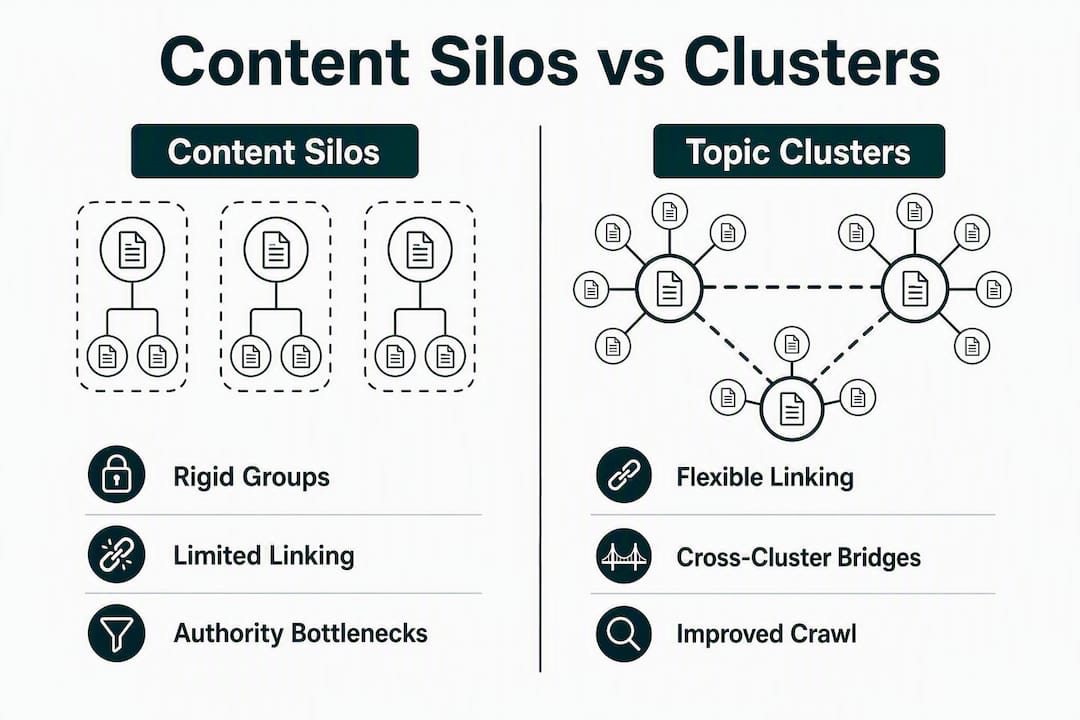
The practical differences between strict silos and topic clusters come down to flexibility, link equity flow, and how well each model scales.
Strict folder silos:
- Links stay within the folder; cross-topic linking is prohibited or heavily restricted.
- URL structure carries the organizational logic, which creates migration risk if the structure needs to change.
- Editorial governance is simple but brittle; exceptions accumulate over time.
- Works for very small, stable sites with a single tightly scoped topic.
Topic clusters (pillar + supporting pages):
- Topic clusters outperform rigid folder-based silos for mid-to-large sites because they are flexible and easier to maintain.
- Internal links are contextual and bidirectional; a supporting page can link to the pillar and to related supporting pages in adjacent clusters.
- URL structure is cleaner and does not need to encode the full hierarchy.
- Scales without structural debt because the linking rules are based on relevance, not folder membership.
| Situation | Recommended approach |
|---|---|
| Site under 30 pages, single topic, stable content | Light silo or flat structure |
| Mid-size site (30–500 pages), multiple topics | Topic clusters with contextual bridges |
| Large site (500+ pages), diverse content types | Hybrid: strong cluster architecture + strategic cross-cluster bridges |
| Site with active crawl or indexation issues | Audit first; add bridges before any URL moves |
| High engineering risk, no redirect plan in place | Defer URL restructuring; fix links first |
For most mid-to-large sites, the right answer is a hybrid: strong topical clusters with strategic cross-cluster bridges. Dense internal linking within topical clusters and strategic cross-cluster bridges maximize both topical signals and PageRank flow. The cluster model gives you the topical clarity that silo proponents value, without the authority dams and structural debt.
How to fix an existing siloed site without breaking rankings
The safest remediation sequence moves from low-risk, high-impact changes first and defers risky URL restructuring until you have data.
Start with contextual bridges, not URL moves. Identify your highest-authority pages in each cluster and add two to five contextual internal links pointing to related pages in adjacent clusters. This is the fastest way to improve authority distribution and crawl accessibility without touching URLs. Multiple practitioner guides recommend incremental fixes rather than wholesale URL restructuring to avoid ranking loss.
Fix orphan pages next. Pull your internal link report from Screaming Frog or Sitebulb. Any page with zero or one internal link pointing to it needs immediate attention. Add links from the most relevant high-authority pages in your site, and make sure the anchor text describes the relationship clearly.
Strengthen pillar pages. Your pillar or hub pages should have the highest internal link counts on the site. If a pillar page has fewer than ten internal links pointing to it from supporting content, it is underserving its role. Add links from every relevant supporting page.
Add topic cluster navigation. Hub pages, breadcrumb navigation, and related-content modules help both users and crawlers understand the cluster structure without requiring URL changes. Breadcrumbs, rel=canonical, and structured data help search engines parse your hierarchy even when the URL structure is flat or inconsistent.
Defer URL migrations. Only restructure URLs when you have a complete 301 redirect plan, have tested the redirect chain, and have confirmed that the new structure genuinely requires a URL change to implement. Most silo problems can be resolved entirely through internal linking without touching a single URL.
| Action | Impact | Effort | Priority |
|---|---|---|---|
| Add cross-cluster contextual links | High | Low | Do first |
| Fix orphan pages (add internal links) | High | Low | Do first |
| Strengthen pillar page link counts | High | Medium | Week 1–2 |
| Add breadcrumb and hub navigation | Medium | Medium | Week 2–4 |
| Implement structured data on key pages | Medium | Medium | Week 2–4 |
| URL restructuring with 301 redirects | High risk | High | Only if necessary |
Pro Tip: Roll out link changes in staged batches rather than all at once. Change links on 20–30 pages, wait three to four weeks, and check GSC for crawl rate and impressions changes before the next batch. This gives you a clean rollback point if something unexpected happens and makes it easier to attribute ranking changes to specific link additions.
How to prove a silo is hurting your SEO
Diagnosis before remediation. Here is a numbered protocol you can run in a single afternoon.
- Pull the Coverage report in Google Search Console — Look for valid pages that are not indexed or are indexed but receive zero impressions. Cross-reference with your low-internal-link list.
Key KPIs to track throughout: indexation rate, GSC impressions, average position, organic sessions, and internal link count per page.
What SEO practitioners say about the strict silo model
The practitioner consensus has shifted clearly against rigid isolation. Selim Reggabi’s analysis of semantic cocoon failures makes the core argument plainly:
Ahrefs’ commentary on silo structure reinforces the same point from a different angle: siloing is often confused with organizing. A tidy pyramid architecture is genuinely useful. The mistake is adding the rule that silos must never link to each other, which is the part that makes no sense from a modern SEO perspective.
Common audit patterns bear this out. When practitioners audit sites that have followed strict silo rules for two or more years, they consistently find the same cluster of problems: a growing list of exception links that were added manually over time, orphan pages that nobody noticed because the silo rule prevented natural linking, and conversion pages buried at depth four or five because the folder hierarchy grew without anyone tracking click depth. The architecture that was supposed to concentrate authority has instead fragmented it.
The recommended alternative is consistent across practitioners: topic clusters with contextual bridges, audited regularly, with a minimum internal link threshold for any page considered important. Auditors commonly flag any high-value page with fewer than five internal links as under-served, regardless of its folder location. Understanding how search engines rank websites in 2026 makes clear why: entity-based ranking systems evaluate the density and quality of topical relationships, not folder membership.
Key Takeaways
Strict content silos hurt SEO primarily by blocking the contextual internal links that distribute authority, support crawlability, and signal topical depth to modern ranking systems.
| Point | Details |
|---|---|
| Orphan pages are the first warning sign | Any page with zero or one internal link is at risk of poor indexation and low authority. |
| Bridges beat URL migrations | Add contextual cross-cluster links before considering any URL restructuring to avoid ranking loss. |
| Pillar pages need strong link counts | Hub pages should receive internal links from every relevant supporting page in the cluster. |
| Measure before and after every change | Track GSC impressions, average position, and crawl frequency over 2–6 weeks per experiment batch. |
| Ranksector automates the audit | Ranksector’s AI audit tool identifies orphan pages and surfaces internal link gaps without manual crawl analysis. |
The silo debate misses the real question
Most of the silo-versus-cluster debate focuses on architecture as if structure were the primary ranking signal. It is not. The real question is whether your internal links reflect how your content actually relates to each other, or whether they reflect an organizational rule someone wrote three years ago.
Strict silos are a governance tool that got mistaken for an SEO tool. They solve a real problem, which is editorial chaos on large sites, but they solve it by restricting links, and restricting links is almost always the wrong answer for SEO. The better solution is a clear linking policy based on topical relevance, not folder membership. That policy can coexist with a clean URL hierarchy without requiring isolation.
The other thing practitioners underestimate is how quickly structural debt accumulates. A silo that looks clean at 50 pages becomes unmanageable at 500. The exception links pile up, the orphan pages multiply, and the team spends more time debating whether a link is “allowed” than whether it is useful. That governance overhead is a real cost, and it compounds.
If you are auditing a site with strict silo rules in place, the fastest diagnostic is not a crawl tool. It is asking the content team how many times in the last month they wanted to add a link but could not because of the silo rule. The answer is usually revealing.
Ranksector helps you diagnose and fix silo problems faster
Buried pages and fragmented authority are exactly the problems Ranksector’s AI audit tool was built to surface. Instead of spending a day in Screaming Frog cross-referencing crawl reports with GSC data, you get a prioritized remediation list: orphan pages ranked by potential impact, internal link gaps flagged by cluster, and pillar pages identified by authority and click depth.
Ranksector also automates internal linking suggestions as new content publishes, so the structural debt that accumulates under strict silo rules does not build up in the first place. For teams managing hundreds of pages without the bandwidth for weekly manual audits, that automation is the practical alternative to hiring a dedicated technical SEO. Run your first audit at ranksector.com/free-tools and see exactly which pages on your site are under-linked today.
Useful sources and further reading
- SEO Silo Structure: Why It Makes No Sense (And What to Do Instead) — Ahrefs
- Silo SEO: Website structure that ranks in 2026 — HubSpot
- What Are Data Silos and Why Is It a Problem? — Salesforce
- Google Search Central: SEO Starter Guide — Google Developers
- Screaming Frog SEO Spider — crawl depth, internal links, orphan page detection
- Sitebulb — log file analysis and internal link visualization
- Ranksector AI Audit — automated orphan page detection and internal link gap analysis
Recommended
- How Keyword Cannibalization Affects Rankings in 2026 · Ranksector Blog — Ranksector
- SEO Content Types for Small B2B SaaS Teams in 2026 · Ranksector Blog · Ranksector
- Why Keyword Intent Matters in Competitive SEO · Ranksector Blog · Ranksector
- Types of SEO Quick Wins for Faster Rankings in 2026 · Ranksector Blog — Ranksector