
How to Steal Competitor SEO Strategy Steps in 2026
The most direct path to better rankings is already mapped out by your competitors. Every page they rank for, every backlink they’ve earned, every content cluster they’ve built — it’s all publicly visible. The process of systematically analyzing and adopting those proven tactics is what practitioners mean when they talk about reverse engineering a competitor’s SEO approach.
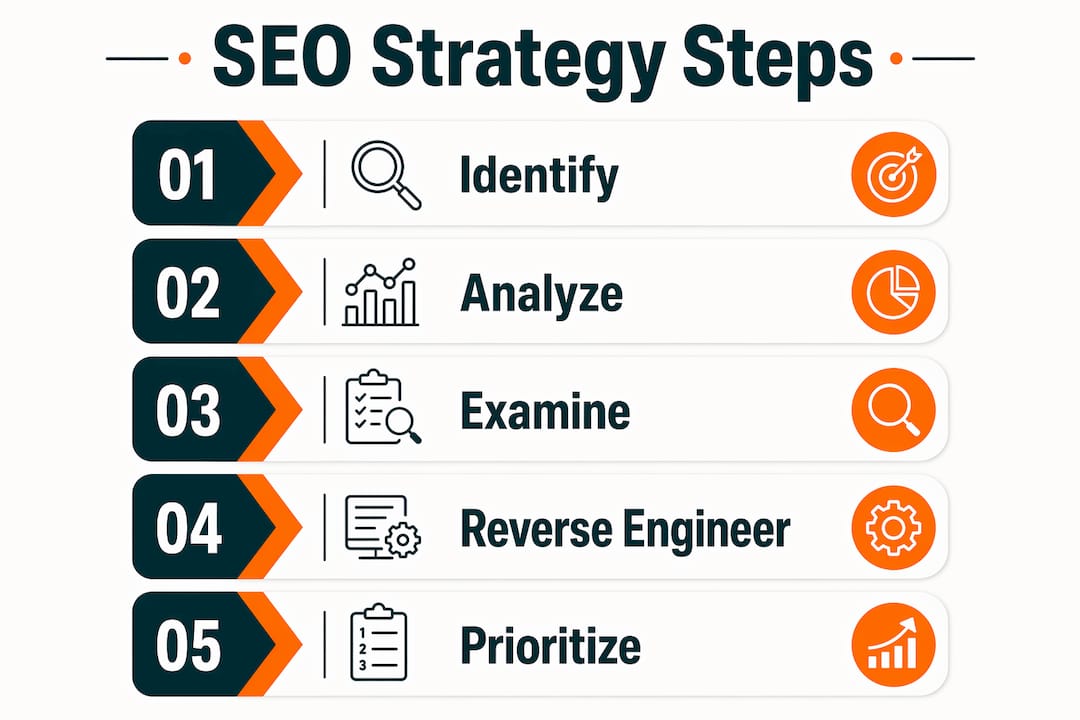
Here’s the core sequence:
- Identify real SEO competitors using SERP data, not business assumptions
- Audit their Google Business Profiles and online reputation signals
- Analyze website structure, on-page elements, and technical SEO factors
- Examine backlink profiles and local citations at the page level
- Reverse engineer content and keyword strategies to find winnable gaps
- Prioritize your actions into a 90-day sprint plan
- Run AI visibility audits to capture queries where no competitor is cited yet
Each step builds on the last. Skip one and your analysis has blind spots. Work through all of them and you end up with a ranked list of opportunities your competitors have already validated.
Table of Contents
- 1. How to identify your real SEO competitors online
- 2. Analyzing competitors’ website structure and on-page SEO
- 3. Examining backlinks and local citations to gauge off-page strength
- 4. Reverse engineering competitors’ content and keyword strategies
- 5. Prioritizing and planning your SEO actions based on competitor insights
- 6. Expert insights and advanced strategies for competitor SEO analysis
- Key Takeaways
- Ranksector turns competitor insights into published content, daily
1. How to identify your real SEO competitors online
Your actual SEO competitors are rarely who you think they are. The business you consider your main rival might barely appear in organic search, while a content site you’ve never heard of is taking traffic from your best keywords every day.
The most reliable method is keyword-based identification. Search your top ten money keywords in Google and list every domain that appears on the first two pages consistently. Those are your real SEO competitors, regardless of whether they sell the same product or service. A four-list competitor framework combines client-stated rivals, organic SERP competitors, AI search competitors, and business-model competitors into a master list of 5–15 prioritized rivals.
Beyond Google, check AI search platforms directly:
- Query ChatGPT, Perplexity, and Claude with your priority keywords
- Note which domains get cited repeatedly
- Flag queries where no competitor appears — those are AI visibility gaps worth targeting immediately
To filter noise, score each domain by frequency of SERP overlap and strategic relevance. A site appearing for three of your keywords matters less than one appearing for thirty. Once you have your shortlist, audit each competitor’s Google Business Profile: check their review count, average rating, response patterns, and category selections. Local SEO strength shows up here before it shows up anywhere else.
Pro Tip: Most practitioners over-rely on initial keyword tool outputs. Expand your competitor mapping to problem-aware and education queries — these often reveal “invisible competitors” capturing top-of-funnel traffic you’re missing entirely.
2. Analyzing competitors’ website structure and on-page SEO

Once you know who you’re competing against, the next step is understanding how their sites are built. Site architecture tells you a lot about how a competitor has organized their topical authority. A flat structure with short URL paths and dense internal linking usually signals a deliberate SEO strategy. Deep hierarchies with orphaned pages often signal opportunity.
Walk through their top-ranking pages and assess:
- URL depth and structure: Are their best pages two clicks from the homepage or buried five levels deep?
- Internal linking patterns: Do they funnel link equity toward money pages, or is it scattered?
- Meta tags and headings: Are H1s keyword-specific? Do meta descriptions match search intent?
- Schema markup: Check for FAQ schema, HowTo schema, and Product schema using a browser extension like Schema Markup Validator
Content format is equally telling. Analyzing content format and depth helps you replicate effective structures and fill gaps your competitors missed. Note whether their top pages use comparison tables, numbered lists, video embeds, or original data. These aren’t stylistic choices — they’re signals about what Google rewards for a given query type.
On the technical side, compare Core Web Vitals using PageSpeed Insights. An LCP under 2.5 seconds is the threshold that separates competitive pages from lagging ones. If a competitor’s top page loads in 1.8 seconds and yours loads in 4.2, that gap is contributing to their ranking advantage in a measurable way. Fix the performance delta before you worry about content depth.
3. Examining backlinks and local citations to gauge off-page strength

Backlink analysis is where most people make the same mistake: they pull domain-level reports and get overwhelmed by the volume. The more useful approach is page-level backlink exports, which show you exactly which content types earn authoritative links. A competitor’s homepage might have 800 referring domains, but their pricing comparison page might have 40 links from high-DR publications — and that’s the page you actually need to understand.
Work through this sequence:
- Export backlinks for each competitor’s top 10–15 ranking pages, not their domain
- Identify referring domains that link to two or more competitors but not to you — these are your highest-priority outreach targets
- Categorize link acquisition methods: editorial mentions, guest posts, digital PR placements, resource page inclusions
- Check anchor text distribution for naturalness; over-optimized anchor profiles signal risky tactics worth avoiding
For local SEO, citations matter separately from backlinks. Check whether competitors are listed consistently across Google Business Profile, Yelp, industry directories, and local chamber of commerce sites. Inconsistent NAP (name, address, phone) data across citations is a common weakness you can exploit by building a cleaner, more consistent local presence.
Domain Rating and referring domain count give you a baseline for the authority gap you’re working against. If a competitor has 400 referring domains and you have 80, you won’t close that gap in a quarter. But you can identify the 15–20 domains linking to them that you could realistically earn links from, and that’s where your outreach list starts.
4. Reverse engineering competitors’ content and keyword strategies
Keyword gap analysis tells you what competitors rank for that you don’t. Content gap analysis goes further: it identifies entire topic clusters and formats they’ve covered that you haven’t touched. Both matter, but the role of competitor content in SEO strategy is often underestimated until you see how much traffic a single well-built content cluster can generate.
Pull each competitor’s full keyword footprint using a tool like Ahrefs or Semrush. Filter for:
- Long-tail keywords with low difficulty and clear commercial or informational intent
- Secondary keywords their top pages rank for beyond the primary target
- Keyword clusters where they’ve built multiple supporting pages around a pillar topic
One structural insight from DataWise SEO’s analysis framework is worth applying directly: a list of 340 gap keywords might collapse to 18 content clusters, each addressable with one pillar page plus 2–5 supporting articles. The cluster is the unit of work, not the individual keyword. Ahrefs research shows that 45–60% of a page’s organic traffic comes from keywords other than the primary target, which means clustering captures traffic your competitor earns that doesn’t even appear in a standard gap report.
Look specifically for “dead-star” pages: competitor content that once ranked well but is now losing momentum due to age, thin coverage, or outdated information. Identifying and exploiting dead-star pages with fresher, deeper, better-structured content is one of the fastest ways to capture rankings without building authority from scratch. Also check whether competitors have published original research or proprietary data — these pages tend to earn disproportionate links and are worth benchmarking against.
Pro Tip: Use AI tools like ChatGPT or Claude to cluster your keyword gap list by intent and topic. Feed in 50–100 gap keywords and ask for groupings by user journey stage. It cuts hours of manual sorting down to minutes.
5. Prioritizing and planning your SEO actions based on competitor insights
Raw competitor data doesn’t move rankings. A prioritized plan does. The 80/20 rule applied to SEO means roughly 20% of your opportunities will drive 80% of your traffic and authority gains. The job at this stage is identifying that 20% and sequencing it into sprints.
Score every opportunity across three axes: estimated traffic if won, difficulty relative to your current authority, and strategic fit with revenue goals. Keep the top 30 opportunities and group them into six sprints of five each. Then sequence the work:
- Days 1–14: Merge your keyword gap list, overlap close-gap candidates, and content clusters into one master opportunity table. Rank and assign sprint slots.
- Days 15–45: Close overlap gaps first. These are pages already ranking where targeted improvements can move them up quickly. Expect 40–70% of these pages to shift within six weeks.
- Days 46–75: Ship gap content in priority clusters. Build the pillar page plus supporting articles for your top three clusters, with internal links connecting them.
- Days 76–90: Rerun the competitor analysis. Measure what moved, what’s stuck, and what new gaps competitors have created by publishing during the quarter.
Convert your findings into three working documents: a keyword target list ranked by opportunity score, a link outreach list of referring domains linking to competitors but not you, and a content update plan for existing pages with freshness or depth gaps.
Pro Tip: Run an AI visibility audit before finalizing your sprint plan. Queries where no competitor appears in ChatGPT or Perplexity citations are blue-ocean opportunities — you can capture them with well-structured, authoritative content before the space gets crowded.
6. Expert insights and advanced strategies for competitor SEO analysis
The practitioners who get the most out of competitor analysis tend to do a few things differently from the standard playbook.
Multi-surface competitor mapping is the first. Most guides tell you to search Google and list who appears. The more complete approach combines four lists: what your clients say, what SERPs show, what AI platforms cite, and what business-model analysis reveals. Each list surfaces different rivals. A master competitor list of 5–15 domains weighted by SERP overlap, AI citation frequency, and strategic relevance gives you a far more accurate picture of who you’re actually competing against across all discovery surfaces.
AI citation auditing is the second. Checking ChatGPT, Claude, and Perplexity for your priority queries isn’t optional anymore. AI search visibility is a distinct traffic source, and the domains that dominate it often differ from traditional organic leaders. Queries where no competitor is cited represent genuine blue-ocean opportunities — you can claim that space with authoritative, well-structured content before others notice the gap.
Prioritization matrices separate advanced practitioners from beginners. Rather than treating all opportunities equally, segment them into categories:
- Shared wins: Keywords where you and competitors both rank but you’re lower — fastest to improve
- Client losses: Queries competitors win that you don’t appear for at all — requires new content or significant upgrades
- Blue-ocean gaps: Queries nobody covers well, especially in AI search — highest long-term leverage
The dead-star content tactic deserves specific attention here. When a competitor’s page was strong two years ago but hasn’t been updated since, it’s vulnerable. A fresher, deeper page on the same topic with current data, better structure, and stronger internal linking can outrank it within weeks, not months. Spotting these pages requires checking competitors’ publication and update dates alongside their current ranking trajectories.
Finally, keyword gap analysis at the cluster level rather than the individual keyword level is what separates a 90-day plan that compounds from one that plateaus. Build topical authority around clusters, not isolated pages, and your wins reinforce each other.
Key Takeaways
Reverse engineering a competitor’s SEO strategy works because every ranking signal they’ve earned is publicly visible — your job is to observe the patterns, identify the gaps, and execute a better version.
| Point | Details |
|---|---|
| Start with real competitors | Use SERP data and AI search citations to build a 5–15 domain competitor list, not business assumptions. |
| Audit all three SEO layers | Analyze on-page structure, backlink profiles, and AI citation presence together for a complete picture. |
| Work at the cluster level | Group keyword gaps into content clusters; each cluster drives more traffic than isolated individual pages. |
| Apply the 80/20 framework | Score opportunities by traffic potential, difficulty, and strategic fit, then focus effort on the top 20%. |
| Ranksector automates the execution | Ranksector publishes daily SEO-optimized articles driven by competitor keyword analysis, turning your gap list into live content without manual effort. |
Ranksector turns competitor insights into published content, daily
Doing the analysis is one thing. Executing on it consistently is where most teams stall. You can map every keyword gap, identify every dead-star page, and build a perfect 90-day sprint plan — and still fall behind if you can’t publish fast enough to act on what you found.
Ranksector is built for exactly this situation. Rather than handing you another dashboard to manage, it takes the competitor keyword research and turns it into daily, SEO-optimized articles published directly to your blog. The platform combines competitor-driven keyword research with a backlink exchange system, so your domain authority grows alongside your content volume. With over 11,000 articles already published across B2B SaaS clients, the results show up in domain rating increases that typically take agencies months to produce manually.
For small teams without a dedicated content operation, this is the difference between a competitor analysis that sits in a spreadsheet and one that actually closes the gap. See what Ranksector can do for your content pipeline at ranksector.com/product/agency.
Recommended
- How Competitor SEO Research Works: 2026 Guide · Ranksector Blog — Ranksector
- What Is the SEO Competitive Landscape in 2026? · Ranksector Blog — Ranksector
- Competitive SERP Analysis Best Practices for SEO Teams · Ranksector Blog — Ranksector
- Monitor Competitor Keyword Rankings: 2026 Guide · Ranksector Blog — Ranksector