
Search Volume's Role in Keyword Selection: 2026 Guide
Search Volume’s Role in Keyword Selection: 2026 Guide
Search volume is defined as the average number of times a keyword is searched within a given month, and it serves as the primary demand signal in keyword research. The role of search volume in keyword selection is to quantify audience interest so you can prioritize which topics deserve your content investment. But volume alone is not a traffic guarantee. Google Keyword Planner and similar tools report monthly search volume (MSV) as a 12-month rolling average, which means the number reflects historical demand, not a live pulse. Effective keyword selection strategies treat volume as one input alongside search intent, ranking difficulty, and click availability.
How does search volume influence keyword prioritization?
Search volume sets a demand floor. It tells you the minimum size of the audience actively searching for a topic, which helps you avoid investing in content nobody wants. A keyword with zero monthly searches is a dead end regardless of how well you rank for it.

The problem starts when marketers treat volume as the only signal. High-volume keywords often carry mixed intent, meaning the same query attracts users at completely different stages of the buying process. Mixed intent produces unstable rankings and low engagement because your content cannot satisfy everyone searching that term.
Volume trends matter as much as raw numbers. A keyword showing 1,200 monthly searches with a rising trend over six months is a better bet than one showing 5,000 searches in steady decline. Trend data, available through tools like Google Trends, reveals whether demand is growing or fading before you commit to a content series.
- High-volume keywords (10,000+ monthly searches): Dominated by established domains, expensive to rank for, and often informational with low commercial value
- Mid-volume keywords (400–2,400 monthly searches): The sweet spot for most sites; intent is clearer and competition is manageable
- Low-volume long-tail keywords (50–500 monthly searches): Ideal for new sites; higher conversion rates and less competition
Pro Tip: Sort your keyword list by intent first, then filter by volume. You will find far more usable targets than if you sort by volume alone.
What are the limitations of relying on raw search volume?
Raw search volume overstates what you will actually receive in organic traffic. Search volume is a trailing metric averaged over 12 months, so it reflects where demand was, not where it is heading. Seasonal spikes get smoothed out, and emerging trends get underreported until they gain enough history.
The bigger structural problem is zero-click search. AI Overviews, featured snippets, and knowledge panels answer queries directly on the results page. Users get what they need without clicking any result. Effective volume accounts for organic clicks after adjusting for these SERP features, and the reduction can be dramatic.
Consider what the click data actually shows:
- Position 1 captures 20–30% of clicks on a standard SERP. That number drops sharply when a featured snippet or AI Overview sits above organic results.
- Position 5 captures only 5–10% of clicks. A keyword showing 10,000 monthly searches might deliver fewer than 500 visits even if you rank fifth.
- Zero-click results eliminate traffic entirely for queries answered by SERP features, regardless of your ranking position.
- Volume does not measure difficulty. A keyword with 2,000 monthly searches could require years of link building to rank for, or it could be winnable in weeks. Volume gives you no signal on that.
“Chasing high-volume keywords without matching intent is the most expensive SEO mistake a marketer can make.” The cost is not just wasted content production. It is the opportunity cost of every mid-volume, intent-aligned keyword you ignored while chasing a number.
Volume also says nothing about commercial relevance. A keyword searched 50,000 times per month by people who will never buy your product is worth less than a keyword searched 500 times by buyers ready to convert.
How has AI changed the way we interpret search volume?
AI search interfaces have created a demand layer that traditional keyword tools cannot see. ChatGPT, Gemini, and Google AI Overviews absorb queries that never appear in keyword tool databases. When someone asks ChatGPT a question instead of typing it into Google, that query generates real demand but produces zero data in your keyword research platform.
This means the volume figures you see in keyword tools are now a floor estimate, not a ceiling. The true demand for many topics is higher than reported, but you cannot see the AI-driven portion of it. For digital marketers, this changes how you interpret low-volume keywords. A keyword showing 300 monthly searches in a tool might represent thousands of additional queries happening inside AI chat interfaces.
Practical implications for your keyword strategy:
- Evaluate click availability before committing. Run the keyword in a browser and count how many organic results appear above the fold without SERP features blocking them.
- Prioritize “clean” SERPs. Keywords where organic blue links dominate the results page offer more realistic traffic potential than those buried under AI Overviews and featured snippets.
- Track AI-driven topics separately. Topics that generate heavy AI chat traffic often show artificially low MSV in traditional tools. Cross-reference with search trend shifts to spot the gap.
- Recalibrate volume thresholds. What counted as “low volume” in 2022 may represent substantial real-world demand in 2026 once AI query volume is factored in.
The hidden demand layer in AI search is not a reason to abandon volume data. It is a reason to treat volume as a starting point rather than a final verdict.
What balanced framework should marketers use for keyword selection?
Search volume should never be the sole factor in keyword selection. A composite scoring approach evaluates each keyword across four dimensions: volume, intent, difficulty, and click availability. This produces a ranked list where the top keywords offer the best combination of demand, ranking feasibility, and actual traffic potential.
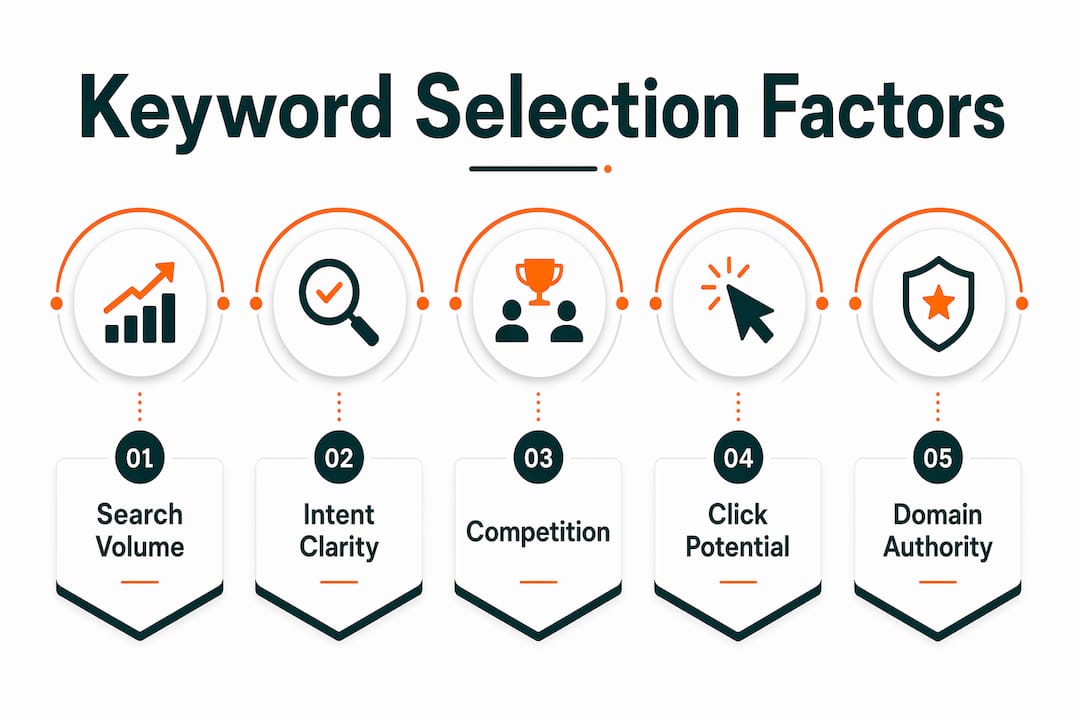
Here is how each factor interacts in practice:
| Factor | What it measures | Why it matters |
|---|---|---|
| Search volume | Monthly demand size | Sets the opportunity ceiling |
| Search intent | User goal behind the query | Determines content format and conversion fit |
| Ranking difficulty | Competition level for the keyword | Predicts how long ranking will take |
| Click availability | Organic clicks after SERP features | Estimates realistic traffic capture |
| Commercial relevance | Buyer intent and revenue potential | Connects rankings to business outcomes |
Mid-tier keywords with 400–2,400 monthly searches matched to clear search intent outperform both high-volume vanity terms and niche intent-only keywords by 2.8x to 4.1x in revenue per ranking page. That gap exists because mid-volume keywords attract users with specific needs, which means your content can satisfy them precisely. Broad head terms attract everyone and convert almost no one.
Calibrate your volume thresholds to your domain authority. A site with a domain rating below 30 has no realistic path to ranking for a keyword with 50,000 monthly searches in a competitive niche. Targeting keywords in the 200–1,000 monthly search range gives that site a path to traffic and authority building simultaneously.
Pro Tip: Build a simple scoring spreadsheet. Assign each keyword a score from 1 to 5 on volume, intent clarity, difficulty (inverted), and click availability. Sum the scores. The keywords at the top of that list are your best investments.
How to apply search volume data in your 2026 keyword research
Applying volume data well requires combining tool output with manual SERP analysis. No single tool gives you the complete picture, and common keyword research mistakes almost always involve trusting one data source without verification.
- Cross-reference volume across multiple tools. Different platforms use different data sources, so a keyword showing 1,000 searches in one tool might show 400 in another. Use the lower figure as your conservative estimate.
- Focus on long-tail keywords for new or smaller sites. New websites succeed faster by targeting keywords with 50–500 monthly searches rather than competing for head terms dominated by established domains.
- Review SERP features manually. Before finalizing any keyword, search it in an incognito browser. Count the organic results visible without scrolling. If fewer than three appear above the fold, click availability is low regardless of the volume figure.
- Match content format to intent. Informational keywords with high volume call for long-form guides. Transactional keywords with lower volume call for product pages or comparison content. Volume tells you the size of the audience; intent tells you what to build for them.
- Update your keyword list quarterly. Volume data shifts. A keyword that showed 200 monthly searches in january may show 800 by july if the topic gains traction. Regular reviews prevent you from missing rising opportunities.
Pro Tip: When you find a keyword with strong intent and low volume, check whether AI Overviews appear for it. If they do not, that keyword likely has cleaner click availability than its volume suggests. That is a hidden opportunity most competitors will overlook.
Understanding search volume impact also means knowing when to ignore it. A keyword with 50 monthly searches that maps perfectly to a high-value buyer persona can outperform a 5,000-search term that attracts casual browsers. The connection between AI query behavior and traditional volume data makes this even more true in 2026.
Key Takeaways
Search volume is a demand signal, not a traffic guarantee, and effective keyword selection requires scoring each term across volume, intent, difficulty, and click availability together.
| Point | Details |
|---|---|
| Volume is a floor, not a ceiling | AI search interfaces generate hidden demand that keyword tools do not capture. |
| Mid-volume keywords convert best | Keywords with 400–2,400 monthly searches matched to intent outperform extremes by up to 4.1x in revenue per page. |
| Zero-click SERPs reduce effective volume | SERP features can cut organic clicks by 50% or more even for top-ranked pages. |
| Composite scoring beats volume-only methods | Evaluate every keyword on volume, intent, difficulty, and click availability before committing. |
| New sites should target long-tail terms | Keywords with 50–500 monthly searches offer lower competition and higher conversion rates for smaller domains. |
Search volume is a compass, not a scoreboard
I have reviewed hundreds of keyword strategies over the years, and the pattern is almost always the same. Marketers start with a volume filter, set a floor of 1,000 monthly searches, and discard everything below it. Then they wonder why their content ranks but does not convert.
The search volume as a compass framing is the one I keep coming back to. A compass tells you which direction demand exists. It does not tell you how fast you will get there, what obstacles are in the way, or whether the destination is worth reaching. That is exactly what volume data does. It points. You still have to evaluate the path.
What I find most underappreciated is the AI demand gap. Traditional tools are now systematically undercounting interest in topics that get heavy AI chat traffic. Marketers who treat a 200-search keyword as low-priority may be ignoring a topic that thousands of people are actively researching inside ChatGPT or Gemini. That gap will only widen.
My honest advice: stop optimizing for volume and start optimizing for fit. The best keyword for your site is the one where your content can rank, the SERP offers real click potential, and the user arriving has a reason to care about what you sell. Volume is one input in that equation. Treat it accordingly.
— Savannah
Ranksector’s approach to smarter keyword evaluation
Keyword research that accounts for volume, intent, and click availability is complex to do manually at scale. Ranksector’s free SEO tools give digital marketers a faster path to keyword evaluation that goes beyond raw volume numbers.
Ranksector combines AI-driven keyword research with competitor analysis to surface mid-volume, intent-aligned keywords your site can realistically rank for. The platform’s AI audit tool analyzes your existing content against keyword opportunity, identifying gaps where search demand exists but your site has no coverage. For teams managing content at scale, Ranksector’s agency product integrates volume data with SERP analysis to prioritize keywords that deliver traffic, not just rankings. Over 11,000 articles published through the platform demonstrate what consistent, data-informed content production looks like in practice.
FAQ
What is search volume in keyword research?
Search volume is the average number of monthly searches for a keyword, reported as a 12-month rolling average. It measures demand but does not predict traffic or conversions on its own.
Why does high search volume not guarantee traffic?
SERP features like AI Overviews and featured snippets reduce organic clicks significantly. Position 1 captures only 20–30% of clicks, and that share drops further when SERP features appear above organic results.
What is the best search volume range for a new website?
New sites perform best targeting keywords with 50–500 monthly searches. These terms have lower competition and higher conversion rates than high-volume head terms dominated by established domains.
How does AI search affect keyword volume data?
AI interfaces like ChatGPT and Gemini handle queries that never appear in keyword tools, making reported volume figures a floor estimate of true demand. Real interest in many topics is higher than tools show.
What factors should I combine with search volume when selecting keywords?
Effective keyword selection scores each term on search intent, ranking difficulty, click availability, and commercial relevance alongside volume. Composite scoring frameworks consistently produce better revenue outcomes than volume-only approaches.
Recommended
- Why Keyword Research Drives Content Decisions in 2026 · Ranksector Blog — Ranksector
- Rank for Competitor Traffic Keywords: 2026 SaaS Guide · Ranksector Blog — Ranksector
- Find Untapped Keywords: Competitor Research Guide · Ranksector Blog — Ranksector
- Common Keyword Research Mistakes Businesses Make in 2026 · Ranksector Blog — Ranksector