
Apply Google’s Quality Rater Guidelines in 15 Minutes for SEOs
The Search Quality Rater Guidelines are the official manual Google gives to its human evaluators for judging search result quality. You can download the full document as a PDF directly from Google, and a consolidated version lives on Search Central’s rater hub. Below, you’ll find both sources, how the rating process actually works, and how to turn it into a working content audit.
TL;DR:
- The guidelines emphasize the importance of assessing a page’s purpose, harm potential, and quality of its main content independently from auxiliary elements.
- Raters evaluate reputation signals by checking external, credible sources rather than trusting self-descriptions or claims made on the website.
- The Needs Met score reflects how effectively a page satisfies a specific user query, with a narrow “fully meets” standard for exact matches in navigational searches.
- Google’s evaluation system is designed as a feedback tool for algorithm testing, meaning individual rater scores do not directly influence rankings.
- To improve SEO, content audits should focus on clarifying purpose, strengthening authority signals, and ensuring content genuinely meets user intent across multiple query variations.
Table of Contents
- What Are the Quality Rater Guidelines and Where Do You Download Them?
- How Page Quality (PQ) Rating Actually Works
- What Is the Needs Met Rating and Why Does It Matter?
- E-E-A-T: Turning an Acronym Into Evidence
- Who Are the Search Quality Raters, and How Does Their Work Get Used?
- How the Guidelines Change: Recent Updates and the Revision Process
- Turning the Guidelines Into an SEO Audit Checklist
- How to Navigate the Official PDF Without Reading All 170-Plus Pages
- Where to Download and Cite the Official Guidelines
- How Ranksector Applies the Guidelines at Scale
- The Gap Between Reading the Guidelines and Applying Them
- Sources
- FAQ
What Are the Quality Rater Guidelines and Where Do You Download Them?
Two official PDFs matter here, and they’re not identical. The Search Quality Rater Guidelines: An Overview is Google’s own condensed explainer, built for people who want the core concepts without wading through hundreds of pages. The General Guidelines document, hosted on the raterhub domain, is the full working manual raters actually use day to day, complete with Page Quality (PQ) rating scales, Needs Met (NM) instructions, and dozens of annotated example pages.
If you’re auditing your own site, start with the raterhub version. It’s longer, but it’s the one that shapes actual rater judgments, and it gets revised on a rolling basis rather than staying static.
A few things worth knowing before you open either file:
- The raterhub PDF carries a revision date on its cover page. Check it every time you download, since Google updates the document without much fanfare.
- Google’s Search Central blog posts a changelog whenever a meaningful update lands, usually summarizing what changed and why.
- The 2021 overview post from Google’s own blog explains the guidelines’ purpose in plain language, which helps if you’re introducing this concept to a team that’s never seen the PDF before.
- Bookmark the Search Central blog’s search-quality tag rather than the PDF link alone. Updates sometimes ship quietly, and the blog is where Google explains the reasoning.
One practical habit: save the date stamp from your last download somewhere in your audit notes. When you revisit your checklist in six months, you’ll know immediately whether you’re working from a stale copy.
How Page Quality (PQ) Rating Actually Works
Page Quality rating is the core task raters perform on almost every page they review, and it follows a rough sequence rather than a single snap judgment.
Step 1: Determine the page’s purpose. Raters ask what the page is trying to do for the person who lands on it. A recipe page, a product listing, and a news article all get judged against different expectations, but every page needs a purpose that’s beneficial to visitors rather than purely self-serving.
Step 2: Assess potential harm. Before anything else, raters check whether the page could cause harm to the reader’s health, finances, safety, or well-being. This step alone can override everything that follows.
Step 3: Evaluate Main Content (MC) quality. MC is the part of the page that directly serves its purpose: the article body, the product description, the actual recipe steps. Everything else, navigation menus, ads, related-post widgets, footers, counts as Supplementary Content (SC). Raters are trained to isolate the MC mentally and judge it on its own merits, since a page can have excellent MC buried under distracting or excessive SC.
Step 4: Research the creator’s and website’s reputation. This is the step most SEOs underestimate. Raters are instructed to look outside the page itself, checking independent sources like news coverage, professional references, and third-party reviews rather than trusting an “About” page’s self-description, a practice detailed in the rater overview.
The PQ rating itself runs on a slider from Lowest to Highest, with these rough bands:
- Lowest: harmful, deceptive, or spam content, or pages with no discernible beneficial purpose.
- Low: thin MC, poor expertise signals, or a mismatch between the page’s stated purpose and what it actually delivers.
- Medium: adequate MC that satisfies the purpose without excelling at authority or depth.
- High: strong MC backed by clear expertise, satisfying reputation signals, and a well-served purpose.
- Highest: exceptional MC combined with verified expertise and a strong, well-documented reputation, often reserved for recognized authorities on YMYL-adjacent topics.
Pro Tip: Isolate your own MC before you judge it. Print your article with the navigation, sidebar, and related-posts widget stripped out. If the remaining text feels thin once the visual clutter is gone, a rater would likely flag it the same way.
What Is the Needs Met Rating and Why Does It Matter?
Needs Met (NM) rating asks a different question than PQ. Instead of judging the page in isolation, it asks whether a specific result satisfies a specific user’s intent for a specific query. A page can carry a high PQ score and still get a low NM rating if it answers the wrong question.
The scale runs from Fails to Meet up through Fully Meets, and the top category is narrow by design. A result that “fully meets” a query has to satisfy the user immediately and completely, without sending them back to the results page, according to the official guidelines. Google’s own example: a navigational query for a specific brand’s homepage is fully met only by that exact homepage; a lookalike page, even a good one, falls short.
A few things shape how raters apply NM in practice:
- Query interpretation comes first. Raters have to consider every plausible meaning of an ambiguous query before judging any single result against it.
- Locale changes the answer. A query rated by someone in one country, in their own language and context, can land a different NM score than the identical query judged by someone elsewhere, since local relevance is part of the test.
- Partial satisfaction still counts for something. A page that answers half of a compound query earns a middle rating rather than an automatic fail.
- NM and PQ work as a pair. A poorly written page can still fully meet a narrow, simple query, and a beautifully written page can badly miss a complex one. Google needs both scores to understand the full picture.
If you want to test your own content this way, run the exercise Ranksector’s guide on featured snippets that survive AI Overviews walks through: read your top page as if you were the searcher, and time how long it takes before you’d bounce back to the results.
E-E-A-T: Turning an Acronym Into Evidence
E-E-A-T stands for Experience, Expertise, Authoritativeness, and Trust, and raters are trained to look for concrete proof of each element rather than take a page’s word for it.
Experience asks whether the content creator has actually done the thing they’re writing about. A product review written by someone who owns the product reads differently than one assembled from spec sheets, and raters are told to notice the difference.
Expertise is about depth of knowledge, formal or otherwise. A hobbyist forum thread from someone who has fixed the same appliance fifty times can carry real expertise even without a credential attached.
Authoritativeness measures whether the site or author is a recognized go-to source on the topic, something raters verify by checking what other independent sources say about them, not just what the site claims about itself.
Trust sits at the center of the model, since a page can show experience and expertise and still fail if the information itself is unreliable, the site lacks security basics, or the content misleads readers about who’s behind it.
Here’s where raters actually look for these signals:
- Author bylines with real names, credentials, and a linked bio page.
- Citations to primary sources, studies, or named institutions rather than vague claims.
- External endorsements: press mentions, professional awards, or citations from other reputable sites.
- Clear organizational information, like a company’s physical presence, licensing, or affiliations.
Formal credentials and first-hand experience aren’t interchangeable, and the guidelines treat them differently depending on topic. A medical dosage question calls for a credentialed source; a review of hiking boots benefits more from someone who has logged actual miles in them. On Your Money or Your Life topics, financial advice, medical information, safety guidance, expectations tighten considerably, and raters are instructed to hold YMYL pages to a stricter trust standard than a hobby blog or entertainment site.
Pro Tip: Run your own site through a reputation check the way a rater would. Search your brand name plus a neutral term like “review” or “complaint” and see what independent sources actually say. That gap between your self-description and your external reputation is exactly what raters are trained to find. Ranksector’s breakdown of what E-E-A-T means in practice walks through more signal-building tactics if you want to go deeper.
Who Are the Search Quality Raters, and How Does Their Work Get Used?
Search Quality Raters are not Google employees. They work through external vendor companies, and Google structures the program so raters are matched to the language and country they’re rating for, which keeps judgments grounded in local context rather than a single cultural lens.
The scale is genuinely large: Google has cited roughly 16,000 raters working globally across languages and regions. That figure matters because it explains why the guidelines document runs so long. A rating system that has to stay consistent across 16,000 independent evaluators needs extremely specific instructions, or scores would drift wildly between raters judging the same page.
Before a rater’s scores count toward anything, they have to pass qualification tests demonstrating they can apply the guidelines consistently rather than substituting personal preference. The instructions are deliberately prescriptive for exactly this reason: strip out room for individual taste, and the ratings become comparable across a massive, distributed workforce.
Here’s the part most people misunderstand about how these ratings get used:
- Rater scores do not directly move any individual page’s ranking.
- They function as a measurement layer, telling engineers whether an algorithm change made results better or worse in aggregate.
- Google runs rater evaluations alongside experiments and A/B tests to check whether a proposed ranking change actually improves quality before rolling it out broadly, a distinction explained in Google’s overview of the rater program.
- A single rater’s judgment on your page has zero direct effect on where it ranks tomorrow.
The practical takeaway: raters are a feedback mechanism for testing the system, not a jury deciding your fate one page at a time. That distinction should change how you read every guideline in this document. You’re not trying to please one person. You’re trying to build a page that would score well across thousands of independent evaluations, which is a much more durable target.
How the Guidelines Change: Recent Updates and the Revision Process
Google revises the guidelines regularly, and the changes usually fall into one of two buckets: new content formats that didn’t exist when the last version was written, or clarifications where raters were interpreting an instruction inconsistently.
The most notable recent update landed in November 2023, when Google simplified the Needs Met rating scale and added fresh example pages reflecting how people actually search today. That update folded some of the more granular NM categories into clearer, fewer buckets, and it introduced examples built around short-form video and forum content, formats that barely registered in earlier versions of the document.
That shift reflects a broader pattern: as new content types gain search visibility, whether that’s video, forums, or something else entirely, Google has to teach thousands of raters how to judge them consistently, which means the guidelines are always playing catch-up with how the web actually looks.
A few practical notes on tracking future changes:
- The Search Central blog’s update posts are the fastest way to learn what changed without rereading the entire PDF.
- Revision dates on the raterhub PDF’s cover page are your quickest sanity check for whether you’re working from current guidance.
- Updates rarely reverse core principles like E-E-A-T or the PQ/NM split. They tend to refine examples and simplify scales rather than rewrite the philosophy.
If you cite the guidelines in your own content or training materials, note the revision date you’re referencing. A claim sourced to a two-year-old version can misrepresent current guidance, especially around Needs Met definitions that have since been simplified.
Turning the Guidelines Into an SEO Audit Checklist
Reading the guidelines is one thing. Using them to fix your own content is where the real value shows up. Here’s a prioritized sequence for running your own quality audit.
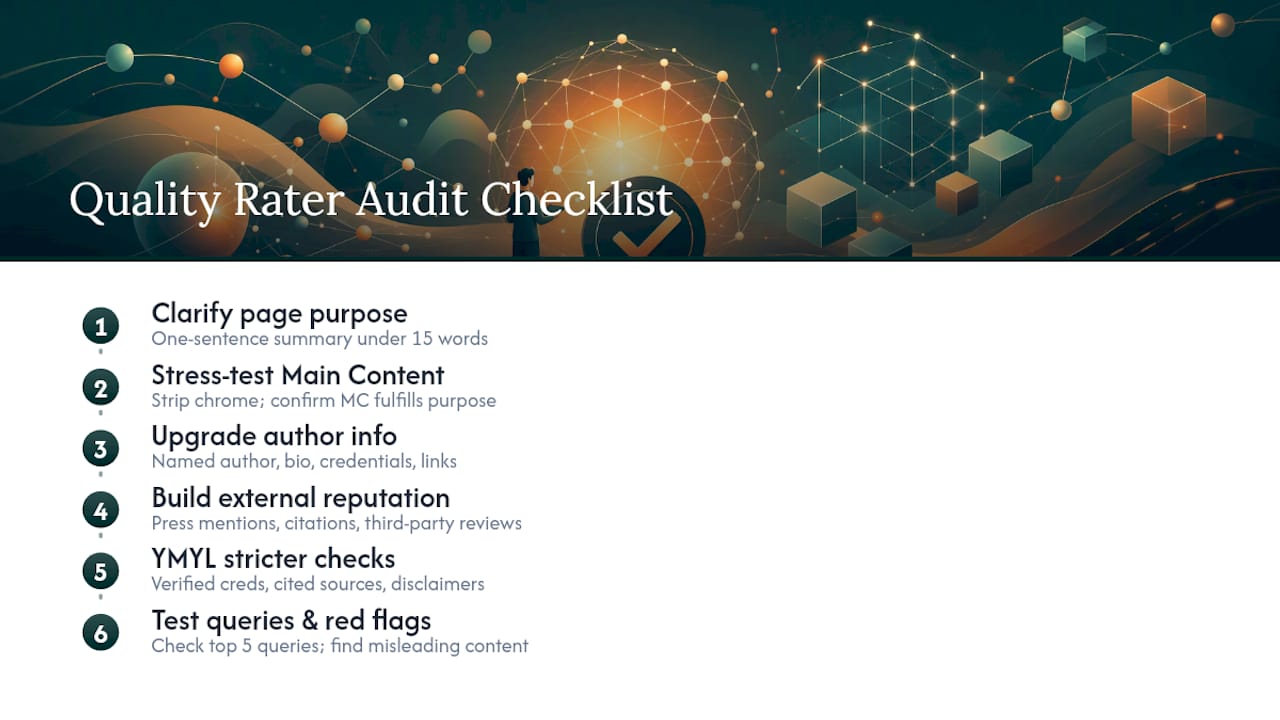
1. Clarify your page’s purpose in one sentence. If you can’t summarize what a page is supposed to do for a visitor in under fifteen words, a rater would struggle too. Rewrite the opening paragraph until the purpose is unmistakable.
2. Isolate and stress-test your Main Content. Strip out navigation, sidebars, and promotional widgets mentally, then ask if what’s left actually delivers on the page’s purpose. Thin MC surrounded by heavy Supplementary Content is one of the most common reasons otherwise reasonable pages score low.
3. Add or upgrade author information. A named author with a bio, credentials where relevant, and a link to their other work closes one of the biggest gaps between amateur and professional content. This single fix tends to produce the fastest visible improvement.
4. Build external reputation signals deliberately. Since raters are told to check independent sources rather than trust self-description, your job is making sure those independent sources exist. That means pursuing legitimate press mentions, industry citations, or third-party reviews rather than just polishing your own “About” page.
5. Run YMYL topics through a stricter checklist. If your content touches health, finances, safety, or legal matters, hold it to the higher trust bar the guidelines apply there: verified credentials, cited sources, and disclaimers where appropriate.
6. Test Needs Met against your actual target queries. Pick your five most important target queries and read your ranking page as if you were the searcher. Would you leave satisfied, or would you bounce back to Google within thirty seconds? Ranksector’s piece on why meta descriptions matter more since AI Overviews launched covers how to signal a “fully meets” answer before the click even happens.
7. Hunt for the red flags that trigger Lowest ratings. Deceptive claims, content that misrepresents who created it, aggressive ads that obscure the MC, and thin AI-generated text with no editorial oversight are the fastest routes to a bottom-tier score. Ranksector’s guide on spotting AI-generated content Google may flag breaks down what those red flags look like in practice.
8. Recheck query interpretation for ambiguous terms. If a keyword you’re targeting has multiple possible meanings, make sure your page addresses the dominant interpretation rather than a narrow reading that only makes sense to you.
Pro Tip: Don’t try to fix everything at once. Run this checklist against your ten highest-traffic pages first. Those pages carry the most exposure, and improvements there compound faster than spreading effort thin across your entire archive.
The common thread across every item on this list: raters, and by extension the systems trained on their judgments, are looking for evidence, not assertions. Claiming expertise is free. Demonstrating it, through citations, author transparency, and content that reflects actual first-hand knowledge, is what actually moves the needle described in Google’s rater guideline overview.
How to Navigate the Official PDF Without Reading All 170-Plus Pages
The full document is long, but it’s organized predictably enough that you can target exactly what you need.
The structure generally runs: front matter and purpose statement, then the PQ rating sections with the full slider and its criteria, then NM sections with the satisfaction scale, and finally a large block of annotated examples showing real (sometimes altered) search results scored against the criteria you just read.
Pick your reading path based on what you need:
- Quick skim (15 minutes): Read the purpose statement, the PQ slider definitions, and the NM scale summary. That’s enough to understand the framework.
- Focused read (45 minutes): Add the reputation-research guidance and the E-E-A-T sections, which is where most practical SEO value lives.
- Full read (a few hours): Work through the annotated examples section page by page, since these are the closest thing to seeing an actual rater’s reasoning in action.
The example pages deserve special attention. They’re not filler. Each one shows a real scoring decision with the reasoning spelled out, which makes them usable as direct test cases against your own site. Find an example closest to your content type, whether that’s a recipe, a YMYL health page, or a local business listing, and compare its stated reasoning against your own page.
Where to Download and Cite the Official Guidelines
For anyone citing this material in their own research or training documentation, these are the canonical sources:
- Search Quality Rater Guidelines: An Overview — Google’s condensed explainer PDF covering PQ, NM, and the reasoning behind the rating system.
- Search Quality Raters Guidelines update — Google’s changelog post covering the November 2023 revision.
- An overview of our rater guidelines for Search — background on why the program exists and how rater feedback fits into Google’s broader testing process.
Always cite the raterhub PDF’s cover-page revision date alongside any claim you attribute to it. Guidelines get revised, and a quote pulled from a two-year-old version can misstate current instructions, especially anything touching the Needs Met scale.
How Ranksector Applies the Guidelines at Scale
We treat the guidelines less like a reference document and more like a QA spec. Every automated article Ranksector publishes runs through checks mapped directly to the PQ and E-E-A-T signals raters are trained to look for: is the purpose of the page clear in the first few sentences, does the Main Content actually deliver on that purpose, and does the piece carry the kind of source attribution that survives a reputation check rather than reading as a generic rewrite.
That mapping has to work without a human editor touching every draft. Our workflow verifies author and source signals, checks that claims trace back to a real citation rather than an unsupported assertion, and flags thin or duplicated content before it ever reaches publication. It’s the same logic a rater applies manually, built into the content pipeline instead of left to chance.
If you want a read on how your own site’s content and technical signals stack up against these same quality principles, Ranksector’s GEO Audit checks your visibility across both traditional search and AI-driven answer engines. And if daily, guideline-aware publishing is the gap holding your content calendar back, the Pro plan runs $99 per month for fully automated, SEO-optimized articles built to hold up under exactly the kind of scrutiny this document describes.
The Gap Between Reading the Guidelines and Applying Them
Most SEOs who read the Search Quality Rater Guidelines treat it as a compliance document: a list of rules to satisfy so Google doesn’t penalize them. That framing misses the point entirely. The guidelines aren’t a punishment manual. They’re Google’s attempt to describe, in exhaustive detail, what a genuinely useful page looks like to a human being reading it cold, with no context and no loyalty to your brand.
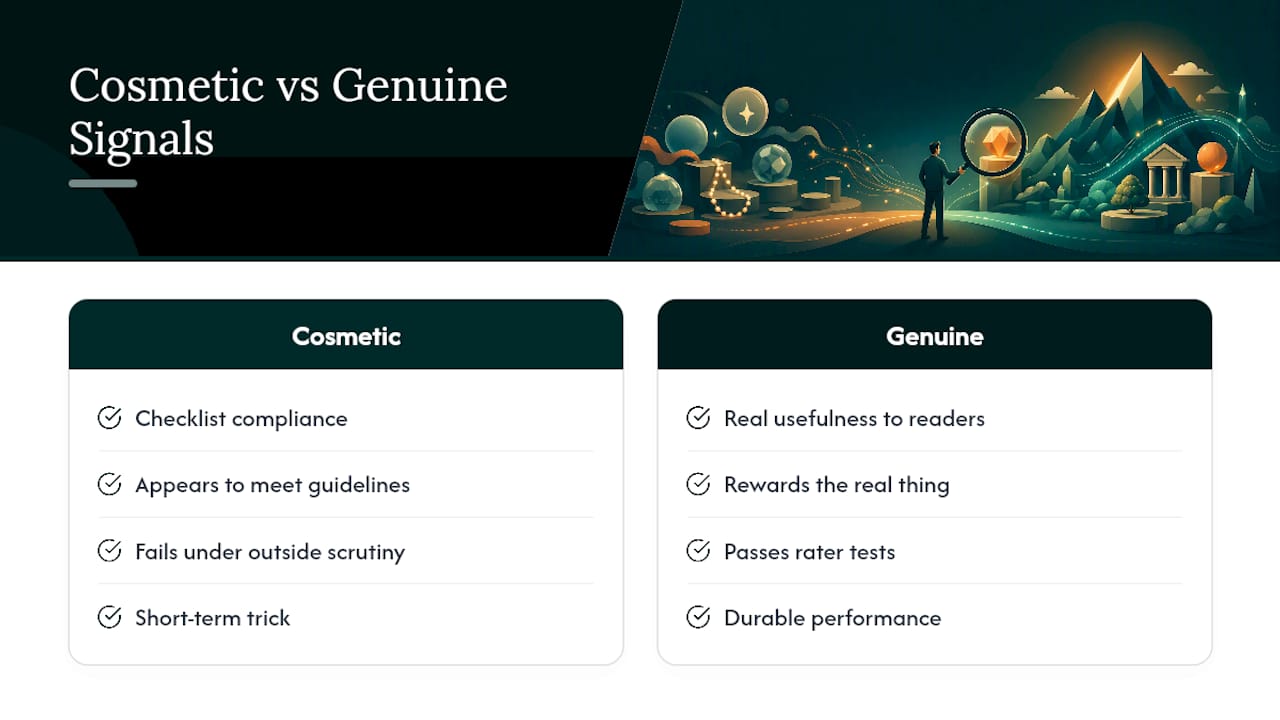
That reframing matters because it changes what you optimize for. Chasing E-E-A-T as a checklist, add an author bio, add a citation, add a credential badge, produces cosmetic compliance without the substance behind it. Raters are specifically trained to check whether reputation signals hold up under outside scrutiny, which means a fabricated author bio or a hollow “about us” page fails the same test a genuine one passes. The guidelines reward the real thing, not its appearance.
The other underappreciated point: the 16,000-rater scale isn’t a detail, it’s the whole reason the document reads the way it does. When you’re training a workforce that large to reach consistent conclusions, you can’t rely on shared intuition. You have to spell out exactly what “Main Content” means, exactly where the PQ slider’s bands sit, exactly what “fully meets” requires. That specificity is a gift to anyone auditing their own site, because it removes the guesswork most SEO advice leaves in. You don’t have to wonder what “quality content” means anymore. Google already wrote the rubric.
Where I think most content teams get it backwards is treating PQ and Needs Met as separate concerns to be optimized independently. They’re not. A page that nails Needs Met for a narrow query but carries weak PQ signals will underperform over time, because the same page gets judged against dozens of query variations, some broad, some ambiguous, and PQ is the baseline that determines how much benefit of the doubt a rater extends. Fix your Main Content and reputation signals first. Needs Met optimization on a weak foundation is a short-term trick, not a durable one.
— Savannah
Sources
- Search Quality Rater Guidelines: An Overview
- Search Quality Raters Guidelines update
- An overview of our rater guidelines for Search
FAQ
What Are Google’s Quality Rater Guidelines?
They’re the official manual Google gives to external human evaluators for judging search result quality, covering Page Quality (PQ) and Needs Met (NM) ratings with detailed criteria and examples. The full document is available as the General Guidelines PDF, with a shorter explainer in the rater overview.
What Are the General Guidelines for Search Quality Raters?
Raters follow a two-part evaluation process: Page Quality rating, which judges a page’s Main Content, purpose, and reputation on a scale from Lowest to Highest, and Needs Met rating, which judges how well a specific result satisfies a specific query’s intent. Both tasks rely on independent reputation research rather than trusting a site’s own claims about itself, as detailed in the official guidelines.
What Are SEO Guidelines Based on the Rater Guidelines?
The rater guidelines aren’t SEO rules directly, but they describe what Google’s systems are trained to recognize as quality, which makes them a practical audit framework. Clarifying page purpose, strengthening author and reputation signals, and testing whether your content fully satisfies target queries all map directly to the criteria raters use, a connection outlined in Google’s overview of the rater program.
How Do Raters Assess a Website’s Reputation?
Raters are instructed to look outside the page itself, checking independent sources like news coverage, professional citations, and third-party reviews rather than relying on what a site says about itself. This reputation research directly affects the Page Quality score a page receives, per the rater guidelines.
How Often Does Google Update the Rater Guidelines?
Google revises the guidelines periodically rather than on a fixed schedule, usually to add examples for new content formats or clarify definitions raters were interpreting inconsistently. The most notable recent revision came in November 2023, when Google simplified the Needs Met scale and added examples covering short-form video and forum content.