
How to Write a Perfect Article: A Step-by-Step Guide
A perfect article does three things: it delivers a clear promise, answers the reader’s real question fast, and stays useful enough that someone finishes it. The single habit that improves outcomes more than any other is building an outline before you write a word, then writing each section so the first sentence answers the question the heading raises.
That’s not a hunch. In the Orbit Media content and blogging survey, bloggers who outline before drafting and add 10 or more images to their posts are roughly twice as likely to report strong results. Ranksector’s own publishing process, built on more than 11,000 articles, follows the same order: outline, draft answer-first, then edit in passes. Here’s what that promise looks like in practice:
- Clear: one topic, one audience, one promise stated up front.
- Useful: every heading answers a real question instead of teasing one.
- Finished: edited in structure, clarity, and polish passes before it goes live.
Key Takeaways
| Point | Details |
|---|---|
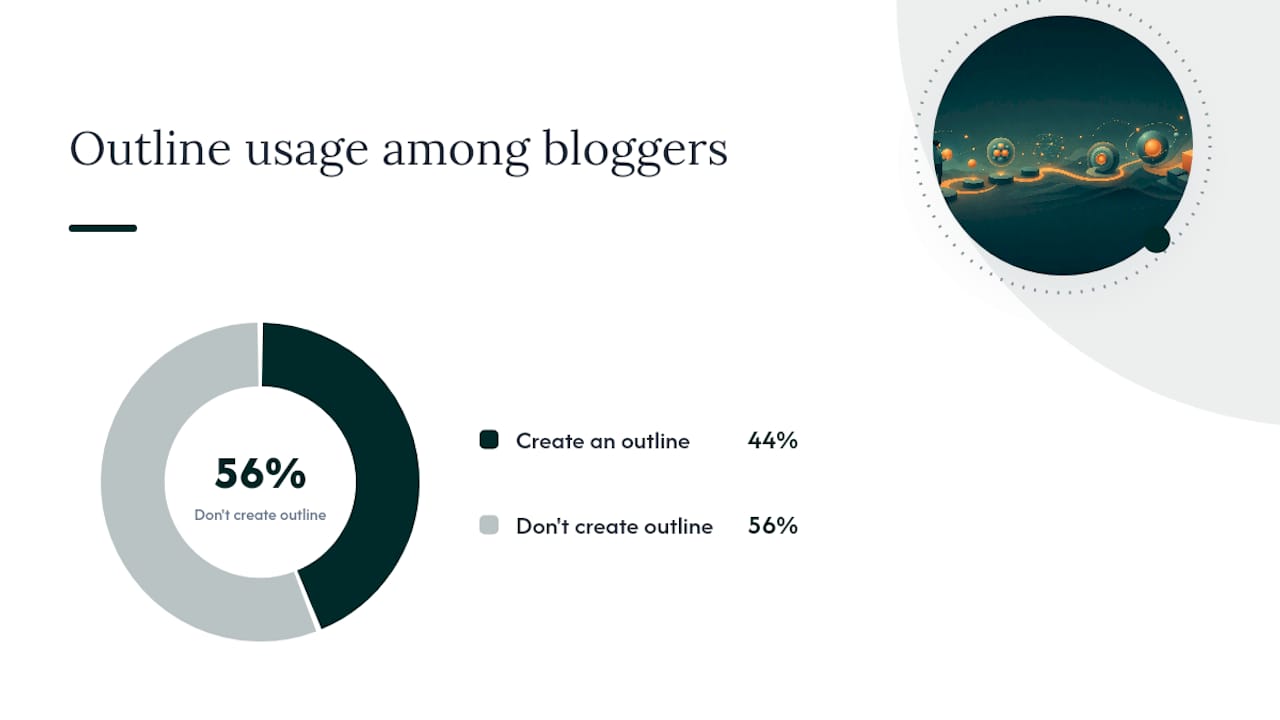
| Outline before drafting | Build headings as promises first; only 44% of bloggers do this step. |
| Answer-first sections | Open every section with the direct answer, then support it with evidence. |
| Separate drafting from editing | Draft fast with placeholders, then edit in structure, clarity, and polish passes. |
| Match visuals to text | Place roughly one image every 300 to 400 words to break up long sections. |
| Keep tone consistent | Lock in voice, terminology, and formatting choices before you start drafting. |
Table of Contents
- How Do You Pick a Topic and Promise Readers Something Specific?
- What’s the Fastest Way to Research an Article Without Getting Lost?
- How Should You Structure an Article Outline?
- How Do You Draft an Article Without Losing Momentum?
- What’s the Right Order for Editing an Article?
- What Belongs on Your SEO and Publishing Checklist?
- How Do Images and Formatting Keep Readers on the Page?
- Why Does Publisher Experience Matter for Article Quality?
- How Do You Keep Tone and Style Consistent Across an Article?
- What Mistakes Sink Most First Drafts?
- How Can Storytelling Make an Article More Memorable?
- How Should You Adjust Your Writing for Different Platforms?
- Ready to Publish Consistently Without the Manual Grind?
- Where the Data and Guidance in This Article Came From
- An Editorial Take on Why Beginners Overcomplicate This
- Frequently Asked Questions
- Sources
How Do You Pick a Topic and Promise Readers Something Specific?
Vague topics produce vague articles. “Tips for better writing” promises nothing measurable. “How to cut your first draft time in half with a fast outline” promises something a reader can check five minutes after finishing. The gap between those two headlines is the gap between a forgettable post and one that gets bookmarked.
Start by narrowing your subject until it fits in one sentence: “This article will teach [specific audience] to [specific outcome] using [specific method].” If you can’t fill in all three blanks, the topic is still too broad. A topic like “content marketing” needs narrowing into something like “how solo founders can publish weekly without hiring a writer.”
Audience language rarely comes from your own head. It comes from where people are already asking questions:
- Search the “People also ask” boxes for your topic and note the exact phrasing.
- Skim forums like Reddit or niche Discord servers where your reader actually hangs out.
- Check autocomplete suggestions in the search bar for the phrases people type after your keyword.
- Read comments on competing articles for what people say is still missing.
Once you have that language, draft a working headline and a one-sentence thesis. Keep both visible while you write. The thesis acts like a compass. Every paragraph either supports it or gets cut.
Pro Tip: Write your one-sentence promise on a sticky note and keep it next to your screen. If a paragraph doesn’t serve that sentence, delete it, no matter how good the writing sounds.
What’s the Fastest Way to Research an Article Without Getting Lost?
Open the top 5 search results for your target query and read them with a notepad, not just your eyes. You’re not copying ideas. You’re mapping what’s already been said so you can say the missing part better.
Semrush’s seven-step writing process recommends checking the top results specifically for gaps, repeated claims worth confirming, and angles nobody has covered yet. That audit takes twenty minutes and saves you from writing an article that duplicates what already ranks.
For evidence, stick to sources you can name and link: industry surveys, government data, academic research, and named company blogs with a byline. Avoid unsourced “studies show” claims you find on content farms; if you can’t trace a number back to its origin, don’t use it.
A simple citation log keeps you organized:
- Claim: the exact stat or quote you plan to use.
- Source: the publication and author, with a direct link.
- Context: the sentence or two around it, so you remember why it mattered.
- Date checked: when you verified it, since some data ages fast.
Statistic Callout: Only 44% of bloggers create an outline before drafting, according to Orbit Media’s survey of over 1,000 bloggers, yet those who do report stronger results at roughly twice the rate.
Evaluate credibility by checking who published the source, when, and whether the claim matches other independent sources. One data point from one blog is a hint. The same number from a survey, an academic paper, and a trade publication is a fact you can build on.
How Should You Structure an Article Outline?
A working outline for a standard article looks like this: one H1 title, five to eight H2 sections, and H3 subheadings only where a section splits into distinct subpoints. Every H2 should read like a promise, and the section beneath it should keep that promise in the first sentence.
Build it in this order:
- Draft your H1 from the one-sentence thesis you wrote earlier.
- List every question your audience research surfaced, then group related questions into H2 candidates.
- Rewrite each H2 as a direct question or a clear claim, never a vague label like “Overview” or “Considerations.”
- Add H3s only where an H2 needs two or three distinct sub-answers.
- Mark placeholders in the outline itself for where an image, a pull quote, an example, or a data callout will go.
That last step matters more than most beginners realize. If you wait until the draft is finished to think about visuals, you end up cramming them in wherever there’s space, which usually means nowhere useful. Planning visual placement inside the outline, the same practice DEV Community’s writing synthesis points to, prevents the wall-of-text problem before it starts.
Test each heading before you draft under it: could a reader skim just that heading and the first sentence beneath it and walk away with the core answer? If not, the heading isn’t doing its job yet.
How Do You Draft an Article Without Losing Momentum?
Write the answer first, every time. Whatever question your H2 raises, the very next sentence should answer it directly. Everything after that sentence exists to support, explain, or add nuance to the answer you already gave. Readers who skim (and most do) still get the value even if they read nothing else in the section.
Drafting and editing are two different jobs, and doing them at the same time is why so many beginners stall out. When you hit a spot where you need a statistic you haven’t found yet, drop in a placeholder like [STAT NEEDED: image count and engagement] and keep moving. Stopping to search mid-draft breaks your rhythm and turns a two-hour draft into a six-hour one.
A few micro-rules keep the prose readable without slowing you down:
- Keep most paragraphs between one and four sentences; a wall of text loses mobile readers fast.
- Aim for an average sentence length in the 12 to 20 word range, but let some run shorter and some longer.
- Write in active voice: “The editor cut the paragraph,” not “The paragraph was cut by the editor.”
- Use contractions where they sound natural. “You’re” and “it’s” read more human than “you are” and “it is.”
- Vary sentence length deliberately. Three short sentences in a row followed by one longer one reads better than uniform length throughout.
Pro Tip: Set a timer for 25 minutes and draft one full section without stopping to fix a word choice or check a fact. You can always fix a clumsy sentence later. You can’t fix a section that never got written.
By the time you reach your conclusion, you should have a full draft with a few bracketed placeholders and probably a rough patch or two. That’s normal. First drafts are supposed to be rough. The editing passes are where the article actually gets built.
What’s the Right Order for Editing an Article?
Edit in three separate passes, and don’t skip the order. Trying to fix grammar and structure at the same time is how writers miss both.
- Structure pass. Read only the headings and first sentence of each section. Does every heading fulfill its promise? Reorder sections if the logic doesn’t flow, and cut any section that doesn’t serve the thesis you wrote at the start.
- Clarity pass. Cut filler words, tighten long sentences, and check that transitions between sections actually connect ideas instead of just changing subjects. Read the piece out loud; anywhere you stumble is a sentence that needs rewriting.
- Polish pass. Fix grammar, check every link works, add alt text to images, and fact-check every number and quote against your citation log one final time.
This three-pass method mirrors what most professional editors do instinctively: separate the big fixes from the small ones so you’re not polishing a sentence you’re about to delete.
| Editing Pass | What to Check |
|---|---|
| Structure | Headings deliver their promise; sections are in logical order. |
| Clarity | Filler is cut; transitions connect; examples support the point. |
| Polish | Grammar, alt text, working links, and fact-checked numbers. |
What Belongs on Your SEO and Publishing Checklist?
Before you hit publish, run through the technical details that determine whether anyone finds the article you just wrote. A great draft with no metadata is invisible to search engines.
- Keep the title tag between 40 and 60 characters, with your primary keyword placed near the front.
- Write the meta description at 150 to 160 characters, framed around the benefit the reader gets, not a dry summary.
- Choose a short, readable URL slug that mirrors your title without extra filler words.
- Link to two or three related internal pages, and consider how internal linking improves discoverability if you’re publishing regularly.
- Link out to one or two external sources that back up a specific claim, never as a generic gesture.
Statistic Callout: A practical benchmark from DEV Community’s data-backed writing guide suggests roughly one image per 300 to 400 words of text, which keeps a 2,000-word article visually broken up without feeling padded.
Every image needs alt text that describes what’s actually in the frame, not a stuffed keyword phrase. “A writer’s outline on a yellow legal pad next to a laptop” tells a screen reader what’s there. “Best article writing tips 2026” does not. Getting the title tag right and pairing it with a clean meta description is often the difference between a click and a scroll past.
How Do Images and Formatting Keep Readers on the Page?
Place a visual, a pull quote, or a callout roughly every 300 to 400 words to break the wall of text before it forms. If a section runs long without a visual break, readers on a phone will bail before they reach your conclusion.
- Drop images right after the point they illustrate, not before, so the visual confirms what the reader just read.
- Use pull quotes to surface the single most quotable sentence in a long section, especially useful for skimmers.
- Keep paragraphs short on mobile: three to four sentences maximum in most sections.
- Space headings every 150 to 300 words so the page never feels like a solid block of gray text.
- Name image files descriptively (“outline-example-headings.jpg” instead of “IMG4821.jpg”) and add captions where context helps.
Free, properly licensed images from sources like Unsplash work well when you credit the photographer per the license terms.
Why Does Publisher Experience Matter for Article Quality?
An article’s structure only holds up if the process behind it actually gets tested at scale, not just written about in theory. Ranksector has published more than 11,000 articles through an automated workflow built on the same outline first, answer first, edit in passes structure covered here paired with keyword research driven by competitor analysis and a backlink exchange network that grows domain authority without manual outreach.
That scale surfaces patterns a single writer never sees: which headline structures hold attention, which outline formats keep bounce rates down, and where automation genuinely speeds up a repeatable workflow instead of just producing more words.
- Automated publishing applies the outline, answer-first draft, and multi-pass edit sequence to every article, consistently, without the fatigue that creeps into manual workflows by article 200.
- Keyword research based on competitor gaps means each topic gets narrowed the way this guide recommends, before a single sentence gets written.
- The backlink exchange system supports the technical side of getting an article found once it’s published.
How Do You Keep Tone and Style Consistent Across an Article?
Pick your voice before you draft, not after. Decide whether you’re writing as a peer giving advice (“you”) or a neutral reporter stating facts, and hold that choice for the entire piece. Switching between “you should” and “one might consider” mid-article makes the writing feel like it was stitched together from two different drafts.
Lock in small decisions early and stick with them: contractions or not, Oxford comma or not, “email” or “e-mail.” These sound trivial until a reader notices you wrote “e mail” in paragraph two and “email” in paragraph nine.
Read your draft aloud in one sitting during the polish pass. Tone drift is almost always audible before it’s visible. If a paragraph suddenly sounds more formal or more casual than the ones around it, that’s usually the spot where you took a break and came back in a different mood.
Keep terminology consistent too. If you call your reader “beginners” in the intro, don’t switch to “aspiring writers” and then “content creators” by the conclusion. One label, used consistently, reads as intentional. Rotating labels reads as sloppy, even when the writing itself is solid.
What Mistakes Sink Most First Drafts?
The most common mistake is writing an outline that lists topics instead of promises. A heading like “Research” tells the reader nothing about what they’ll get. A heading like “How to research an article without getting lost” tells them exactly what problem the section solves.
The second mistake is burying the answer. Beginners often build up to their main point with three sentences of context before finally answering the question their own heading asked. Cut the windup. State the answer first, then explain it.
Overwriting introductions is the third trap. If your intro takes four paragraphs to get to the point, most readers won’t make it to your best material. State your claim, back it with one piece of evidence, and move into the body.
Watch for these on your next pass:
- Headings that describe a topic instead of promising an answer.
- Paragraphs that open with throat-clearing instead of the point.
- Uneven pacing, where one section gets 500 words and a comparably important one gets 80.
- Skipping the edit passes entirely and publishing straight from the first draft.
How Can Storytelling Make an Article More Memorable?
Facts inform, but a well-placed story is what readers remember and share. A single concrete example, one specific person, situation, or scenario, does more work than three paragraphs of general advice.

Drop a short scenario near the top of a section where the concept might otherwise feel abstract: “Imagine you’ve spent three hours on a draft, only to realize in the edit pass that two sections say the same thing.” That sentence does more to explain why structural editing matters than a definition ever could.
You don’t need a dramatic narrative arc. One honest, specific moment, a mistake you can describe, a decision a reader will recognize from their own experience, builds more trust than polished perfection. Authenticity and genuine usefulness tend to outperform flashy writing, because readers can tell the difference between advice that’s been lived and advice that’s been assembled.
Use storytelling sparingly, though. One well-placed example per major section is usually enough. Stacking anecdotes on every point turns a useful article into a memoir.
How Should You Adjust Your Writing for Different Platforms?
A long-form blog post, a LinkedIn article, and a Medium piece are not the same format wearing different fonts. Each platform has its own reading rhythm.
Blog posts built for search traffic need the full structure covered here: outline, headings that answer questions, and SEO metadata, because readers arrive mid-intent from a search query and need to confirm quickly they’re in the right place.
Social platforms compress everything. Hootsuite’s content guidance recommends concise captions and testing multiple headline variations before committing to one, since a caption competing in a feed has a fraction of a second to earn a click compared to a blog post a reader already chose to open.
Newsletter and email formats reward a more personal, direct voice since the reader already opted in. You can drop some of the SEO scaffolding, but the answer-first habit still applies. Nobody wants to scroll three paragraphs into an email to find out why they opened it.
Ready to Publish Consistently Without the Manual Grind?
Following this process for one article is manageable. Following it for four articles a week, every week, is where most solo founders and small teams burn out. That’s the exact gap Ranksector was built to close: automated keyword research based on competitor analysis, daily SEO-optimized articles that follow this same outline first, answer first structure, and a backlink exchange network that builds domain authority in the background.
If you want to see what a fully automated version of this workflow produces, Ranksector’s free tools let you test the process on your own topic before committing to anything. Teams managing content for multiple clients or brands can look at the agency product page for managed white-label workflows built on the same publishing engine.
Where the Data and Guidance in This Article Came From
- The Semrush seven-step process shaped the research-to-publish workflow order recommended throughout.
- Hootsuite’s content guidance informed the platform-specific advice on captions and headline testing.
- The DEV Community writing synthesis provided the practical publishing checklist benchmarks.
An Editorial Take on Why Beginners Overcomplicate This
The conventional advice on article writing treats structure and creativity as opposites, as if outlining kills spontaneity. That’s backward. The Orbit Media numbers say the opposite: writers who plan the most tend to produce the strongest results, not the driest ones. An outline isn’t a cage. It’s what frees you to write faster because you’re not inventing structure and content at the same time.
Where most beginner guides fail is treating editing as one step instead of three. Fixing grammar before fixing structure is like painting a wall you’re about to knock down. The three-pass method feels slower at first. It’s actually faster, because you stop rewriting sentences that get cut in the next pass anyway.
If you take one thing from this guide, prioritize the outline and the answer-first habit before anything else. Formatting, headlines, and polish matter, but they’re finishing work. They can’t save an article that never had a clear promise to begin with.
Frequently Asked Questions
How long should a “perfect” article be? Length depends on the promise you made in your thesis, not a fixed word count. An article answering a narrow question might need 800 words; a comprehensive guide covering a full workflow, like this one, often needs 2,000 or more. Cut when the point is made, not when a target is hit.
How many drafts does it usually take to write a great article? Most solid articles go through one full draft plus three distinct editing passes: structure, clarity, and polish. That’s four total touches, not four full rewrites.
What’s the biggest difference between an average article and a great one? The outline. Writers who plan headings as promises before drafting consistently produce clearer, more useful sections, backed by survey data showing outlining correlates with stronger reported results.
Do I need to hire an editor to catch every mistake? Not necessarily. Reading your draft aloud during the clarity pass catches most tone and flow problems a second pair of eyes would find. A second reader still helps for fact-checking and blind spots, but the structured editing passes cover most quality issues on their own.
How often should I publish to see results from consistent article writing? Consistency matters more than frequency. A steady weekly or biweekly schedule sustained over months outperforms sporadic bursts, largely because search engines and readers both reward predictable, ongoing publishing.
Sources
- Semrush — How to write an article audiences want to read (7 steps)
- Hootsuite — Create engaging and effective social media content
Recommended
- How to Repurpose One Article into 5 LinkedIn Posts Without Burning Out · Ranksector Blog — Ranksector
- Best AI Tools for High-Volume Blog Publishing in 2026 · Ranksector Blog — Ranksector
- How to A/B Test Article Titles Without Losing Rankings · Ranksector Blog — Ranksector
- On-Page SEO Basics: A Beginner’s Guide to Better Rankings · Ranksector Blog · Ranksector