
How the Organic Search Pipeline Works in 2026
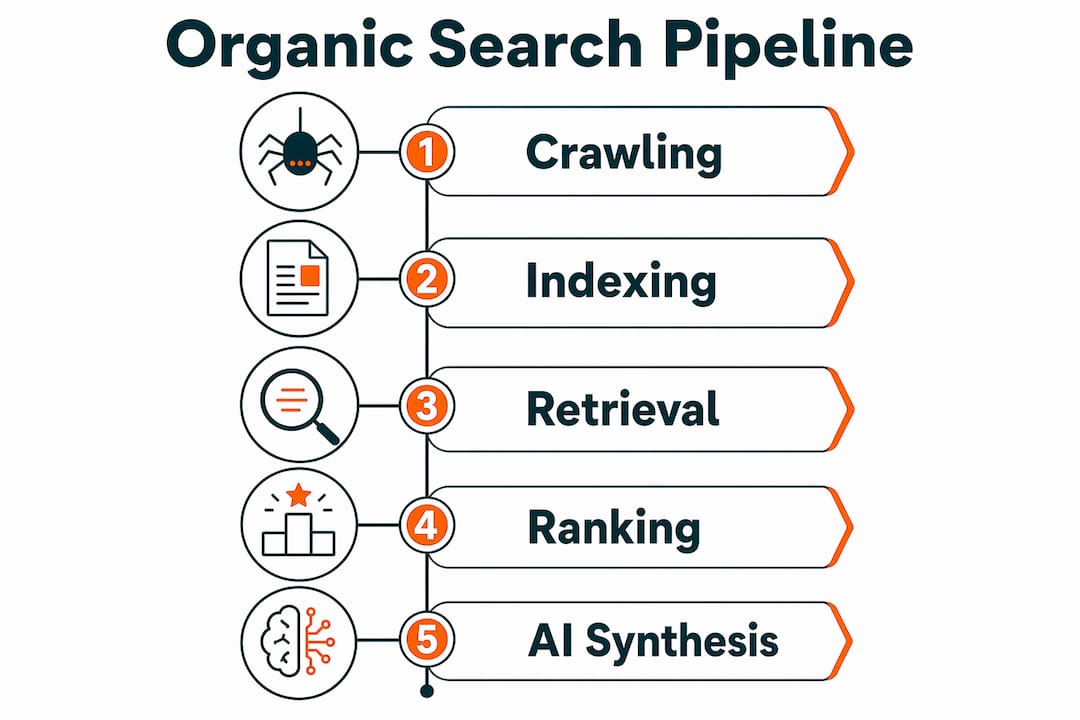
The organic search pipeline is the multi-stage process search engines use to discover, evaluate, and deliver web content in response to a query. It runs through five sequential stages: crawling, indexing, retrieval, ranking, and AI synthesis. Each stage acts as a filter, and a page must pass every one of them to appear in search results. Marketers who understand how organic search pipeline works gain a structural advantage. They stop guessing at ranking signals and start fixing the right problems at the right stage. This guide maps each stage clearly, corrects the most common misconceptions, and shows you where to focus your SEO effort for maximum return.
How does the organic search pipeline work, stage by stage?
The pipeline begins with crawling, the process by which search engine bots discover URLs by following links across the web. Crawl budget determines how many pages a bot visits on your site within a given period. Clean internal linking, crawlable resources, valid directives, and fast server response times all affect how efficiently bots move through your site. A 100ms improvement in server response time can increase crawl activity by roughly 15%. That is not a marginal gain. It directly determines how much of your site gets seen.
Indexing follows crawling, but the two are not the same. A crawled page is not automatically indexed. About 90% of crawled URLs do not get indexed because they fail quality thresholds or are flagged as duplicates. That figure reframes the entire SEO conversation. Technical accessibility alone does not guarantee index inclusion. Your content must clear quality filters before it earns a place in the index.

Retrieval is the stage most marketers overlook entirely. When a query arrives, the search engine does not scan the full index. It selects a candidate set of 1,000 to 10,000 documents using two parallel methods: lexical matching via BM25 and neural matching via vector embeddings. BM25 matches keywords; neural matching captures meaning. A page must appear in this candidate set before ranking even begins.
Ranking then orders the candidate set using over 200 signals evaluated by learning-to-rank models. Hundreds of specialized systems assess relevance, authority, freshness, and user satisfaction signals simultaneously. Ranking shifts can occur within hours based on user interaction data. This is not a static reward. It is a continuous competitive evaluation.
The fifth stage is AI synthesis. Google’s AI Overviews use retrieval-augmented generation (RAG) to produce natural-language answers with citations on top of the traditional index. This AI synthesis layer runs selectively for queries where it predicts a better user experience. It does not replace the four prior stages. It adds an interpretive layer on top of them.
| Stage | Core function | Key SEO implication |
|---|---|---|
| Crawling | Bot discovers URLs via links | Server speed and internal links control access |
| Indexing | Quality filtering of crawled pages | Content must clear duplication and value thresholds |
| Retrieval | Candidate set selection via BM25 and neural matching | Semantic clarity determines eligibility |
| Ranking | Signal-based ordering of candidates | 200+ signals evaluated by machine-learned models |
| AI synthesis | RAG-based answer generation with citations | Depth and diversity of content increase citation probability |
Pro Tip: Run a crawl audit before any ranking work. If bots cannot reach your pages efficiently, no amount of on-page optimization will move the needle.
How do query processing and document matching shape results?
Every query goes through reformulation before retrieval begins. The search engine rewrites and expands the original query to capture intent more accurately. Intent classification sorts queries into categories: informational, navigational, transactional, commercial investigative, local, and conversational or synthesis. The detected intent determines which result modules appear, including featured snippets, local packs, shopping results, and AI Overviews.
This matters because the same keyword can trigger completely different result compositions depending on how intent is classified. A query like “project management software” may return a mix of transactional and commercial investigative results. A query like “how does project management software work” triggers informational modules. Your content must match the intent category, not just the keyword, to surface in the right module.
Document matching then runs on two parallel tracks. Lexical retrieval uses BM25 to score keyword overlap between the query and indexed documents. Neural retrieval uses dense vector embeddings to score semantic similarity. Both tracks run simultaneously, and the candidate set is assembled from their combined output. Pages that score well on both tracks are more likely to enter the candidate set and reach the ranking stage.
- Match the intent category first. Check what result modules appear for your target query before writing a single word.
- Use entity-rich language. Named entities and clear topic relationships improve neural retrieval scores.
- Cover the full query space. Synonyms, related questions, and subtopics increase lexical match breadth.
- Avoid thin content. Pages with low information density score poorly on both BM25 and neural matching.
Pro Tip: Search your target keyword in an incognito window and note every result module that appears. That composition tells you exactly which intent category the engine has assigned to the query.
What misconceptions about the organic search pipeline should marketers avoid?
The most damaging misconception is that SEO starts at ranking. It does not. Retrieval eligibility is a hard filter that precedes ranking in the pipeline. If your page is not in the candidate set, every ranking optimization you apply has zero effect. Fixing technical accessibility and semantic clarity must come before any ranking-focused work.
The second misconception concerns AI Overviews. Many marketers believe they need special schema markup or AI-specific technical signals to appear in AI-generated answers. Google AI Overviews do not require special schema or AI-specific markup. They rely on the same core index and ranking signals as classic results. The AI synthesis layer reads content that already ranks well. It does not reward a separate optimization track.
Ranking is not a reward system. It is a competitive decision model built on user satisfaction signals. A page that earns a top position today can lose it within hours if interaction data shifts. Treating ranking as a destination rather than a dynamic state is the root cause of most SEO stagnation.
A third misconception is that domain authority alone drives visibility. Authority is one of 200+ signals. A high-authority domain with poorly structured content can lose retrieval eligibility to a lower-authority page with clear semantic structure and strong topical depth. Authority amplifies relevance. It does not replace it.
Finally, shortcuts like gimmicky AI content generation or generative engine optimization (GEO) hacks do not bypass the pipeline. Every page still passes through the same crawl, index, retrieval, and ranking filters. Content that fails quality thresholds at the indexing stage never reaches ranking, regardless of how it was produced.
How does pipeline knowledge improve your SEO and content strategy?
Understanding the pipeline turns SEO from guesswork into a diagnostic process. You can identify exactly which stage is limiting your visibility and fix it directly.
- Audit crawl efficiency first. Check server response times, fix broken internal links, and review your robots.txt and sitemap. Pages that bots cannot reach efficiently will never enter the index.
- Prioritize content quality for indexing. Thin pages, duplicate content, and low-value articles fail the indexing filter. Consolidate weak pages and raise the information density of content you want indexed.
- Build semantic structure for retrieval. Semantic SEO reduces retrieval cost by structuring content around entities and relationships. Clear entity coverage increases the probability of entering the candidate set for relevant queries.
- Balance technical and authority signals for ranking. Page experience, backlink quality, and user engagement signals all feed the ranking cascade. No single signal dominates. Treat ranking as a portfolio, not a checklist.
- Create depth and diversity for AI synthesis. AI Overviews cite pages that provide thorough, well-organized answers. A single comprehensive article on a topic is more likely to earn a citation than five shallow posts covering the same ground.
Pro Tip: Track your pages by pipeline stage, not just by ranking position. A page stuck at the indexing stage needs different work than a page that ranks on page two. Knowing the stage tells you the fix.
Monitoring with a pipeline mindset also changes which metrics you track. Crawl coverage, index inclusion rate, and search intent alignment become leading indicators. Ranking position becomes a lagging indicator. Fix the upstream stages and ranking tends to follow.
Key Takeaways
The organic search pipeline is a five-stage sequential filter, and a page must pass every stage before it can rank or appear in AI-generated answers.
| Point | Details |
|---|---|
| Crawling sets the ceiling | Bots must reach your pages efficiently before any other stage can begin. |
| 90% of crawled pages are not indexed | Content must clear quality and duplication filters to earn a place in the index. |
| Retrieval precedes ranking | A page not in the candidate set receives zero benefit from ranking optimizations. |
| Ranking uses 200+ signals | Machine-learned models evaluate relevance, authority, and user satisfaction simultaneously. |
| AI Overviews need no special markup | They cite content that already performs well through standard indexing and ranking signals. |
Why I stopped obsessing over rankings and started fixing the pipeline
Most marketers I talk to spend the majority of their SEO budget on ranking signals: link building, on-page optimization, and content refreshes. That work matters. But it only matters if the upstream stages are healthy. I spent years watching well-optimized pages underperform because they were failing at retrieval, not ranking. The content was good. The links were solid. But the semantic structure was loose, and the pages were not entering the candidate set for the queries that mattered.
The shift that changed my approach was treating the pipeline as a diagnostic framework rather than a linear checklist. When a page underperforms, I now ask: Is it crawled? Is it indexed? Is it entering the candidate set? Only after confirming the first three do I look at ranking signals. That sequence saves time and surfaces the real problem faster.
The AI synthesis layer is the part most marketers are currently misreading. It is not a separate game with separate rules. It is an extension of the same pipeline. Pages that earn AI Overview citations are pages that already rank well and provide thorough, clearly structured answers. The opportunity is not to chase AI-specific signals. The opportunity is to write better, deeper content that serves the full query intent. That has always been the job. The pipeline just makes it more visible.
If you take one thing from this: fix the stage that is actually broken. Do not apply ranking solutions to indexing problems. The pipeline tells you where to look.
— Savannah
How Ranksector supports your organic search pipeline strategy
Knowing the pipeline stages is one thing. Executing against them consistently is another challenge entirely, especially for small teams managing content at scale.
Ranksector publishes daily SEO-optimized articles built around keyword research and competitor analysis, targeting the exact retrieval and ranking signals that move pages through the pipeline. With over 11,000 articles already published for B2B SaaS companies, the platform handles crawl-friendly site structure, semantic content depth, and topical authority building without requiring a full content team. Explore Ranksector’s free SEO tools to audit your current pipeline performance, or review the agency-level solutions built for teams that need consistent organic growth at scale.
FAQ
What are the five stages of the organic search pipeline?
The five stages are crawling, indexing, retrieval, ranking, and AI synthesis. Each stage filters content sequentially, and a page must pass all five to appear in standard results or AI-generated answers.
Why does retrieval matter more than ranking for SEO?
Retrieval is a hard filter that runs before ranking. If a page does not enter the candidate set of 1,000 to 10,000 documents selected during retrieval, no ranking signal can help it appear in results.
Do AI Overviews require special technical markup?
No. Google AI Overviews rely on the same core index and ranking signals as classic search results. Pages that rank well and provide thorough answers are the most likely candidates for AI citation.
How does query intent affect which results appear?
Search engines classify queries into intent categories including informational, navigational, transactional, and conversational. The detected intent determines which result modules appear, such as featured snippets, local packs, or AI Overviews.
How can I tell which pipeline stage is limiting my page?
Check crawl coverage first, then index inclusion, then retrieval eligibility using query-specific ranking tests. A page that is crawled but not indexed has a content quality problem. A page that is indexed but not ranking has a retrieval or signal problem.
Recommended
- How Search Engines Rank Websites: 2026 Guide · Ranksector Blog — Ranksector
- How Search Intent Drives Content Strategy in 2026 · Ranksector Blog — Ranksector
- What Is the SEO Competitive Landscape in 2026? · Ranksector Blog — Ranksector
- What Is a Search Engine Algorithm? 2026 Guide · Ranksector Blog — Ranksector