
Content Hubs SEO: A Practical Hub-and-Spoke Strategy
A content hub is a set of interlinked pages built around one central topic, anchored by a pillar page and supported by cluster pages that all link back to it. That structure concentrates topical authority and internal link equity in ways a pile of disconnected blog posts never can, which is why Googlebot tends to crawl hubs more efficiently and rank them faster for competitive head terms. If you’re starting from scratch, your first move isn’t writing. It’s mapping your keyword universe into one hub topic and 8 to 20 realistic spoke ideas, then checking what you can pull from Search Console before you draft a single brief.
Key Takeaways
Content hubs improve SEO performance because concentrated internal linking builds topical authority and directs link equity toward pages that would otherwise compete against each other for the same rankings.
| Point | Details |
|---|---|
| Anatomy comes first | Define your hub, spokes, and any matrix pages before mapping keywords so linking rules stay consistent. |
| Size the hub deliberately | Aim for 8 to 20 spokes; fewer rarely builds depth, and more increases maintenance burden. |
| Linking rules aren’t optional | Every spoke must link to the hub within the first 30% of the page, and the hub must link to every live spoke. |
| Publish the hub first | Launch the pillar page with placeholder spoke links, then stagger spoke publication over several weeks. |
| Scale production with Ranksector | Ranksector automates daily article creation, internal-link suggestions, and backlink exchange to keep hub production consistent without added headcount. |
Table of Contents
- What Is Content Hubs SEO and How Does the Structure Work?
- Why Do Content Hubs Help SEO Performance?
- What Types of Content Hubs Should You Build?
- How Do You Create a Content Hub Step by Step?
- Which Technical SEO Choices Protect Hub Performance?
- How Long Does It Take to See Results, and What Should You Track?
- What Mistakes Sink Content Hubs, and How Do You Fix Them?
- What Do the Best Content Hub Examples Look Like?
- What Does the Data Say About Hub Sizing and Depth?
- Why Discipline Matters More Than Volume in Hub Strategy
- How Ranksector Helps You Scale Content Hubs Without Adding Headcount
- Sources
What Is Content Hubs SEO and How Does the Structure Work?
The vocabulary trips people up before the strategy does, so let’s fix that first. A hub page (sometimes called a pillar page) is the broad, comprehensive page that ranks for the head term and orients the reader to every subtopic beneath it. Spoke pages (also called cluster pages) go narrow and deep on individual subtopics, each targeting a longtail keyword the hub only touches briefly. Every spoke links back up to the hub, and the hub links down to every spoke it governs.

Some hubs also use matrix pages, single canonical URLs that multiple hubs can link into. A pricing page or a glossary entry might belong to three different hubs at once without needing three separate versions of itself. That avoids duplicate content while still letting several topic clusters point at the same high-intent page.
Here’s the anatomy broken down:
- Hub (pillar) page: broad topic overview, ranks for the head keyword, links to every spoke
- Spoke (cluster) pages: narrow subtopic coverage, link back to the hub, occasionally cross-link to sibling spokes
- Matrix pages: shared destination pages reachable from more than one hub, useful for high-value conversion pages
- Canonical URL: the single authoritative version of a page search engines should index, critical when matrix pages create multiple access paths to the same content
This hub, spoke, and matrix relationship is the backbone described in most content hub frameworks, and it’s worth internalizing before you touch keyword research, because every later decision (URL structure, linking rules, content briefs) refers back to these three roles.
Why Do Content Hubs Help SEO Performance?
Search engines reward coherence. When ten pages about the same broad topic link to each other in a deliberate pattern, that network signals something a single standalone article can’t: a comprehensive, authoritative source on the subject. Google’s own guidance on helpful content has consistently rewarded sites that demonstrate depth over sites that scatter thin coverage across many isolated posts.
Three mechanisms explain most of the lift:
- Topical authority: interlinked pages act as one semantic entity rather than a set of unrelated posts, which helps search engines understand exactly what your site knows
- Internal link equity distribution: hub-and-spoke architecture concentrates authority on the hub page because every spoke funnels link value upward, and the hub redistributes it back down
- Crawl efficiency and engagement: a well-linked hub keeps Googlebot moving through related pages in one session, and it keeps readers doing the same, which shows up as longer session depth in Analytics
One documented case shows the mechanism in action: a single hub attracted over 500 backlinks and grew organic traffic to an estimated 6,400 visits per month, largely because external sites linked to the hub as the definitive resource rather than scattering links across a dozen thin pages. That’s the backlink aggregation effect: instead of splitting authority across many pages that each earn a handful of links, a hub concentrates external signals on fewer, stronger URLs.
Pro Tip: Check your Search Console “Links” report before you build anything. If you already have scattered backlinks pointing at three or four related posts, that’s a strong signal you should consolidate them into a hub rather than start a new topic from zero.
What Types of Content Hubs Should You Build?
Not every topic needs the same shape. Picking the wrong format is one of the fastest ways to waste a quarter of production time on a structure that doesn’t fit your content volume or your audience’s research behavior.
Four models cover most use cases:
- Hub-and-spoke: one pillar page, 8 to 25 tightly scoped spokes, ideal for a focused product category or service line
- Content library: a large, loosely themed collection organized more by content type than by strict topic hierarchy, useful for media sites or SaaS companies with broad documentation needs
- Topic gateway: a deep dive into a single narrow subject with many angles, common in niche B2B verticals where the audience wants exhaustive coverage of one problem
- Content database: structured, often templated pages generated from a dataset (think directories, comparison pages, or location-based service pages)
Choose based on volume and complexity, not on what looks impressive:
- Choose hub-and-spoke if you have one clear commercial topic and can commit to 8 to 20 spokes over a few months
- Choose a content library if your content spans multiple unrelated topics that share only a brand, not a subject
- Choose a topic gateway if your audience wants encyclopedic depth on one narrow problem (compliance, a specific technical process)
- Choose a content database if you’re generating many similar pages from a repeatable template (city pages, product comparisons)
Hybrid models exist too. A SaaS company might run a hub-and-spoke structure for its core product topic while using matrix pages to route high-intent readers from multiple hubs into one pricing or demo page.
How Do You Create a Content Hub Step by Step?
Building a hub is a sequencing problem more than a writing problem. Get the order wrong and you’ll publish spokes that have nothing solid to link into, or worse, a hub with no supporting pages ranking behind it.
- Select the hub topic and map the keyword universe. Aim for a head term with enough search volume to justify 8 to 20 spoke topics beneath it. Fewer than 8 rarely builds enough depth to establish topical authority; more than 25 spokes tends to create a maintenance burden that outpaces most small teams’ capacity.
- Audit existing content for repurposing candidates. Most sites already have three or four posts that could become spokes with light editing. Pulling these into the hub structure is faster than writing everything from zero, and it’s the approach Semrush recommends for teams trying to launch quickly.
- Prioritize spokes by impact. Score each candidate spoke on search volume, commercial relevance, and competition, then build the highest scoring ones first.
- Write content briefs with consistent fields. Every brief should specify target keyword, search intent, target word count, calls to action, and which pages it must link to.
- Apply the internal linking checklist. Every spoke needs a hub link in the first 30% of the page, the hub needs to link to every live spoke, and spokes should cross link to two or three closely related siblings using descriptive, keyword-relevant anchor text.
- Sequence the rollout. Publish the hub page first, even with placeholder links to spokes that aren’t live yet, then stagger spoke publication over several weeks rather than dumping everything at once.
A few operational notes make this run smoother:
- Keep a shared spreadsheet mapping every spoke to its target keyword, its priority score, and its publish status
- Build the hub page’s outline last, after you know what every spoke actually covers, so the hub’s internal links point at real, specific value rather than vague summaries
- Treat the hub page itself as a living document you’ll revise every time a new spoke launches
Pro Tip: Write the hub’s linking section as a simple list of spoke titles with one-sentence descriptions before you write any spoke content. That list becomes your production roadmap, and it forces you to catch topic overlap before you’ve wasted a week writing two spokes that answer the same question.
Which Technical SEO Choices Protect Hub Performance?
Architecture decisions made in week one can quietly undercut a hub’s SEO value for years if nobody catches them. The most common failure point is URL structure that buries the hub too deep or fragments spokes across unrelated paths.
Follow this hierarchy logic:
- Keep hub and spoke URLs under a shared first path segment (
/hub-topic/spoke-name/) so search engines immediately associate them - For service businesses, a service-first hierarchy (service, then industry, then location) tends to preserve more link equity on the page that matters most commercially, because the first path segment usually inherits the strongest topical signal
- Avoid nesting spokes more than two levels deep from the hub; each extra folder dilutes crawl priority
Canonicalization and indexing decisions matter just as much:
- Set self-referencing canonical tags on every spoke unless it’s a matrix page shared across hubs, in which case canonicalize to the single authoritative URL
- Submit hub and spoke URLs in your XML sitemap as a group, and prioritize the hub’s crawl frequency if your CMS allows priority hints
- Add breadcrumb structured data so both users and crawlers can trace a spoke back to its hub
- Use Article schema on spokes and consider FAQ schema where a spoke answers several discrete questions
- Decide index versus noindex deliberately for thin utility pages (tag archives, filtered views) that might otherwise compete with your spokes for the same query
Engineers should also confirm hreflang tags are correct if the hub serves multiple language markets, since a mismatched hreflang setup can quietly split ranking signals between regional duplicates. Tools like internal linking automation can help enforce these rules at scale once you’re managing more than a handful of hubs.
How Long Does It Take to See Results, and What Should You Track?
Hub performance builds in stages, and setting expectations early prevents a stakeholder from calling the project a failure in month two.
| Timeframe | What to expect |
|---|---|
| — | Hub and initial spokes indexed; early impressions appear in Search Console but rankings are volatile |
| 3 to 6 months | Cluster impressions climb steadily; average position for target spokes starts stabilizing in the top 20 |
| 6 to 12 months | Hub page begins ranking for the head term; backlinks aggregate toward the hub rather than individual spokes |
| Ongoing | Organic conversions attributable to the hub grow as topical authority compounds and older spokes get refreshed |
Track four KPIs consistently:
- Cluster impressions: total Search Console impressions across the hub and all its spokes combined
- Average cluster position: mean ranking position across the spoke set, which reveals whether the hub is gaining ground as a unit
- Backlinks to hub and spokes: watch whether links concentrate on the hub over time, a sign the aggregation effect is working
- Organic conversions attributable to the hub: tie Analytics goal completions back to hub and spoke landing pages specifically
Resourcing a hub properly usually means a content strategist for planning and prioritization, a writer or two for drafting, an editor for consistency, an SEO specialist for technical review, and a developer for schema and URL implementation. Small teams often compress several of these roles into one person, but the workload doesn’t disappear just because headcount is limited. Reporting cadence should run monthly through Search Console and Analytics, with a deeper crawl audit every quarter. Governance discipline like this is what separates hubs that compound in authority from ones that plateau after the first few spokes go live.
What Mistakes Sink Content Hubs, and How Do You Fix Them?
Most failing hubs share the same handful of root causes, and every one of them is diagnosable in an afternoon with a spreadsheet and Search Console open.
- Keyword cannibalization between spokes: two spokes target nearly identical intent, splitting ranking signals between them. Fix: merge the weaker page into the stronger one and 301 redirect it.
- Thin spokes that never get real internal links: a spoke gets published but the hub never actually links to it. Fix: audit every spoke URL against the hub’s live links and patch any gaps within a week of publishing.
- Generic anchor text everywhere: “click here” and “read more” tell search engines nothing about the linked page’s topic. Fix: rewrite anchors to include the spoke’s target keyword or a close variant.
- Wrong information architecture from day one: spokes scattered across unrelated URL paths instead of nested under the hub. Fix: this one is expensive to correct later, since it usually requires redirects and canonical updates, so get it right before launch.
- A hub summary that reads like a table of contents instead of real content: readers and crawlers both need the hub page itself to demonstrate expertise, not just list links.
Run a quick audit checklist monthly: pull every spoke’s current ranking position, check whether it still links to the hub, and flag any two spokes ranking for overlapping queries.
Pro Tip: If two spokes are cannibalizing each other, don’t just add more internal links between them. Consolidate the thinner one into the stronger page, keep the stronger URL, and redirect the old one. Search engines resolve cannibalization faster after consolidation than after any amount of tactical link tweaking.
What Do the Best Content Hub Examples Look Like?
A few widely referenced hubs illustrate different structural choices worth studying directly rather than secondhand.
Think with Google organizes its hub around marketing insight categories, using a library style structure rather than a strict pillar and spoke model, since its content spans dozens of loosely related marketing topics rather than one narrow keyword cluster. Moz’s SEO learning hub leans closer to a topic gateway, going deep on core SEO concepts with heavy internal cross linking between related terms like keyword research and on page optimization. Zapier’s content hub around automation and workflow topics blends a content library with hub and spoke elements, using category pages as mini hubs that then link into individual use case articles.
Common URL patterns worth adapting:
| Hub Model | Example URL Pattern | Best Fit |
|---|---|---|
| Service-first hub | /service/industry/location/ |
Local or regional service businesses |
| Topic gateway | /topic/subtopic-name/ |
Deep single-subject coverage |
| Content database | /directory/category/item/ |
Large templated comparison or listing pages |
For internal linking, place the hub link within the first few paragraphs of every spoke using descriptive anchor text tied to the hub’s head keyword, then add two or three contextual cross links to sibling spokes further down the page. Resources like Ranksector’s internal linking blueprint walk through anchor text patterns in more detail if you’re building this into a team style guide.
A short outreach email template for building backlinks to your hub:
Subject: Resource on [topic] that might fit your [related page] link
Hi [name], I noticed your page on [related topic] links to a few resources on [subject]. We recently published a hub covering [topic] in more depth, including [specific subtopic]. Thought it might be a useful addition if you’re updating that page. Happy to share more detail if it’s relevant.
What Does the Data Say About Hub Sizing and Depth?
An industry pattern worth building your roadmap around: tightly linked hub systems with roughly a moderate number of spokes consistently outperform larger sets of disconnected articles covering the same overall subject area, even when the disconnected set has more total pages. The logic tracks with how topical authority accumulates. A search engine parsing 15 interlinked pages about one subject can infer a coherent, comprehensive entity. The same engine parsing 40 scattered posts across a site sees fragments, not depth.
This lines up with a broader industry observation that tightly connected hub structures with 12 to 18 well-linked pages often communicate topical depth more effectively than dozens of disconnected posts, since AI-driven answer engines increasingly favor sources that demonstrate structural coherence when deciding what to cite. The uncertainty here is real. No universal number applies to every vertical, and a highly competitive commercial topic might need more spokes than a niche B2B subject to build the same authority signal.
Practical implications for your roadmap:
- Treat a moderate number of spokes as a planning range rather than a hard rule, and adjust based on competitive density in your niche
- Prioritize link quality between pages over sheer page count when deciding whether to add another spoke
- Score new hub candidates using a portfolio method, scoring each on subtopic depth, search volume, and your team’s realistic publish capacity, then build the highest scoring hub first
Why Discipline Matters More Than Volume in Hub Strategy
Most teams treat content hubs as a content calendar problem: pick a topic, assign writers, publish on schedule. That misses what actually makes hubs work. The linking discipline matters more than the writing schedule. A hub with twelve mediocre spokes that all link correctly will usually outperform a hub with twenty well-written spokes that got published without anyone checking whether the hub actually links down to each one.
The trade-off nobody likes discussing openly is time versus payoff. A properly built hub takes real planning before a single word gets written, mapping keywords, scoring priority, drafting briefs with consistent fields. Teams under deadline pressure skip that step and go straight to drafting, then wonder six months later why their “hub” behaves like a pile of unrelated posts. If you don’t have the bandwidth to maintain linking discipline across a growing spoke set, it’s better to build a smaller hub of a smaller hub of tightly connected pages than to sprawl to a large number of spokes you can’t keep internally linked or updated.
Know when to pause, too. If a hub’s core topic starts showing declining search interest, or if a competitor has clearly out built you with a more comprehensive structure, the right move is often to consolidate what you have into a tighter, higher quality set rather than keep adding spokes to a topic that’s losing relevance. Sunk cost thinking kills more hubs than bad keyword research does.
How Ranksector Helps You Scale Content Hubs Without Adding Headcount
Building a hub properly, the kind with disciplined internal linking, consistent briefs, and steady publishing cadence, takes exactly the kind of sustained output that small marketing teams struggle to maintain month after month. Ranksector automates the parts of that workflow that eat the most hours: daily SEO-optimized article creation, direct publishing to your CMS, internal-link suggestions between hub and spoke pages, and a backlink exchange network that helps your hub earn the external links this guide keeps pointing to as a ranking driver.
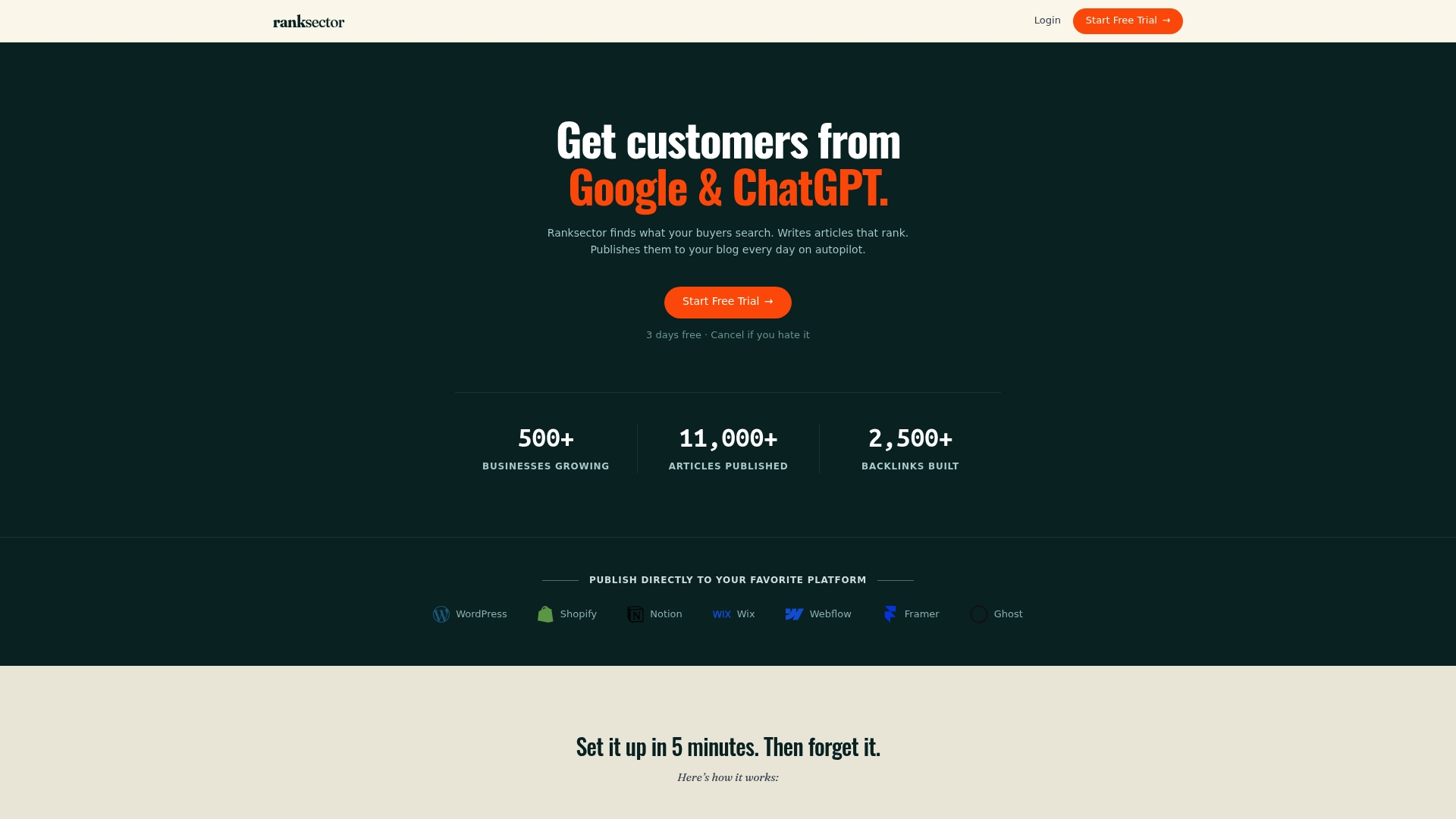
Where an in-house team might spend weeks drafting and prioritizing eight spoke briefs, Ranksector’s competitor-driven keyword research and daily publication cadence compress that into a running production line, without hiring a writer, an editor, and an SEO specialist just to keep one hub current. If you want a clear read on where your existing content stands before committing to a full hub build, run a free AI visibility audit to see which pages are already positioned to become spokes and which gaps still need coverage.
Sources
- Content Hubs for SEO: How to Get More Traffic and Links With Topic Clusters
- Content Hub: What is it and who needs it?
- Internal Link Architecture: Building a Hub-and-Spoke Site Structure - Link Building Journal
- Hub & Spoke SEO: The Complete 2026 Playbook & Examples - Jordan James Media
- Content Hub Strategy: 7 Proven Steps to Compound Traffic (2026) — The Seo Engine
Recommended
- Why Content Silos Hurt SEO: A Practical Guide for SEOs · Ranksector Blog · Ranksector
- How SEO Content Audits Work for Content Strategists · Ranksector Blog · Ranksector
- Semantic SEO: Optimize for Topics, Not Just Keywords · Ranksector Blog · Ranksector
- How Content Gaps Drive SEO Wins for Content Teams · Ranksector Blog · Ranksector