
How Content Gaps Drive SEO Wins for Content Teams
Closing content gaps is one of the fastest, highest-leverage moves you can make to increase organic visibility and earn AI citations. The role of content gaps in SEO wins is not theoretical: when your site fails to answer a query, a competitor fills that slot, and increasingly, an AI Overview or LLM summary cites them instead of you. The dual win from gap-closing is real: you recover traditional rankings AND raise your chances of appearing in AI-generated answers.
Before you open a single tool, run this quick checklist to spot your highest-leverage gaps right now:
- Missing direct-answer openings: Your page ranks but opens with context instead of a clear, one-sentence answer. LLMs skip it.
- Absent entity attributes: You cover the topic but omit key sub-questions (pricing, comparisons, limitations, use cases) that complete the knowledge graph.
- No original data or citations: Generic synthesis without a sourced statistic, study, or first-hand example is easy for AI to ignore.
- Missing decision-stage pages: You have awareness content but no comparison, alternatives, or “X vs. Y” pages for buyers who are close to converting.
- Broken internal linking: Related pages exist but are not connected, so neither users nor crawlers can navigate the full topic cluster.
Three micro-actions you can take today: add a 1–2 sentence direct answer at the very top of your highest-traffic pages, attach at least one sourced statistic or concrete example to each key claim, and add FAQ or HowTo structured data where the query is question-shaped.
Table of Contents
- What is a content gap, and what types should you know?
- Why do content gaps affect your rankings, traffic, and AI visibility?
- How do you run a content gap analysis from inventory to execution?
- Which tools and data sources reveal content gaps?
- How do you prioritize which gaps to fill first?
- What formats and on-page tactics actually fill gaps?
- How do you measure the impact of filling content gaps?
- What pitfalls should you avoid in gap analysis?
- The citation gap: what it is and why it threatens your whole site
- Key Takeaways
- The part of gap analysis most teams get wrong
- Ranksector closes content gaps without the manual overhead
- Useful sources and further reading
What is a content gap, and what types should you know?
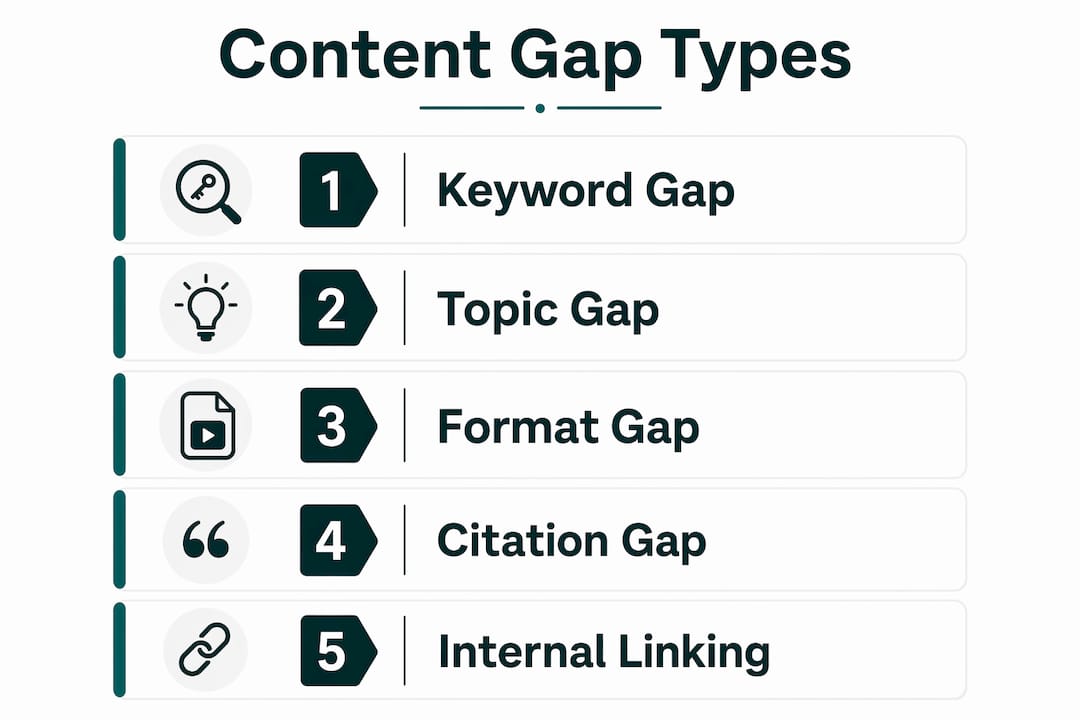
A content gap is any query, sub-question, entity attribute, or format that your audience searches for (or that an AI engine needs to answer) but your site does not adequately address. The gap can be a missing keyword, a missing topic angle, a wrong format, a broken internal link, or the newest variant: a citation gap, where your page ranks but is invisible to LLMs.
For a deeper look at the keyword-level variant specifically, keyword gap analysis is a useful companion methodology.
| Gap Type | What It Means | Concrete Example |
|---|---|---|
| Keyword gap | Queries your competitors rank for that you do not | Competitor ranks for “SaaS churn rate benchmark”; you have no page targeting it |
| Topic/entity gap | A sub-question or entity attribute missing from your coverage | You cover “email marketing” but never address deliverability rates or sender reputation |
| Intent/format gap | Right topic, wrong format for the query’s intent | A listicle where the searcher wants a step-by-step implementation guide |
| Internal linking gap | Related pages exist but are not connected | A pillar on “content strategy” with no links to your “editorial calendar” or “content audit” posts |
| Citation/AI visibility gap | Page ranks in classic search but is not cited by LLMs | Your “best CRM for startups” page appears on page one but never shows in ChatGPT or Perplexity answers |
One point that surprises most teams: low-search-volume nodes still matter. Zero or near-zero volume keywords often represent the entity attributes and sub-questions that complete a knowledge graph. Skipping them creates semantic holes that weaken topical authority, even when each individual gap looks trivial in a keyword tool. A single comprehensive, entity-dense page that covers all relevant attributes can outperform a cluster of thin pages that each target one keyword.
Why do content gaps affect your rankings, traffic, and AI visibility?
The mechanism is straightforward: Google’s ranking systems reward pages that fully satisfy a query, and they evaluate topical authority at the domain level, not just the page level. When your site has systematic gaps, you signal incomplete expertise, and that signal compounds.

Google’s Helpful Content system operates as a site-wide classifier. Unhelpful or off-topic content can suppress the performance of otherwise strong pages across your entire domain. This is not a page-level penalty you can isolate; it is a domain-level signal that affects every URL you publish. Research from practitioners analyzing the Helpful Content update confirms that Google evaluates each page as part of a topical group, comparing its topic against all other pages on the site. Pages that are too topically distant from your core cluster, or too close to each other without adding new information, can receive an “unhelpful” tag that drags down the whole domain.
The AI-citation dimension adds a second layer of risk. Pages can rank in classic search yet be uncited by LLMs due to a lack of extractable factual density or clear structure. Competitors optimized for AI citation are being surfaced in AI summaries that intercept users before they click, diverting qualified buyers by answering their questions without ever sending traffic to uncited sites. If your page is not cited, you are invisible at the moment of highest intent.
The combined impact: A content gap is not just a missed keyword. It is a missed ranking, a missed AI citation, and a missed conversion, all from the same unfilled slot.
Topical authority, as the research makes clear, is about entity coverage and complete answers, not a raw URL count. Publishing more thin pages to fill gaps faster makes the problem worse, not better.
How do you run a content gap analysis from inventory to execution?
A repeatable quarterly workflow beats a one-off audit every time. Teams that maintain a gap log and run this process on a regular cadence compound value over time. Here is the full sequence:
-
Define your topical boundary. Before pulling any tool export, map your core topic clusters and the entities within each. Start with an entity map, not a competitor export. Building the topical model first prevents you from anchoring to competitors’ blind spots and missing gaps they also have.
-
Audit your existing content inventory. List every URL, its primary topic, its target query, and its current ranking position. Flag pages with high impressions but low clicks, pages with no ranking positions at all, and pages that cover overlapping topics.
-
Collect data from multiple sources. Pull Google Search Console queries with impressions above a threshold but low CTR or low average position. Export GA4 landing page data to find pages that attract traffic but convert poorly. Run AI citation tests across Perplexity, ChatGPT, and Gemini for your top 20 queries. Check internal site search logs for queries your visitors type that your navigation does not answer.
-
Map gaps against your entity model. For each entity in your topical map, check whether you have a page that covers it, whether that page answers the direct question, and whether it appears in AI answers. A workflow for finding keyword gaps your competitors miss can accelerate this step.
-
Build a gap log. This is your working document. Each row is one gap. Columns should include: the query or sub-question, where competitors are cited for it, why your page fails (structure, missing evidence, wrong format, or no page at all), and a priority score.
-
Sequence your fixes. Divide gaps into three buckets:
- Fix first: High-traffic pages with zero AI citations. These are your biggest losses.
- Fix next: Mid-traffic pages with inconsistent citations. Structural and evidence improvements here move the needle quickly.
- Create new: Queries you have no page for. These take longer but fill genuine holes in your topical map.
Sample gap log structure:
| Query / Sub-question | Competitor Cited | Why Your Page Fails | Priority | Next Action |
|---|---|---|---|---|
| “SaaS churn rate benchmark 2026” | Competitor A | No page exists | High | Create new page |
| “How to reduce churn in B2B SaaS” | Competitor B | No direct answer at top; no data | High | Fix first |
| “Churn vs. retention rate difference” | None | Thin paragraph, no structured data | Medium | Fix next |
| “Churn calculation formula” | Competitor A | Exists but buried in long post | Low | Restructure |
Effective gap analysis in 2026 is both keyword-based and citation-aware; scoring pages for Information Gain and AI-extractability is now part of the standard workflow, not an advanced add-on.
Which tools and data sources reveal content gaps?
Each tool in your stack surfaces a different slice of the gap picture. The skill is in combining exports, not in picking one tool and running with it.

| Tool / Source | What to Export | How to Use It |
|---|---|---|
| Google Search Console | Queries with impressions > 100, CTR < 2%, position > 10 | Identifies pages that are visible but underperforming; these are fix-first candidates |
| GA4 / Google Analytics | Landing pages with high sessions but low goal completions or high bounce rate | Surfaces intent mismatches where traffic arrives but the page does not satisfy the query |
| Internal site search logs | Top searched terms with no results or low-click results | Reveals what your own audience cannot find; often the highest-intent gaps |
| Keyword research tools | Competitor top pages, keyword gap reports, question-format queries | Maps queries competitors rank for that you do not; exports the raw gap list |
| AI citation tests (Perplexity, ChatGPT, Gemini) | Which pages are cited for your priority queries; which competitors appear | Identifies citation gaps; use an AI Visibility Gap Finder to track prompts where your brand is absent |
| Ranksector analytics dashboard | GSC-integrated query data, AI audit results, internal linking suggestions | Combines gap discovery and execution in one place; surfaces citation and keyword gaps together |
The most productive move is to cross-reference GSC’s high-impression/low-CTR queries with your AI citation test results. A page that ranks in position 6 but is never cited by an LLM is a higher priority fix than a page in position 14 with no AI presence at all, because the ranking-page fix requires only editorial work, not a full content build. For teams evaluating AI-assisted publishing tools to execute fixes at scale, high-volume blog publishing tools are worth reviewing alongside your gap workflow.
How do you prioritize which gaps to fill first?
Not every gap deserves equal attention. A simple scorecard keeps your team focused on work that moves revenue, not just rankings.
Score each gap on five dimensions (1–3 scale for each):
-
Traffic potential: How many monthly searches does this query cluster represent? Use keyword tool volume estimates, but weight GSC impression data more heavily for queries you already appear for.
-
Commercial intent: Does this query sit at the awareness, consideration, or decision stage? Decision-stage gaps (comparisons, alternatives, pricing pages) carry higher business value even at lower search volume.
-
AI-citation opportunity: Does your page currently appear in LLM answers for this query? A “no” here adds urgency, especially for queries where competitors are consistently cited.
-
Effort required: Is this a structural fix to an existing page (low effort), a content expansion (medium), or a net-new page requiring research, design, and internal linking (high)?
-
Dependency: Does filling this gap require a technical change, a new internal link structure, or sign-off from another team? Dependencies push timelines out and lower effective priority.
Priority tiers by score:
- Score 12–15: Fix immediately. These are high-traffic, high-intent gaps where you are losing to cited competitors. Typical examples: missing comparison pages, pillar pages with no direct-answer opening, or pages with structured data absent.
- Score 8–11: Fix in the next sprint. Mid-traffic pages needing evidence upgrades, format changes, or internal link additions.
- Score 4–7: Backlog. Low-volume entity nodes that matter for topical completeness but will not move the traffic needle in the short term. Schedule these for quarterly fill cycles.
Fold product priorities into the scoring by adding a “sales alignment” flag. If your sales team is losing deals because prospects cannot find a comparison page, that gap scores a 3 on commercial intent regardless of search volume. Aligning editorial work with sales priorities is how content teams earn stakeholder buy-in for sustained gap-closing investment.
What formats and on-page tactics actually fill gaps?
The format you choose matters as much as the content itself. A well-researched answer in the wrong format will still lose to a competitor whose page matches the query’s intent.
When to consolidate vs. when to create new pages
Consolidate when you have two or more thin pages covering the same sub-topic with overlapping keywords. Merge them into a single, entity-dense page with a clear canonical URL. Creating a new page makes sense when the gap is a genuinely distinct query with its own intent, its own entity set, and no existing page that could be expanded to cover it. Publishing a thin new page to chase a keyword, without the evidence and structure to satisfy the query, makes the gap problem worse.
Format recommendations by intent
- Direct-answer queries: Open with a 1–2 sentence answer before any context. This is the single highest-impact structural change for AI citation. Understanding what AI search engines look for when choosing citations makes this pattern clear.
- Comparison and alternatives queries: Build a dedicated page, not a section buried in a longer post. Use a structured table, clear H2s for each option, and a verdict section.
- Implementation guides: Use a numbered step format with H3 subheadings for each step. Include a concrete example or screenshot at each stage.
- Data-driven gaps: Add a sourced statistic, an original benchmark, or a first-hand case example. Content with original data and expert attribution earns significantly higher citation rates in AI answers.
On-page tactics that improve extractability
Every gap-fill page should include a direct-answer opening paragraph, a clear H2/H3 hierarchy that maps to sub-questions, bullet lists for any enumerable set of items, and FAQ or HowTo schema where the query is question-shaped. Author bylines with credentials and first-hand evidence signal E-E-A-T and raise the probability of AI citation. For featured-snippet-style formatting that holds up in AI Overviews, the tactics for writing featured snippets that survive AI Overviews apply directly here.
Pro Tip: Before publishing any gap-fill page, test the draft by pasting your target query into Perplexity and checking whether the answer structure your page uses matches what the LLM extracts from cited competitors. If their cited pages use bullet lists and yours uses dense paragraphs, restructure before you publish.
How do you measure the impact of filling content gaps?
Set a baseline before you touch anything. Without a before-and-after snapshot, you cannot attribute traffic changes to your gap-closing work, and you cannot make the case for continued investment.
Core KPIs to track:
- Organic sessions and impressions for the specific pages you fixed (not site-wide, which mixes too many signals)
- Average ranking position for the target queries
- CTR from GSC for those queries
- Conversions or goal completions attributed to the fixed pages
- AI-citation rate: the percentage of your priority queries for which your page appears in LLM answers
The early signal window for editorial fixes is 4–8 weeks. Structural changes (adding a direct-answer opening, restructuring H2s, adding schema) often show impression and CTR movement within this window. Full ranking consolidation typically takes 90–180 days, which is why a quarterly audit cadence aligns naturally with the measurement cycle.
Measurement note: Track AI-citation rate separately from classic SEO KPIs. A page can improve in ranking position while its citation rate stays flat, or vice versa. Both matter, and they often require different fixes.
For teams looking for faster wins to demonstrate ROI, SEO quick wins for faster rankings are worth reviewing alongside your gap-closing roadmap, since some structural fixes produce measurable movement well within the first 30 days.
Report impact by combining traffic delta with citation changes and, where possible, revenue proxies. A page that gains 400 monthly sessions and moves from uncited to cited in three LLMs is a stronger story than raw traffic numbers alone.
What pitfalls should you avoid in gap analysis?
Most gap analysis failures fall into four categories. Each has a clear red flag and a remediation path.
-
Publishing thin pages to chase keywords. Red flag: page count grows but average session duration and pages-per-session fall. Remediation: consolidate thin pages into entity-dense pillars; prune or redirect pages with no ranking positions after 6 months.
-
Failing to update high-priority pages. Red flag: GSC shows high impressions and declining CTR on pages you have not touched in over a year. Remediation: schedule quarterly content refreshes for your top 20 pages by impression volume; add new data, update examples, and recheck AI-citation status.
-
Creating off-topic content that dilutes topical authority. Red flag: your site covers topics that are topically distant from your core cluster, and your domain-level Helpful Content signals are declining. Remediation: audit for topical distance; remove or noindex pages that do not belong in your cluster, and redirect their link equity to relevant pages.
-
Ignoring internal linking. Red flag: new pages earn no organic traffic despite strong content because no existing pages link to them. Remediation: every new gap-fill page needs at least three contextual internal links from related, higher-authority pages before it is published.
-
Chasing low-value keywords without a topical rationale. Red flag: your gap log is sorted by search volume with no column for topical relevance or business value. Remediation: add a “topical fit” column to your gap log and filter out any gap that does not map to your core entity model, regardless of volume.
Checking for AI-generated content Google may penalize is also worth building into your quarterly review, since thin AI-generated pages that lack first-hand evidence are a common source of Helpful Content suppression.
The citation gap: what it is and why it threatens your whole site
The citation gap is the modern SEO team’s blind spot. Your page ranks. It gets impressions. But when a user asks ChatGPT, Perplexity, or Gemini the same question, your site is not mentioned. A competitor with a structurally similar page, but with a direct-answer opening, a sourced statistic, and clear entity-attribute coverage, gets cited instead.
Google’s Helpful Content system creates a parallel risk at the domain level. As the official guidance states:
The practical consequence: a cluster of thin, gap-filled pages published to chase keywords can suppress your entire domain’s performance, including your strongest pages. Treating your site as a cohesive topical whole, rather than a collection of individual URLs, is the only way to manage this risk.
Closing the citation gap requires three specific actions. First, run citation tests quarterly across Perplexity, ChatGPT, and Gemini for your top 50 queries. Running citation tests across multiple LLMs gives you a prioritized list of pages to fix, surfacing editorial changes that can convert ranking pages into cited pages. Second, add authoritative external references and original data to every high-priority page. Pages with first-hand evidence and strong structure consistently outperform generic synthesis in AI citation tests. Third, implement entity mapping and structured data (FAQ schema, HowTo schema, Article schema with author markup) so LLMs can extract structured facts rather than having to parse dense prose.
A quarterly pruning cadence completes the loop. Remove or consolidate pages that have no ranking positions, no AI citations, and no topical rationale. Each pruned page reduces the unhelpful-content signal at the domain level and concentrates authority on the pages that remain.
Key Takeaways
Closing content gaps drives measurable SEO and AI-citation wins when you prioritize by impact times effort, fix structure before creating new pages, and run the audit quarterly.
| Point | Details |
|---|---|
| Gaps are multi-dimensional | Keyword, topic, format, internal linking, and citation gaps each require a different fix; address all five types. |
| Site-wide Helpful Content risk | Unhelpful or off-topic pages suppress your entire domain, not just the individual URLs involved. |
| Citation gap is the modern blind spot | Pages can rank in classic search yet be invisible to LLMs; fix structure and add original data to close this gap. |
| Prioritize by impact times effort | Score each gap on traffic potential, commercial intent, AI-citation opportunity, effort, and dependency before sequencing work. |
| Ranksector accelerates execution | Ranksector’s automated content creation, AI audit, and GSC-integrated analytics map directly to the gap-closing workflow described here. |
The part of gap analysis most teams get wrong
Most SEO teams treat content gap analysis as a keyword exercise. They export a competitor gap report, sort by volume, and start writing. The result is a backlog of pages that rank for mid-volume queries but never appear in AI answers, never convert, and quietly accumulate as thin-content liability.
The more productive frame is to start with the entity model and work outward. What are the core concepts your audience needs to understand to make a decision? What attributes of each concept are they asking about? Which of those attributes does your site answer completely, and which does it skip? That sequence surfaces the gaps that actually matter for topical authority, not just the gaps that look large in a keyword tool.
The citation gap deserves its own audit track, separate from the classic keyword gap workflow. A page that ranks in position 4 but is never cited by an LLM is losing to a competitor at the exact moment a buyer is forming their shortlist. Fixing that page, adding a direct answer, a sourced statistic, and structured data, is often a two-hour editorial task that produces a measurable citation rate improvement within weeks. That is a better return than publishing three new pages targeting long-tail keywords with no existing topical foundation.
Stakeholder buy-in is easier when you frame gap-closing in terms of citation rate and revenue proximity, not just ranking position. Show a before-and-after citation test result for a single high-priority page. That one data point often does more for your content budget than a full quarterly report.
Ranksector closes content gaps without the manual overhead
Running a thorough gap audit, building a prioritized gap log, and then executing fixes across dozens of pages is where most small teams stall. The analysis is clear; the bandwidth is not.
Ranksector is built for exactly this constraint. The platform combines automated, gap-oriented content creation with an AI audit that surfaces citation gaps across your priority queries, direct publishing to your CMS, and an analytics dashboard with Google Search Console integration that tracks ranking and citation movement over time. Instead of managing a spreadsheet gap log manually, you get a system that identifies what to fix, generates the content to fix it, and publishes it on a daily cadence, all without requiring a full editorial team.
For teams that want to start with discovery before committing to full automation, Ranksector’s free tools are the fastest entry point. If you want a structured look at your citation gaps specifically, the AI audit surfaces which of your priority pages are invisible to LLMs and what editorial changes would move them into cited status. Start there, and the gap log practically writes itself.
Useful sources and further reading
| Source | What It Covers | Where It Fits in the Workflow |
|---|---|---|
| Google Helpful Content guidance | Site-wide content quality signals and what makes content “helpful” by Google’s classifier | Use when assessing domain-level risk and deciding what to prune |
| The AI Content Audit (PromptHorizon) | Citation gap concept, LLM citation testing methodology, and editorial fixes for cited vs. uncited pages | Use for citation gap discovery, prioritization, and measurement |
| AI Visibility Gap Finder (TrackingLLM) | Tool for identifying prompts where your brand is absent from AI-generated answers | Use in the tools-and-data step to run citation tests at scale |
| Topical Authority: Coverage Not URLs (Product Philosophy) | Entity coverage vs. URL count as the correct frame for topical authority | Use when deciding whether to consolidate or create new pages |
| Topical Authority Gaps Using AI (Digital Marketing Support) | How AI tools surface low-volume entity nodes that complete a knowledge graph | Use when building your entity map and deciding which low-volume gaps to include |
| Content Gap Analysis Workflow (TopicalMap) | Quarterly gap analysis workflow and gap log structure for ongoing cadence | Use as a process reference when setting up your recurring audit system |
| Moz: Helpful Content Update Lessons | Practitioner observations on how Helpful Content evaluates topical alignment across a domain | Use when building the case for pruning and topical cohesion with stakeholders |
Cite these sources in your internal audit documents and stakeholder reports. A gap analysis backed by Google’s own guidance and independent practitioner research carries more weight in budget conversations than a spreadsheet of keyword volumes alone.
Recommended
- How to Find Keyword Gaps Competitors Miss: A SaaS SEO Workflow · Ranksector Blog — Ranksector
- Keyword Gap Analysis: What SEO Specialists Need to Know · Ranksector Blog — Ranksector
- SEO Content Types for Small B2B SaaS Teams in 2026 · Ranksector Blog · Ranksector
- Types of SEO Quick Wins for Faster Rankings in 2026 · Ranksector Blog — Ranksector