
Win AI Citations: Pillar Page Strategy for B2B SaaS Teams
A pillar page strategy is a hub-and-spoke content model: one comprehensive page anchors a topic, and a cluster of supporting posts links to and from it. The result is topical authority that both search engines and AI answer engines can recognize, plus a real jump in organic visibility. It benefits any content strategist or marketing team that owns a domain’s growth and needs search engines to see the site as a genuine authority, not a pile of disconnected posts.
TL;DR:
- Creating a pillar page requires selecting a manageable topic that can support 10 to 20 detailed subtopics, avoiding overly broad or narrow subjects.
- Proper internal linking, including both links to cluster posts and back to the pillar, is essential for passing authority and maintaining site structure.
- Building a topic cluster involves grouping keywords by intent, avoiding cannibalization, and ensuring each cluster post targets a unique, relevant query.
- Promoting the pillar through outreach, resource links, and internal navigation helps establish external signals and improves search visibility.
- Measuring success involves tracking combined visibility of the pillar and its clusters, monitoring backlinks, click-through rates, and ensuring regular updates to prevent decay.
Table of Contents
- What Is a Content Pillar, and Why Does It Change Your SEO Results?
- How Do You Pick a Pillar Topic That Won’t Collapse Under Its Own Weight?
- Building the Pillar: Structure and Linking Rules That Actually Pass Authority
- Turning Keyword Research Into Cluster Posts That Don’t Compete With Each Other
- Getting the Pillar Seen: Promotion and Link-Building That Actually Moves It
- Measuring and Maintaining the Pillar So It Doesn’t Decay
- Three Pillar Formats You Can Copy Instead of Designing From Scratch
- Scaling Pillar Production Without Losing Editorial Quality
- Where Most Pillar Programs Actually Go Wrong
- Scale Your Pillar and Cluster Program Without Adding Headcount
- Sources
What Is a Content Pillar, and Why Does It Change Your SEO Results?
A pillar page covers a broad topic comprehensively, then links out to narrower cluster posts that each own one specific subtopic. The pillar links down to every cluster post; each cluster post links back up to the pillar. That two-way structure is the entire mechanism, and it’s what separates a real pillar page strategy from a blog category page with a fancy name.
The payoff shows up in several places at once:
- Topical authority builds because search engines see dozens of interlinked pages covering one subject from every angle, not one page trying to say everything.
- Internal linking passes authority (PageRank) from cluster posts up to the pillar, and from the pillar back down, so no single page carries the SEO weight alone.
- User experience improves because readers land on a page that answers the immediate question and offers a clear path to the deeper subtopic they actually need.
- Backlink efficiency rises, since one strong link to any cluster post lifts the whole family, not just that page.
- AI citation odds improve, because structured clusters create semantic connections that make it easier for AI and search engines to credit a brand with topical authority.
That last point matters more each year. Repeated, semantically connected content around one topic raises the chance an AI answer engine cites your brand instead of a competitor’s thinner, disconnected page. A pillar isn’t just an index, either. It has to summarize its subtopics well enough to be useful standing alone, or it reads to search engines as a thin directory page rather than genuine E-E-A-T evidence of expertise.
How Do You Pick a Pillar Topic That Won’t Collapse Under Its Own Weight?
The most common failure in a pillar page strategy isn’t bad writing. It’s picking a topic that’s either too broad to cover credibly or too narrow to justify a cluster at all. “Social media marketing” can’t be covered on one page. “Instagram caption ideas” can’t support ten supporting articles. You need the middle zone.
Here’s how to find it:
- Draft the topic in one phrase, then ask whether you could realistically write 10 to 20 distinct subtopics under it without repeating yourself. That range is the practical sweet spot for pillars that stay comprehensive but manageable.
- Run the topic through a parent-topic or query-group report in your keyword tool of choice. If the report surfaces a tight cluster of related searches with real volume, you’ve found a viable pillar; if it returns a scattershot of unrelated queries, the topic is too broad.
- Check search intent consistency across the group. A pillar works when most of the underlying queries share the same intent (informational, commercial, navigational); mixed intent signals you’re actually looking at two pillars, not one.
- Weigh business priority against search volume. A topic with modest volume but high buyer relevance can outrank a bigger, generic topic that never converts.
Using Parent Topics or query groups instead of treating every keyword in isolation produces clusters search engines actually understand as one coherent subject. Our own breakdown of keyword clustering methods walks through how to build that query-group map before you write a single word.
Pro Tip: Before you commit to a pillar topic, search it yourself and skim the top five results. If they’re all thin, outdated, or written by low-authority sites, that’s a signal the topic is winnable, not just viable.
Building the Pillar: Structure and Linking Rules That Actually Pass Authority
A pillar page’s structure has to do two jobs simultaneously: answer the reader’s immediate question and route them to deeper subtopics without friction. Start with an answer-first lead paragraph, the same principle that governs how AI answer engines pull content into responses. Follow it with a scannable table of contents, then a section for each subtopic that gives a genuine summary, not just a teaser sentence, before linking to the full cluster post.
The linking discipline is where most pillar programs quietly fail:
- The pillar must link to every cluster post, both in a visible list (like a table of contents) and contextually within the section prose.
- Every cluster post must link back up to the pillar, ideally in the first or second paragraph, not buried in a footer.
- Anchor text should describe the destination topic, not generic phrases like “click here” or “read more.”
- New links get added the same day a cluster post publishes, because delayed linking creates orphaned pages that never pass authority to the pillar until someone remembers to fix it.
| Structural element | Role in the pillar | Common mistake |
|---|---|---|
| Answer-first lead | Gives readers (and AI crawlers) the core claim immediately | Burying the definition after a long intro |
| Table of contents | Lets readers jump to the exact subtopic they need | Static text with no anchor links |
| Section summaries | Make each subtopic useful even without clicking through | One-sentence teaser instead of a real answer |
| Contextual links | Pass authority to cluster posts inline, not just in a list | Only linking in a sidebar or footer |
| Back-links from clusters | Return authority to the pillar and confirm the relationship | Cluster posts that never mention the pillar |
Treat the pillar as a living document. Every time a new cluster post ships, the pillar’s structure needs a matching update, not just a mental note to “add it eventually.” Our guide on building a hub-and-spoke content strategy covers templates for this exact structure if you’re starting from a blank page.
Turning Keyword Research Into Cluster Posts That Don’t Compete With Each Other
Once the pillar topic is locked, the real work is mapping keywords to individual cluster posts without letting two posts fight over the same query. Cannibalization, where two pages on your own site rank for the same term and split authority, is the single most avoidable mistake in a pillar and cluster strategy.
Here’s the operational sequence that avoids it:
- Cluster keywords by parent topic, not by isolated phrase. Group every related query, including long-tail variants, under one shared intent before assigning it to a post.
- Assign exactly one primary intent per cluster post. If two keyword groups seem to answer the same underlying question, merge them into one post instead of splitting the authority across two thin pages.
- Draft a lightweight content template per post type (how-to, comparison, definitional) so writers or automated workflows produce a consistent structure that always includes a link back to the pillar.
- Set a publishing cadence you can actually sustain. A cluster of 15 posts published in one week with no follow-up looks like a content dump; the same cluster released over six to eight weeks, each one immediately linked from the pillar, reads as a maintained program.
- Audit for overlap before publishing, not after. Run the target keyword through your own site search first; if an existing post already targets it, expand that post instead of creating a competitor to it.
Our keyword gap analysis guide is useful here for spotting subtopics your competitors have covered that your cluster is still missing.
Pro Tip: Keep a single spreadsheet mapping every cluster post to its assigned keyword group and its link status on the pillar. It takes five minutes to update and saves hours of untangling cannibalized pages later.
Getting the Pillar Seen: Promotion and Link-Building That Actually Moves It
A pillar page won’t rank on structure alone. It needs outside signals, and that means active promotion the week it launches, not a quiet hope that organic crawling finds it eventually.
A few tactics consistently work:
- Newsletter and curator outreach. Pitch the pillar directly to niche newsletter curators and roundup writers who cover your topic; a single feature in a well-read newsletter can outperform months of passive link building.
- Resource-link campaigns. Reach out to sites that already maintain a “useful resources” or “further reading” page in your niche and ask to be added, using the pillar as the anchor asset.
- Syndication where it makes sense. Republishing a condensed version on a partner site with a canonical link back can extend reach without diluting authority.
- Downloadable bundles as lead magnets, since pairing a pillar with a gated resource gives readers a reason to hand over an email address while giving you a promotable asset beyond the page itself.
- Internal promotion through navigation. Add the pillar to your main navigation menu, footer, and a related-articles module on every relevant cluster post so existing site traffic finds it without a single outreach email.
Agencies that run structured outreach and link-building programs often treat pillar launches exactly like a product launch: a coordinated week of pitches, not a single tweet and a shrug.
Measuring and Maintaining the Pillar So It Doesn’t Decay
The biggest measurement mistake in a pillar page strategy is checking the pillar URL alone in Google Search Console and calling it done. A pillar’s real performance only shows up when it’s measured as a query family, the aggregate visibility of the pillar plus every cluster post ranking for its intended subtopic.
Watch these signals together, not in isolation:
- Aggregate visibility and impressions across the pillar and every linked cluster post, tracked as one group in Search Console rather than page by page.
- Organic clicks per cluster post, which shows whether individual subtopics are actually earning search traffic or just sitting indexed and ignored.
- Backlinks accumulating on any page in the cluster, since a link to one cluster post lifts the pillar’s authority too.
- Internal click-through rate from the pillar to cluster posts, which tells you whether your table of contents and contextual links are actually being used.
- Dwell time on the pillar itself, a rough proxy for whether the page answers enough on its own to satisfy E-E-A-T signals instead of reading as a thin link list.
Checking whether cluster posts are ranking for their intended subtopics, and whether the pillar’s position improves as those posts accumulate links, is the actual test of whether the model is working. Build two recurring habits into your operations: add the pillar link the same day any new cluster post publishes, and run a full coverage review once a year to catch subtopics that have gone stale, out of date, or newly relevant since launch.
Three Pillar Formats You Can Copy Instead of Designing From Scratch
Not every pillar should look the same, and forcing every topic into one template is how programs stall. The format should match the head-term’s search intent and what you already have in your content inventory, not a one-size template pulled from a competitor’s site.
- The definitional pillar. Built for “what is X” and conceptual topics; leads with a tight definition, then breaks into subtopics covering components, benefits, and use cases. Best when the head term is genuinely a concept people need explained before they’ll search for anything more specific.
- The how-to or process pillar. Structured as sequential steps or phases, each linking to a deeper cluster post on that step. Fits topics with a clear workflow, where readers arrive wanting to accomplish a task, not understand a concept.
- The hub or index pillar. Functions closer to a curated directory: short summaries of many subtopics with links out, useful when you already have a large inventory of existing posts that just need a unifying structure.
UX patterns that work across all three: a sticky table of contents, a scroll-based progress indicator so readers see how much remains, a related-articles carousel at the bottom of each cluster post pointing back to siblings in the same cluster, and a downloadable bundle CTA for readers who want the whole topic in one file.
Scaling Pillar Production Without Losing Editorial Quality
The hardest part of any pillar page strategy isn’t the first cluster. It’s the fifth one, when the team is stretched, the backlog of subtopics keeps growing, and internal linking updates start slipping. Automation genuinely helps here, but it has to be paired with human editorial checkpoints to preserve E-E-A-T, not left to run unsupervised.
A workable scaling process looks like this:
- Automated keyword clustering and drafting handle volume, but a human reviews each draft against the assigned intent before it publishes.
- Internal linking suggestions get generated automatically the day a cluster post goes live, then a quick editorial pass confirms the anchor text and placement actually make sense in context.
- A recurring QA checkpoint catches thin summaries before they ship, since a pillar section that’s just a link with no substance undermines the whole structure.
Ranksector has published more than 11,000 articles for B2B SaaS and small-business clients, pairing daily automated publishing with a contextual backlink exchange network designed to grow domain authority without adding headcount.
That combination, daily tailored articles plus backlink support, is precisely the operational gap that stalls most pillar programs: teams can plan the cluster in an afternoon but can’t sustain the publishing cadence for months without it becoming someone’s full-time job.
Where Most Pillar Programs Actually Go Wrong
The technical model for a pillar page strategy is well documented. What isn’t talked about enough is how often teams get the topic scope wrong before they write a single word. An overbroad pillar tries to be the definitive resource on something too large to cover honestly, and it shows: shallow sections, no real depth anywhere, and a bounce rate that never recovers.
The second failure is the orphaned pillar: a beautifully structured hub page that nobody links to internally and nobody promotes externally, so it sits indexed and invisible. The third is delayed linking, where cluster posts get published on schedule but the pillar update slips a week, then a month, then never happens.
For a small team, prioritize ruthlessly: pick one pillar topic you can genuinely support with 10 to 15 posts, link every single one the day it publishes, and only then start a second pillar. Depth beats breadth every time in this model.
— Savannah
Scale Your Pillar and Cluster Program Without Adding Headcount
A pillar page strategy demands a publishing cadence most small teams can’t sustain alongside everything else on their plate, which is exactly the gap Ranksector was built to close. Instead of hiring a writer or booking retainer hours with an agency, Ranksector publishes daily, keyword-researched, fully formatted cluster articles directly to your CMS, complete with internal-linking suggestions so new posts get connected to your pillar the day they go live.
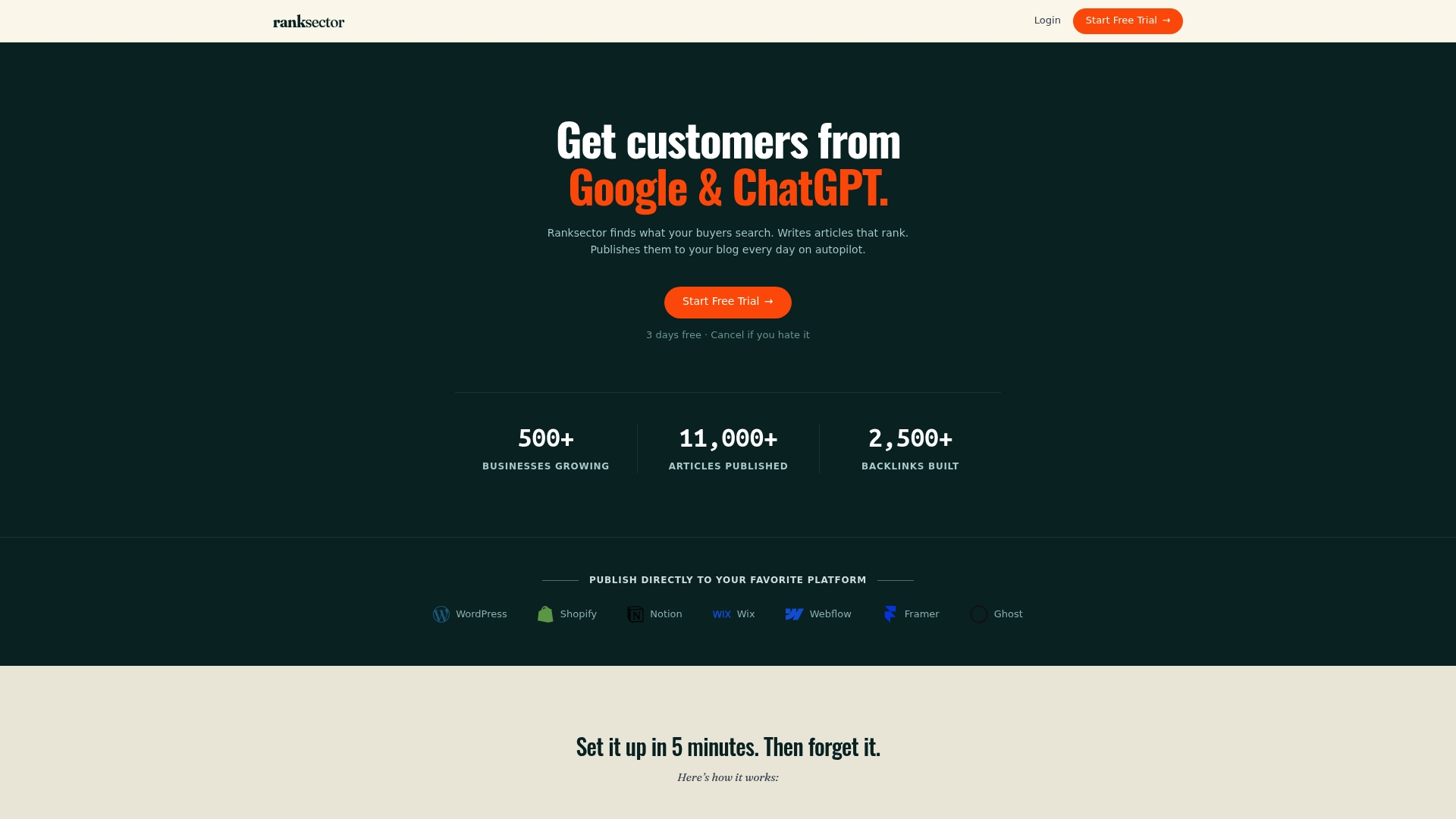
The platform pairs that daily output with a contextual backlink exchange network built specifically to grow domain authority, the same signal search engines and AI answer engines use to decide whether your pillar deserves to be cited. It fits small B2B SaaS teams and marketing leads who need a real cluster, not just one hero page, but don’t have the bandwidth to brief and edit ten new posts a month by hand.
If you’re weighing whether automation fits your pillar plan, start with the free tools to see keyword and content gap suggestions firsthand, or review the agency-focused product plan if you’re scaling a cluster across multiple client sites at once.
Sources
The sources behind this playbook are worth bookmarking if you’re building your first pillar program:
- How to create a pillar page (HubSpot)
- Content pillars: What they are & how to build them for SEO & AI visibility (Ahrefs)
- SEO pillar page content strategy (Ignite Visibility)