
Track 3 AI Search Visibility Metrics That Drive Revenue for B2B SaaS
AI search visibility means how often your brand gets mentioned or cited inside AI-generated answers, not just how you rank on a results page. The single best first move is to measure share-of-answer across your priority query clusters, then check whether the pages you’d want cited are actually indexable. Tooling like Google Search Console’s generative AI reports and dedicated trackers helps, but they only matter once you know your baseline.
TL;DR:
- Sharing a high share-of-answer percentage indicates your brand regularly appears in AI responses, especially on question-shaped long-tail queries.
- Citation position and rate metrics reveal whether your content is effectively retrieving and being referenced by AI, with pages needing indexability and clear answer formatting.
- Content should prioritize answer-first formats, unique data, and proper schema markup, as technical and formatting issues directly impact citation frequency.
- Monitoring across multiple AI platforms with consistent sampling and normalization is essential for accurate and actionable insights into AI visibility trends.
- Building a high-volume, citation-ready content base through regular, structured publishing supports long-term growth in AI-generated brand mentions and references.
Table of Contents
- What Is AI Search Visibility Across Different AI Surfaces?
- Why AI Search Visibility Matters for Revenue, Not Just Rankings
- How Do You Measure AI Search Visibility Consistently?
- Which Technical and Content Changes Improve Citation Odds?
- What Does a Citation-Ready Content Template Look Like?
- How Do You Build a Dashboard to Track AI Search Visibility?
- Your Prioritized Checklist for Improving AI Search Visibility
- The Overlooked Part of AI Search Visibility
- How Ranksector Turns This Playbook Into a Daily Habit
- Sources
What Is AI Search Visibility Across Different AI Surfaces?
AI search visibility breaks down into three distinct signals, and marketers who lump them together end up measuring the wrong thing. A mention is any time an AI system references your brand name in a generated answer, with or without a link. A citation is a mention that includes a source link back to your domain, the kind that shows up as a numbered footnote in Google’s AI Overviews or as a clickable reference in Perplexity. Share of answer (sometimes called Share of Model) is the percentage of relevant queries in a cluster where your brand appears at all, mentioned or cited, compared to competitors who show up for the same prompts.
These three metrics matter because they answer different business questions. Mentions tell you whether AI models know who you are. Citations tell you whether you’re driving referral traffic. Share of answer tells you whether you’re winning or losing ground across an entire topic, not just one query.
The surfaces themselves behave differently, and treating them as one channel is a mistake:
- Google AI Overviews (AIO) pull from indexed pages using retrieval-augmented generation, meaning the system fetches candidate URLs from Google’s index and grounds its response to them, so standard indexability still governs eligibility.
- Google AI Mode behaves more conversationally, often running multiple underlying searches per query and synthesizing across a wider set of sources than a single AIO panel.
- Chat and answer engines like ChatGPT, Perplexity, and Gemini vary widely in how they source information. Some rely on live web retrieval, others lean on training data that may be months or years stale, and citation behavior differs engine to engine.
Query shape matters as much as the platform. AI Overviews trigger far more often on informational, long-tail, question-shaped queries than on high-volume head terms. A search for “best project management software” is less likely to surface an AIO panel than “how do I choose project management software for a 10-person remote team.” That distinction should shape where you spend your content budget, a point the next section builds on.
Why AI Search Visibility Matters for Revenue, Not Just Rankings
AI citations change what a click means. When a user reads a full answer inside an AI Overview and never clicks through, your brand still gets impression value and trust transfer, but your analytics won’t show it as a session. That’s the funnel distortion marketing teams are grappling with right now: traffic can flatten or dip even while brand awareness and consideration climb, because the AI answer is doing part of the persuasion work before the user ever lands on your site.
This is why classic SEO dashboards built purely around sessions and rankings undercount what’s actually happening. You need a parallel set of KPIs built specifically for generative surfaces.
Pro Tip: Don’t retire your organic rankings dashboard. Pages that already rank well in traditional search have a meaningfully higher shot at AI Overview inclusion, so classic SEO performance is still a leading indicator, not a competing one.
The core KPIs worth tracking:
- Share of answer: the percentage of queries in a cluster where your brand appears, tracked weekly or biweekly per cluster.
- Citation position distribution: AI Overviews often cite multiple sources per query, with several sources typically referenced, so track where you land across that spread rather than only whether you got the first slot, reflecting the multiple citations per response.
- Citation rate: citations divided by total queries sampled in a cluster, a straightforward ratio that shows whether your content is retrieval-friendly.
- Mention depth: how much of the answer discusses your brand versus a passing name-check.
- Sentiment: whether the AI-generated framing is neutral, favorable, or (worth flagging fast) inaccurate.
- Blended organic velocity: the rate of change in organic sessions once you overlay citation trend data, which tells you whether AI visibility is compensating for, or compounding, traditional ranking movement.
Reading these trends takes some judgment. A rising citation rate paired with flat organic velocity usually means AI answers are absorbing clicks that used to convert to visits, so the fix is on-page conversion elements (calls to action, embedded comparisons) rather than more content volume. A falling share of answer paired with stable rankings usually points to a content gap: competitors are publishing more citation-ready material on the same topic even though your rankings haven’t moved yet. That gap is often the earliest warning sign you’ll get, weeks before it shows up in ranking reports.
How Do You Measure AI Search Visibility Consistently?
Measuring AI search visibility requires combining automated reporting with manual prompt testing, because no single data source covers every engine. Four sources form a reasonably complete picture.
Primary data sources:
- Google Search Console’s generative AI performance report, which shows impressions and clicks tied specifically to AI Overview appearances.
- Server log analysis, which can reveal crawler activity from AI-specific bots that traditional analytics tools miss.
- Manual prompt testing across ChatGPT, Perplexity, and Gemini, run against a fixed query list on a set cadence.
- Dedicated AI visibility trackers, which automate prompt sampling at a scale manual checks can’t match.
A repeatable five-step workflow:
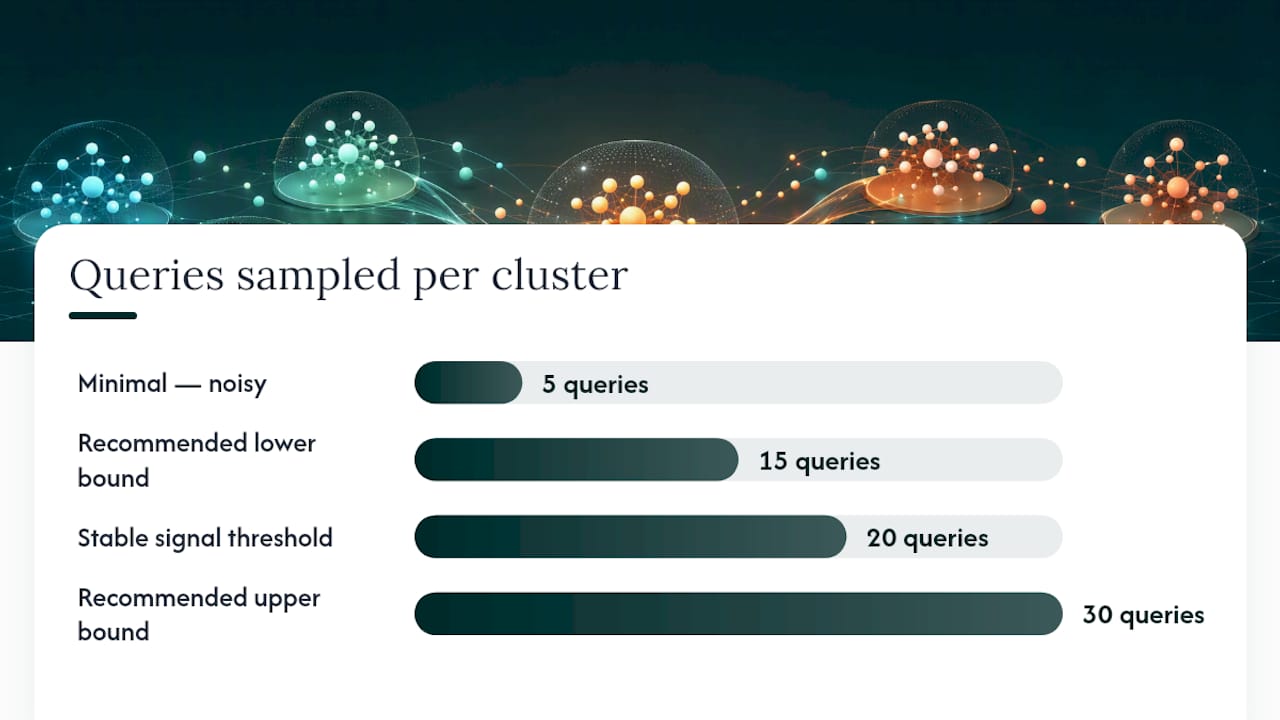
- Define your query clusters. Group 15 to 30 queries per topic around actual buyer language, not just keyword-tool suggestions, weighting toward the long-tail, question-shaped phrasing that triggers AI Overviews more reliably.
- Run prompt sampling. Submit each query to your target engines on a fixed schedule, capturing whether your brand appears, where, and whether the reference carries a link.
- Collect mentions and citations. Log results in a shared spreadsheet or tracker with columns for engine, query, mention/citation status, and position.
- Normalize and calculate share-of-answer. Divide brand appearances by total queries sampled per cluster, per engine, so you’re comparing like to like instead of mixing platforms into one blurry number.
- Set cadence and alerts. Weekly sampling works for competitive clusters; biweekly is fine for stable, lower-priority topics. Flag any cluster where share-of-answer drops more than 15 percentage points between cycles.
Sampling volume matters more than most teams assume. Testing five queries per cluster produces noisy, unreliable results, because AI answers vary between sessions even for identical prompts. Twenty or more queries per cluster, sampled consistently, gives you a signal stable enough to act on.
Cross-platform normalization is the part teams skip and later regret. Google AI Overviews, ChatGPT, and Perplexity don’t cite sources the same way or at the same rate, so a 40% citation rate in Perplexity isn’t directly comparable to a 40% rate in AI Overviews. Track each engine as its own column, then build a blended score only after you understand each platform’s individual baseline. Running an AI content audit on your top pages before you start sampling gives you a clean starting point and flags indexability problems before they skew your results.
Which Technical and Content Changes Improve Citation Odds?
Indexability comes first, and it’s non-negotiable in the sense that no content tactic compensates for a page an AI system can’t retrieve. Google’s own guidance is explicit: there’s no special technical track for generative features beyond standard Search eligibility. That means checking robots.txt for accidental blocks, confirming the page renders correctly for Googlebot (not just for a browser), running it through URL Inspection in Search Console, and requesting recrawl after any structural change. If a page can’t get indexed conventionally, it can’t get cited generatively either.
Once indexability is confirmed, formatting decides whether a retrieval system can lift a clean answer out of your page. The pattern that works consistently: a short, direct verdict in the first sentence or two under a heading, followed by supporting evidence. AI systems tend to extract the verdict sentence, so burying it under three paragraphs of scene-setting means it never gets pulled.
What makes a passage citation-worthy:
- Unique data or statistics your team generated, clearly attributed with a source and date.
- Specific numbers instead of vague ranges. “Response times dropped 34%” retrieves better than “response times improved significantly.”
- Genuine user-generated content, like verified reviews, which functions as a trust signal that AI systems increasingly weigh when choosing between competing sources.
- Passages placed in plain HTML text near their heading, not buried inside images, PDFs, or JavaScript-rendered elements that retrieval layers might skip.
Pro Tip: Publish your statistics as standalone sentences directly under the heading they support, in plain paragraph text. A number trapped inside a chart image or an infographic is invisible to most retrieval systems, no matter how good the data is.
Structured data deserves a more careful approach than most teams take. Match your schema markup to what’s actually visible on the page. Don’t slap FAQ or HowTo schema onto content that isn’t genuinely structured as a Q&A or a sequential process just because someone read that it helps with AIOs. Practical testing shows over-optimizing with FAQ/HowTo schema doesn’t reliably improve first-citation odds, and mismatched schema can actually hurt trust signals if Google’s systems detect the markup doesn’t reflect the visible page. Article schema and breadcrumb schema are safer, more broadly useful investments for most content types.
Performance signals round out the checklist. Core Web Vitals, render speed, and basic accessibility (alt text, semantic heading structure, readable contrast) all affect whether a page gets crawled efficiently and rendered completely enough for an AI system to extract clean text from it.
What Does a Citation-Ready Content Template Look Like?
Winning citations consistently is less about one brilliant article and more about a repeatable authoring pattern applied across every priority page. Four rules cover most of it.
- Lead every H2 and H3 with a direct answer, then expand. If the heading asks “How long does X take?”, the first sentence underneath should state the answer in one line, followed by context and caveats.
- Write 40 to 80 word mini-answers for follow-up questions. These act as self-contained, quotable blocks that retrieval systems can lift cleanly, which is also why they survive well as featured snippets.
- Match page length to search intent, not to a word-count target. A definitional query (“what is share of answer”) deserves a tight 300 to 600 word page. A comparative or how-to query justifies a fuller 1,000 to 2,000 word explainer. Padding a simple definition into an “ultimate guide” doesn’t help; longer isn’t automatically more citable, and it often buries the answer the retrieval layer is looking for.
- Support key passages with cited stats, outbound links to authoritative sources, and internal links to related pages on your own site. Understanding what AI engines weigh when choosing between competing sources helps you prioritize which claims need the strongest backing.
Formatting alone won’t carry weak content. Every mini-answer, definitional page, and explainer still needs a genuine information gain, something a reader (or a retrieval system) can’t get from three other pages already ranking for that query.
Where distribution fits in:
- Reddit threads discussing your product or category increasingly show up as sources inside AI Overviews and chat-engine answers, particularly for comparison and “is X worth it” queries.
- YouTube transcripts get indexed and referenced by some engines, making video a complementary citation surface rather than a separate channel to ignore.
- Neither replaces owned content, but both extend your footprint into places AI systems are already pulling from.
How Do You Build a Dashboard to Track AI Search Visibility?
A working AI visibility dashboard needs four widgets at minimum, each answering a different operational question rather than duplicating the same view four times.
- Share-of-answer by cluster: a trend line per topic cluster, refreshed on your sampling cadence, so you catch cluster-level decline before it shows up in aggregate.
- Citation position distribution: a stacked view showing how often you land in positions 1 to 11 across sampled queries, since AIOs frequently cite that many sources per answer and position matters for how much attention a citation actually gets.
- Citation trend versus baseline: the same cluster tracked over time against the first month you started measuring, so seasonal noise doesn’t get mistaken for a real trend.
- Conversion after citation: a rough proxy, comparing branded search volume or direct traffic in weeks following a citation spike, since most AI platforms don’t pass clean referral data yet.
Monthly reporting works for steady-state monitoring; weekly makes sense during a content push or right after a major algorithm shift.
| Dashboard element | What it tracks | Recommended cadence |
|---|---|---|
| Share-of-answer by cluster | Percentage of sampled queries where brand appears | Weekly or biweekly |
| Citation position distribution | Where citations land across positions 1 to 11 | Biweekly |
| Citation trend vs. baseline | Change over time against a fixed starting point | Monthly |
| Conversion after citation | Branded/direct traffic shift following citation spikes | Monthly |
Ranksector’s own workflow mirrors this structure for its client base of B2B SaaS teams. Daily article publication tied to keyword clusters, combined with Search Console integration, gives marketing teams a running feed of indexability and generative-performance data without anyone manually pulling reports.
Your Prioritized Checklist for Improving AI Search Visibility
Treat this as a sequence, not a menu. Early wins fund the case for the medium-term content work that follows.
- Run an indexability audit on your top 20 pages. Owner: SEO lead. Effort: low. Fixes crawl and rendering blockers before anything else matters.
- Build your first three query clusters. Owner: content strategist. Effort: medium. Prioritize long-tail, question-shaped queries.
- Run baseline prompt tests across ChatGPT, Perplexity, and Gemini. Owner: marketing analyst. Effort: low. This is your starting share-of-answer number.
- Reformat your five highest-traffic pages with answer-first passages. Owner: content team. Effort: medium.
- Add or clean up schema markup to match visible content. Owner: developer or SEO lead. Effort: low.
- Source or surface genuine UGC (reviews, testimonials) on key pages. Owner: marketing ops. Effort: medium.
- Set your sampling cadence and build the dashboard. Owner: marketing analyst. Effort: medium.
- Review and adjust clusters based on the first full sampling cycle. Owner: content strategist. Effort: low.
| Timeframe | Expected signal |
|---|---|
| 30 days | Clean baseline share-of-answer numbers; indexability issues resolved |
| — | Measurable movement in citation rate on reformatted pages |
| — | Share-of-answer gains compounding across multiple clusters, visible in blended organic velocity |
The Overlooked Part of AI Search Visibility
Most teams treat AI search visibility like a new discipline requiring new tools, new hires, and a new budget line. That’s mostly wrong. The teams making real progress are the ones already doing traditional SEO well and simply extending their existing content discipline to a new set of retrieval systems.

The uncomfortable truth is that a lot of the “AI SEO” advice circulating right now amounts to schema hoarding and word-count inflation, both of which the data increasingly contradicts. Stuffing FAQ schema onto every page or bloating a simple answer into a 3,000 word guide doesn’t reliably win citations. What wins is precision: a clear verdict up top, a real statistic near it, and a page that was already earning trust in classic organic results before an AI model ever touched it.
For B2B SaaS teams specifically, the compounding effect matters more than any single tactic. One well-formatted page rarely moves share-of-answer numbers on its own. A steady cadence of properly structured, indexable, citation-ready pages across a full set of clusters does, which is exactly the kind of scale that automated daily publishing was built to support.
— Savannah
How Ranksector Turns This Playbook Into a Daily Habit
Running the measurement workflow above by hand, cluster research, prompt sampling, reformatting, schema checks, on top of daily publishing, is more than most lean marketing teams can sustain alongside everything else on their plate. Ranksector is built to carry the content half of that workload automatically: daily, SEO-optimized articles generated around keyword research pulled from real competitor analysis, published directly to your CMS, with Search Console integration so you can see indexability and search performance without stitching reports together yourself.
The backlink exchange network adds domain authority over time, which matters directly for AI visibility since pages that already rank well in traditional search have a stronger shot at AI Overview inclusion. Small SaaS teams and solo founders get the most out of it, since they’re the ones least likely to have a dedicated content team running prompt tests and reformatting pages every week. If you want a concrete read on where your own site stands before committing to anything, start with a free AI visibility audit and see exactly which pages are indexable, citation-ready, and worth prioritizing first.
Sources
- Google Search Central — Guide to optimizing for generative AI features on Google Search
- Seer Interactive — What it takes to rank in Google’s AI Overviews in 2026