
How Blog Publishing Frequency Affects Your Rankings
Publishing frequency affects rankings indirectly: more quality posts create more indexed pages, broader topical coverage, stronger internal linking, and more backlink opportunities, all of which compound into higher organic visibility over time. Frequency itself is not a direct ranking signal, but it multiplies every signal that is.
Start here:
- New blogs (under 12 months): target 4–8 posts per month to build crawl momentum and topical surface area fast.
- Established blogs (12+ months): 2–4 new posts per month paired with systematic refreshes often outperforms raw volume.
- Audit your indexation rate in Google Search Console before scaling output. If Google is not indexing what you already have, publishing more will not fix it.
Key Takeaways
Publishing frequency affects rankings through compounding indirect signals: more indexed pages, broader topical coverage, stronger internal linking, and higher backlink velocity all grow together when cadence is paired with consistent quality.
| Point | Details |
|---|---|
| Frequency is indirect, not direct | Publishing more posts multiplies indexed pages, topical coverage, and backlink opportunities rather than triggering a direct ranking boost. |
| 11+ posts/month drives 3.5x traffic | Cross-study data across 13,500+ blogs shows companies at this cadence earned roughly 3.5x more organic traffic than those publishing once per month. |
| Cadence by maturity | New sites: 4–8 posts/month; growing sites: 4–6 with 30% refreshes; established sites: 2–4 new posts with 60% refresh focus. |
| Measure at 30/60/90 days | Track indexation rate at 30 days, impressions at 60 days, and clicks and position at 90 days before drawing conclusions about a cadence change. |
| Ranksector for scaling | Ranksector automates daily SEO-optimized publishing with GSC integration and internal linking, letting small B2B SaaS teams sustain high cadence without sacrificing quality. |
Table of Contents
- How does blog publishing frequency affect SEO rankings?
- How search engines actually respond to your publishing cadence
- What you actually gain from publishing more often
- When publishing more often actually hurts your rankings
- How to choose the right publishing cadence for your blog
- New posts vs. refreshes: how to split your editorial budget
- How to measure whether your cadence change actually worked
- Evidence and benchmarks that support these recommendations
- What to do this week, by site maturity
- An editorial perspective on frequency, quality, and what teams get wrong
- Ranksector makes consistent, high-quality publishing achievable at scale
- Sources
How does blog publishing frequency affect SEO rankings?
The debate around blogging schedule and rankings has been running for years, and it keeps resurfacing because the answer is genuinely nuanced. Frequency does not appear in any confirmed list of direct Google ranking factors. Yet the data consistently shows that teams publishing more often rank for more keywords, earn more backlinks, and grow organic traffic faster than teams publishing less.
The reason is mechanical. Every new post is a new indexed page, a new keyword target, a new internal linking node, and a new asset that other sites can link to. Publish more quality posts and you expand every one of those surfaces simultaneously.
This guide answers the specific questions SEO teams need to make a defensible cadence decision:
- Does frequency directly affect rankings, or only indirectly?
- What mechanisms connect publishing cadence to Google’s signals?
- What are the real risks of publishing too fast?
- How do you pick the right cadence for your site’s maturity and resources?
- How do you measure whether a cadence change actually worked?
The answers matter for resource allocation. Publishing more content costs money and time. Publishing the wrong amount, in either direction, wastes both.
How search engines actually respond to your publishing cadence
Understanding the causal chain here prevents a lot of wasted effort. Publishing frequency affects SEO indirectly by changing the signals Google measures, not by triggering some “frequency reward” in the algorithm.
Crawling and indexation
Googlebot visits sites based on signals like update frequency, authority, and server responsiveness. A site that publishes regularly tends to get crawled more often because the crawler’s model learns that new content appears there. The practical effect: new posts get discovered and indexed faster on active sites than on dormant ones.
The risk side of this is “Discovered — currently not indexed” status in Google Search Console. If you publish faster than Googlebot processes your queue, pages accumulate in that limbo state. More posts do not help if they never get indexed.
Freshness signals vs. quality signals
Google’s Query Deserves Freshness model rewards recency for time-sensitive queries. For evergreen topics, freshness matters far less than depth, authority, and relevance. Publishing a new post every day on a topic that does not need daily updates does not earn freshness credit; it just adds pages to your crawl queue.
Topical authority and keyword surface area
Each post you publish on a related topic adds to your site’s topical coverage. A blog with 40 posts on B2B SaaS onboarding covers more keyword variants, answers more specific questions, and earns more internal links than a blog with four posts on the same topic. Academic modeling supports the idea that early velocity and topical coverage materially affect crawl patterns and long-run visibility.
Backlink velocity
More published assets give more opportunities for other sites to link to you.
Key mechanisms at a glance:
- Higher cadence → more indexed pages → broader keyword coverage
- More pages → more internal linking nodes → stronger topical clusters
- More assets → more backlink opportunities → faster domain authority growth
- Regular updates → more frequent crawling → faster indexation of new content
Across an analysis of 12 studies covering 13,500+ blogs, companies publishing 11 or more posts per month received roughly 3.5x more organic traffic than those publishing once per month. That figure reflects the compound effect of all four mechanisms working together, not frequency as a standalone cause.
What you actually gain from publishing more often
The upside of a higher cadence is real, but it is worth quantifying in operational terms so you can weigh it against the cost.
Visibility and traffic growth. More indexed pages means more entry points from search. A blog with 200 posts covering a topic cluster will almost always outrank a blog with 20 posts on the same cluster, assuming comparable quality. The gap widens over time because older posts accumulate authority while new posts expand coverage.
Faster topical authority. Front-loading publishing in months 0–6 accelerates crawl frequency and indexing, producing a larger pool of articles entering the ranking acceleration phase between months 7–12. Early velocity is not just about getting more pages live; it is about compressing the timeline to authority.
Compounding backlink acquisition. Each post is a potential link target. Teams that publish consistently build a larger asset library, which means more opportunities for editorial links, resource-page inclusions, and content partnerships. The compound effect here is slow but durable.
Shorter time to 400 posts. Speed to 400 published posts is a meaningful threshold in the cross-study data. Sites that reach it faster tend to see compounding traffic effects sooner. A team publishing 8 posts per month reaches 400 posts in roughly 50 months. A team publishing 2 per month takes over 16 years.
Pro Tip: Batch content production in two-week sprints rather than publishing one post at a time. Batching lets you maintain editorial standards across a group of posts, assign consistent internal linking, and avoid the quality slippage that comes from rushing individual pieces to hit a daily quota.
For teams exploring AI tools for high-volume blog publishing, the operational math changes significantly when drafting is automated and editorial review becomes the primary bottleneck.
When publishing more often actually hurts your rankings
Scaling cadence without scaling quality is one of the most common SEO mistakes content teams make. The risks are specific and measurable.
Quality dilution and E-E-A-T erosion. Rushed research produces thin pages. Thin pages lower the average quality signal across your entire domain. Google evaluates site-level quality, not just page-level quality, so a cluster of weak posts can drag down rankings for your best content. This is the E-E-A-T risk that most teams underestimate when they chase a competitor’s publishing volume.
Indexation problems at high velocity. Publishing spikes that outpace Googlebot’s crawl capacity create backlogs. Pages sit in “Discovered — currently not indexed” for weeks or months, meaning you paid to produce content that is not ranking for anything. Watch this metric in Search Console before and after any cadence increase.
Internal linking overhead. Every new post should link to and from related posts. At low cadence, this is manageable. At 20+ posts per month, the internal linking work compounds fast. Teams that skip it lose one of the primary benefits of high-frequency publishing.
Red flags to monitor:
- Rising “Discovered — currently not indexed” count in Search Console
- Declining average engagement time per post (a signal of thin content)
- Flat or falling impressions per new post over a 60-day window
- Backlink acquisition rate not keeping pace with post volume
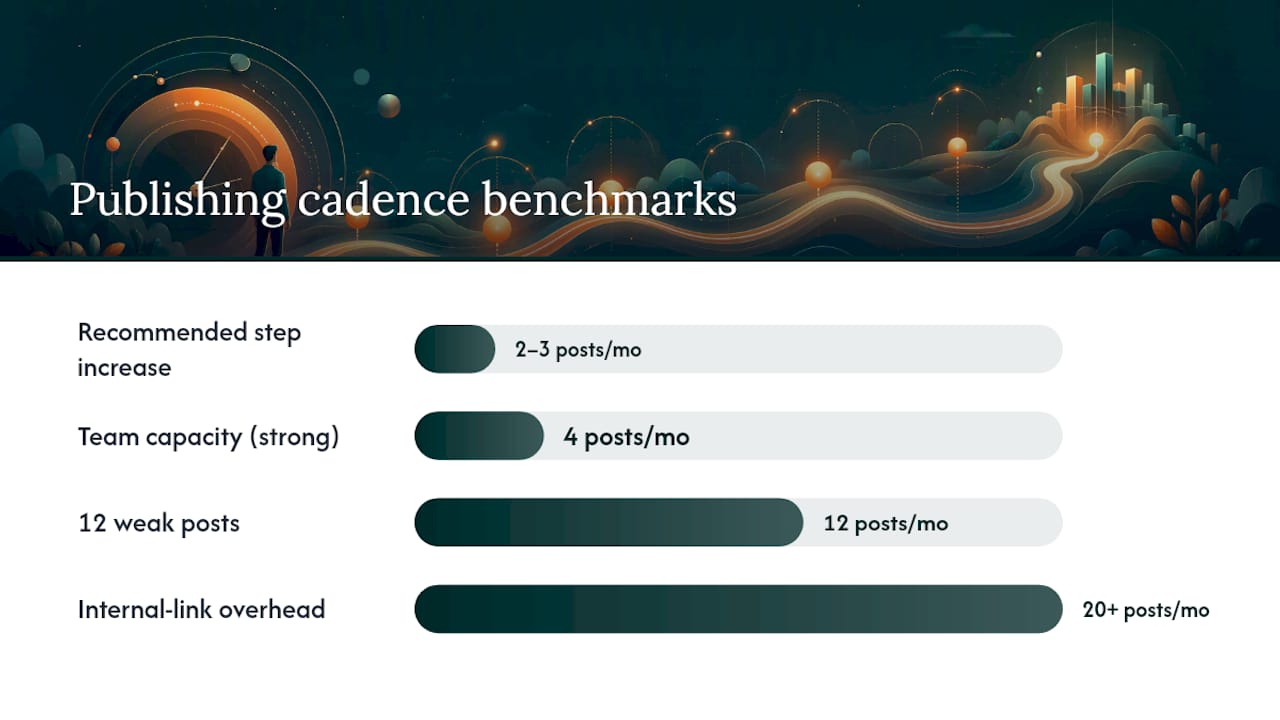
Avoiding the pitfalls. Increase cadence in steps of no more than 2–3 posts per month at a time. Set per-post quality KPIs (minimum word count, required internal links, source citations) before scaling. Audit your editorial capacity honestly: if your team can produce 4 strong posts per month, publishing 12 weak ones is a net negative. The publishing cadence trade-offs between daily, weekly, and burst strategies are worth mapping before committing to a schedule.
How to choose the right publishing cadence for your blog
There is no universal answer, but there is a repeatable framework. HubSpot’s benchmarks and cross-study data both point to site maturity as the primary variable.
Cadence by site maturity
New sites (0–12 months): Aim for 4–8 posts per month. The goal is to build topical coverage and crawl momentum fast. Quality must not drop, but velocity matters more at this stage than at any other.
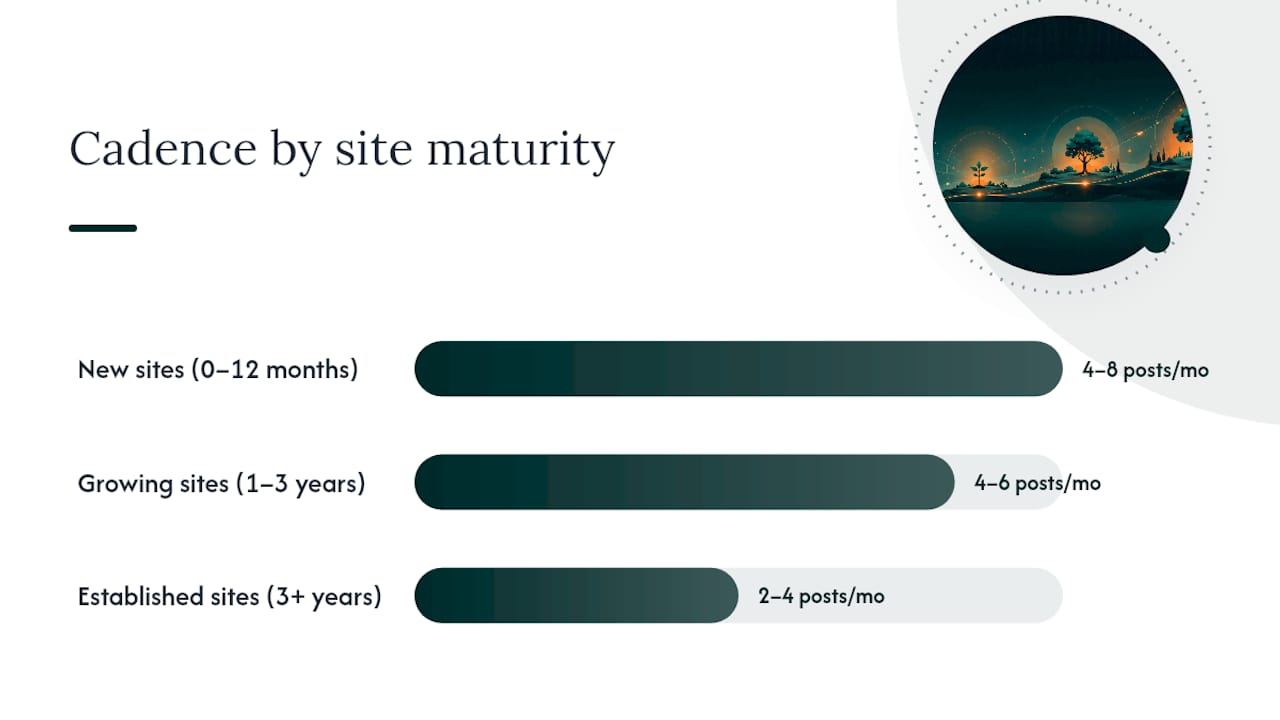
Growing sites (1–3 years): 4–6 posts per month, with a growing share of refresh work as existing posts accumulate ranking history. This is the stage where internal linking strategy pays the biggest dividends.
Established sites (3+ years): 2–4 new posts per month is often sufficient if paired with systematic content refreshes. At this stage, updating a post that ranks on page 2 often produces faster results than publishing a new post from scratch.
Operational capacity check
Convert your actual capacity to a sustainable cadence before committing to a schedule:
- Count your available writing hours per month (staff + freelance).
- Divide by your average hours-per-post (research + draft + edit + publish).
- That number is your maximum sustainable cadence. Start at 70% of it to leave room for quality review.
Competitive benchmarking
Check how often your top 3–5 competitors publish. If they are publishing 10 posts per month and you are publishing 2, you are losing topical coverage ground every week. You do not need to match their volume immediately, but you need a plan to close the gap. Search visibility benchmarks can help you frame this competitively.
Decision checklist
- Audit current indexation rate (indexed pages / total published posts in GSC).
- Set a quality floor: define minimum standards for every post before scaling.
- Choose a starting cadence based on site maturity and capacity.
- Run a 90-day pilot on one topic cluster.
- Measure impressions, clicks, and indexation rate at 30/60/90 days.
- Increase cadence only if indexation rate stays above 85% and per-post impressions are stable or growing.
New posts vs. refreshes: how to split your editorial budget
The right mix of net-new posts and content refreshes shifts as your blog matures. Getting this ratio wrong is one of the most common ways teams leave ranking gains on the table.
Why total post count matters. The compound effect of content accelerates as your library grows. Speed to 400 posts is a documented inflection point where compounding traffic effects become visible. Early-stage blogs should prioritize new posts almost exclusively to reach that threshold faster.
Suggested ratios by maturity:
- New sites (0–12 months): 100% new posts. You have nothing to refresh yet, and every post adds to your topical surface area.
- Growing sites (1–3 years): roughly 70% new posts, 30% refreshes. Posts from year one are starting to age, and some will be sitting on page 2 with a refresh opportunity.
- Established sites (3+ years): 40% new posts, 60% refreshes. At this stage, your existing library is your biggest asset. Refreshing a post that already has authority is faster and cheaper than building a new one from zero.
Audit checklist for refresh candidates:
- Posts ranking in positions 6–20 (page 1 bottom or page 2): small improvements can push them to the top 5.
- Posts with declining impressions over the past 90 days in Search Console.
- Posts with outdated statistics, broken links, or references to discontinued tools.
- Posts that lack internal links to newer, related content.
Example editorial split for a growing site publishing 6 posts per month:
- Weeks 1–2: produce 3 new posts in the primary topic cluster.
- Week 3: refresh 1 existing post (update stats, add internal links, expand thin sections).
- Week 4: produce 1 new post + refresh 1 existing post.
This schedule maintains new-post velocity while systematically improving the existing library. For SEO quick wins on a tight timeline, refreshes on page-2 posts often deliver faster results than any new post.
How to measure whether your cadence change actually worked
Most teams change their publishing cadence and then check rankings three weeks later, see no movement, and conclude it did not work. That is the wrong timeline and the wrong metrics.
Experiment blueprint
- Set a hypothesis. Example: “Increasing from 2 to 6 posts per month in the [topic cluster] will increase impressions by 30% within 90 days.”
- Define a control group. Keep one topic cluster at the old cadence so you have a comparison baseline.
- Set a timeline. 30 days for indexation signals, 60 days for impression trends, 90 days for click and position movement. Ranking changes lag publishing by weeks to months.
- Set a minimum sample size. At least 8–10 new posts in the test cluster before drawing conclusions.
Metrics to track in Google Search Console
| Checkpoint | Metric | Expected signal |
|---|---|---|
| 30 days | Indexation rate (indexed / published) | Should stay above 85% |
| 30 days | “Discovered — currently not indexed” count | Should not be rising |
| 60 days | Impressions for new posts | Should show upward trend |
| 60 days | Average position for new posts | May still be 30–50; normal |
| 90 days | Clicks and CTR for new posts | Should begin meaningful movement |
| 90 days | Organic traffic by cohort | Compare test cluster vs. control |
Interpreting the signals
If impressions are flat at 60 days but indexation is healthy, the issue is likely content quality or keyword targeting, not cadence. If indexation is dropping, you have a crawl-budget or technical problem that more posts will only worsen. Incremental testing, tracking per-post performance at 30/60/90-day intervals, and reallocating budget to refresh work when per-post ROI drops are the operational practices that separate teams that learn from their data from teams that just publish and hope.
Evidence and benchmarks that support these recommendations
The cross-study data on publishing cadence is more consistent than most SEO debates. A few findings are worth anchoring your planning to.
Companies publishing 11+ posts per month received roughly 3.5x more organic traffic than those publishing once per month, across 12 studies covering 13,500+ blogs. That is not a marginal difference. The same analysis highlights speed to 400 posts as a compounding factor, meaning the benefit is not just about monthly volume but about cumulative library size.
A minimum viable cadence of 2–4 posts per month helps maintain momentum. Stopping new publishing does not immediately kill traffic because existing content continues to accumulate authority, but organic traffic plateaus and eventually declines without fresh fuel or systematic refreshes.
The diminishing-returns curve is real. Benchmark data shows that exceeding a site’s breakeven publishing cadence without scaling editorial quality can produce per-post performance declines and indexation problems. Rapid scaling without proportional editorial investment often reduces per-post ROI.
Ranksector’s publishing infrastructure, which has produced over 11,000 SEO-optimized articles for B2B SaaS clients, consistently shows that the teams with the best results are not the ones publishing the most. They are the ones publishing consistently, with clear topical structure, and measuring at regular intervals.
What to do this week, by site maturity
Tactical clarity matters more than comprehensive planning at this stage. Pick your maturity bucket and execute the three actions below.
New blog (0–12 months):
- Audit your current indexation rate in Search Console. If it is below 85%, fix technical issues before adding more posts.
- Commit to a minimum of 4 posts per month in one focused topic cluster for the next 90 days.
- Set a 90-day measurement checkpoint: track impressions and indexed pages weekly.
Growing blog (1–3 years):
- Pull your page-2 rankings from Search Console (positions 11–20). Identify the top 3 refresh candidates.
- Pilot a cadence increase of 2 posts per month on one topic cluster for 60 days.
- Schedule a 60-day review: compare impressions and clicks for the test cluster vs. a control cluster.
Established blog (3+ years):
- Reallocate 40–60% of your editorial budget to refreshes this quarter. Start with posts in positions 6–15.
- Maintain a floor of 2 new posts per month to keep crawl momentum active.
- At 90 days, compare organic traffic for refreshed posts vs. a matched set of unrefreshed posts to quantify the ROI of refresh work.
One-week action for any maturity level: Open Search Console, filter by “Discovered — currently not indexed,” and investigate the top 10 URLs. Resolving indexation blockers is the highest-leverage move before any cadence change.
For teams with limited budgets, ranking on Google with a low budget is achievable when you prioritize cadence efficiency over raw volume.
An editorial perspective on frequency, quality, and what teams get wrong
The most persistent mistake I see in content teams is treating publishing cadence as a goal rather than a constraint. Teams set a target of “one post per day” because a competitor is doing it, then spend the next six months producing content that ranks for nothing and confuses their editorial voice.
Cadence is a function of capacity, not ambition. The teams that get the most out of high-frequency publishing are the ones that solve the quality problem first, then scale. They build editorial templates, define minimum standards per post, and automate the mechanical parts of production so writers can focus on the parts that actually require judgment.
The other thing teams consistently underestimate is the refresh opportunity. A blog with 150 posts has a significant asset base. Many of those posts are sitting on page 2 with a clear path to page 1 if someone spends two hours updating them. Ignoring that in favor of publishing post 151 is a resource allocation mistake, not a content strategy.
Automated publishing, when done with proper quality controls and topical structure, can genuinely accelerate the compounding effect. But automation without editorial guardrails is how you produce 200 posts that collectively rank for nothing. The discipline is in the structure, not the volume.
Ranksector makes consistent, high-quality publishing achievable at scale
Daily publishing is the fastest path to topical authority, but most B2B SaaS teams do not have the editorial capacity to sustain it. Ranksector closes that gap directly.
Ranksector publishes fully formatted, SEO-optimized long-form articles to your CMS every day, built from competitive keyword research and aligned to your topical clusters. It is not a generic AI writer; it is a publishing system with built-in quality controls, Google Search Console integration, and an internal linking engine that connects new posts to your existing content automatically.
What you get:
- Daily AI-generated articles tailored to your niche and keyword targets
- Automatic internal linking suggestions across your content library
- A contextual backlink exchange network to grow domain authority passively
- GSC-connected analytics so you can track indexation, impressions, and clicks without switching tools
Start with Ranksector’s free tools to see how automated publishing fits your current cadence and content gaps.
Sources
The studies and posts below are the primary sources behind this guide. Each one is worth reading directly if you want to go deeper on a specific aspect of publishing cadence and SEO.
- Blogging frequency benchmarks (HubSpot)
- Content Velocity and Ranking Correlation: The Publishing Frequency Sweet Spot | Organic Arbitrage
- How Often Should You Publish Blog Posts? Here’s What Our 12-Month Data Says
- arXiv preprint on discoverability and content production dynamics
Recommended
- Best AI Tools for High-Volume Blog Publishing in 2026 · Ranksector Blog — Ranksector
- Top 4 Ranklyx.com Alternatives for 2026 · Ranksector Blog — Ranksector
- Why Domain Rating Affects Rankings: 2026 SEO Guide · Ranksector Blog — Ranksector
- AI Blog Publishing for SaaS SEO: Manual Workflow vs Automation · Ranksector Blog — Ranksector